The Money Noose Tightens Further

The desperate folks in government are looking for money everywhere. In fact, at the last two G20 meetings, the richest 20 nations seemed able to agree on only one thing: that they will automate the trading of financial records with each other to try to catch corporations and individuals who are trying to avoid taxes. Other than that, the meetings were said to have a lot of bickering over Syria, NSA global spying, the Japanese debasing their currency faster than other regions, and so forth.

The International Monetary Fund, whose employees pay no taxes at all on their own salaries, is recommending a 10% wealth tax on all European Union citizens. Why? “..to restore debt sustainability.” In other words, they are admitting that EU countries are drowning in unpayable debt loads, so they advise snatching 10% of the wealth of everyone in those countries to pay off some national debts. And what will that 10% wealth grab accomplish? They say it will restore national debt levels to where they were in 2007. 2007?!? Wasn’t that the precipice of the financial crisis? They don’t seem to understand that countries were already drowning in too much debt in 2007, which was one of the primary enabling factors of the financial crisis. They say this is a one-time wealth grab. But after they grab that 10% of people’s money and it fixes nothing, what will they advise then? Grabbing 20% perhaps? More? Very likely.

Poland joined Argentina, Hungary, Ireland, Cyprus, and France in confiscating people’s pension assets. The Polish government grabbed national bonds held in pension funds managed by private sector money managers (think IRA or 401K managers ) and pulled them into the public sector pension program. Why? To count those bonds as government assets rather than debts so that their debt to GDP ratio looks better so they can borrow more money more cheaply in the open market. (Now you might think: why would bond  investors fall for such pathetic tricks? Why indeed. Don’t ask me. These “investors” are probably the same people who had money with Madoff.)

And Chase has told lots of its small business and individual clients that they can no longer use wire transfers to transfer money out of the country. If this sounds to you like progress along the lines of the dreaded currency controls, then you are being rational and astute. Currency controls, through which people are prohibited from moving their money out of its home country, are a plague on people when a country’s currency is plummeting in value. Ask people in Argentina how that feels, they’ve been through it twice.

Governments tried printing and borrowing lots of money to boost economies so they could collect more taxes. This has backfired: the economies barely grew while the debt continues to grow wildly.  Here’s what it looks like in the US, where the debt is the red line and the economy the blue line:

Debt_GDP

Some people, like Dick Cheney and Paul Krugman, say “who cares,” but the problem is, debts costs money, that is, you have to pay interest on the debt and you have to pay back the principal. And when the debt load keeps increasing faster than the economy, and faster than tax collections, it’s a classic case of unsustainability. Which is why governments are now starting to confiscate. They want more money, folks. They want to get it from you. Protect yourself accordingly.

The Sad States of America

This is what the mainstream propaganda machine serves to the US public. These are Time Magazine’s covers for different regions of the world for their Sept 16 issue:

Time

(hat tip to Zerohedge)

If you think that’s a Photoshopped trick, it’s not, it’s from their web site, here is the link. During the week where Putin made US politicians look like schoolboys in a civics class, the rest of the world gets Putin, and US readers get a real “burning question of our time” story on college football. Sure wouldn’t want to upset US citizens with anything resembling truth, they might end up not trusting their leaders as those politicians coax them to overspend, take on more debt, support the latest war, and vote the same sellouts into office yet again; let’s face it, that might be “bad for the economy” and we must aaaaaaaallllllllllllllll bow down to the economy.

But wait. It gets worse. Here’s a story (one has to go to the UK press for this, in this case the UK Guardian and Glenn Greenwald) that Gen. Keith Alexander, the guy in charge of the US government spy apparatus, spent who knows how much taxpayer and borrowed money that funded some secret budget to have his office re-modeled to look like the bridge on Star Trek’s Enterprise:

StarTrek

It’s a 10,740 square foot labyrinth in Fort Belvoir, Virginia. The brochure touts how “the prominently positioned chair provides the commanding officer an uninterrupted field of vision to a 22′-0″ wide projection screen…”

This is not a joke. Foreign Policy magazine had this to say:

“When he was running the Army’s Intelligence and Security Command, Alexander brought many of his future allies down to Fort Belvoir for a tour of his base of operations, a facility known as the Information Dominance Center. It had been designed by a Hollywood set designer to mimic the bridge of the starship Enterprise from Star Trek, complete with chrome panels, computer stations, a huge TV monitor on the forward wall, and doors that made a ‘whoosh’ sound when they slid open and closed. Lawmakers and other important officials took turns sitting in a leather ‘captain’s chair’ in the center of the room and watched as Alexander, a lover of science-fiction movies, showed off his data tools on the big screen.

“‘Everybody wanted to sit in the chair at least once to pretend he was Jean-Luc Picard,’ says a retired officer in charge of VIP visits.”

More pictures and commentary are here and here.

And now it gets really sad. The US says that Syria can be attacked because they used chemical weapons. And these are heinous weapons, to be sure. But the US used weapons that spread plenty of semi-depleted uranium all over Iraq and someone, I can’t imagine who, has been suppressing World Health Organization investigations and reports on the immediate and lasting (birth defects) effects of such weapons. I guess “radioactive” is somehow way less bad than “chemical”?

What is not sad is that truth is emerging about these things and many more. And that this emergence of truth is just one aspect of an energetic change across our entire continuum, from greater to lesser density, toward permeability, porosity, visibility. Where it becomes more difficult to hide truth because people can see through the dense places where secrets can be hidden. Where the Earth’s crust opens with sinkholes, volcano vents, and earthquakes. Where people begin to deeply explore what they were told in high school–that everything is energy–and begin operating telepathically: communicating, healing, interacting with vast life beyond the strictly physical. What is not sad is our bright future emerging as we communicate now.

War

Despite a rare display of intelligence shown by a group of politicians, with the British parliament rejecting their Prime Minister’s call for war, at least for now; and despite serious questions raised by the likes of a former NPR reporter with years of on-the-ground experience in the Middle East who states that eyewitnesses say it is the Saudis who supplied the chemical weapons to the rebel forces; it seems almost certain that the US will be waging war in Syria, likely beginning with attacks launched from US naval vessels.

Most people might think this will be another “Libya” type of war with US techno-hardware pummeling the country for a couple of months and then it will be over. A bunch of political posing and sniping. Lots of discussion about whether annihilating people is legal! Little or no direct inconvenience to anyone in the US or Europe. And little consideration of the reality of those who will hold someone they love in their arms and experience the agony of seeing their beautiful friend demolished.

Why is this war less likely to be a brief campaign and more likely lead to World War 3?

1. There are 30,000 Russians living in Syria. If some of these people are killed, do you think Russia will just say, “Oh well. No problem.”

2. Russia is a long-time ally of Syria. They have a naval base there. They sell lots of arms to Syria. If Assad is toppled, Russia loses big strategically and economically: they wil likely lose their naval base; they lose a good arms customer; but most importantly, a new regime might be quite happy to allow the Qatari’s to build a natural gas pipeline across Syria to supply Europe with natural gas, breaking the Russian monopoly on the European natgas market.

3. Iran is an ally of Syria. Both countries are well aware that they are on the list of countries  whose governments the US planned to topple as early as 2001, as reported in this required-listening two minute video interview with General Wesley Clark:

So I came back to see him a few weeks later, and by that time we were bombing in Afghanistan. I said, “Are we still going to war with Iraq?” And he said, “Oh, it’s worse than that.” He reached over on his desk. He picked up a piece of paper. And he said, “I just got this down from upstairs” — meaning the Secretary of Defense’s office — “today.” And he said, “This is a memo that describes how we’re going to take out seven countries in five years, starting with Iraq, and then Syria, Lebanon, Libya, Somalia, Sudan and, finishing off, Iran.”

And Iran is an ally of China.

4. Cycles: Manfred Zimmel, whose excellent forecasting work we have discussed here and here, has for many years been predicting that the period from 2013 to 2018 will be “the War Years.”

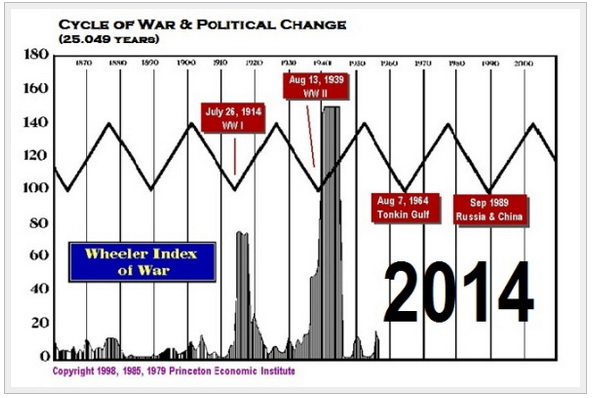
5. Cycles: The uncanny Wheeler Cycle of War and Political Change, discussed here, arrives again at its most intense point for the risk of major war in 2014:

WheelerCycle

6. Cycles: Michael Mau’s books predicted world war for this period unless humanity can stand up to being manipulated into war yet again. Mau’s books contain detailed discussions regarding who manipulates politicians and populations into war. So this is a big test for humanity: do people want war or have they truly had enough of it?

7. Cycles: August 2013 was given here as a major potential economic turning point. Oftentimes, people and nations play their part when a big cycle is ready to turn.

8. The US badly needs a distraction from the revelations of illegal spying that arrive almost daily.

9. The US badly needs distraction from its financial failures and its upcoming battle over the debt ceiling. Even researchers from within the US Federal Reserve have admitted that the Fed’s money printing has had little positive effect, and they have announced that they would like to gradually stop printing so much. (Perhaps the White House will basically force them to keep printing to support a war?) And even that gold-bashing defender of the status quo, the Financial Times, began an article with this quote:

The world is doomed to an endless cycle of bubble, financial crisis and currency collapse.

And included this sentence in the same article:

A stable international financial system has eluded the world since the end of the gold standard.

(Side note: Numbers 8 and 9 are partial indications that things have not been going so well for the US lately. This too is a result of a specific cyclic influence, so if you are confident that a US war foray will be quick and successful, you might wish to contemplate what the news flow has looked like for the US for the last several months.)

10. There are always those powerful groups who stand to profit greatly, financially and politically, from war, as described so well by US Marine Corp hero General Smedley Butler in his booklet War Is A Racket.

So what’s it going to be, folks? Have we had enough of war? Or do too many still want war, or not care one way or the other? Whatever the numbers, it seems that humanity still does not understand that the advice “Do unto others as you would have them do unto you,” contains the idea that what you do to others you are doing to yourself. Humanity is one, though it appears that few are aware of their awareness that such is the case.

If you have chosen to have preparations in place for when it really hits the fan, and if you have not completed those plans, my suggestion would be that you wrap them up now. Not in a state of fear, not in a panic, but with definite persistence and logic. Perhaps the status quo in this world can hold on till 2014, or even 2015. But betting that way entails some serious risks. Besides, preparing for a life independent of the theftocracy–that is, working with gardens, greenhouses, plug-in vehicles, solar arrays, water wells, and so forth–is a lot of fun.

In Praise of Plug-In Vehicles

Over the last three days, I’ve driven a car 150 miles without burning a drop of gasoline. That is quite a pleasure. Here’s how it happened.

On Aug 6, I wrote that the war drums were getting louder. So I reviewed my own preparations for the transition, this time focusing on energy and transportation. And I came face to face yet again with my own pitiable dependence on the oil cartel for transportation.

So I signed up for the daily e-mail from Green Car Reports, an excellent site covering advances in automobile transport via hybrids, plug-in hybrids, and fully electric vehicles. And I contacted an extremely knowledgeable and very friendly fellow named Gordy who heads the Panhandle Electric Vehicle Association and converts vehicles with internal combustion engines to electric vehicles.

While doing my research, the war drums got much louder with events appearing to take place in the following order: troops entering Syria accompanied by the CIA as reported by Le Figaro; then a UN team of weapons inspectors arrives in Syria to test for evidence of chemical warfare; and then there just happens to be a poison attack in Syria that kills hundreds. Followed (of course?) by a report by the Wall St Journal that the US is refining its military options in Syria.

Which “kind of” ups the ante: If there is all-out war in the Middle East, how long before the price of gasoline doubles, or worse? Or gets rationed, or is simply unavailable at times?

So this further stimulated my interest in vehicles that can operate on electricity. A lot of whether these types of vehicles can work for a person relates to their driving needs. Gordy educated me that a conversion would probably not work for us, or better put, that a conversion would be too expensive to build to meet the requirements of my household.

So I looked at the available automobile products, which fall into three general categories:

1. Existing hybrids, like the Prius, that get modified by the addition of a small battery bank that enables a person to drive a small number of miles on electricity alone after the battery bank has been charged. For example, with the plug-in Prius, Toyota claims a person can drive 6 to 11 miles on electricity alone before the gasoline engine kicks in. Reviewers claim that this is actually 5 to 6 miles.

2. Newer hybrid designs like the Chevy Volt and Ford CMax Energi that have larger battery banks that offer 38 miles on electricity alone for the Volt and 18 miles for the CMax Energi, after which a gasoline engine takes over.

3. Fully electric vehicles like the Nissan Leaf, Honda Fit EV, Ford Fusion EV, Chevy Spark EV, and the Tesla Motors models that run only on electricity with no gasoline engine backup.

To be honest, I would have been happy to fully investigate Category 3, but I live in the Town of Boondocks just east or north or south or west of the Middle of Nowhere, and no one sells or services those cars around here.

And Category 1 seems like afterthought design that offers little benefit for a large increase in price, at least for my driving needs.

So I pursued Category 2, and am I ever happy it turned out that way. For those of us who have had very low expectations of General Motors for decades, the Chevy Volt is a very pleasant shocker.  Here’s how it works: The Volt has a sizable battery bank (16Kw) that powers an electric motor that propels the car. If one does not drive aggressively, one can go 50 miles on a single charge of the battery bank. If one drains the battery bank and continues driving, a 1.4 liter gasoline engine kicks in and acts as an electric generator, powering the electric motor that propels the car. So either the battery bank drives the electric motor, or a gasoline generator drives the electric motor. So if you want to drive straight across the US, you can do that, though most of the trip would be done with the Volt running on gasoline. This is a huge advantage over the all-electric cars in Category 3 which would need to drive the 100 miles or so (more for the far more expensive Tesla’s) that they can attain from a single charge, followed by a multi-hour period of battery re-charging before further progress could be made.

With the Volt, if a person drives less than 50 miles a day, they never need to buy gasoline, they can just plug the car into a standard (in the US) 120 volt outlet and the batteries recharge in about 10 hours, typically overnight. If there is a 240 volt outlet available, the recharge takes four hours, which would allow a person to drive 50 miles on electricity alone multiple times a day. But there is no “range anxiety” with the Volt as there is for the all-electric cars where a person sometimes ends up wondering whether they will get to their destination before running out of electricity.

The published all-electric mileage capability of the Volt is 38 miles, not 50. And I think that would likely be correct if one drives aggressively or at 70 miles per hour for the entire trip. But with non-aggressive driving averaging 35 or 45 miles per hour, 50 miles is attainable on a single charge.

These vehicles are more expensive than their gasoline-only counterparts. To ease the pain, some governments offer tax incentives. The US offers a $7,500 tax credit for the Volt and for the all-electric cars in Category 3. And because Chevy had a $5,000 price drop incentive in play for the Volt, and because we were willing to buy a 2012 demo model, we were able to get a decent price, so it pays to shop around. And powering a car with electricity is far less expensive than powering it with gasoline. Most EV owners talk about paying 1 to 4 cents per mile for their electric fuel depending on their electricity rate and their car, which is about 90% cheaper than gasoline. So the calculation for a Volt at today’s gasoline prices is that one will save over $7,000 on fuel costs over five years. And if gasoline costs double or worse?  After awhile, with the tax and fuel savings, these cars start to look cheaper than their gas-guzzling cousins.

People actually talk about payback on electric vehicles. Some criticize that the payback is too long. But have you ever heard anyone talk about payback on a gas-only vehicle? Of course not, one pays the car company for the car and the oil companies to run it. Period.

And driving with electricity is far greener than using gasoline. There are zero tailpipe emissions. Yes, the power company producing the electricity pollutes, but the pollution from a large power plant is far less per kilowatt than an internal combustion engine. And if one powers an electric vehicle with renewable energy–either with their own renewables system or if they are lucky enough to live in an area with lots of hydro power–the pollution drops to near-zero for the EV, and takes an admittedly tiny bite out of the oil production chain of drilling, pumping, transporting to a refinery, refining, transporting to a delivery point, and finally burning in an internal combustion engine. Each of those points in the oil production chain has it deleterious effects on the quality of life on Earth. So any reduction in that chain has value.

If you wish to educate yourself on these topics, the Green Car Reports web site is highly recommended, and attending a meeting of your local electric vehicle club, if you are lucky enough to have one, is an outstanding opportunity. I was lucky enough to attend a meeting of Gordy’s PEVA and it was one of the jolliest meetings I’ve ever attended. These folks doing electric car conversions are having a lot of fun and some people at PEVA reported that their heath improved after they switched to an electric vehicle. Unfortunately, given that the US has become a theftocracy, now that the big car companies all have plug-in offerings, the US government no longer gives tax credits for converting cars from gasaholism to electricity, only for buying new ones.

A Tale of Two Countries

I see a beautiful city and a brilliant people rising from this abyss, and, in their struggles to be truly free, in their triumphs and defeats, through long years to come, I see the evil of this time…making expiation for itself and wearing out…
― Charles Dickens, A Tale of Two Cities

In 2005, economist Raghuram Rajan, 42 years old at the time, delivered a speech at the annual meeting of the crowned heads and elder statespeople of central banking telling them how those in attendance were brewing up a wicked credit crisis. After the speech, former US Treasury Secretary Lawrence Summers led the charge against Rajan, describing himself as “someone who finds the basic, slightly Luddite premise of this paper to be largely misguided.” According to Bloomberg:

Summers also said “while I think the paper is right to warn us of the possibility of positive feedback and the dangers that it can bring about in financial markets, the tendency toward restriction that runs through the tone of the presentation seems to me to be quite problematic.”

We all know now that Rajan was right and Summers, who had spent several years helping to tear down any restrictions on the gambling and deception by Wall St banks, was wrong in many ways.

India just made Rajan–who clearly saw the financial crisis coming and had the courage and intelligence to publicly state his case to those who were aiding and abetting it–the new head of India’s central bank, the Reserve Bank of India.  And Obama is considering appointing Summers–who aided and abetted the ongoing financial crisis mightily and who didn’t see it coming–the next head of the US central bank, the Federal Reserve. Summers is also infamous for abruptly resigning as the President of Harvard after losses in the endowment fund, his public statement that women are unable to learn science and math as well as men, and a no-confidence motion from the faculty.

Obama’s alternate candidate for the next head of the Federal Reserve is said to be Janet Yellen. She testified to Congress that she didn’t see the financial crisis coming either. Yellen was in charge of the Federal Reserve Bank of San Francisco from 2004 through 2010. So she was one of the top regulators presiding over the ramping up of the deranged lending that supported the real estate bubble in her territory that included California, Nevada, and Arizona.

So India has appointed someone with a track record of getting economic things right, and who is willing to risk career to state truth about a seriously dysfunctional status quo. And the US is poised to appoint someone who not only got it wrong about the financial crisis, but who, it could easily be argued, was on the team of architects who helped to create it. Worse still, Summers and Yellen have been in positions of financial power since and have done little to solve those architectural problems that still plague the system. My guess is that they have resisted real solutions.

One would think that Obama would prefer to appoint someone like Rajan, who had seen the financial crisis coming. But that is not the way things work in the US. Those who saw it coming would be similar to Rajan in clearly pointing out the structural problems in the US system, and that would seriously step on the toes of the rich and powerful. That is not tolerated at this time in the US.

And this is not limited to the financial sphere. Obama just appointed Director of National Intelligence James Clapper to head a commission to review the practices of the NSA despite the fact that Clapper lied at a Senate hearing in March, telling the Senate that the NSA does not collect the phone records of millions of Americans. He has since apologized for his lie. But how can such a person be expected to objectively review the practices of the NSA? Clearly, this is strictly political theater.

India has its problems. In Rajan’s first speech on the job, he went right after the corruption that is plaguing India’s economic system. India, a nation on the rise, is trying to solve its problems. The US, on the other hand, looks like it has no intention of arresting its own decline.

The Demise of Lies, Part 2

In Part 1, the focus was primarily on economic, political, and legal lies in the USA. This time, let’s check in on Europe:

     Euro crisis is over, says France’s Francois Hollande

The President of France was begging for money in Japan—politicians and bankers figure that if Japan is going to print money faster than anyone, they might as well go there and ask for some of it—and declared that the “Euro crisis is over.” This joins the regular chorus from Euro-politicians who have been claiming that “Europe is fixed” for years. And last week, the French head of the IMF, Christine Lagarde, speaking in Lithuania– which the Euro-pols are trying to sucker into the Euro fold—said there would be “a brilliant future for the Eurozone and the Euro.” Every time there is the tiniest uptick in any economic statistic, a Euro-pol will be out there claiming that the EU recession is over.

So let’s take a look. Maybe things are getting better! The OECD—the Organisation for Economic Co-operation and Development, a statistics agency for the largest 34 national economies in the world, also known as “the rich countries club”—just came out with a report on employment in all of their member countries. “The social scars of the crisis are far from being healed,” said OECD Secretary-General Angel Gurría at the launch of the report in Paris.  Oops. Somehow that doesn’t sound like “fixed.” Here is a quote from a summary of the OECD report by Martin Armstrong:

The OECD has made it clear that the greatest obstacle to reduced unemployment remains the horrible labor markets in Europe, whose abysmal performance over the past five years has opened the door for extreme political movements and massive civil unrest. Looking at Southern Europe, Portugal’s jobless rate “has more than doubled from a pre-crisis average (for the years 2005-08) of 7.7% to a a projected 18.6% in 2014.” In Greece and Spain, the numbers are even more outrageous with the Greek pre-crisis average of 8.7% to a forecast 28.4% next year…This level is above the peak 25% in the USA during the Great Depression. The picture in Spain has jumped from 9.3% to 28.0%, also exceeding the peak levels on the whole of the Great Depression.

So things are bad, perhaps dangerously so, in Portugal, Greece, and Spain. What about Italy, whose national debt bomb ranks among the top five in the world?

     Crisis is closing ‘134 retail outlets’ a day in Italy

(ANSA) – Rome, June 19 – Each day 134 shops, restaurants and bars close in recession-hit Italy, retail association Confesercenti said on Wednesday. Confesercenti, which represents small and medium-sized businesses in the retail and tourism sectors, said 224,000 enterprises had closed their shutters since the start of the global economic crisis in 2008.

“It’s a massacre,” said Confesercenti President Marco Venturi.

“Every day five green grocers, four butchers, 42 clothes shops, 43 restaurants and 40 bars and catering business close down”.

Hmmm, if retail is awful, maybe their industrial output is better? Nope, it’s fallen by 25% since 2008 and is back to where it was in the 1970’s:

     Italy’s industrial output falls back to 1970s

Maybe France is better. Here’s a report from an analyst known for generally being a rather optimistic fellow:

     Charles Gave: “France Is On The Brink of A Secondary Depression”

Here’s a chart of French Industrial Production. Notice it’s all minus signs for the last 18 months:

France_IP

(Chart source)

And the fellow “tasked with fighting tax evasion by President Francois Hollande” has been brought up for charges of, what else, tax evasion:

     France’s ex-budget minister Jerome Cahuzac ‘tried to invest 15 million euros’

Mr Cahuzac was charged with tax fraud after he admitted owning an undeclared foreign bank account containing some 600,000 euros ($770,000) last month.

However, Swiss public television network RTS reported on its website that the former leading Socialist once tried to deposit many times that amount, citing unidentified banking sources… Swiss newspaper Tages Anzeiger also claimed that when Mr Cahuzac decided to transfer money to Singapore in 2009 he provided a falsified tax certificate.

Mr Cahuzac, a cabinet heavyweight who had been tasked with fighting tax evasion by President Francois Hollande, finally admitted to having a foreign bank account last week, following weeks of denials.

But surely, if the “euro crisis is over,” then Italy, Spain, France, Greece, and Portugal must be the exceptions, overall Europe must be doing fine, right? Oops:

     European car sales sink to 20-year low in first half

European car sales slumped to their lowest six-months total in 20 years in the first half of 2013, with a 6.3 percent drop in June.

Ah, it must be that the European countries have been tightening their belts: austerity! They must be paying down their debts, that must be what they mean by “fixed”? Nope:

     Euro Area Government Debt Rises To New Record High

• Euroarea: 92.2%, up from 88.2% a year ago
• Greece: 160.5%, up from 136.5% a year ago
• Italy: 130.3%; up from 123.8% a year ago
• Portugal: 127.2%, up from 112.3% a year ago
• Ireland: 125.1%, up from 106.8% a year ago
• Spain: 88.2%, up from 73.0% a year ago
• Netherlands: 72.0%, up from 66.7% a year ago

Speaking of liars, the Spanish banks should be up for some kind of award. What they want to do is this: They have lots of losses from the ongoing real estate crash in Spain. If these banks ever become profitable again, they will be able to offset those losses against future profits for tax purposes. Fine. But what they want is to count those future tax offsets as capital. Now. You know, capital, something they can use to write new loans, to prove they are safe, etc. This is equivalent to you or me saying, “I bought some Apple stock at $690 back in September and sold it for a loss at $400 in June. Since I’ll get tax writeoffs for this loss for years to come, I want the bank to count that loss as money in my bank account now.” This is how rotting with lies the world banking system is, folks. If you been reading Thundering Heard, you can’t say you haven’t been warned about this. Accounting is one of the great new forms of lying.

     Spanish Banks Petition To Convert Historical Losses Into Bank Capital

Well, what should we expect in a country where the ruling party has been operating a giant slush fund where rich folks and companies deposit money into the slush fund and it gets distributed to the party politicians. The President has been denying his involvement for two years, but now they have text messages showing his connection:

     European Political Crisis Spreads – Leaked Texts Prove Rajoy Link To Illegal Party Funding

Even the IMF, infamous for its incorrect optimistic forecasts, has a tough time coming up with a rosy outlook for Spain:

     IMF forecasts alarming Spain unemployment outlook

Spain will be stuck with an unemployment rate above 25 per cent for at least five more years, according to a forecast by the International Monetary Fund.

And Portugal, which has already been bailed out and is held up as an example of a bail-out success story, is going to need a new bailout by mid-2014, likely to the tune of $76 billion, to keep afloat. Perhaps the EU has commissioned a new Liars’ Dictionary with a new definition of the word success.

And the way they do their bailouts in the EU is quite curious: the European Central Bank (ECB) is not supposed to directly bail out countries. So they inject cash into that country’s insolvent banks in the form of loans. Those banks then buy the bonds of their insolvent government. And everyone looks more solvent. The ECB lies and says it is not printing money. Yet the balance sheet of the ECB is over $3 trillion, up from a far smaller amount in 2008. If the money isn’t being printed, where is it coming from, the Money Tree??? In other words, where did the $3 trillion come from?

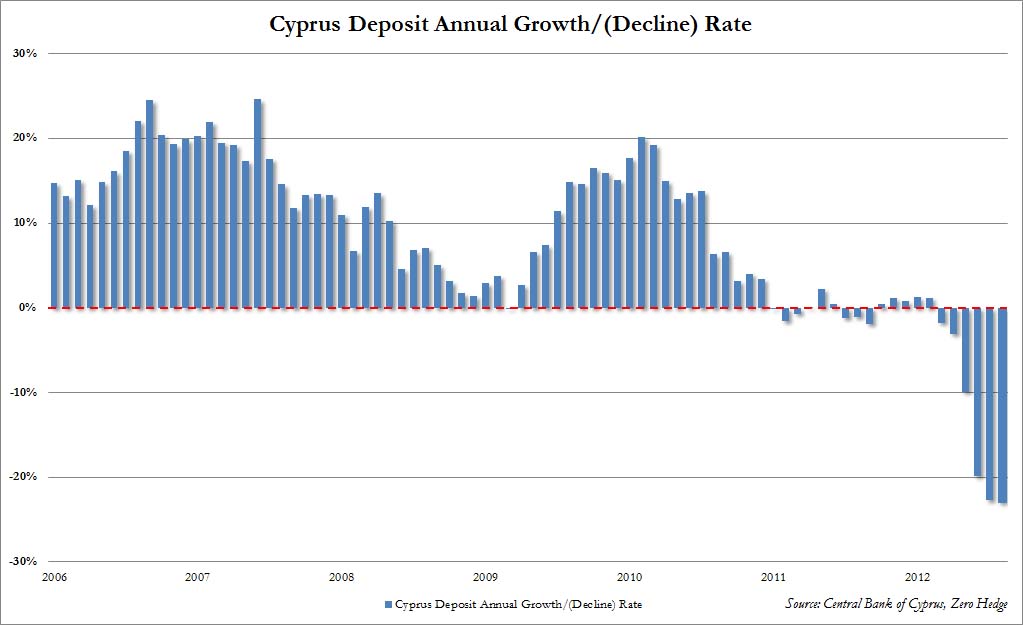
Back to countries: Cyprus is fixed as well. Sure, people lost 47.5% of their bank deposits, but they were given stock in their bank, surely that is working out. Nope, it turns out no one wants to keep their money in those banks and they are withdrawing as much as they are allowed to withdraw:

     Cyprus Deposits Plunge At Fastest Rate In History

Cyprus Deposits 3

And in Greece, wow, things just keep getting worse:

     Greece Laying off 25,000 State Workers

     Greek Unemployment, Non-Performing Loans Soar To Fresh Record Highs

     Greek Youth Unemployment Soars To Record 65%

     On The Ground In Athens: “Too Many People Are Committing Suicide”

So I think we really need to ask President Hollande and Ms. Lagarde and the other Euro-politicians: Fixed for whom? Clearly not for the people. Perhaps they mean it is fixed for them! Most of the Eurozone office-holders were not even elected, they were appointed. Yet they are running around eating caviar at endless summit meetings and handing down regulations most of which are not reviewed by any referendum or democratically-elected institution. Sounds more like royalty than democracy. And come to think of it, an awful lot of law and regulation in the US now arrives by Executive Order, agency regulation, and court order, not by debate and voting. So what’s going on here? Has democracy become a mere facade? Are we witnessing the return of royalty? Is all the attention lavished in the media on Kate and William and what they are wearing today as they take their baby for a stroll some kind of diversion to make this all more palatable?

trickle down

Next time, let’s look at lies in the Land of the Rising Radiation, Japan.

The Demise of Lies, Part 1

Without a doubt, there is acceleration in lying, but also acceleration in the revelation of truth. Lies are the basis of many slaveries that exist on our planet at this time. Until they have been demolished, these slaveries will continue. As awareness increases on all levels, the lies will be demolished. But all of us can all accelerate that expansion of awareness. So on with the show:

War drums again

The war drums are intensifying. The US Government has been having a seriously bad time these last few months keeping their lies secret: We found out that the IRS targets political opponents, the IRS tracks people’s activities in Facebook, EBay, etc and reads their e-mails without a warrant, the Justice Department spies on reporters who publish stories the Administration doesn’t like, the NSA spies on everyone worldwide and actively misleads Congress about all this, the US Attorney General likely lied to Congress, the military admitted that the “war on terror’ is permanent, worried about the lie that is the US Federal Reserve Note (aka the Dollar) twelve US states have measures in progress pushing for gold as legal tender, and today we find out that the DEA spies on people, tips off other law enforcement agencies about what they found, and then those agencies create fake evidence to show how they found out about this alleged wrongdoing. Government spokespeople regularly lie and are being found out within days. At first, the NSA claimed that their data collection had foiled 54 terrorist plots, but now NSA deputy director John C. Inglis testified “that at most one plot might have been disrupted by the bulk phone records collection alone. ‘There is an example that comes close…’ ” They kept saying “we only collect this, not that” but then it came out that they collect “word for word” all electronic communications.

It just seems to get worse almost every day. So what’s a country to do? War is a real possibility. Announce that no one will be home at most Middle East embassies because of a “credible terrorist threat.” If there is no attack, they can say all that spying was necessary and “a plot was foiled.” If there is an attack, they can decide who to blame and start a new war, distract people from everything that’s in this post, create a passel of new laws further restricting people’s freedom, further expand bloated intrusive government agencies, and so forth. Plus, we’re getting into the zone of the Wheeler Cycle of War and Political Change–which Wheeler researched in the 1930s–which projects war and/or major political change in 2014. You can see that the previous cycle low points on the chart pinpointed the starts of World Wars 1 and 2, the War in Viet Nam, and the huge political shifts in the USSR and China in 1989:

WheelerCycle

(Chart source: How Empires Collapse – A Orderly Path to Conclusion?)

I would not take that chart to mean that there won’t be any war till 2014. Cycles of this size are not always perfectly precise, I would say that we are in the cycle zone for the next war now.

Previous Thundering Heard posts weighed in on the world’s propensity for war: Beware the False Flag AttackPathetic Beating of War Drums, and Recommended: War Pigs – The Fall of a Global Empire.

Trickle down economics

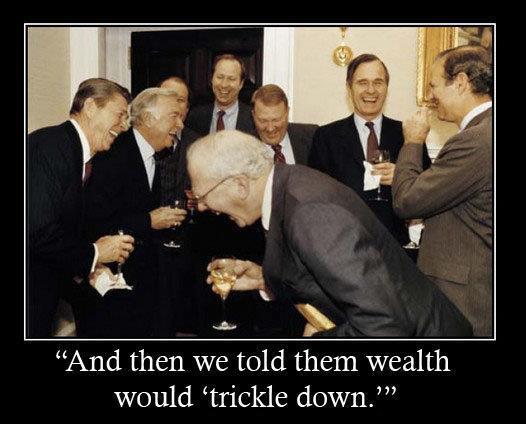
For years we have been told by government and business “leaders” that if we make life great for the rich—those “dynamic people” who create businesses that create jobs—then life will be better for everyone. But what it actually does is–surprise, surprise–make things great for the rich. Every statistic about income disparity shows that disparity widening to extremes not seen since 1929, at the start of the Great Depression.

The richest two hundred people on the planet have $2.7 trillion in assets. That’s more than the assets of the poorest 3.5 billion people, whose assets total $2.2 trillion.

I am not arguing for some kind of communist redistribution of wealth. But I am arguing against a system where the tables are extraordinarily slanted in favor of the rich. And against a system where big business and political parties are in league to feather each other’s nests. They work so well together because they are the same! Modern political parties are big businesses fighting for market share. Just like the big corporations, they stand for the “principle” of increasing their own power and wealth, everything else is window dressing.

For example, US Federal Reserve Chairman Bernanke said this week that the Fed’s money printing has not benefited Wall St more than Main St. This one qualifies as a pathetic lie. Why? Because it’s so easy to disprove. But hey, ever since Ronald “The Great Communicator” Reagan set the trend for pathetic lying by saying things like, “With all the fuss people are making about homelessness, you’d think there were people actually living in the streets,” other public officials have felt more free to simply lie, lie, and lie some more.

Clearly, people who buy Armani and Porsches are doing great:

*FERRARI SAYS 1H (first half) NET INCOME RISES 20%
*PORSCHE JULY U.S. SALES UP 36%

Everyone else, not so good:

     80% Of US Adults Are Near Poverty, Rely On Welfare, Or Are Unemployed

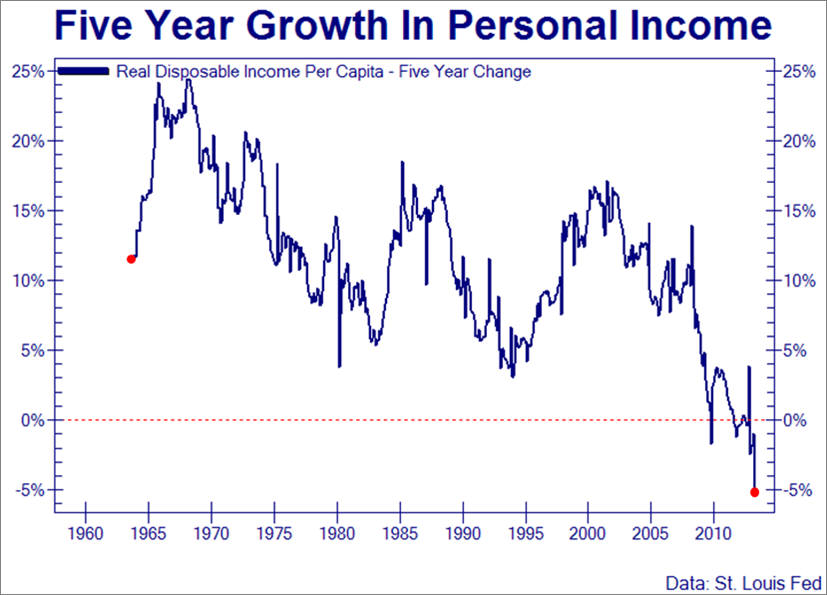
But US politicians and stock market cheerleaders tell us that we are in a recovery and that incomes are rising. But here’s a chart that shows the truth about income in the US over the last 50 years:

Personal_20130727_income

(Chart source)

And guess what: That chart above includes the income of the rich. Which is a real problem because, as shown here, the top 0.1% of income earners in the US now take in 10.4% of all income earned. And their income has been skyrocketing along with Bernanke’s printing. But the bottom 90% of income earners have been losing ground. Their share of the national income pie is now back to where it was in…(drumroll please)…1929! That was the last time the very rich were getting absurdly richer at the expense of everyone else.

Let’s look at another tactic of the Federal Reserve: Everyone with savings of any kind hasn’t exactly been getting much in the way of interest on their savings for more than a decade. Bernanke and his predecessor, Alan Greenspan, have kept interest rates near zero for their big bank masters to “save” the banking system (they say it’s to save the economy, but then why does Wall St always get to hang right at the faucet to get and use the money first before it “trickles down” to everyone else?) for over a decade. Not that the banks actually needed saving—as a group, the big banks have only had one unprofitable quarter in the last several years. Which required huge bailouts. But I digress. These ultra-low interest rates have meant that the banks haven’t had to pay much interest at all on people’s deposits. So how much have people lost because of this? If interest rates had been at the same level as their average level from 1920 to 2000, depositors would have collected an additional $10.8 trillion in interest payments versus what they actually did collect. The calculations are here. So the banks (Wall St) get off the hook for interest payments, adding hugely to their profits, and everyone else, including Main St, loses out to the tune of $10.8 trillion.

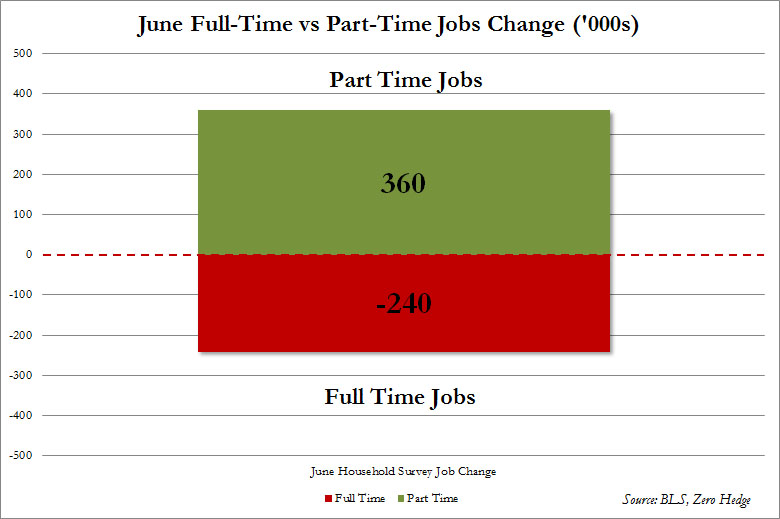
So what about employment? Politicians keep saying they are creating lots of jobs. These statements are shot with lies and distortions as well. There was a “better than expected” monthly jobs report in June. But what really happened is that 360,000 part-time jobs were created and 240,000 full-time jobs were lost:

June Full vs Part Time Jobs_2

(Chart source)

In fact, of the 953,000 jobs the US government claims were created in 2013, 731,000 are part time.

And what kind of jobs are these? Ten times more waiter and bartender jobs have been created in 2013 than manufacturing jobs:

Waiters Bartenders vs mfg 2013

(Chart source)

And different sets of government statistics disagree about just how many jobs are actually being created. If you look separately at the 50 US states, three (Texas, NY, and North Dakota) have more total jobs that they did at the end of 2007. The other 47 states have fewer jobs. Added up, those 47 states have 3.1 million fewer jobs than they did at the end of 2007, as shown here:

Job State Snapshot 2007

(Chart source)

But we’ve been told that the unemployment rate has dropped from over 10% to 7.4%, isn’t that correct? That statistic has improved right in line with an alleged drop in the total size of the labor pool despite population increase. In other words, the government claims that fewer and fewer people are part of the overall labor pool, meaning that the percent of them who are working automatically goes up. It’s a very convenient way to make sure the rate of unemployment drops since it can be done with statistics alone. Here’s a chart of the percent of adults who are participating in the labor force:

LaborParticipationFP April

This rate is now back to where it was in 1979. So the unemployment rate has improved only because lots of disgruntled job seekers have entirely given up on looking for work at all? Or is this simply a statistical ruse? The fact is, more than 90 million working-age Americans don’t have a job.

“We’re No. 1!”

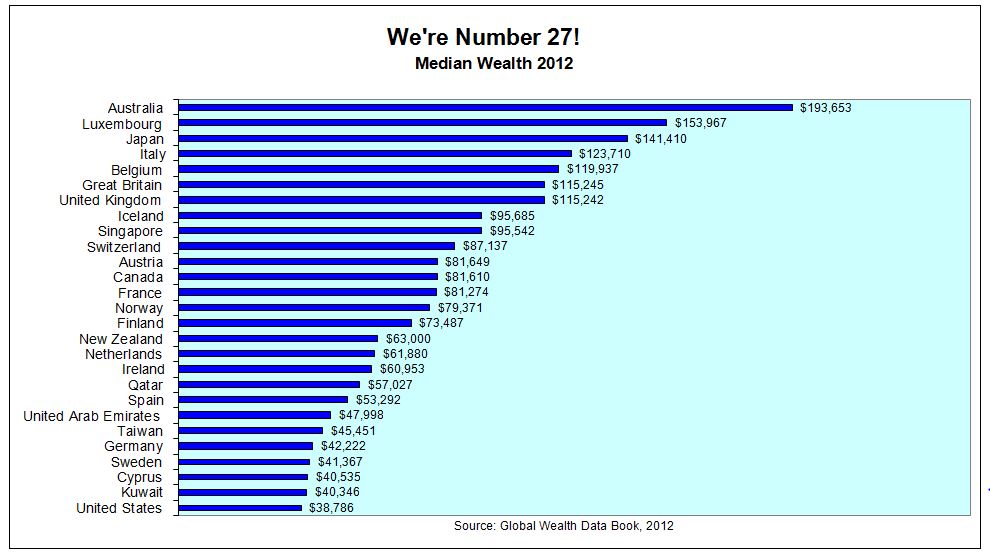
And you know that US lie where the people think the US is No.1 in everything that’s important? Well when it comes to median wealth, the US is 27th in the world. Here’s the chart:

American-Middle-Class

(Chart source)

Things have become so bad in the US that a member of the US Federal Reserve Board says, and I quote, that the “Mexican Government is better run than the US Government.”

Folks, there are so many lies out there that this post could probably be perpetual. But for today, the persecution rests. In the next post on the topic of lies, we’ll pick on Europe. Surely, things must be better in Europe. Ha!

Way too far

Here’s what it promises on the Obama 2008 campaign site:

Protect Whistleblowers: Often the best source of information about waste, fraud, and abuse in government is an existing government employee committed to public integrity and willing to speak out. Such acts of courage and patriotism, which can sometimes save lives and often save taxpayer dollars, should be encouraged rather than stifled. We need to empower federal employees as watchdogs of wrongdoing and partners in performance. Barack Obama will strengthen whistleblower laws to protect federal workers who expose waste, fraud, and abuse of authority in government. Obama will ensure that federal agencies expedite the process for reviewing whistleblower claims and whistleblowers have full access to courts and due process.

Tell it to the whistleblowers! This administration has used the Espionage Act of 1917 to prosecute whistleblowers more times than all previous administrations combined.

What appears to be true is that the whistleblowers are underestimating just how far astray things have gone. Here’s a story about how six agents showed up this week at a household because of various google searches performed by different members of the family:

What happened was this: At about 9:00 am, my husband, who happened to be home yesterday, was sitting in the living room with our two dogs when he heard a couple of cars pull up outside. He looked out the window and saw three black SUVs in front of our house; two at the curb in front and one pulled up behind my husband’s Jeep in the driveway, as if to block him from leaving.

Six gentleman in casual clothes emerged from the vehicles and spread out as they walked toward the house, two toward the backyard on one side, two on the other side, two toward the front door.

A million things went through my husband’s head. None of which were right. He walked outside and the men greeted him by flashing badges. He could see they all had guns holstered in their waistbands.

After things had calmed down, the husband of the household was told this:

They mentioned that they do this about 100 times a week. And that 99 of those visits turn out to be nothing.

What has happened to the “land of the free”???

And prior to Russia granting temporary asylum to whistleblower Edward Snowden, US Attorney General Eric Holder felt the need to publicly assure Russia that the US would not torture or kill Snowden. How far the US government has descended that it has to assure others that it won’t torture and kill a person!

And I surely don’t mean the above as disparaging comments on only one of two big businesses that masquerade as political parties in the US. The following is from a Washington Post article that includes an ibecilic reaction from John McCain on Russia granting asylum to Snowden:

Sen. John McCain (R-Ariz.) called Russia’s action “a disgrace and a deliberate effort to embarrass the United States,” as well as “a slap in the face of all Americans…”

McCain called for additional U.S. legislation targeting Russian human rights violators, a renewed push to complete missile defense programs in Europe and “another round of NATO expansion, including the Republic of Georgia.” He said the United States should also challenge Russian crackdowns on dissidents and speak out for those who are demanding “greater freedom, accountability and rule of law in Russia.”

So McCain wants prosecution of a US dissident who is calling for more accountability from the US government, but pretends to defend Russian dissidents who are calling for more accountability from the Russian government. And being John McCain, of course he advises that the appropriate response to a diplomatic legal disagreement is an increase in warmongering.

And speaking of the ramping up of war, one has to wonder what the warmongers have planned for this weekend.

* * *

Note:  I just noticed that the latest version of the Washington Post article has been edited to remove McCain’s contradictory stance on dissidents. Gee, I wonder why.

More cycles

Yet another instance of the accelerating flood cycle: a photo from the devastating Himalayan floods, indicating a stance people might wish to take during these times:

submerged-lord-shiva-idol-in-rishikesh-1

* * *

Despite being surrounded by the cyclic nature of physical life (breathing, heartbeat, blinking, day/night, tides, seasons, birth/death … and the less visible or invisible: sound waves, radio waves, x-rays, microwave cooking, evolution … and for a fun contemplation of large astronomical cycles, see this and this), for the most part, people tend to ignore cyclicality in favor of seeing life as a straight-line progression. This is unfortunate for at least two reasons: first, because all form is cyclic—form emerges, flourishes to some extent, and dissolves; second, because there are some not-so-obvious cycles that offer understanding for what is otherwise quite mysterious. In fact, here at Thundering Heard, we are on a path to discuss the biggest cycle of them all for people, a cycle that, once grasped, contains the answers to “little” questions like the meaning of life, why are we here, and so forth. But first, let’s get more adept at seeing the cyclic aspect of life and how important it is.

The Sunspot Cycle

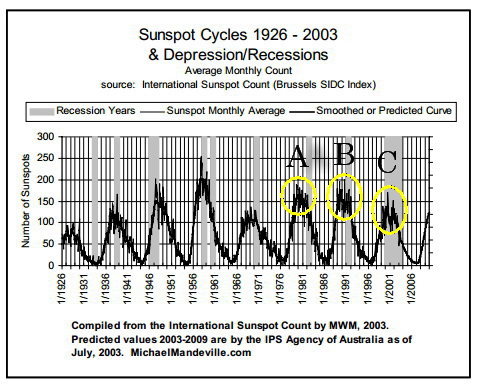
There is a peak of sunspot activity every 10 to 13 years, with 11 years being the average for each cycle. A chart of the peaks and troughs of sunspot activity from 1926 to 2009 looks like this:

Sunspots_Longer_Annot3

Let’s look at the three peaks labeled A, B, and C.

The peaks of sunspot activity often really “rev people up” financially, that is, there is typically an excitation of human activity that leads to a financial market bubble that coincides with the sunspot peak.

Three peaks ago, the peak in 1980, labeled A above, coincided with the peak of the commodity price boom and price inflation that took place in the 1970s after Nixon defaulted on the US promise, made near the end of World War 2, to always support conversion of Dollars into gold. Those were the days when the so-called Misery Index (inflation plus the unemployment rate) was tracked in daily newspapers, and mortgage rates in the US rose to 18%.

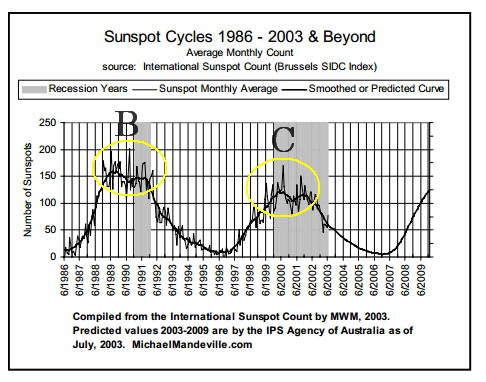
Here’s a closer look at the last two peaks of sunspot cycle activity:

Sunspots_2_Annot

The cycle peak labeled B was in 1990 and corresponded with the peak in Japan of bubbles in their stock and real estate markets. This was the time when it was generally held that Japan Inc. would rule the world, or at least own it; that its economy would soon be the largest in the world. A single block of downtown Tokyo real estate was said to be worth more than all of the real estate in California. Now that’s a bubble! (We’ll see in our next post on cycles why that Japan bubble grew so large when we cover another cycle that also contributed to this Japan peak. When multiple important cycles converge, the results can be gargantuan.) Following that peak, Japan experienced what has come to be called The Lost Decade, though it has now run for two decades. Both their stock and real estate markets lost 75% of their “value” after that peak, and they still have not come anywhere close to recovering their former glory as Japan has been mired in nearly constant recession ever since.

The sunspot peak labeled C aligned with the peak in the internet/technology stocks in the Spring and Summer of 2000, another famous bubble. Again money flowed, this time into Pets.com, Webvan,com, Geocities,com, DrKoop.com, and many others, most of which had little going for them except an idea and a web site. Little or no sales, no profits—who cared! They were going to the moon. It was a New Paradigm. If you thought it was insane, you “just didn’t get it.” And the thing is, that craziness for internet stocks had been in play for a few years; that hoopla could have ended in 1998 or 1999. But it didn’t. It ended when the sunspot cycle peaked in 2000.

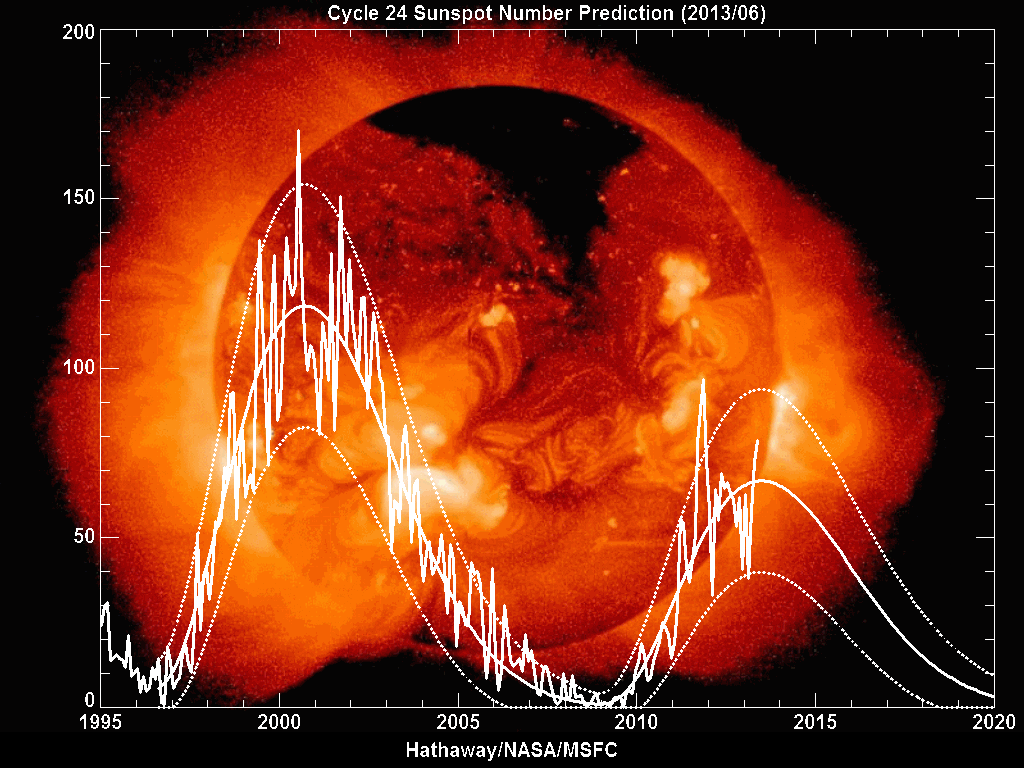
Looking back, it would have been great for the participants in those bubbles to be aware of the sunspot cycle peak. They could have sidestepped a lot of trouble. So what’s going to happen this time around? Well, for a few years, I have thought that  this economic cycle might hang on into the peak of the current sunspot cycle, called Solar Cycle 24, which was projected for August 2013. But Amon Ra may have thrown us a curve ball. It looks like this cycle will not have the usual single large peak, but rather a dual peak like Solar Cycle 14 from the early 20th Century. According to solar physicist Dean Pesnell of NASA’s Goddard Space Flight Center:

“This is solar maximum. But it looks different from what we expected because it is double peaked.” Pesnell noted similarities between the current cycle and Solar Cycle 14, which happened between February 1902 and August 1913 and experienced a double peak. If the two cycles are in fact twins, he said that “it would mean one peak in late 2013 and another in 2015.”

Here is a chart that shows the peak in 2000 plus our current cycle:

sunspts_predict_l

If the NASA guy is right, there should be a bubble peak in either 2013 or 2015. But a bubble in what? Here are some clues:

  • Lots of savings accounts pay only 0.01% in interest.
  • Mortgage rates got near 1% in Japan and 3% in the US. (Would you lend money to a stranger for 30 years for 3% interest? Neither would banks, which is why almost all mortgages need a guarantee from a government program or the banks won’t make the loan.)
  • Short-term interest rates in Germany and Switzerland recently went negative. That’s right, if you wanted to lend money to Germany or Switzerland on a short term basis, you had the pay them for the privilege.

If you think these phenomena don’t make a lot of sense, you are right. But it points to the culprit that has all the hallmarks of a monster bubble: the world government bond market. The bull market in bonds has been running for over 30 years. On May 2, if you wanted to lend money to Germany for 10 years, they would pay you an interest rate of 1.2%; the US, 1.6%. And if you wanted to lend Switzerland money for 10 years in December, they were paying a whopping 0.4%. Japan? 0.45%.

And in the case of Japan in particular, they are working very hard to devalue their currency, to make sure the yen falls in value. So the question is, who in their right mind would lend to these countries for such a pittance in interest, especially while most of them are printing money to intentionally debase the value of their currencies!?! You get a very poor interest rate and, if you get your capital back, it will be in a currency that will have fallen in value over 10 years. Yet, that is what institutions and people are doing. Recently, if you wanted to get a reasonable interest rate on 10-year government bonds, then you would have lend money to the country of Rwanda; they paid 7% on a recent offering of 10 year bonds. Best of luck getting your capital back 10 years from now.

When this bubble bursts, the consequences will be huge. This is not a bubble in one country, like Japan in 1980, or in one sector of the economy, like tech stocks in 2000, we’re talking about government bonds, worldwide! This is the market that supports military spending, education, transportation, and just about every safety net (in the US: Social Security, Medicare, Food Stamps, Medicaid, Unemployment Insurance, and so forth) on the planet. And you get this paltry interest rate when you might not even get your capital back in 10 years. A number of governments are on a clear trajectory for bankruptcy; there is a good chance that bond buyers will not get their capital back! And yet they lend huge amounts of money to these governments. Especially Baby Boomers, they have been pouring money into bond funds. Just like they poured money into stocks in 2000, and real estate investments in 2006. Oh well.

When do I think the bond bubble will pop? This year! 2013. I don’t think it can last to 2015. In fact, the bubble pop may have already started. And guess which institutions count government bonds as their major “stable” capital: banks. Yet another reason to watch out for the banks!

Furthermore, the solar cycle might actually peak this year. The NASA guy might be wrong about the dual-peak forecast.

What will it mean if this bubble pops? It means interest rates will rise, possibly a lot. This will strongly increase the amount of interest governments must pay on their debts. Their deficits will skyrocket.

Mortgage interest rates are closely tied to the government bond market, so mortgage rates will rise as well. (US mortgage rates rose from 3.88% to 4.35% just over the last week!) And if government deficits skyrocket, programs will need to be cut, so the massive support they are currently providing for the mortgage market will be in jeopardy, threatening even further rate increases.

Still, two cycles that we will discuss in the next post about cycles argue for that 2015 date.

* * *

I would like to make one thing very clear: If you woke up tomorrow and heard that a large “systemically important” international bank had collapsed, causing chaos in the rest of the financial system, and that most banks would be closed for some number of days, would you really be surprised? Probably not. Many people are starting to get the idea that the system is not exactly solid. I am certainly in that camp. So when I talk about August 2013 or some month in 2015 as the month when the real systemic collapse will commence, please know that, in my view, the more-than-sufficient conditions are in place for that full system collapse to happen at any minute. Discussions like the one above are an attempt to get a handle on probabilities. In terms of preparation, acceleration is not to be trifled with: I think that everyone should be doing what they can to be prepared now. If it turns out there is more time for preparation, fabulous, this type of preparation takes awhile and I’m sure we can all use the time. But that time may be short indeed. As the photo at the top of the post shows, when change arrives in your area, it may be monumental change.

Upcoming Thefts by Big Money

The insatiable banking/corporate/political crony network that has stolen so much from people in the past has some new schemes in store. First on the docket is the bail-in, where reckless banks with huge losses will be kept afloat not by the general base of taxpayers, but by those who have lent them money. And as mentioned in Update on Metals, Deposit Confiscation, and Capital Controls, depositors are definitely grouped into the class of those who have “lent” money to these banks. As in Cyprus, if a bank fails and the regulators decide that depositor money will be confiscated, the depositors receive some stock in the bank in exchange for their money. We’ll see later in this post just how well that is working out for people in Cyprus. But first, let’s establish that bail-ins are definitely the new thing:

     It Can Happen Here: The Confiscation Scheme Planned for US and UK Depositors

Confiscating the customer deposits in Cyprus banks, it seems, was not a one-off, desperate idea of a few Eurozone “troika” officials scrambling to salvage their balance sheets. A joint paper by the US Federal Deposit Insurance Corporation and the Bank of England dated December 10, 2012, shows that these plans have been long in the making; that they originated with the G20 Financial Stability Board in Basel, Switzerland (discussed earlier here); and that the result will be to deliver clear title to the banks of depositor funds…  

Although few depositors realize it, legally the bank owns the depositor’s funds as soon as they are put in the bank. Our money becomes the bank’s, and we become unsecured creditors holding IOUs or promises to pay. (See here and here.) But until now the bank has been obligated to pay the money back on demand in the form of cash. Under the FDIC-BOE plan, our IOUs will be converted into “bank equity.”  The bank will get the money and we will get stock in the bank. With any luck we may be able to sell the stock to someone else, but when and at what price?…

No exception is indicated for “insured deposits” in the U.S., meaning those under $250,000, the deposits we thought were protected by FDIC insurance. This can hardly be an oversight, since it is the FDIC that is issuing the directive.

     Wealthy bank depositors to suffer losses in EU law

A draft European Union law voted on Monday would shield small depositors from losing their savings in bank rescues, but customers with over 100,000 euros in savings when a bank failed could suffer losses.

     Asmussen clarifies EU Parliament: savers must bleed for bank rescue

     Japan to adopt ‘bail-ins,’ force bank losses on investors if needed, Nikkei says

     Land Of The Rising Bail In: Deposit Confiscation Coming To Japan Next

Other countries have hopped on the bail-in bandwagon, but you get the idea.

To absolutely confirm that bail-ins are coming, the next story is about an organization called ISDA preparing for how to handle bail-ins. Why is this important? Because the following is a list of the voting members of the ISDA Determinations Committee:

  • Bank of America N.A.
  • Barclays Bank plc
  • BNP Paribas
  • Citibank, N.A.
  • Credit Suisse International
  • Deutsche Bank AG
  • Goldman Sachs International
  • JPMorgan Chase Bank, N.A.
  • Morgan Stanley & Co. International plc
  • UBS AG

That is the rogues gallery of derivatives trading on this planet. And what is this Determinations Committee determining? Who gets what on all of the derivative bets placed with respect to any bank that gets a bail-in. In other words, there will be bets that the bank will fail, bets that the bank will survive, bets on the bank’s bonds, etc. etc., and these guys are now setting the rules for who gets what after a bail-in. If these folks think it’s necessary to protect themselves relating to bail-ins, then gee, I wonder if everyone else ought to do the same?:

     New CDS trigger event proposed to tackle bail-in

ISDA is consulting on a proposal to add another credit event for financial credit default swaps in order to adapt to sweeping changes in regulation that will give supervisory authorities the power to bail-in the debt of floundering institutions.

For further proof, those who are well-connected are already working to make sure that they are exempt from the torture of a bail-in:

     EACH wants CCP exemption from bail-ins 

Rest assured that there will be bank failures because the big ones have gone back to the methods that precipitated the financial crisis on the first place. They are again selling CDOs, one of the primary culprits in 2008:

     ‘Frankenstein’ CDOs twitch back to life

And they are once again granting what are called “covenant-lite” loans.

And in new depths of scum-sucking bottom-feeding, banks are so desperate for capital and profits and bonuses that they are now pursuing people upon whom they foreclosed to make up the difference between the mortgage loan amount and the price the banks were able to get for the house when they sold that house after foreclosure:

     Lenders seek court actions against homeowners years after foreclosure

For Jose Santos Benavides, the ordeal of losing his home was over.

The Salvadoran immigrant had worked for years as a self-employed landscaper to make a $15,000 down payment on a four-bedroom house in Rockville. He had achieved a portion of the American dream, earning nearly six figures.

Then the economy soured, and lean paychecks turned into late mortgage payments. On Aug. 20, 2008, one year after he bought his dream home for $469,000, the bank’s threat to take his house became real via a letter in the mail. Just four days before the bank seized the property, he moved out, along with his wife and their two young children.

That wasn’t the worst of it.

In November, more than three years after the foreclosure, he was stunned to learn he still owed $115,000 — with the interest alone growing at a rate high enough to lease a luxury car.

“I’m scared, you know,” Benavides said. “I can’t pay.”

The 42-year-old is among the many homeowners being taken to court by their lenders long after their houses were taken in foreclosure. Lenders are filing new motions in old foreclosure lawsuits and hiring debt collectors to pursue leftover debt, plus court fees, attorneys’ fees and tens of thousands in interest that had been accruing for years.

From that Washington Post article, here is a chart that shows that, in some states of the US, the banks have 40 or more years after the foreclosure to go after former “homeowners” upon whom they foreclosed:
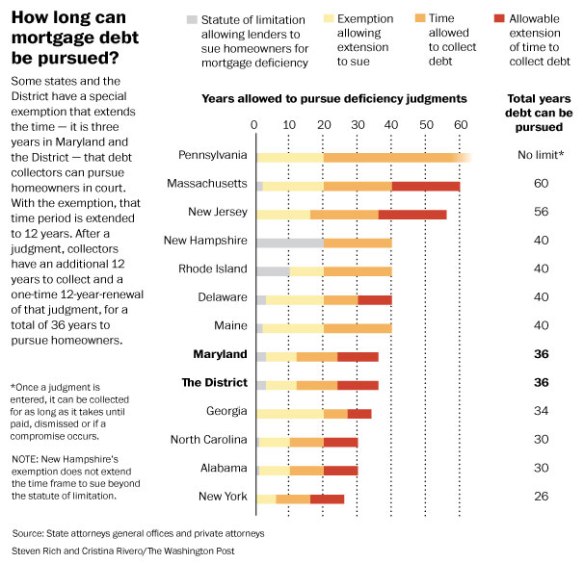
wpdeficiencytimeframephoto2So the banks engaged for years in seriously questionable lending practices, packaged up mortgages they knew would fail into “securities” that they sold all over the world, created fake documents and had them robo-signed to accomplish foreclosures, and now they can hound people for decades for what the banks say are their losses on these mortgages. With interest. And attorneys fees. I wonder who created such a legal system. As Bank of America employees reported:

     ‘We were told to lie’ – Bank of America employees open up about foreclosure practices

Employees of Bank of America say they were encouraged to lie to customers and were even rewarded for foreclosing on homes, staffers of the financial giant claim in new court documents…

“To justify the denials, employees produced fictitious reasons, for instance saying the homeowner had not sent in the required documents, when in actuality, they had,” William Wilson, Jr., a former underwriter for the bank, wrote in his statement.

As a side note on Europe, rumor has it that the infamous EU Finance Minister Jeroen Dijsellbloem, the one who correctly stated in public that the Cyprus bank action was a template for future bank resolutions, is pressing EU officials to try to preemptively resolve the problem of insolvent EU banks via deposit confiscation. And he wants to do that soon. So far, all attempts to fix EU bank problems have been band-aids that temporarily covered over the real problems; none have come close to a real solution, and we’ll get to the reason for that below. But if you have any notion that EU banks are solvent, then read this comment about Deutsche Bank by a former US Federal Reserve Bank President:

     Deutsche Bank “Is Horribly Undercapitalized… It’s Ridiculous” Says Former Fed President Hoenig

A top U.S. banking regulator called Deutsche Bank’s capital levels “horrible” and said it is the worst on a list of global banks based on one measurement of leverage ratios. “It’s horrible, I mean they’re horribly undercapitalized,” said Federal Deposit Insurance Corp Vice Chairman Thomas Hoenig in an interview. “They have no margin of error.” Deutsche’s leverage ratio stood at 1.63 percent, according to Hoenig’s numbers, which are based on European IFRS accounting rules as of the end of 2012.

Deutsche Bank is the biggest player in the world in the risk-laden derivatives market. At last count, they had $73 trillion in derivatives outstanding, which is over twenty times the size of the German GDP, so if Deutsche Bank has a derivatives blow up, it’s unlikely that Germany or anyone else would be able to afford to make good on their losses. After all, $73 trillion is larger than the entire world GDP.

And why is it that, as stated above, there have been no attempts to really solve EU bank problems?  It’s very simple: too much debt was issued to buy assets (e.g., real estate), pushing up the price of those assets to unrealistic levels. There are real losses that need to be taken, and no one wants to take the losses. All involved prefer to pretend that there are no such losses, so they use near-zero-interest bridge loans, accounting lies, and round robin I’ll-lend-your-bank-money-to-buy-your-government-debt-and-you-use-the-proceeds-to-bail-out-your-bank games to mask the truth. With non-performing loans at EU banks at record highs and growing by the day, good luck with that.

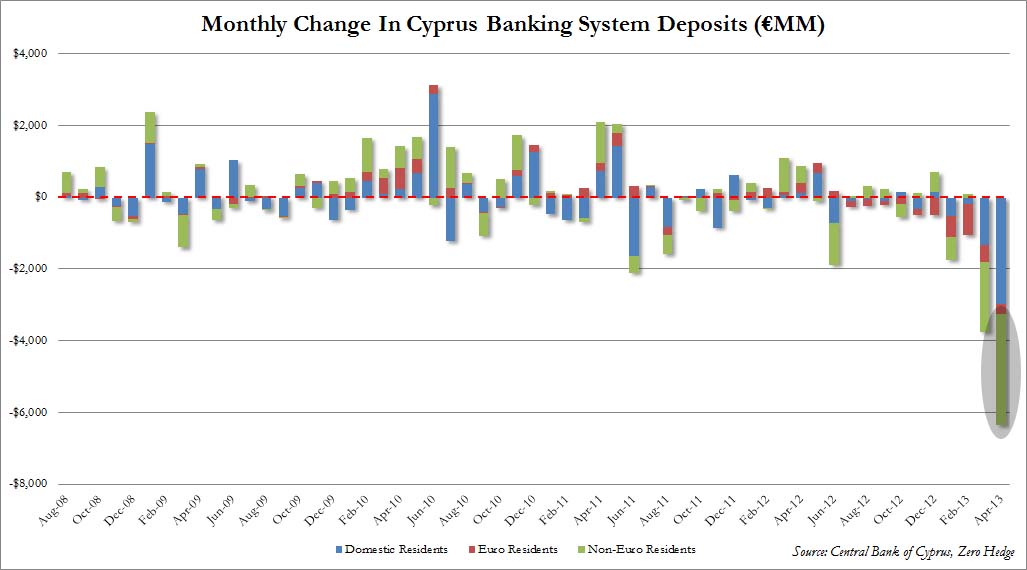
But here is the problem with bail-ins, the latest and great “fix” for the financial system: so far, they don’t work.  Let’s look at the infamous Cyprus case: they stole a lot of deposits and in return, gave people stock in the bank. But few want to keep their money in that bank anymore. Even with strong limits on daily withdrawals from the Cyprus banks, people are persistently removing their money from those banks:

     Cyprus Bank Deposits Plunge By Most Ever During “Capital Controls” Month

Here’s what the trend of withdrawals from the Cyprus banks look like:
Cyprus Bank Deposits Seq Change

That’s more than $6 billion being withdrawn in April, after the March bail-in. So that bank stock that people received in return for their “expropriated” deposits? Must be worth a fortune. If people still received stock certificates as a matter of course, at least these could be framed as memorabilia, yet another testament to the financial follies of humanity. But it’s all just electronic entries these days. Switch a few bits and bytes and then who owns what?

And the whole Cyprus action is breaking down anyway:

     The Cyprus Bail-In Blows Up: President Urges Complete Bailout Overhaul

Cyprus’ President Nicos Anastasiades has realized (as we warned), too late it seems for the thousands of domestic and foreign depositors who were sacrificed at the alter of monetary union, that the TROIKA’s terms are “too onerous.” Anastasiades has asked EU lenders to unwind the complex restructuring and partial merger of its two largest banks…

Not that the bail-outs actually worked either. Despite the fact that the EU leaders touted each of the first three Greek bailouts as the final fix, Greece now needs a fourth:

     Greece Has One Month To Plug A €1.2 Billion Healthcare Budget Hole

Think Cyprus is the only country that will need a repeat bailout (as the FT reported earlier)? Think again. Cause heeeeere’s Greece… again…. where as Kathimerini reports, a brand new, massive budget hole for €1.2 billion has just been “discovered.

And here’s another nice theft tactic. Well, nice if you are the bank. The Bank of Ireland just doubled the interest rate on existing floating rate mortgages where the fine print allowed them to do so:

     Bank Of Ireland Doubles Mortgage Rates, Homeowners Fear More To Come

And expect to hear a good deal more about wealth taxes in the coming months:

     German ‘Wise Men’ push for wealth seizure

Professors Lars Feld and Peter Bofinger said states in trouble must pay more for their own salvation, arguing that there is enough wealth in homes and private assets across the Mediterranean to cover bail-out costs. “The rich must give up part of their wealth over the next ten years,” said Prof Bofinger.

And last but not least, you know all that money sitting in retirements accounts? Multiple countries have nationalized such accounts in recent years. People like former Republican Administration insider Catherine Austin Fitts have been warning people that US politicians salivate when they contemplate getting their hands on that pool of $18 trillion.

OK, just three final (brief!) comments:

1. You’ve heard the old saying about someone who “wants your money in their pocket.” The problem here is most people’s money is already stored in “their pocket,” that is, it’s already being held by the institutions that want to grab it.

2. That thing about the banks going after people for more money after they have already foreclosed on them? Too bad we don’t have a Charles Dickens around to dramatize this type of behavior, maybe then people would get the depth of depravity in this system.

3. Tread carefully out there, folks, it looks like acceleration spares nothing, so I think you want to be real careful about “wait and see.” You know my view: banks are for transaction accounts, not savings.

Next time we’ll cover another big pile of electronic money, brokerage accounts.