The Demise of Lies, Part 1

Without a doubt, there is acceleration in lying, but also acceleration in the revelation of truth. Lies are the basis of many slaveries that exist on our planet at this time. Until they have been demolished, these slaveries will continue. As awareness increases on all levels, the lies will be demolished. But all of us can all accelerate that expansion of awareness. So on with the show:

War drums again

The war drums are intensifying. The US Government has been having a seriously bad time these last few months keeping their lies secret: We found out that the IRS targets political opponents, the IRS tracks people’s activities in Facebook, EBay, etc and reads their e-mails without a warrant, the Justice Department spies on reporters who publish stories the Administration doesn’t like, the NSA spies on everyone worldwide and actively misleads Congress about all this, the US Attorney General likely lied to Congress, the military admitted that the “war on terror’ is permanent, worried about the lie that is the US Federal Reserve Note (aka the Dollar) twelve US states have measures in progress pushing for gold as legal tender, and today we find out that the DEA spies on people, tips off other law enforcement agencies about what they found, and then those agencies create fake evidence to show how they found out about this alleged wrongdoing. Government spokespeople regularly lie and are being found out within days. At first, the NSA claimed that their data collection had foiled 54 terrorist plots, but now NSA deputy director John C. Inglis testified “that at most one plot might have been disrupted by the bulk phone records collection alone. ‘There is an example that comes close…’ ” They kept saying “we only collect this, not that” but then it came out that they collect “word for word” all electronic communications.

It just seems to get worse almost every day. So what’s a country to do? War is a real possibility. Announce that no one will be home at most Middle East embassies because of a “credible terrorist threat.” If there is no attack, they can say all that spying was necessary and “a plot was foiled.” If there is an attack, they can decide who to blame and start a new war, distract people from everything that’s in this post, create a passel of new laws further restricting people’s freedom, further expand bloated intrusive government agencies, and so forth. Plus, we’re getting into the zone of the Wheeler Cycle of War and Political Change–which Wheeler researched in the 1930s–which projects war and/or major political change in 2014. You can see that the previous cycle low points on the chart pinpointed the starts of World Wars 1 and 2, the War in Viet Nam, and the huge political shifts in the USSR and China in 1989:
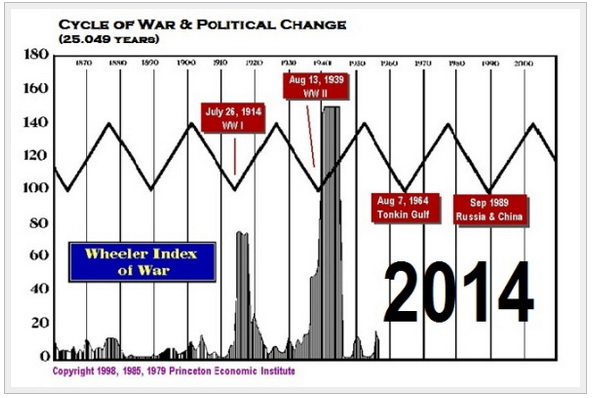
WheelerCycle

(Chart source: How Empires Collapse – A Orderly Path to Conclusion?)

I would not take that chart to mean that there won’t be any war till 2014. Cycles of this size are not always perfectly precise, I would say that we are in the cycle zone for the next war now.

Previous Thundering Heard posts weighed in on the world’s propensity for war: Beware the False Flag AttackPathetic Beating of War Drums, and Recommended: War Pigs – The Fall of a Global Empire.

Trickle down economics

For years we have been told by government and business “leaders” that if we make life great for the rich—those “dynamic people” who create businesses that create jobs—then life will be better for everyone. But what it actually does is–surprise, surprise–make things great for the rich. Every statistic about income disparity shows that disparity widening to extremes not seen since 1929, at the start of the Great Depression.

The richest two hundred people on the planet have $2.7 trillion in assets. That’s more than the assets of the poorest 3.5 billion people, whose assets total $2.2 trillion.

I am not arguing for some kind of communist redistribution of wealth. But I am arguing against a system where the tables are extraordinarily slanted in favor of the rich. And against a system where big business and political parties are in league to feather each other’s nests. They work so well together because they are the same! Modern political parties are big businesses fighting for market share. Just like the big corporations, they stand for the “principle” of increasing their own power and wealth, everything else is window dressing.

For example, US Federal Reserve Chairman Bernanke said this week that the Fed’s money printing has not benefited Wall St more than Main St. This one qualifies as a pathetic lie. Why? Because it’s so easy to disprove. But hey, ever since Ronald “The Great Communicator” Reagan set the trend for pathetic lying by saying things like, “With all the fuss people are making about homelessness, you’d think there were people actually living in the streets,” other public officials have felt more free to simply lie, lie, and lie some more.

Clearly, people who buy Armani and Porsches are doing great:

*FERRARI SAYS 1H (first half) NET INCOME RISES 20%
*PORSCHE JULY U.S. SALES UP 36%

Everyone else, not so good:

     80% Of US Adults Are Near Poverty, Rely On Welfare, Or Are Unemployed

But US politicians and stock market cheerleaders tell us that we are in a recovery and that incomes are rising. But here’s a chart that shows the truth about income in the US over the last 50 years:
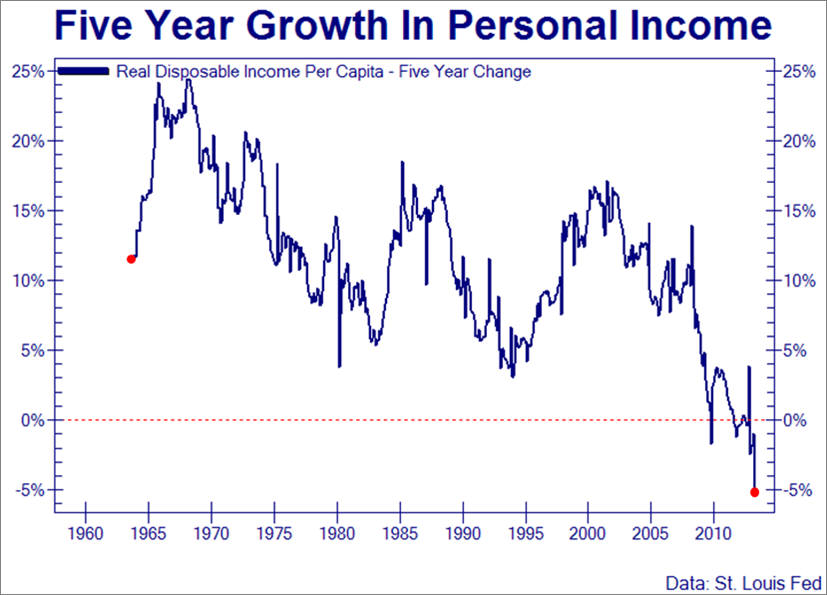
Personal_20130727_income

(Chart source)

And guess what: That chart above includes the income of the rich. Which is a real problem because, as shown here, the top 0.1% of income earners in the US now take in 10.4% of all income earned. And their income has been skyrocketing along with Bernanke’s printing. But the bottom 90% of income earners have been losing ground. Their share of the national income pie is now back to where it was in…(drumroll please)…1929! That was the last time the very rich were getting absurdly richer at the expense of everyone else.

Let’s look at another tactic of the Federal Reserve: Everyone with savings of any kind hasn’t exactly been getting much in the way of interest on their savings for more than a decade. Bernanke and his predecessor, Alan Greenspan, have kept interest rates near zero for their big bank masters to “save” the banking system (they say it’s to save the economy, but then why does Wall St always get to hang right at the faucet to get and use the money first before it “trickles down” to everyone else?) for over a decade. Not that the banks actually needed saving—as a group, the big banks have only had one unprofitable quarter in the last several years. Which required huge bailouts. But I digress. These ultra-low interest rates have meant that the banks haven’t had to pay much interest at all on people’s deposits. So how much have people lost because of this? If interest rates had been at the same level as their average level from 1920 to 2000, depositors would have collected an additional $10.8 trillion in interest payments versus what they actually did collect. The calculations are here. So the banks (Wall St) get off the hook for interest payments, adding hugely to their profits, and everyone else, including Main St, loses out to the tune of $10.8 trillion.

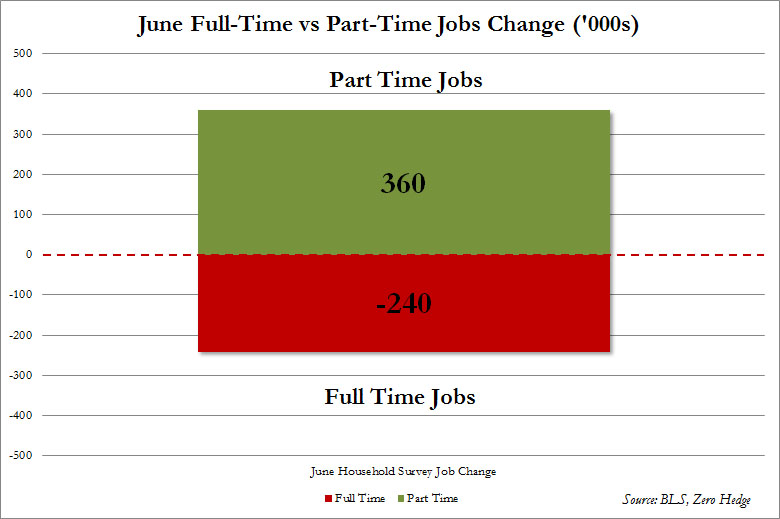
So what about employment? Politicians keep saying they are creating lots of jobs. These statements are shot with lies and distortions as well. There was a “better than expected” monthly jobs report in June. But what really happened is that 360,000 part-time jobs were created and 240,000 full-time jobs were lost:
June Full vs Part Time Jobs_2

(Chart source)

In fact, of the 953,000 jobs the US government claims were created in 2013, 731,000 are part time.

And what kind of jobs are these? Ten times more waiter and bartender jobs have been created in 2013 than manufacturing jobs:

Waiters Bartenders vs mfg 2013

(Chart source)

And different sets of government statistics disagree about just how many jobs are actually being created. If you look separately at the 50 US states, three (Texas, NY, and North Dakota) have more total jobs that they did at the end of 2007. The other 47 states have fewer jobs. Added up, those 47 states have 3.1 million fewer jobs than they did at the end of 2007, as shown here:

Job State Snapshot 2007

(Chart source)

But we’ve been told that the unemployment rate has dropped from over 10% to 7.4%, isn’t that correct? That statistic has improved right in line with an alleged drop in the total size of the labor pool despite population increase. In other words, the government claims that fewer and fewer people are part of the overall labor pool, meaning that the percent of them who are working automatically goes up. It’s a very convenient way to make sure the rate of unemployment drops since it can be done with statistics alone. Here’s a chart of the percent of adults who are participating in the labor force:

LaborParticipationFP April

This rate is now back to where it was in 1979. So the unemployment rate has improved only because lots of disgruntled job seekers have entirely given up on looking for work at all? Or is this simply a statistical ruse? The fact is, more than 90 million working-age Americans don’t have a job.

“We’re No. 1!”

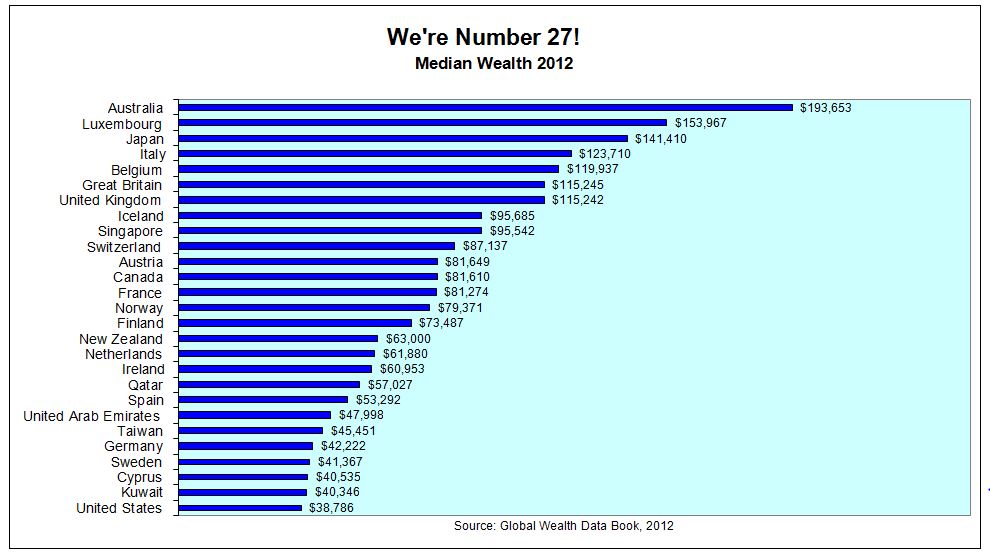
And you know that US lie where the people think the US is No.1 in everything that’s important? Well when it comes to median wealth, the US is 27th in the world. Here’s the chart:
American-Middle-Class

(Chart source)

Things have become so bad in the US that a member of the US Federal Reserve Board says, and I quote, that the “Mexican Government is better run than the US Government.”

Folks, there are so many lies out there that this post could probably be perpetual. But for today, the persecution rests. In the next post on the topic of lies, we’ll pick on Europe. Surely, things must be better in Europe. Ha!

It’s Bail-In time

The posts Upcoming Thefts by Big Money and Update on Metals, Deposit Confiscation, and Capital Controls explained how the authorities have made is perfectly clear that their new Bail-In regimen would confiscate deposits from regular folks in an attempt–which will ultimately fail–to keep the bankrupt banks and bankrupt governments afloat. I enter as evidence the bankruptcy of the City of Detroit. Ellen Brown has written an excellent post on the topic that everyone should read, especially anyone who tends to think the current financial/legal/political system is a trustworthy custodian.

What’s happening is this: in the Detroit bankruptcy, the banks have been ruled to have “super-seniority,” that is, the banks get taken care of first, everyone else comes after that. Why? Because the banks sold Detroit derivatives and the banks got Congress to pass a law in 2005 that derivatives have seniority over all other obligations. So Detroit’s pensioners–the retired firefighters, police, water workers, garbage collectors, etc.–will get whatever crumbs might or might not be left after the super-senior derivative sellers and senior bondholders get their take. The first proposal had pensions being cut to ten cents on the dollar.

The banks convinced Congress that derivatives are “systemically important” so that’s how they got this super-seniority scam in place. Since there are over $700 trillion worth of derivatives out there in the world and that’s more than 10 times larger than then entire world economy, that means the banks will ultimately get all of everything before anyone else gets any of anything every time there is trouble. And there will be a lot of trouble. Particularly if they start a big war. Think about it: we have a system where money is debt and almost all countries and banks have way too much debt and the banking and government debt system is cross-linked to all financial institutions and pension funds and insurance companies across the globe. What will that look like when institutions in one country decide to not pay the institutions in another country because the two are at war, or since no one will be sure which countries will be left standing at the end of the war, everyone will gets suspicious about the value of everyone else’s currency? Trouble will take on entirely new dimensions. And we’ve all been told who has seniority in terms of dibs on assets, and that “who” is not you and me.

Or from another vantage point, please consider this: it has taken over a year for the bankruptcy trustee for MF Global, which stole $1.6 billion from its depositors, to even figure out where the money is. And he has only been able to figure out where 80% of it is. Not because anyone was hiding it, but because assets now get lent to someone who lends them to someone else who lends them to someone else…and so forth. This is how complicated the financial system has become. Think about what this will look like when the amounts are literally millions of times larger than MF Global and spread across the globe in countries which are no longer on speaking terms.

And as a friend just pointed out to me in an e-mail, it’s really now in the banks’ best interest to have cities like Detroit go bankrupt so that the banks can get all of their money from derivatives right away.

I wonder if that’s why Detroit isn’t getting a bailout from the State or Federal governments–that the banks want their money now.

And the City of Detroit gets relief from its debts. So government and banks bail in (steal!) the money from regular folks, game set and match. Ah, the public-private partnership in action!

It’s dangerous out there folks. Please take action accordingly. Soon!

From Ellen’s post, The Detroit Bail-In Template: Fleecing Pensioners to Save the Banks:

In Cyprus, the depositors were “bailed in” (stripped of a major portion of their deposits) to re-capitalize the banks. In Detroit, it is the municipal workers who are being bailed in, stripped of a major portion of their pensions to save the banks.

Bank of America Corp. and UBS AG have been given priority over other bankruptcy claimants, meaning chiefly the pensioners, for payments due on interest rate swaps they entered into with the city. Interest rate swaps – the exchange of interest rate payments between counterparties – are sold by Wall Street banks as a form of insurance, something municipal governments “should” do to protect their loans from an unanticipated increase in rates. Unlike ordinary insurance, however, swaps are actually just bets; and if the municipality loses the bet, it can owe the house, and owe big. The swap casino is almost entirely unregulated, and it is a rigged game that the house virtually always wins. Interest rate swaps are based on the LIBOR rate, which has now been proven to be manipulated by the rate-setting banks; and they were a major contributor to Detroit’s bankruptcy.

Derivative claims are considered “secured” because the players must post collateral to play. They get not just priority but “super-priority” in bankruptcy, meaning they go first before all others, a deal pushed through by Wall Street in the Bankruptcy Reform Act of 2005. Meanwhile, the municipal workers, whose pensions are theoretically protected under the Michigan Constitution, are classified as “unsecured” claimants who will get the scraps after the secured creditors put in their claims. The banking casino, it seems, trumps even the state constitution. The banks win and the workers lose once again.

Ellen’s full post is here.

More cycles

Yet another instance of the accelerating flood cycle: a photo from the devastating Himalayan floods, indicating a stance people might wish to take during these times:

submerged-lord-shiva-idol-in-rishikesh-1

* * *

Despite being surrounded by the cyclic nature of physical life (breathing, heartbeat, blinking, day/night, tides, seasons, birth/death … and the less visible or invisible: sound waves, radio waves, x-rays, microwave cooking, evolution … and for a fun contemplation of large astronomical cycles, see this and this), for the most part, people tend to ignore cyclicality in favor of seeing life as a straight-line progression. This is unfortunate for at least two reasons: first, because all form is cyclic—form emerges, flourishes to some extent, and dissolves; second, because there are some not-so-obvious cycles that offer understanding for what is otherwise quite mysterious. In fact, here at Thundering Heard, we are on a path to discuss the biggest cycle of them all for people, a cycle that, once grasped, contains the answers to “little” questions like the meaning of life, why are we here, and so forth. But first, let’s get more adept at seeing the cyclic aspect of life and how important it is.

The Sunspot Cycle

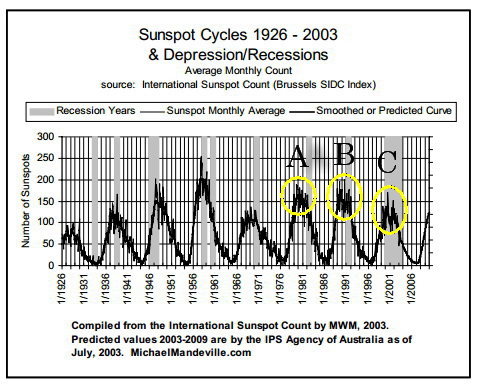
There is a peak of sunspot activity every 10 to 13 years, with 11 years being the average for each cycle. A chart of the peaks and troughs of sunspot activity from 1926 to 2009 looks like this:

Sunspots_Longer_Annot3

Let’s look at the three peaks labeled A, B, and C.

The peaks of sunspot activity often really “rev people up” financially, that is, there is typically an excitation of human activity that leads to a financial market bubble that coincides with the sunspot peak.

Three peaks ago, the peak in 1980, labeled A above, coincided with the peak of the commodity price boom and price inflation that took place in the 1970s after Nixon defaulted on the US promise, made near the end of World War 2, to always support conversion of Dollars into gold. Those were the days when the so-called Misery Index (inflation plus the unemployment rate) was tracked in daily newspapers, and mortgage rates in the US rose to 18%.

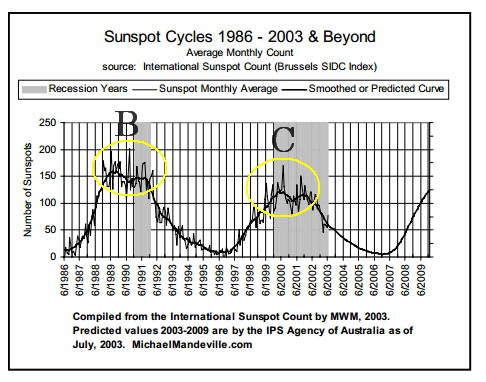
Here’s a closer look at the last two peaks of sunspot cycle activity:

Sunspots_2_Annot

The cycle peak labeled B was in 1990 and corresponded with the peak in Japan of bubbles in their stock and real estate markets. This was the time when it was generally held that Japan Inc. would rule the world, or at least own it; that its economy would soon be the largest in the world. A single block of downtown Tokyo real estate was said to be worth more than all of the real estate in California. Now that’s a bubble! (We’ll see in our next post on cycles why that Japan bubble grew so large when we cover another cycle that also contributed to this Japan peak. When multiple important cycles converge, the results can be gargantuan.) Following that peak, Japan experienced what has come to be called The Lost Decade, though it has now run for two decades. Both their stock and real estate markets lost 75% of their “value” after that peak, and they still have not come anywhere close to recovering their former glory as Japan has been mired in nearly constant recession ever since.

The sunspot peak labeled C aligned with the peak in the internet/technology stocks in the Spring and Summer of 2000, another famous bubble. Again money flowed, this time into Pets.com, Webvan,com, Geocities,com, DrKoop.com, and many others, most of which had little going for them except an idea and a web site. Little or no sales, no profits—who cared! They were going to the moon. It was a New Paradigm. If you thought it was insane, you “just didn’t get it.” And the thing is, that craziness for internet stocks had been in play for a few years; that hoopla could have ended in 1998 or 1999. But it didn’t. It ended when the sunspot cycle peaked in 2000.

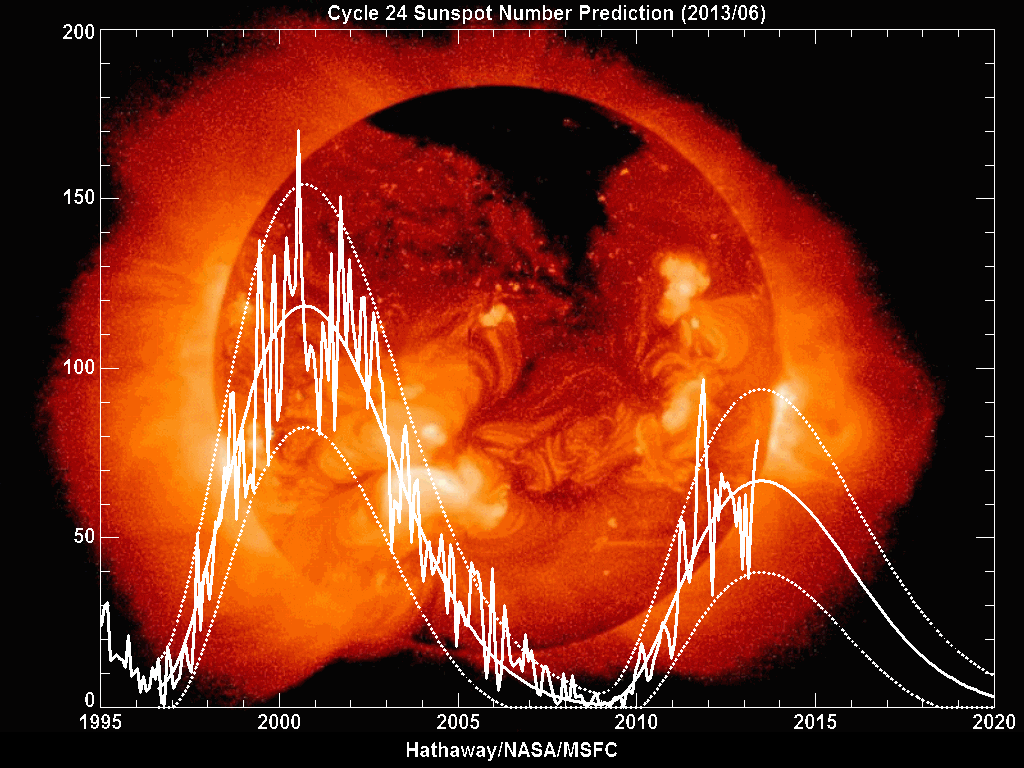
Looking back, it would have been great for the participants in those bubbles to be aware of the sunspot cycle peak. They could have sidestepped a lot of trouble. So what’s going to happen this time around? Well, for a few years, I have thought that  this economic cycle might hang on into the peak of the current sunspot cycle, called Solar Cycle 24, which was projected for August 2013. But Amon Ra may have thrown us a curve ball. It looks like this cycle will not have the usual single large peak, but rather a dual peak like Solar Cycle 14 from the early 20th Century. According to solar physicist Dean Pesnell of NASA’s Goddard Space Flight Center:

“This is solar maximum. But it looks different from what we expected because it is double peaked.” Pesnell noted similarities between the current cycle and Solar Cycle 14, which happened between February 1902 and August 1913 and experienced a double peak. If the two cycles are in fact twins, he said that “it would mean one peak in late 2013 and another in 2015.”

Here is a chart that shows the peak in 2000 plus our current cycle:

sunspts_predict_l

If the NASA guy is right, there should be a bubble peak in either 2013 or 2015. But a bubble in what? Here are some clues:

  • Lots of savings accounts pay only 0.01% in interest.
  • Mortgage rates got near 1% in Japan and 3% in the US. (Would you lend money to a stranger for 30 years for 3% interest? Neither would banks, which is why almost all mortgages need a guarantee from a government program or the banks won’t make the loan.)
  • Short-term interest rates in Germany and Switzerland recently went negative. That’s right, if you wanted to lend money to Germany or Switzerland on a short term basis, you had the pay them for the privilege.

If you think these phenomena don’t make a lot of sense, you are right. But it points to the culprit that has all the hallmarks of a monster bubble: the world government bond market. The bull market in bonds has been running for over 30 years. On May 2, if you wanted to lend money to Germany for 10 years, they would pay you an interest rate of 1.2%; the US, 1.6%. And if you wanted to lend Switzerland money for 10 years in December, they were paying a whopping 0.4%. Japan? 0.45%.

And in the case of Japan in particular, they are working very hard to devalue their currency, to make sure the yen falls in value. So the question is, who in their right mind would lend to these countries for such a pittance in interest, especially while most of them are printing money to intentionally debase the value of their currencies!?! You get a very poor interest rate and, if you get your capital back, it will be in a currency that will have fallen in value over 10 years. Yet, that is what institutions and people are doing. Recently, if you wanted to get a reasonable interest rate on 10-year government bonds, then you would have lend money to the country of Rwanda; they paid 7% on a recent offering of 10 year bonds. Best of luck getting your capital back 10 years from now.

When this bubble bursts, the consequences will be huge. This is not a bubble in one country, like Japan in 1980, or in one sector of the economy, like tech stocks in 2000, we’re talking about government bonds, worldwide! This is the market that supports military spending, education, transportation, and just about every safety net (in the US: Social Security, Medicare, Food Stamps, Medicaid, Unemployment Insurance, and so forth) on the planet. And you get this paltry interest rate when you might not even get your capital back in 10 years. A number of governments are on a clear trajectory for bankruptcy; there is a good chance that bond buyers will not get their capital back! And yet they lend huge amounts of money to these governments. Especially Baby Boomers, they have been pouring money into bond funds. Just like they poured money into stocks in 2000, and real estate investments in 2006. Oh well.

When do I think the bond bubble will pop? This year! 2013. I don’t think it can last to 2015. In fact, the bubble pop may have already started. And guess which institutions count government bonds as their major “stable” capital: banks. Yet another reason to watch out for the banks!

Furthermore, the solar cycle might actually peak this year. The NASA guy might be wrong about the dual-peak forecast.

What will it mean if this bubble pops? It means interest rates will rise, possibly a lot. This will strongly increase the amount of interest governments must pay on their debts. Their deficits will skyrocket.

Mortgage interest rates are closely tied to the government bond market, so mortgage rates will rise as well. (US mortgage rates rose from 3.88% to 4.35% just over the last week!) And if government deficits skyrocket, programs will need to be cut, so the massive support they are currently providing for the mortgage market will be in jeopardy, threatening even further rate increases.

Still, two cycles that we will discuss in the next post about cycles argue for that 2015 date.

* * *

I would like to make one thing very clear: If you woke up tomorrow and heard that a large “systemically important” international bank had collapsed, causing chaos in the rest of the financial system, and that most banks would be closed for some number of days, would you really be surprised? Probably not. Many people are starting to get the idea that the system is not exactly solid. I am certainly in that camp. So when I talk about August 2013 or some month in 2015 as the month when the real systemic collapse will commence, please know that, in my view, the more-than-sufficient conditions are in place for that full system collapse to happen at any minute. Discussions like the one above are an attempt to get a handle on probabilities. In terms of preparation, acceleration is not to be trifled with: I think that everyone should be doing what they can to be prepared now. If it turns out there is more time for preparation, fabulous, this type of preparation takes awhile and I’m sure we can all use the time. But that time may be short indeed. As the photo at the top of the post shows, when change arrives in your area, it may be monumental change.

Upcoming Thefts by Big Money

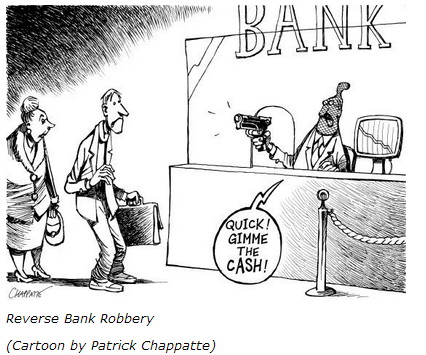
The insatiable banking/corporate/political crony network that has stolen so much from people in the past has some new schemes in store. First on the docket is the bail-in, where reckless banks with huge losses will be kept afloat not by the general base of taxpayers, but by those who have lent them money. And as mentioned in Update on Metals, Deposit Confiscation, and Capital Controls, depositors are definitely grouped into the class of those who have “lent” money to these banks. As in Cyprus, if a bank fails and the regulators decide that depositor money will be confiscated, the depositors receive some stock in the bank in exchange for their money. We’ll see later in this post just how well that is working out for people in Cyprus. But first, let’s establish that bail-ins are definitely the new thing:

     It Can Happen Here: The Confiscation Scheme Planned for US and UK Depositors

Confiscating the customer deposits in Cyprus banks, it seems, was not a one-off, desperate idea of a few Eurozone “troika” officials scrambling to salvage their balance sheets. A joint paper by the US Federal Deposit Insurance Corporation and the Bank of England dated December 10, 2012, shows that these plans have been long in the making; that they originated with the G20 Financial Stability Board in Basel, Switzerland (discussed earlier here); and that the result will be to deliver clear title to the banks of depositor funds…  

Although few depositors realize it, legally the bank owns the depositor’s funds as soon as they are put in the bank. Our money becomes the bank’s, and we become unsecured creditors holding IOUs or promises to pay. (See here and here.) But until now the bank has been obligated to pay the money back on demand in the form of cash. Under the FDIC-BOE plan, our IOUs will be converted into “bank equity.”  The bank will get the money and we will get stock in the bank. With any luck we may be able to sell the stock to someone else, but when and at what price?…

No exception is indicated for “insured deposits” in the U.S., meaning those under $250,000, the deposits we thought were protected by FDIC insurance. This can hardly be an oversight, since it is the FDIC that is issuing the directive.

     Wealthy bank depositors to suffer losses in EU law

A draft European Union law voted on Monday would shield small depositors from losing their savings in bank rescues, but customers with over 100,000 euros in savings when a bank failed could suffer losses.

     Asmussen clarifies EU Parliament: savers must bleed for bank rescue

     Japan to adopt ‘bail-ins,’ force bank losses on investors if needed, Nikkei says

     Land Of The Rising Bail In: Deposit Confiscation Coming To Japan Next

Other countries have hopped on the bail-in bandwagon, but you get the idea.

To absolutely confirm that bail-ins are coming, the next story is about an organization called ISDA preparing for how to handle bail-ins. Why is this important? Because the following is a list of the voting members of the ISDA Determinations Committee:

  • Bank of America N.A.
  • Barclays Bank plc
  • BNP Paribas
  • Citibank, N.A.
  • Credit Suisse International
  • Deutsche Bank AG
  • Goldman Sachs International
  • JPMorgan Chase Bank, N.A.
  • Morgan Stanley & Co. International plc
  • UBS AG

That is the rogues gallery of derivatives trading on this planet. And what is this Determinations Committee determining? Who gets what on all of the derivative bets placed with respect to any bank that gets a bail-in. In other words, there will be bets that the bank will fail, bets that the bank will survive, bets on the bank’s bonds, etc. etc., and these guys are now setting the rules for who gets what after a bail-in. If these folks think it’s necessary to protect themselves relating to bail-ins, then gee, I wonder if everyone else ought to do the same?:

     New CDS trigger event proposed to tackle bail-in

ISDA is consulting on a proposal to add another credit event for financial credit default swaps in order to adapt to sweeping changes in regulation that will give supervisory authorities the power to bail-in the debt of floundering institutions.

For further proof, those who are well-connected are already working to make sure that they are exempt from the torture of a bail-in:

     EACH wants CCP exemption from bail-ins 

Rest assured that there will be bank failures because the big ones have gone back to the methods that precipitated the financial crisis on the first place. They are again selling CDOs, one of the primary culprits in 2008:

     ‘Frankenstein’ CDOs twitch back to life

And they are once again granting what are called “covenant-lite” loans.

And in new depths of scum-sucking bottom-feeding, banks are so desperate for capital and profits and bonuses that they are now pursuing people upon whom they foreclosed to make up the difference between the mortgage loan amount and the price the banks were able to get for the house when they sold that house after foreclosure:

     Lenders seek court actions against homeowners years after foreclosure

For Jose Santos Benavides, the ordeal of losing his home was over.

The Salvadoran immigrant had worked for years as a self-employed landscaper to make a $15,000 down payment on a four-bedroom house in Rockville. He had achieved a portion of the American dream, earning nearly six figures.

Then the economy soured, and lean paychecks turned into late mortgage payments. On Aug. 20, 2008, one year after he bought his dream home for $469,000, the bank’s threat to take his house became real via a letter in the mail. Just four days before the bank seized the property, he moved out, along with his wife and their two young children.

That wasn’t the worst of it.

In November, more than three years after the foreclosure, he was stunned to learn he still owed $115,000 — with the interest alone growing at a rate high enough to lease a luxury car.

“I’m scared, you know,” Benavides said. “I can’t pay.”

The 42-year-old is among the many homeowners being taken to court by their lenders long after their houses were taken in foreclosure. Lenders are filing new motions in old foreclosure lawsuits and hiring debt collectors to pursue leftover debt, plus court fees, attorneys’ fees and tens of thousands in interest that had been accruing for years.

From that Washington Post article, here is a chart that shows that, in some states of the US, the banks have 40 or more years after the foreclosure to go after former “homeowners” upon whom they foreclosed:

wpdeficiencytimeframephoto2So the banks engaged for years in seriously questionable lending practices, packaged up mortgages they knew would fail into “securities” that they sold all over the world, created fake documents and had them robo-signed to accomplish foreclosures, and now they can hound people for decades for what the banks say are their losses on these mortgages. With interest. And attorneys fees. I wonder who created such a legal system. As Bank of America employees reported:

     ‘We were told to lie’ – Bank of America employees open up about foreclosure practices

Employees of Bank of America say they were encouraged to lie to customers and were even rewarded for foreclosing on homes, staffers of the financial giant claim in new court documents…

“To justify the denials, employees produced fictitious reasons, for instance saying the homeowner had not sent in the required documents, when in actuality, they had,” William Wilson, Jr., a former underwriter for the bank, wrote in his statement.

As a side note on Europe, rumor has it that the infamous EU Finance Minister Jeroen Dijsellbloem, the one who correctly stated in public that the Cyprus bank action was a template for future bank resolutions, is pressing EU officials to try to preemptively resolve the problem of insolvent EU banks via deposit confiscation. And he wants to do that soon. So far, all attempts to fix EU bank problems have been band-aids that temporarily covered over the real problems; none have come close to a real solution, and we’ll get to the reason for that below. But if you have any notion that EU banks are solvent, then read this comment about Deutsche Bank by a former US Federal Reserve Bank President:

     Deutsche Bank “Is Horribly Undercapitalized… It’s Ridiculous” Says Former Fed President Hoenig

A top U.S. banking regulator called Deutsche Bank’s capital levels “horrible” and said it is the worst on a list of global banks based on one measurement of leverage ratios. “It’s horrible, I mean they’re horribly undercapitalized,” said Federal Deposit Insurance Corp Vice Chairman Thomas Hoenig in an interview. “They have no margin of error.” Deutsche’s leverage ratio stood at 1.63 percent, according to Hoenig’s numbers, which are based on European IFRS accounting rules as of the end of 2012.

Deutsche Bank is the biggest player in the world in the risk-laden derivatives market. At last count, they had $73 trillion in derivatives outstanding, which is over twenty times the size of the German GDP, so if Deutsche Bank has a derivatives blow up, it’s unlikely that Germany or anyone else would be able to afford to make good on their losses. After all, $73 trillion is larger than the entire world GDP.

And why is it that, as stated above, there have been no attempts to really solve EU bank problems?  It’s very simple: too much debt was issued to buy assets (e.g., real estate), pushing up the price of those assets to unrealistic levels. There are real losses that need to be taken, and no one wants to take the losses. All involved prefer to pretend that there are no such losses, so they use near-zero-interest bridge loans, accounting lies, and round robin I’ll-lend-your-bank-money-to-buy-your-government-debt-and-you-use-the-proceeds-to-bail-out-your-bank games to mask the truth. With non-performing loans at EU banks at record highs and growing by the day, good luck with that.

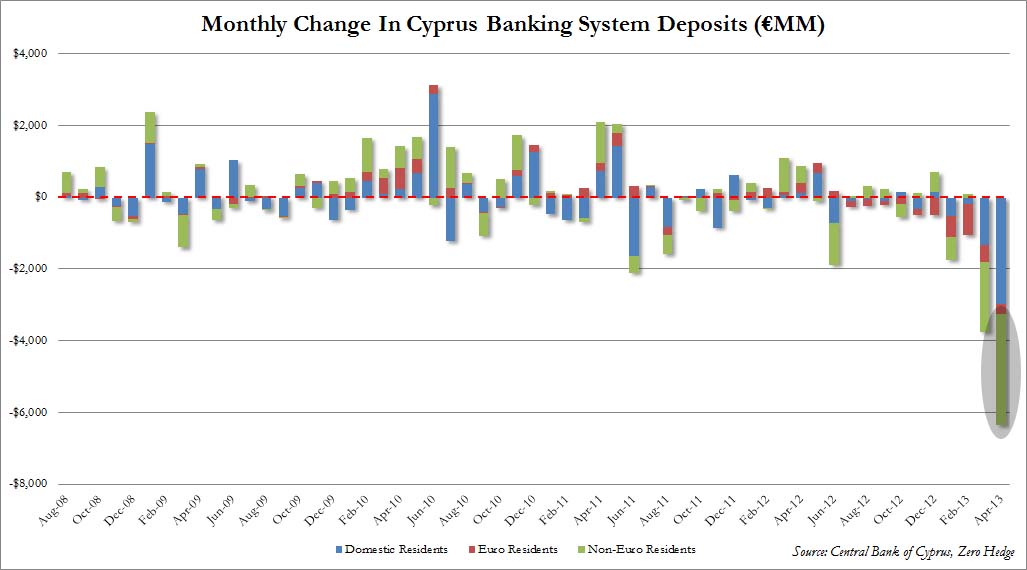
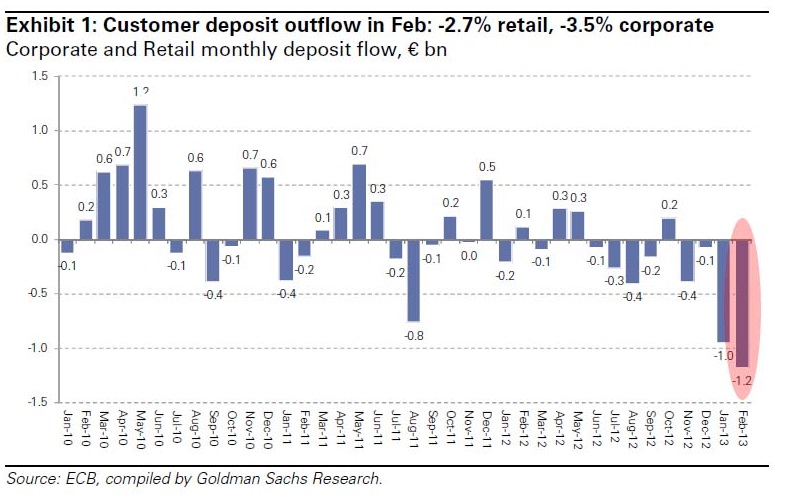
But here is the problem with bail-ins, the latest and great “fix” for the financial system: so far, they don’t work.  Let’s look at the infamous Cyprus case: they stole a lot of deposits and in return, gave people stock in the bank. But few want to keep their money in that bank anymore. Even with strong limits on daily withdrawals from the Cyprus banks, people are persistently removing their money from those banks:

     Cyprus Bank Deposits Plunge By Most Ever During “Capital Controls” Month

Here’s what the trend of withdrawals from the Cyprus banks look like:

Cyprus Bank Deposits Seq Change

That’s more than $6 billion being withdrawn in April, after the March bail-in. So that bank stock that people received in return for their “expropriated” deposits? Must be worth a fortune. If people still received stock certificates as a matter of course, at least these could be framed as memorabilia, yet another testament to the financial follies of humanity. But it’s all just electronic entries these days. Switch a few bits and bytes and then who owns what?

And the whole Cyprus action is breaking down anyway:

     The Cyprus Bail-In Blows Up: President Urges Complete Bailout Overhaul

Cyprus’ President Nicos Anastasiades has realized (as we warned), too late it seems for the thousands of domestic and foreign depositors who were sacrificed at the alter of monetary union, that the TROIKA’s terms are “too onerous.” Anastasiades has asked EU lenders to unwind the complex restructuring and partial merger of its two largest banks…

Not that the bail-outs actually worked either. Despite the fact that the EU leaders touted each of the first three Greek bailouts as the final fix, Greece now needs a fourth:

     Greece Has One Month To Plug A €1.2 Billion Healthcare Budget Hole

Think Cyprus is the only country that will need a repeat bailout (as the FT reported earlier)? Think again. Cause heeeeere’s Greece… again…. where as Kathimerini reports, a brand new, massive budget hole for €1.2 billion has just been “discovered.

And here’s another nice theft tactic. Well, nice if you are the bank. The Bank of Ireland just doubled the interest rate on existing floating rate mortgages where the fine print allowed them to do so:

     Bank Of Ireland Doubles Mortgage Rates, Homeowners Fear More To Come

And expect to hear a good deal more about wealth taxes in the coming months:

     German ‘Wise Men’ push for wealth seizure

Professors Lars Feld and Peter Bofinger said states in trouble must pay more for their own salvation, arguing that there is enough wealth in homes and private assets across the Mediterranean to cover bail-out costs. “The rich must give up part of their wealth over the next ten years,” said Prof Bofinger.

And last but not least, you know all that money sitting in retirements accounts? Multiple countries have nationalized such accounts in recent years. People like former Republican Administration insider Catherine Austin Fitts have been warning people that US politicians salivate when they contemplate getting their hands on that pool of $18 trillion.

OK, just three final (brief!) comments:

1. You’ve heard the old saying about someone who “wants your money in their pocket.” The problem here is most people’s money is already stored in “their pocket,” that is, it’s already being held by the institutions that want to grab it.

2. That thing about the banks going after people for more money after they have already foreclosed on them? Too bad we don’t have a Charles Dickens around to dramatize this type of behavior, maybe then people would get the depth of depravity in this system.

3. Tread carefully out there, folks, it looks like acceleration spares nothing, so I think you want to be real careful about “wait and see.” You know my view: banks are for transaction accounts, not savings.

Next time we’ll cover another big pile of electronic money, brokerage accounts.

Metals On Sale

If governments won’t go back on a gold standard, individuals can go back on the gold standard all by themselves
–Peter Schiff, in the documentary End of the Road: How Money Became Worthless

Want to see what is said to be 10,000 Chinese folks lined up outside of a gold retailer in China to buy physical gold on June 11?

Gold Line 1

Gold Line 2

More photos are here or here.

And there is “unprecedented” demand for US gold and silver bullion coins:

     U.S. bullion coin demand still at ‘unprecedented’ levels : Mint

Demand for U.S. gold and silver bullion coins is still at “unprecedented” high levels almost two months after an historic sell-off in gold released years of pent-up demand from retail investors, the head of the U.S. Mint said on Wednesday.

His comments are likely to allay concerns among some traders that frenzied buying by mom-and-pop investors since mid-April after prices plunged to two-year lows had started to fade…

“Demand right now is unprecedented. We are buying all the coin (blanks) they can make,” Richard Peterson, acting director of the U.S. Mint, said in an interview referring to the Mint’s suppliers.

India imports gold to meet internal demand, and there is so much demand for physical that it is driving up the trade deficit, spurring the government to make laws trying to stop the people in India from buying so much gold:

     India Trade Deficit Deteriorates As Gold Imports Soar 138%

And there is a buying mania for physical in the Middle East, where the gold market is centered in Dubai:

     Gold Demand in Dubai Now Running at 10x Normal Levels

European banks are still having trouble delivering gold stored in those banks by their by clients, and for those who want gold from refineries, they have to wait five to six weeks for delivery:

Clients Denied Gold At Major Banks As Shortage Intensifies

Suppliers & Bank Clients Denied Gold As Shortage Intensifies

Some in the mainstream media have claimed the buying is over, but the data shows otherwise:

     Point Out The “Slump” In Chinese Gold Imports On This Chart

[In China] YTD imports of 500 tons are more than double the 240 tons imported over the same period last year…

And the ultra-rich are said to be buying:

      Deutsche Bank Opens Singapore Gold Vault That Can Hold 200 Tons

Deutsche Bank AG said it started gold storage facilities that can keep as much as 200 metric tons at the Singapore FreePort.

“We are seeing considerable interest on the part of our ultra high net-worth clients in this asset class,” Mark Smallwood, head of wealth planning at the bank’s asset & wealth management unit in the Asia-Pacific region, said today in an e-mailed release.

Now if you think it’s odd that there is a buying frenzy and the price stays low, congratulations, you have not been compromised despite years of hearing lies from the mainstream media.  Just this week, whistleblowers have emerged to reveal that yet another of the world’s major financial markets is manipulated, this time the currency markets, you know, the trading of dollars for yen for pounds for euros and so forth. Those trades add up to $4 trillion to $5 trillion per day. Certainly worth manipulating if one is a criminal and has the means. Well, manipulation is precisely what is going on:

     WM/Reuters Busted In Latest Market Rigging And Collusion Scandal: Foreign Exchange

According to Bloomberg, “employees have been front-running client orders and rigging WM/Reuters rates by pushing through trades before and during the 60-second windows when the benchmarks are set, said the current and former traders, who requested anonymity because the practice is controversial. Dealers colluded with counterparts to boost chances of moving the rates, said two of the people, who worked in the industry for a total of more than 20 years.”

As I’ve said before, all of the large markets are rigged. Now that the truth is emerging on this and so many other fronts, how long will they be able to keep the rigging going?

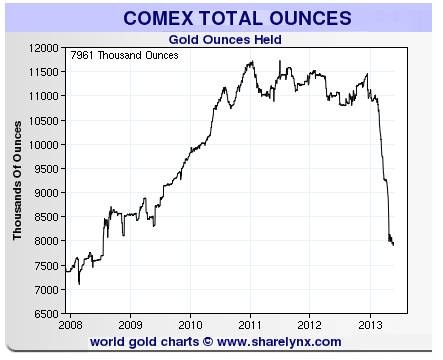
The gold price in particular is still being set not by demand for real gold, but in the paper gold market, the futures market. But there’s a growing problem with that. Just like at the European banks, the physical gold that provides very partial backing for the futures trades is being withdrawn from the vaults. People want physical, not paper! When that chart shown just below goes to zero, and it will, there won’t be any more gold futures trades in the US and the gold price will be free to trade by actual supply and demand for physical gold for the first time in over a hundred years: 

     Comex Gold Inventories Collapse By Largest Amount Ever On Record

COMEX_Deliveries

So, when will the price recover to its former highs and beyond? One of the few advisers who recommended selling gold at right at $1,900 (not the ones who don’t have a clue about gold who repeatedly said to sell when the price was $700 and $800 and $900 all the way up to $1,900, like Nouriel Roubini), now says the downward price move is over, or just about over, and they are buying back in for the long term. From Jim Sinclair’s site:

Jim Sinclair’s Commentary

Charles Nenner, one of the few that called the $1900 high for a SERIOUS reaction without any agenda except to excel in market timing.

Gold/Silver comments:

Sector

We are getting closer to our projected cycle lows for Gold and Silver

So far, Silver reached our downside price target, while Gold missed it twice by 40 Dollars.

As long as Gold does not close above 1530, we think that we can see one more test of the lows – but time is running out.

If we see one more sell off, the risk is limited, and we can just sit it out, while being positioned for the upside.

CharlesNenner.com

I’ve got twenty articles ready to go as sources for my upcoming post on why you might not want to use the banking system for anything but transaction processing. And that will be followed by a similar post about brokerage accounts. As Peter Schiff said a the top of this post, people don’t have to wait for governments to be on the gold standard, they can do it for themselves.

Waterfall of Emerging Truth

Really, what’s happening is, it’s a change in the rules of the game, which means that your cash is increasingly at risk of ending up in the government’s hands.
–Philippa Malmgren, former Special Assistant to the President of the United States for Economic Policy

So, acceleration of US government scandals, acceleration of truth emerging from the shadows into the mainstream, acceleration of clear signs of governments desperate to hold onto power. Wow, if you’ve been reading the news, you know that things are starting to move very quickly:

NSA collecting phone records of millions of Verizon customers daily

NSA PRISM program taps in to user data of Apple, Google and others

–The US has extensive offensive cyber warfare capabilities. According to a US intelligence source, “We hack everyone everywhere.”:

     Obama orders US to draw up overseas target list for cyber-attacks

–Youtube gets a video of a former Canadian Defense Minister saying that UFOs and extra-terrestrials are real, that some of them work in and with the US government, and that there is a worldwide cabal that runs the planet for their own purposes:

Who are these vested interests, and what are they up to? …I have broadened and deepened my definition to cabal, and the cabal comprises members of the Three Sisters—the CFR, Bilderbergers, and the Trilateral Commission—the international banking cartel, the oil cartel, members of various intelligence organizations, and select members of the military…who together have become a shadow government of not only the United States, but of much of the Western world. The aim of the game is a world government comprising members of the cabal who are elected by no one and accountable to no one. And according to Mr. Rockefeller, the plan is well advanced. Does this help you to understand why our civil rights are being taken away from us?

–And weather wildness continues to accelerate, Oklahoma seems to get more than its share:

The National Weather Service reported Tuesday that the killer tornado that struck near Oklahoma City last Friday was a ferocious EF5 twister, which had winds that neared 295 mph… The weather service also said the twister’s 2.6-mile width is the widest ever recorded. According to the National Severe Storm Laboratory, the tornado blew up from one mile to 2.6 miles wide in a 30-second span… There have only been eight F5/EF-5 tornadoes in Oklahoma since 1950, the Weather Underground reports, and two of them have hit in the past two weeks. The other hit Moore on May 20, killing 24 people.

We’ll have more comments on all of that government stuff soon, but today, as part of observing this waterfall of emerging truth, let’s review material from an interview with a true insider. As stated in the post Accelerating Truth, more insiders seem willing, finally, to speak publicly about what is going on.

The insider for this post is Philippa Malmgren. She has served in the White House as the liason between the White House and the Federal Reserve, as the person responsible for all financial market issues for the President, and perhaps most importantly for our discussion today, she was part of what is officially called the President’s Working Group on Financial Markets, but which is known on the Street as the Plunge Protection Team. The PPT was created in early 1988 in reaction to the stock market crash of 1987. This crew goes to work when markets aren’t doing what the White House wants them to be doing and they interfere in whatever way they deem necessary. While the details are not disclosed, these people are said to have access to a very large pile of cash to push markets where they want them to go.

Philippa gave an amazing interview this weekend to King World News.  Here are some quotes:

…the magnitude of the debt that is held by the United States, and indeed by all of the industrialized economies that have a debt problem, is so great it cannot be paid down. The human suffering involved would be so far beyond our capacity to withstand, so it has to be defaulted on.

* * *

Look, we are in a world where every major industrialized government doesn’t have the funds to deliver on the promises they’ve made to the public. So they are going to reach for the public’s cash in different ways…. Some of it is through higher taxes. Some of it is what I would call ‘expropriation,’ although taxation and even inflation are a version of that. But for example, Portugal, about a year ago, announced that they were nationalizing three of Portugal Telecom’s pension funds and placing the assets on the government’s balance sheet so that the government’s balance sheet would look better for the purposes of negotiating with the EU.

Now, were those pensioners expropriated? Yes. It made page 14 of the Wall Street Journal and the Financial Times, as if it was a non-event. But I think what we saw in Cyprus, a really overt expropriation, we are going to see that come in lots of different forms (going forward). Some of it will be obvious like Cyprus. Some of it will be subtle like Portugal, but what’s sure is that it’s happening.

So, yes, we have a really important political, philosophical battle now as states (and governments) try to find a way to take your cash in order to fund themselves, and not necessarily to the citizens best interest.

Really what’s happening is it’s a change in the rules of the game, which means that your cash is increasingly at risk of ending up in the government’s hands. So this is what we need to be alert to around the world.

* * *

You just have to whisper at it (the price of gold), and you can move it big time. Are governments good at that? Yes, they are good at that.

* * *

It is true that governments hate it when gold starts going through the roof, especially when they are in the midst of the largest devaluation, currency debasement strategy ever known…. We have never seen so many large industrialized economies all adopt this strategy simultaneously.

* * *

…this is one reason that many of the institutions that I’m advising are very wary about gold is because they do feel it’s subject to manipulation. That (as a result) the volatility is too heart-stopping to withstand.

And they are looking at other options. One option is definitely the world of diamonds. I see lots of private wealth moving in that direction. That’s one reason we see diamonds hitting absolutely record high prices. It’s because you can move an immense amount of value across a border with this thing in your pocket that a metal detector cannot find.

By the way, I was in charge of anti-money laundering policy for the U.S. government, so I’m not condoning this. I’m just saying it’s a fact. In a world where inflation pressures are definitely ripping through emerging markets, people want to move ‘value.’ And in a world where currencies are being debased, they want to hang on to value.

I’ve said a number of those things on this site, some in almost precisely the same words. The web sites listed on the Blogroll for this site published most of these things earlier than I did. These things are not complex. They are easy and clear. But I thought that perhaps these things would mean more to readers if they heard it from a true big-time insider. Let’s summarize:

1. Governments made lots of financial promises they cannot keep.

2. Governments have borrowed way more money than they can ever pay back.

3. They will try to disguise Points 1 and 2 by printing a lot of money because they see this as the most palatable way to default on their obligations, that is, they will pay their debts in money that is worth less and less and less…

4. Governments are going to do whatever they can to confiscate money from people to remain in power, in both subtle and overt ways.

5. Governments who are debasing their currency hate it when the gold price rises as a direct reflection of people trying to defend themselves from the money printing and the confiscations. So they will try to keep you in their confiscation system by scaring you away from gold. By having the price of gold and silver move wildly when priced in dollars, what governments are trying to do is to convince you that an unbacked currency that can be created digitally in infinite quantities is stable…and that gold and silver, honored as money for thousands of years, is not.

Philippa mentioned diamonds for wealth preservation and that has not been mentioned at all on Thundering Heard. The reasoning is threefold: I am not an expert on diamonds; I have heard of other non-experts who attempt to preserve wealth via diamonds and get fleeced by those who are experts; and the diamond market is a cartel run by DeBeers and the Russians where price is falsely supported by these suppliers withholding huge supplies of diamonds from the open market, so in my view, if their cartel ever gets broken, the price crash in diamonds will be epic.

However, Philippa is right: at least for now, for hiding portable wealth, diamonds are very tough to beat. And her clients are large institutions, sovereign wealth funds, etc. These people can afford to hire experts to make sure they don’t get fleeced when they buy diamonds. So if you have such expertise yourself, or access to it through friends, diamonds might be a very good way to go. But if you do not have access to such expertise, in my view, gold is far better because if you buy minted bullion coins from a reputable dealer, you don’t need to be an expert. Though I guess it is best to mention that the following quote was the advice for getting through the financial collapse from a book mentioned in What is the Transition? Conclusion, that is, the Sanctus Germanus Prophecies Volume 1, published in 2003:

Buy minted gold and silver coins, other precious metals or color gemstones. This is your 100 percent guarantee against the financial collapse. Store them in a safe place other than a bank, as bank failures will multiply. Few, if any, will survive. The US and other country currencies will collapse just as the Confederate currency did after the Civil War in the US.

The overall message here is: if you have savings in bank or brokerage accounts, governments are trying to figure out how to grab that money. They are making this very clear, as I will show shortly in separate posts on the threats to bank accounts and brokerage accounts that have recently been clearly announced by governments.

A Forecast for the Next Eleven Years

Today we’ll review one of the single best pieces of economic / political / social analysis I’ve been lucky enough to see. Read this post and you’ll have an extremely important input for how the world will proceed over the next eleven years. How can I make such a statement? Because this analysis landed on my screen in December, 2007, and it covered the time period from 1995 through 2024, and it has been working extremely well. I promised more about cycles. This is from the world of cycles.

Understand this analysis and you will understand what Ben Bernanke of the US Federal Reserve has publicly admitted has been befuddling him and his colleagues.

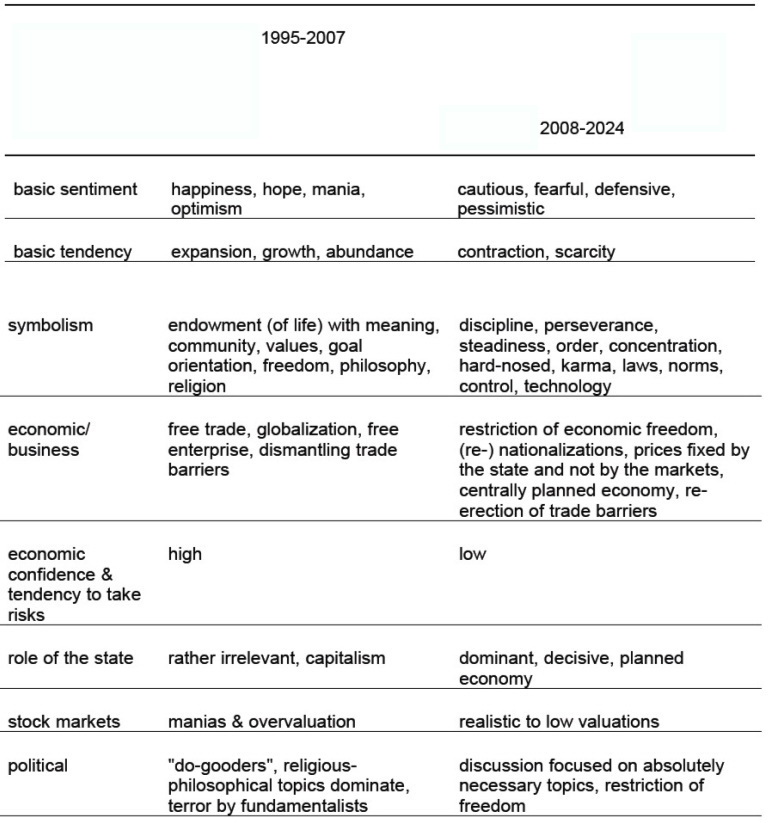
At the time of publication at the end of 2007, this analysis said that we had reached a major turning point: That while the period from 1995 through 2007 had been characterized by optimism (think of all the “new era” talk), manias (think bubbles in stocks and real estate), high confidence, free enterprise, free trade, globalization, unfettered capitalism, and so forth–all of which had clearly been at the forefront during that period–that the period from 2008 through 2024 would be characterized by caution, fear, contraction, pessimism, restrictions on freedom, economies planned by the state, trade barriers, low confidence, and so forth. Here is part of what was presented:

Manfred_Pluto_Switch_ed

To put it mildly, an awful lot of people would have benefited if they had known about this huge switch that did occur, just as predicted, in January 2008. It really was as if, at the end of 2007, someone threw a big switch and changed things dramatically. Central bankers and politicians around the world are still scratching their collective balding heads about why all of the things they used to do in the past, things that would work to stimulate economies, are barely working today. At first they used their old tried-and-true methods–lowering interest rates, feigning confidence, stuffing cash into the banks, spending money on stimulus plans–and they got an anemic recovery at best. So they pulled out the really big guns. “Unconventional” methods, as they call them. Also known collectively as printing money. Lots of it. Enough since 2009 that they have basically tried to add the equivalent of one year of the US economy to the global economy.

What has it got them? Well, since the printed money went into buying assets rather than creating jobs, the rich and their vendors–Sotheby’s, Porsche, Armani, et al–have done very well. Everyone else, not so well. The huge divide between rich and poor is widening at an accelerating pace. Historically, that has always been a dangerous setup. You can only push people so far before they push back. Sometimes fiercely. Overall, what it got them was continuing recession and debt crises in Europe, a US economy with paltry growth at best, and China joined the club of getting themselves over-indebted to keep their economy growing, but now that excess of debt is coming back to bite them and their economy is rapidly losing steam. Japan remains in near-continuous recession no matter what they do.

Since the analysis above has been working remarkably well for 18 years, it makes a whole lot of sense to figure that it will keep working for the next eleven years. That was the claim for this cycle, that it would have two phases, one from 1995 through 2007, and the second, radically different in tone, from 2008 through 2024.

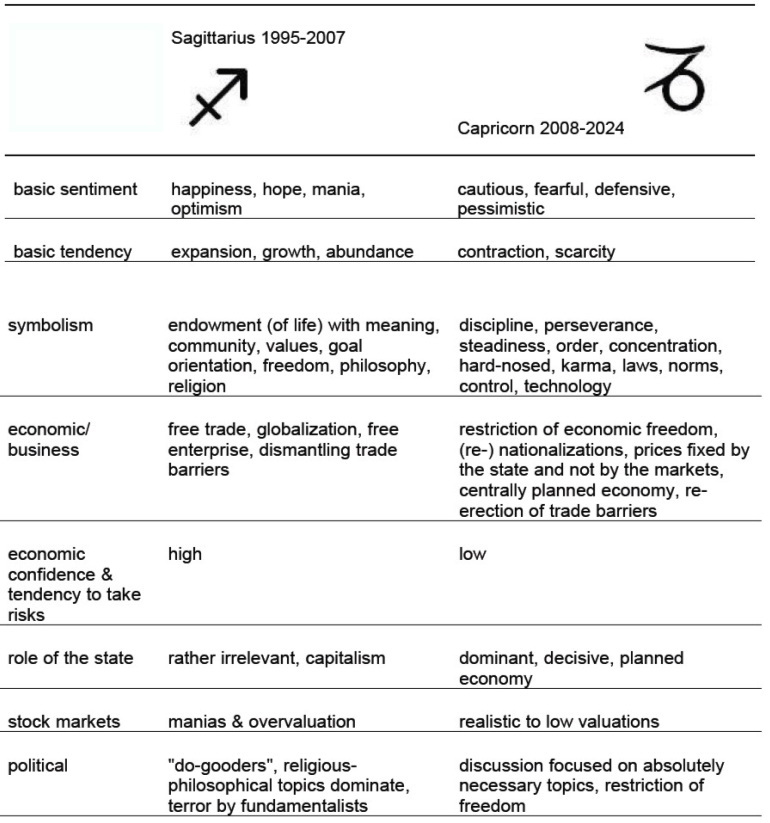
What could be the cause, the source, of such an influential cycle, one that seems to have changed the energetic tone for the majority of people, from excessive optimism from 1995–2007, to caution from 2008–2024? Let’s show more about what the top of that table looked like when presented in December 2007, right at the point of the big switch:

Manfred_Pluto_Switch_ed2

The table was astrological in nature.  It showed what was about to happen as Pluto moved  from Sagittarius into Capricorn.

This outstanding piece of analysis was put forth by Manfred Zimmel through his web site  in his Forecast Issue for the year 2008. At the web site, you can sign up for his free newsletter or paid subscription service. The information above was given to his paid subscribers only.

Now I know that some readers here have a low opinion of astrology. I would say two things about that: First, I agree that popular astrology as shown in daily newspapers and glossy magazines is worse than useless. Second, as with most complex fields of endeavor, there is a small group of practitioners doing excellent work and a much larger group of practitioners who do not. But excluding astrology from one’s view of the world precludes access to information like the above, which can be exceptionally useful in guiding real world decisions. Also, it can provide an outstanding “truth filter” for claims about the world. For example, the article at this link contains five predictions Bernanke made in 2008 that, armed with the information above, one could see at the time that these were more than likely to be wrong. They turned out to be, in fact, entirely wrong:

1/10/08 — The Federal Reserve is not currently forecasting a recession. WRONG

2/27/08 — I expect there will be some failures [among smaller regional banks]… Among the largest banks, the capital ratios remain good and I don’t anticipate any serious problems of that sort among the large, internationally active banks that make up a very substantial part of our banking system. WRONG

4/2/08 — In separate comments, Mr. Bernanke went further than he had in the past, suggesting that the Fed would remain aggressive and vigilant to prevent a repetition of a collapse like that of Bear Stearns, though he said he saw no such problems on the horizon. WRONG

6/10/08 — The risk that the economy has entered a substantial downturn appears to have diminished over the past month or so. WRONG

7/16/08 — [Fannie Mae and Freddie Mac are] adequately capitalized. They are in no danger of failing… [However,] the weakness in market confidence is having real effects as their stock prices fall, and it’s difficult for them to raise capital. WRONG, they needed bailouts to the tune of $160 billion.

The point here is that automatically excluding information because of its source can put a person at a distinct disadvantage in understanding how the world works and where it is heading. Anyone who has read more than a couple of my posts knows that I regularly give the US Federal Reserve a well-deserved lambasting for its lies, its attempts to get over-indebted people to borrow and spend more, and its only real goal: protecting the stranglehold that the large banks have on our society. But I used one of their reports in 2005 to decide when to sell out of real estate. They published a great research paper in 2005 that analyzed the history of maybe 30 real estate booms and busts from many countries. They said that real estate bubbles popped in the following manner: once sales volume peaked, price peaked, on average, six months later. US sales volume peaked in October 2005, and the US price peak was in June 2006, so their estimate was quite good. I took their research seriously and sold in Feb 2006. They, however, did not take their own research very seriously, at least in their public statements. Here are some quotes from Bernanke in 2007 (I won’t bother putting the WRONG label after each.):

7/1/2005CNBC interview:

INTERVIEWER: Tell me, what is the worst-case scenario? We have so many economists coming on our air saying ‘Oh, this is a bubble, and it’s going to burst, and this is going to be a real issue for the economy.’ Some say it could even cause a recession at some point. What is the worst-case scenario if in fact we were to see prices come down substantially across the country?

BERNANKE: Well, I guess I don’t buy your premise. It’s a pretty unlikely possibility. We’ve never had a decline in house prices on a nationwide basis. So, what I think is more likely is that house prices will slow, maybe stabilize, might slow consumption spending a bit. I don’t think it’s gonna drive the economy too far from its full employment path, though.

10/20/05: BERNANKE: House prices have risen by nearly 25 percent over the past two years. Although speculative activity has increased in some areas, at a national level these price increases largely reflect strong economic fundamentals. (Ha!)

So, acting on the Fed’s research can be very helpful. Acting on their opinions and forecasts is a mistake. They aren’t trying to help you, they are trying to help the banks. Anyone who understands that distinction can put Fed forecasts in the proper perspective.

So the next time you hear rosy predictions about the great recovery that is turning out to be perennially “just around the corner,” whether those predictions are from someone who is mistaken or someone with malevolent intent, now you can understand that what these forecasters are up against is this: for an economy based on debt to grow, they need to get people to borrow more money. And until 2024, people are under the influence of Pluto in Capricorn, and most of them don’t really want to take on more debt. Quite the contrary, a lot of them have replaced the notion of “how much debt can I qualify for” with a wish to have less debt. Many have now seen the slavery of debt and they didn’t like what they saw.

Perhaps after 2024 the economists will be able to stimulate the majority’s “animal spirits” again. The question is: can this financial system, which depends on the constant growth of debt, survive through 2024 with people not wanting more and more debt?  I decided quite some time ago that the answer is no and persistently take those pleasant actions that ready a person for financial system collapse.  I take the influence of this Pluto “big switch” as a small but important part of the energetic change bringing us the long-awaited Transition.

Thanks to Manfred Zimmel for permission to reprint this excellent piece of research.

Accelerating Truth

Most people have been trained to internalize only those ideas that come from honchos, that is, political and religious big shots, “experts,” very rich people, celebrities, etc. The powermongers capitalize on this when faced with criticism of the system by often resorting to what the logicians call ad hominem attacks, that is, they deflect attention from the criticism by attacking the person delivering it, attempting to undermine that person’s credibility. They characterize the malcontents as crazy, unpatriotic, uninformed, uneducated, or as crackpots, charlatans, imbeciles, demons, and so forth, while never addressing the issue at hand.

So for a more general public understanding of the nature of our system, it helps when people considered to be honchos start publicly discussing what is in fact going on. Other honchos are less likely to try to pull the ad hominem attack on one of their own. In other words, truth about the nature of our system needs to emerge from the blogosphere and into the mainstream. This process is accelerating.

Below is a link to an amazing video showing Columbia Professor Jeffrey Sachs speaking to a conference organized by the US Federal Reserve:

     Columbia Economist Dr. Jeffrey Sachs speaks candidly on monetary reform

He begins by reporting that he was just at a meeting with foreign ambassadors at the UN who were asking:

“Why are we taking advice from the people who have managed the financial system so badly?”

He goes on to say that while people expect economists to talk about statistics and monetary issues, that the real problem with the system is as follows:

We have a mountain of criminal and fraudulent behavior…The amount of utter criminality and financial fraud is absolutely enormous…This is what’s called the American financial system at the moment.  It’s an unregulated essentially lawless environment…

This is a profound failure of government…

I regard the moral environment as pathological…

We have a corrupt politics to the core. Both parties are up to their necks in this. It really doesn’t have anything to do with right wing or left wing. The corruption, as far as I can see, is everywhere.

Sachs follows that by saying that he meets with the top Wall St CEOs on a regular basis and the common feature he observes is that these people believe they can do anything they want, legal or not, with impunity. And that given their takeover of the politicians and regulators, they are correct!

Now this isn’t coming from MIT’s Prof. Noam Chomsky–who, let’s face it, was decades ahead of all of us in pointing out the criminality of the corporate/political system–it’s coming from a highly respected Columbia professor.

For a few years now, the money printing central banks such as the US Federal Reserve (the central banks have directly printed at least $16 trillion and counting) have been told by bloggers that this money is not supporting jobs and the economy, but rather that it is going to the rich who are bidding for financial assets and causing bubbles in multiple asset markets including stocks, bonds, and real estate. People like Ben Bernanke, his henchman, and academic and Wall St economists have denied this.

But now we find out, from a Freedom of Information Request by Bloomberg and from a leaked Fed document, that the banking insiders who advise the Fed are finally saying the same thing that the continuously-discredited bloggers have been saying all along: that the money printing is creating bubbles in farmland prices and student loans, and:

There is also concern about “an unsustainable bubble in equity and fixed-income markets given current prices.

And for years, bloggers have said that the central banks cannot possibly stop printing more and more money or the whole edifice will crumble, another charge that is roundly derided. The Fed has claimed repeatedly that it has the tools to undo all the money printing so that it will never cause a problem. But now their own banker advisory panel says that if the Fed stops printing, it “may be painful for consumers and businesses…” and thatthe Fed may now be perceived as integral to the housing finance system.” In other words, if the Fed stops printing, the “housing finance system” will collapse. Which it would. In a heartbeat.

People like Matt Taibbi of Rolling Stone have been stalwart in documenting the ongoing manipulations in the interest rate, municipal bond, derivatives, and oil markets. And others have offered very strong evidence of manipulation of the stock market and precious metals markets. Taibbi recently wrote that “everything is rigged.” The US Bond market, the largest in the world, is certainly rigged: the Federal Reserve itself buys 75% of the bonds issued by the US Treasury. And the Fed announces, at the start of each month, which days it will be buying bonds through the Wall St firms in the coming month. The stock market always rises on those days. Always. Why? Because the Wall St firms take that money, leverage it up by further borrowing, and buy stocks. The Fed wants exactly that: they believe that a rising stock market makes people feel a “wealth effect” and therefore they will go out and spend more money in the real economy.
So finally, along comes one the largest banks in the world, Deutsche Bank, saying:

We would stress that we fully understand why the authorities wouldn’t want free markets to operate today as the risk of a huge global default and unemployment cycle would still be very high.

And a recent member of the Federal Reserve Board, Kevin Warsh, said that their money printing is not working and they are losing credibility:

…over the last several years, [the Fed] has over-promised and under-delivered, and the bank’s most important asset – credibility – is under attack.

One would think that, if their strategy isn’t working, that they have other tools they can bring to bear. That’s what they tell us. But Warsh says, “There is no Plan B.”

Bloggers have been warning that European banks are insolvent and getting worse all the time. Now the European Central Bank itself admits that the “euro zone’s slumping economy and a surge in problem loans were raising the risk of a renewed banking crisis.”

Here is an interview with the President of the Chicago Mercantile Exchange, that place where they trade paper and electronic instruments that have an increasingly tenuous connection with physical things like gold, silver, copper, oil, etc. From the interview:

What’s interesting about gold, when we had that big break two weeks ago we saw all the gold stocks trade down significantly, we saw all the gold products (ed: futures) trade down significantly, but one thing that did not trade down, was gold coins, tangible real gold.  That’s going to show you, people don’t want certificates, they don’t want anything else.  They want the real product.

Then there is the supposed eternal juggernaut of the Chinese economy that will keep all the other floundering countries afloat. Much of that juggernaut has been propelled by debts taken on by local governments to promote the economy in their areas. But now the Financial Times reports this:

A senior Chinese auditor has warned that local government debt is “out of control” and could spark a bigger financial crisis than the US housing market crash.

Zhang Ke said his accounting firm, ShineWing, had all but stopped signing off on bond sales by local governments as a result of his concerns.

Last but not least, an insider is finally speaking up about nuclear power plants in the NY Times:

All 104 nuclear power reactors now in operation in the United States have a safety problem that cannot be fixed and they should be replaced with newer technology, the former chairman of the Nuclear Regulatory Commission said on Monday…

The position of the former chairman, Gregory B. Jaczko, is not unusual in that various anti-nuclear groups take the same stance. But it is highly unusual for a former head of the nuclear commission to so bluntly criticize an industry whose safety he was previously in charge of ensuring.

This system is coming apart at the seams. Insiders and whistlebowers are finally describing the details. The US Government realizes this and is desperately trying to keep whistleblowers from telling the truth by filing charges against them and trying to ruin their lives. Ultimately, it won’t work. I just hope that everyone reading here takes those actions they need to take. By the time the collapse is on the television Nightly News and Page 1 of the newspapers, with the system honchos all claiming “No one could have seen this coming,” it will be too late.

Update on Metals, Deposit Confiscation, and Capital Controls

…one goal is to get to the point where all market participants understand with certainty that if a large SIFI (systemically important financial institution) were to fail, the losses would fall on its shareholders and creditors
–Governor Jeremy C. Stein, US Federal Reserve Board, Regulating Large Financial Institutions, speech at a conference sponsored by the International Monetary Fund, April 17, 2013

* * *

“Bank creditors,” as it happens, is a class of people that includes bank depositors. Everything about the rhetoric of banking is designed to obscure this. You deposit money in your bank account…But what you’ve really done is loaned the money to the bank…
Slate.com

A big price drop in the precious metals. So let’s see, on Thursday, April 11:

     CEOs of biggest U.S. banks to meet with Obama on Thursday

and the big selling in metals took place on Friday, April 12 and Monday, April 15.  No chance of any causation in that correlation. Nah. Move along. As Leslie Nielsen said, “Nothing to see here.

Anyway, with all that selling, there must be lots of inventory of coins around. That’s what they teach in Econ 101, right? That if a price is plunging, it’s because people are dumping large quantities of that item onto the market.

But there isn’t lots of inventory. Inventory is very tight, sold out in many cases. Delivery lead times are out to five or six weeks, and that’s if you can even place an order for what you want.  Big-volume dealers like Tulving.com are entirely out of one-ounce silver coins minted by any country, and they have been since April 15. You can scroll down this page at their web site to see how many items they normally sell are currently sold out.

And these people make a living buying and selling lots of coins. They really want to do a lot of business. And they are happy to buy right now, but they can’t sell lots of items because there aren’t any available.

This scramble to buy physical bullion coins is going on worldwide.

In Australia:

     Golden times for Perth Mint

The volume of business that we’re putting through is way in excess of double what we did last week,” Treasurer Nigel Moffatt said, without giving precise figures. “There’s been people running through the gate.”

In Japan:

     As global price slumps, “Abenomics” risks drive Japan gold bugs

But on Tuesday, buyers outnumbered sellers by a wide margin. At Ginza Tanaka, the headquarters shop of Tanaka Holdings, gold buyers waited for as long as three hours for a chance to complete a transaction.

In India:

     India’s Response To The Gold Sell Off: A Massive Buying Frenzy

In China:

     Chinese Gold & Silver Exchange Society Runs Out of Gold…Importing from Switzerland and London

Now we discover that the Chinese Gold & Silver Exchange Society has essentially sold out of gold bullion, and must wait until Wednesday for shipments to arrive from Switzerland and London.

     Gold Buying Frenzy Continues: China, Japan, And Australia Scramble For Physical

In the US:

     US Mint Sells Record 63,500 Ounces Of Gold In One Day

According to today’s data from the US Mint, a record 63,500 ounces, or a whopping 2 tons, of gold were reported sold on April 17th alone, bringing the total sales for the month to a whopping 147,000 ounces or more than the previous two months combined with just half of the month gone.

     Bullion Shortages Develop As Retail Demand Skyrockets

…on Monday there was such chaos in the markets that some of the larger wholesale dealers had to shut down at various times because of the massive demand on the buy side… Gold and silver buyers are still outpacing sellers by a stunning 50 to 1.  There were premium increases on everything bullion related.  The wholesalers are now telling us four to six weeks on silver maple leafs, and wholesalers quit taking orders on one ounce silver rounds.

In Canada and Europe:

     Massive Run On Physical Gold & Silver At UBS & Scotiabank

At the Bank of Nova Scotia in Toronto the gold window has been absolutely swamped. I have confirmed there were people lined up in droves recently for multiple-hours at a time to buy gold and silver bars and coins….

“I then confirmed with UBS today in Zurich, Switzerland, that they are experiencing exactly the same thing. They told me people are waiting in long lines for bullion related bars and coins. The physical market is incredibly tight…

In Switzerland:

     Refiners Can’t Keep Up With Massive Global Gold Demand

If you look at our company, as just one example, we did not have one single seller in the last few weeks.

So during this takedown in gold and silver there wasn’t one single seller, only buyers….

If we turn to the Swiss refiners, Eric, the premium over spot for physical gold is rocketing. Swiss refiners are unable to keep up with the demand for immediate delivery. They are working flat out, including the weekend, and still can’t keep up.

The Swiss refiners are seeing global demand coming in from everywhere, especially from the Middle-East and the Far-East. So, again, this proves that the artificial manipulation of paper gold has nothing to do with the physical market.
–Egon von Greyerz, Matterhorn Asset Management

So, with all that buying interest in real physical gold and silver, why has the price been falling? Because the two largest trading venues on the planet for metals, the LBMA (London Bullion Market Assoc.) and the COMEX in the US, are the places where the price of gold is currently set. And 99% or more of the trades there that are said to be related to gold are not for the physical metal, they are futures contracts that are traded for cash, not physical gold. In other words, these are very large trading casinos. But like the banks, they are fractional reserve systems. In other words, if everyone who had a futures contract for gold actually wanted physical gold for their contract, there would not be anywhere near enough gold to go around. Even supporters of the LBMA admit there is maybe 1% physical gold backing all these contracts. So that’s even more leverage than is used at most banks. A lot more.

Monday, April 15 was a good example. Andrew Maguire–an LBMA trader and whistleblower who the Powers That Be ran down, but did not kill, with a car in 2011 right after Andrew gave testimony on silver price manipulation to the authorities—reported that on Monday, there was a period during which 155 tons of gold was sold on the LBMA in one hour. I can tell you for sure that no one who owned or was the custodian for 155 tons of physical gold would sell it in a panic into a falling market. This was selling of futures contracts that will be settled in cash. They have little or nothing to do with physical gold. People in charge of 155 tons of real gold do not sell in a panic. If they wanted to sell—and such a thing would be quite unusual these days when even central banks are net buyers of physical gold—they would do so carefully, trying to get the best price. They would sell on days when the price was rising, not falling. This is the way anyone with a strong profit motive sells, they hire good traders to sell over time when they can get the best price. They do not panic dump their holdings regardless of price.

In fact, Maguire reports that central banks picked up 55 tons of physical gold during that one hour period when 155 tons worth of paper gold contracts were sold.

Here are Maguire’s comments about Monday, April 15.

At some point, this charade will fall apart. The price of physical gold will separate from the price quoted in these paper instruments. This is already visible when one needs to buy coins at a premium above the spot price of the metal. During these smashdown selloffs (we’ve seen these before in 2006 and 2008), the premium above the quoted spot price for physical gold and silver rises, sometimes to as much as 50% above the spot price if you want prompt delivery. During those periods, the price for physical coins is not the quoted spot price, it is the spot price plus the premium, and that price can be substantially higher. These are the indications of the separation of the paper and physical gold and silver prices to come.

The press duly reported nearly the same quote from representatives of all of the banks. Yes, reps from those same banks that met with Obama on April 11. “Gold has lost its safe haven status. “ “Gold is no safe haven.” And on and on. They should have dressed them up in silly costumes and they could have danced and sang together, at least that would have been entertaining.

So why do they want to scare you out of, or away from, gold and silver? Two main reasons:

First, so that you cough up your goods so they can buy them on the cheap.

Second, when they go to “Cyprus” your accounts, that is, when they want to confiscate some of your money, they want it easily available with a few keystrokes. Confiscating gold and silver coins would be inconvenient at best, dangerous at worst.

Do you think “they’ll never do that here”? Here is the overall order of events in Cyprus:

1. On Feb 10, the Financial Times published the plan for the confiscation of depositor money in Cyprus called Radical rescue proposed for Cyprus.

2. On Feb 11, the Central Bank of Cyprus posted a letter shown at this link saying that the Financial Times article was incorrect, that confiscating depositor money was against the constitution, etc.

3. In mid-March, the confiscation of depositor money was announced.

4. The Cyprus parliament voted against it.

5. The central bank of the EU overruled the Parliament of Cyprus and went ahead with the confiscation. So democracy and the constitution were thrown out the window along with the promises.

On the day after the confiscation, the new head of the EU finance ministers, Jeroen Dijsellbloem, gave not one, but two interviews in the mainstream press in which he said the Cyprus bank resolution was a new template for such actions. From Reuters:

A rescue programme agreed for Cyprus on Monday represents a new template for resolving euro zone banking problems and other countries may have to restructure their banking sectors, the head of the region’s finance ministers said.

The rest of the EU and IMF politicians nearly had a baby on the public stage. For the next three weeks, all they would say was that Cyprus was not a template. We should have put them in a chorus line too. Even Dijsellbloem tweeted that he didn’t say what he said.

But then a member of the US Federal Reserve Board, Governor Jeremy C. Stein, said that if a Too Big to Fail bank failed, that private investors and creditors would have to bear the losses. His speech was on April 17, well after the Cyprus event wherein depositors were ruled as “creditors” of the bank. These people choose their words carefully. I hope everyone out there listens to them carefully.

And it’s worth remembering this: In the US, for example, the bank insurance fund held by the FDIC has $25 billion. That’s the amount insuring $9 trillion worth of deposits.  So that’s 370 times more deposits than the amount in the insurance fund. And the insured banks have an additional $297 trillion in exposure to derivatives. So that’s almost 12,000 times more than the amount in the insurance fund. Very safe and sound, eh? Now you know why the authorities have just hinted that banks won’t be simply bailed out anymore; people’s deposits will be bailed in. Just remember, they’ve put you on notice now that you need to determine whether or not your bank is safe. People who spend their whole lives trying to do that can’t figure out which banks are truly safe anymore, but so what, you are now supposed to be able to do that. You can see a chart of the FDIC situation here. And you can find out a little about the safety of any US bank at the Safe and Sound section here. I am not aware of what is available publicly available for bank analysis in other countries.

Also part of the Cyprus event were strong restrictions on how much money a person could take out of Cyprus, the dreaded capital controls. This is also part of the template. When that happens, people are stuck in their own currency even if it tumbles mercilessly in value. When people tried to switch their money into the electronic currency Bitcoins because it recognizes no borders, it doubled the price of Bitcoins in a few weeks. TPTB then smashed down the price of Bitcoins as well, to show people that there is “no safe haven.”

Throughout history, currency devaluations, capital controls, and asset confiscations are denied until after they have happened. Governments typically say, “Sorry, we didn’t want to do that, but we had no choice.” You need to either anticipate them or be a connected government crony. Here’s a chart of monthly deposits into and withdrawals from the Cypriot banking system. The large withdrawals in January and February show the strong likelihood that some people were given advance notice:

CyprusOutflows

Most people were not given advance notice; if the time comes, you and I will be in that group.

Lots of people are showing that they understand. As the stories above show, people were waiting in line for metals at these prices across the globe. We have seen this play before. Sometimes the elites smash down the prices of metals. Did I see it coming? Nope. Can they do it again? Yep. But as the rising price of gold over the last 12 years proves, they can’t push it down too far. If they do, the Asians and regular people will end up owning all of the gold. And the banksters won’t like that at all since they know the financial (per)version of the golden rule: he who has the gold makes the rules.

Lots of regular people on the planet take these price smashes as a gift. I think these people are smart.

Here is Jim Sinclair’s latest comment on the topic: The US Will Be Cyprused & We Will See $50,000 Gold.

And the recently-released video The Secret World of Gold, while not perfect, has Andrew Maguire briefly explaining how gold and silver prices are manipulated, and brings up the interesting question of whether there is any real gold (and not just gold-plated tungsten bars) at the US gold depository at Ft Knox. Channeled information agrees that Ft Knox is empty of real gold.  It will be a very interesting day when the world finds out about that.

CashGrab1

We interrupt this program…

For two items:

1. The Cyprus Bailout
2. Gold: Last Chance

That title phrase was used when normal television programming was to be interrupted for a special news announcement. And this post is an interruption of sorts—of the What is the Transition series—though actually it is a continuation of a general theme here: Lots of the events that we are all seeing—from earth and weather changes to financial events to the fact that more and more people are taking up meditation by the day—are hints, clues, indicators of things to come. They are not isolated one-off events. They are part of a trend, signs to be read and understood to see what’s coming next. Life has been very kind, bringing things on in evolutionary fashion for anyone who wishes to heed the signs. But things are ramping up. This strongly favors action over a wait-and-see attitude. This first story is a perfect example:

1. The Cyprus Bailout

Europe Does It Again: Cyprus Depositor Haircut “Bailout” Turns Into Saver “Panic”, Frozen Assets, Bank Runs, Broken ATMs

The fifth European national bailout pertains to Cyprus, where receipt of the bailout money is contingent on the confiscation of money directly from people’s bank accounts. The government will take 6.75% of the deposits of anyone with under 100,000 Euros. And they will take 9.9% of anything over 100,000 Euros.

The people will not send in this money, it will be taken directly from their accounts on Tuesday if the Cypriot legislature approves the bailout plan.

Funds to pay the levy were frozen in accounts immediately, ECB Executive Board Member Joerg Asmussen said. The levy will be assessed before Cypriot banks reopen on March 19 after a March 18 national holiday. Sarris said electronic transfers will also be limited until then.

When bankers and politicians want someone’s money…

If a word to the wise is sufficient, one can only hope that more will gain wisdom from this event.  One German newspaper is already suggesting today that a 15% “wealth tax” be levied in Italy to help with its debt problem.

2. Gold: Last Chance

Jim Sinclair (there is always a link to his web site JSMineSet.com on the Thundering-Heard BlogRoll) held lots of gold in the precious metals bull market of the 1980’s, riding the price from $40 to $850 per ounce. He sold his holdings on the very day of the top price in 1980 and thus entered the ranks of investment legends.

In 2003, he started a web site and went public with the prediction, which he reiterated many times in the years that followed, that gold would rise from its 2003 price in the mid-$300’s to $1,620 per ounce by January 2011. He was roundly derided for both the predicted rise of the price and for the precision of the predicted timeframe. It turned out he was off by 8 months: gold’s price did not rise to $1,620 until August of 2011, not January.

The gold price in dollars has been in a sideways correction since late 2011. Recently, Jim has been pounding the table that the current sideways movement in the gold price will be complete before the end of this month, March 2013, and begin its next phase of upward price movement to $3,500 per ounce and beyond. When Jim makes predictions about gold, it pays to listen.

If anyone has been hesitant about buying gold because of claims by those who have been wrong all along about gold that the gold bull market was over, that the “gold bubble” has popped, let’s just look at a few charts, first of gold, and then of charts where bubbles did pop. I think you’ll be able to clearly see that the people claiming a “bubble pop” for gold don’t know the first thing about how to read charts, meaning that they know very little indeed about financial markets. Here’s the longer term chart of gold, from the year 2000 through now:

GoldSince2000 Notice that sideways price drift at the top right of the chart? Chart readers call this a “correction in an ongoing bull market.” It’s a bull market taking a breather before powering higher.

Now, want to see what the chart of a real popped bubble looks like? Here’s a chart of the Nasdaq stock index from Stockcharts.com. This index represented the internet and tech stocks during that time when we were told that there was a new paradigm, that everyone remotely connected with technology was going to be rich rich rich because they had started a web site to sell, well, whatever, it didn’t matter at the time:

Nasd_Bubble

Notice the parabolic upmove as price increased 15-fold in less than 10 years and then: SPLAT! A high-speed drop of 78% in just over two years. Thirteen years and trillions of printed dollars later, the Nasdaq is still 36% below that all-time high price.

Here’s the chart of crude oil from 2003 to 2009 with price rising to $140 per barrel and then crashing back to $32 per barrel in less than a year:

CrudeCrash

Note in both of those cases, no sideways price movement for months and months, as is seen on the gold chart, just a sharp fast very-nasty price crash.

I think Jim Sinclair is correct. I published back in June 2012 (What then can we do?) that people might want to complete their conversion from paper/electronic currency into gold by August 2012. That was a good idea. But cycles research at the time showed that it was possible that we would get one more price downmove, into March of 2013 at the latest, so I did not label that Summer 2012 opportunity as the “last chance” to get gold at a decent price. Now price has come down again into that same area where it was during the Summer of 2012. This time I think that “last chance” phrase is appropriate. Jim Sinclair says, and I agree, that after this month, you won’t ever be able to buy gold anywhere near $1,600 per ounce again.