Unknown's avatar

About Thundering Heard

https://thundering-heard.com/

A brief comment on the metals

This is strictly an opinion piece, I will not try to prove my case with links, charts, and so forth. An attempt to prove the case would be seriously lengthy, a project for which I don’t currently have the time and which I doubt most would want to read.

There is a very bright golden light on the horizon for precious metal prices, but that light is on the horizon (let’s say the first half of August), not right here. In other words, I think prices will drop first before they start rising in a serious way. I see four separate price, time, and trend patterns that include an expectation that price falls first before it takes off to the upside in a big way. And these patterns are supported by the seasonal pattern for gold which shows prices typically falling in the Summer and then turning up sometime in August.

So for anyone who has savings to deploy in the metals, the setup is ideal: you should get lower prices over the next couple of months for your buying, with an expectation that your buying will be followed by the start of a major price rally, that is, the prices available over the next several weeks should be quite a bargain.

For those of you who bought your metals years back–hopefully at prices that are still well below where they are now–and who have no additional buying power, you’ll need to be patient here, but as implied above, a price drop dead ahead will be an elegant completion of major recognizable patterns (based on four entirely different types of calculations) that have an exceedingly high probability of being the end of this general price downmove that started in late 2011. These patterns all clearly indicate that the bull market in metals that started early in this century still has many years to run, and that the best upward price movement is definitely still ahead of us.

Of course this could all be wrong if some huge war breaks out, in which case prices could go up and never look back. But if things are allowed to work out with “only” the normal amount of accelerating instability that is the most important trend of our time, then these reliable price, time, and trend patterns are likely to complete as outlined above. In any case, no matter what, prices should turn up for good later in the Summer.

This post is an attempt to keep emotions out of the precious metals picture so that as many of us as possible own some when we will all truly need them down the road. (I am serious about the word need; my repeated posting about gold and silver has nothing to do with an “investment scheme” to get rich quick or with having the “right asset class in your diversified portfolio,” I am talking about what people will soon need.) As their propaganda on this topic and their dirty tricks clearly show, the Powers That Were want you to get emotional and make the mistake of avoiding or selling physical metals so that they can accumulate more metals for themselves at low prices. I’m hoping that everyone who reads Thundering Heard is well prepared to fend off, or even capitalize on, their tricks.


Get ready for “socially beneficial discrimination” on the internet

If the Obama administration’s FCC (the US Federal Communications Commission) has its way, the web sites of rich companies and large corporations will work fabulously on the web, and the sites of everyone else will work poorly or not at all. What better way to enshrine the status quo than by giving available internet bandwidth to rich corporations and denying it to everyone else. What better way to grace our minds with only the “right” opinions and news, and to censor dissent, inconvenient content, and those pesky “conspiracy theories” that keep turning out to be true.

That’s what the FCC is proposing: the end of what’s called Net Neutrality, under which all web sites have equal access to internet bandwidth. Obama repeatedly stated his support for Net Neutrality while campaigning, but I guess he has forgotten that for some reason, which is odd since here is a quote from January 2014:

In late January 2014, Obama appeared in a Google Hangout session as part of a “virtual whistle-stop tour.” In response to a Net neutrality question, he said: “It’s something that I’ve cared deeply about ever since I ran for office, in part because my own campaign was empowered by a free and open Internet and the ability for citizens all across this country to engage and create and find new ways, new tools to mobilize themselves. A lot of that couldn’t have been done if there were a lot of commercial barriers and roadblocks. So I’ve been a strong supporter of Net neutrality.

The problem is that, in typical revolving door fashion, the Obama administration has stacked the upper echelons of the FCC with people formerly paid by internet service providers and who are known attackers of Net Neutrality, such as:

Daniel Alvarez, an attorney who has long represented Comcast through the law firm Willkie Farr & Gallagher LLP. In 2010, Alvarez wrote a letter to the FCC on behalf of Comcast protesting net neutrality rules, arguing that regulators failed to appreciate “socially beneficial discrimination.”

What the end of Net Neutrality means is that companies can pay internet service providers for priority handling of internet traffic to and from their web sites, thus guaranteeing that their web sites perform better than those who are unable or unwilling to pay for such prioritization of their internet traffic. And you can be sure that it won’t be long before the government steps in directly with prioritization orders. “Socially beneficial discrimination.” They’ll probably even create a bogus court for it like the FISA court that rubber-stamp approves all government requests for spying.

In what I think is a first for Thundering Heard, I recommend that US citizens sign the petition for Net Neutrality at the White House web site. Yes, you have to create an account there to sign a petition, but if the petition garners 100,000 signatures, it forces the White House to publicly respond to the petition. Let’s force the administration to go public regarding a promise that Obama has repeated for years.

Here is a more extensive and excellent article on the topic by Mike Krieger:

     Say Goodbye to “Net Neutrality” – New FCC Proposal Will Permit Discrimination of Web Content


More on the stock market

I’m fairly sure that no one in the stock market cared much about my negative comments about stocks from three days ago:

83% of these new stock offerings over the last three months are money-losing companies…That almost equals the all-time record for such madness of 84% in the year 2000 during the internet/tech stock bubble.

But what about when David Einhorn, probably one of the five most successful hedge fund managers ever, says basically the same thing, which he did in a report issued today. Einhorn says he is selling short (that’s betting on a price decline, that is, Einhorn will make money as the prices of these stocks go down) a basket of overvalued tech stocks:

Our criteria for selecting stocks for the bubble basket is that we estimate there to be at least 90% downside for each stock…

So he thinks there is a good chance that the prices of these stocks will decline by 90% or more. Think that can’t happen? Einhorn again:

There is a huge gap between the bubble price and the point where disciplined growth investors (let alone value investors) become interested buyers. When the last internet bubble popped, Cisco (the best of the best bubble stocks) fell 89%, Amazon fell 93%, and the lower quality stocks fell even more.

For anyone interested, Einhorn’s full report is embedded in this article:

     David Einhorn: “We Are Witnessing Our Second Tech Bubble In 15 Years” – Full Letter

Here’s another perspective that should make anyone with money in stocks promptly head for the hills (that means sell!). In 2002, after tech stocks crashed, Scott McNealy, co-founder and CEO of Sun Microsystems, gave a famous interview in Business Week. Sun was one of the many tech sock darlings. They made and sold high-powered workstations favored by the scientific community, Wall St, oil and gas engineers, etc. At its peak, the market valued his company at 10 times company sales. Not profits (that’s what is left over after all expenses), but sales, the amount of money that comes in the door prior to all expenses such as salaries, rent, supplies, etc. McNealy described how absurd it was for the market to value his company at 10 times sales:

But two years ago we were selling at 10 times revenues when we were at $64. At 10 times revenues, to give you a 10-year payback, I have to pay you 100% of revenues for 10 straight years in dividends…That assumes I have zero cost of goods sold, which is very hard for a computer company. That assumes zero expenses, which is really hard with 39,000 employees. That assumes I pay no taxes, which is very hard. And that assumes you pay no taxes on your dividends, which is kind of illegal. And that assumes with zero R&D for the next 10 years, I can maintain the current revenue run rate. Now, having done that, would any of you like to buy my stock at $64? Do you realize how ridiculous those basic assumptions are?

Well, in mid-March of this year, there were forty companies valued at 10 times sales or higher. The list, compiled by Goldman Sachs, is at this link:

     America’s Most Overvalued Companies Are…

On average, these forty are valued at 15 times sales! To quote David Einhorn from his report: “After all, twice a silly price is not twice as silly; it’s still just silly.”

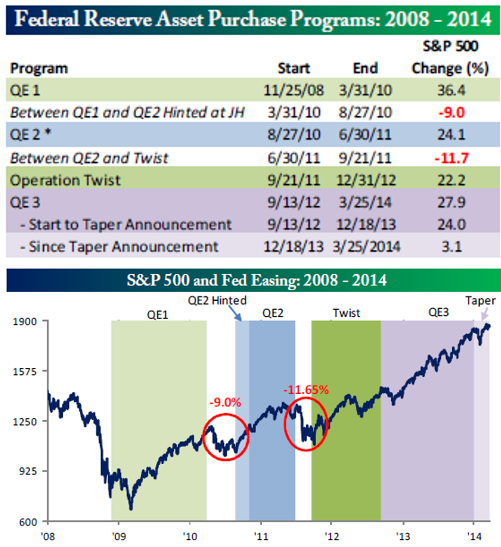
Silly is a direct result of money printing by central banks. The chart in the bottom panel below shows how, since the start of 2008, when the Federal Reserve was printing money (the color-shaded areas on the chart) stocks rose and rose and rose. Anytime they weren’t printing money, stocks fell promptly. So they keep printing. It doesn’t help regular folks, whose real incomes have been declining through this whole period, but it sure helps wealthy stock market investors:

Stocks_QEBespoke-032614

(Chart Source)

It’s very obvious that the sheep are getting set up for another shearing, just as they were in 2000 and again in 2007. When exactly will this shearing take place? I claim no expertise on that score. Can the stock market go higher still? Sure. Clearly it depends on how much money the Federal Reserve prints, how long traders believe in the effectiveness of that printing, and how big the many wars in the world get. But I can tell you for sure, when the shearing happens, “silly” will not be the word on the minds of investors.

I don’t like being shorn, so I have nothing to do with stocks these days. I don’t want my savings anywhere near a brokerage account for reasons described under Lie #6 here. So I don’t have to guess about when the next shearing will take place. If I did want to guess, I would closely follow the work of Jeremy Grantham since he has a multi-decade real-time excellent track record of predicting future returns from stocks. His firm publishes a quarterly newsletter at their web site and Grantham’s comments are followed at web sites like ZeroHedge and King World News. Here are some recent comments:

     Jeremy Grantham’s GMO: “The S&P Is Approximately 75% Overvalued; Its Fair Value Is 1100” 

      Grantham on stocks:

Grantham: We do think the market is going to go higher because the Fed hasn’t ended its game, and it won’t stop playing until we are in old-fashioned bubble territory and it bursts, which usually happens at two standard deviations from the market’s mean. That would take us to 2,350 on the S&P 500, or roughly 25% from where we are now.

Q: So are you putting your client’s money into the market?

Grantham: No. You asked me where the market is headed from here. But to invest our clients’ money on the basis of speculation being driven by the Fed’s misguided policies doesn’t seem like the best thing to do with our clients’ money.

We invest our clients’ money based on our seven-year prediction. And over the next seven years, we think the market will have negative returns. The next bust will be unlike any other, because the Fed and other centrals banks around the world have taken on all this leverage that was out there and put it on their balance sheets. We have never had this before. Assets are overpriced generally. They will be cheap again. That’s how we will pay for this. It’s going to be very painful for investors.

Grantham is a smart fellow and one of the few Wall St people who is honest about the food crisis brewing in the world and certainly one of the very few to quote Bob Marley. He wrote a detailed report on the topic, from the point of view of a numbers man, which he is:

     Welcome to Dystopia! Entering a long-term and politically dangerous food crisis

We are five years into a severe global food crisis that is very unlikely to go away. It will threaten poor countries with increased malnutrition and starvation and even collapse. Resource squabbles and waves of food-induced migration will threaten global stability and global growth. This threat is badly underestimated by almost everybody and all institutions with the possible exception of some military establishments.

As I’ve said before on other topics: be careful out there.

Rockin’ and Rollin’

Regarding earthquakes of magnitude 6.0 or greater, the post Earth changes statistical update said:

These days, the planet has one of these potentially damaging earthquakes on average every two and a half days…

Well we’ve just had 27 of those magnitude 6.0+ earthquakes in the last 30 days! So now we’re up to almost one per day.

If we take the strength down to the magnitude 5.1 level that rattled the nerves of plenty in Los Angeles on March 28, there have been 183 of those in the last 30 days, so that’s six per day on the planet.

If you live in an earthquake zone and have been thinking that this acceleration is no big deal, all I can say is: please reconsider your position! Literally! Or, if you want to maintain your position, ask the US Government, they know everything, tell the truth about everything, and they are certain to tell you that there is nothing to see here, move along.

That same US government refuses to fund an earthquake early warning system for California. The US Geological Survey says they can implement one for $16 million. The US can’t afford that, of course, because they are too busy buying tanks that the US Army says it doesn’t want:

     U.S. Army to Congress: No New Tanks, Please

but 42 per year are purchased anyway at more than $6 million each. Clearly Congress thinks it’s better to blow people up than to save lives.

And you might be thinking that the early warning system wouldn’t work anyway. Well, there is already one in the world that works quite nicely. In Mexico. They built it 21 years ago–after thousands died in the 1985 Mexico City earthquake. One set of system alarms is at the Mexican TV stations. Here’s a video of a Mexico City newscaster getting the warning (that siren in the background) 71 seconds before he feels the fuerte (strong) movement from yesterday’s magnitude 7.2 earthquake off the west coast of Mexico:

     Mexico Earthquake 2014 | Mexico LIVE TV News Anchor REACTION Full Footage Magnitude 7.2

For the record, California also refuses to fund that early warning system despite the fact that they are enjoying another brief budget surplus as they always do when the stock market bubbles over with Initial Public Offerings of companies that are losing money. Yes, 83% of these new stock offerings over the last three months are money-losing companies. Here’s the chart:

IPO_20140418_IPO

That almost equals the all-time record for such madness of 84% in the year 2000 during the internet/tech stock bubble. Everyone of course now agrees that that was a bubble. But of course they swore it wasn’t a bubble then. And they swear that what’s going on now in the stock market isn’t a bubble. This time it’s entirely rational. So money-losing entrepreneurs and insiders like Suckerberg are selling stock like crazy to the gullible public, filling California’s tax coffers and thus tipping the budget balance to briefly positive for the Golden State.

So, the moral of the story is: Buy the stocks of money-losing companies! There’s no stock market bubble! And don’t worry about that pesky acceleration of earthquakes. Stay put right on those active faults. Your results should be at least as good as shown in this video. I’m sure the peace-loving US Congress guarantees it.


Actual democracy

How often do you hear of a referendum where there is huge voter turnout and 90% vote in favor? We just saw two, both with the theme of secession:

     Crimeans vote in referendum on whether to break away from Ukraine, join Russia

Crimean election Spokesman Mikhail Malyshev said the final result was 96.77 percent to rejoin Russia and 2.51 percent against.

That was with an 83% voter turnout.

     Venice votes to split from Italy as 89% of the city’s residents opt to form a new independent state

In Venice, 73% of eligible voters cast ballots. The last time even 60% of voters turned out for a US Presidential election was 1968.

And it’s fairly clear that, despite attempts to quash it by the national government, Catalonia will vote to secede from Spain on November 9:

     Spain Says Catalonia Can’t Vote for Independence, But Catalans Will Go Ahead Anyway

Last September 11, Catalonia’s national day, hundreds of thousands of Catalans formed a vast human chain across the region to call for independence.

According to a site that tracks all of the current wars on the planet, there are 33 other states working to gain independence from their national government. That’s in addition to the 534 militias-guerrillas and separatist groups who are actively fighting their own national government in 60 countries.

Perhaps people are just a bit tired of the confiscation of a huge chunk of their earnings by massive government bureaucracies that: use that money to spy on their own citizens; pass laws that clearly favor their interests over the interests of the people, including laws that apply to regular citizens but not to the lawmakers; jail people for stealing $500 from a convenience store but give rich cronies like Jon Corzine a free pass when they try to steal a billion dollars; start wars ruining countless lives and costing trillions of dollars, indebting current and future generations, wars that very few people want:

     Americans Think the Afghanistan War Was a Mistake, Just Like All the Other Wars Since 1950

It took two years or less for public opinion to turn on the wars in Korea, Vietnam, and Iraq.

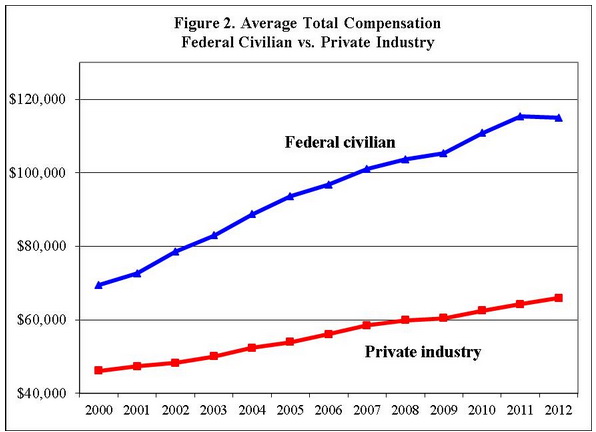
that pad their own salaries when regular people are struggling, as shown here:

Fed_V_Civilian

When benefits such as health care and pensions are included, the federal compensation advantage over private workers is even larger, according to the BEA data. In 2012, federal worker compensation averaged…74 percent more than the private-sector average.

that create trade agreements such as the TPP, written in secret by corporate lobbyists, covered here by Bill Moyers:

     The Top Secret Trade Deal You Need to Know About

that continue playing global power games while people in the US lose basic services:

     US Prepares To Provide A Billion To Ukraine As Detroit Plans Mass Water Shutoffs Over $260 Million

Oh how, as we all know all too well, this list could go on and on. The more the powermongers try to centralize all control, the more they are creating resistance as people rightfully try to bring real governance back to their communities. Charles Hugh Smith has been doing some excellent writing recently on how the huge lumbering centralized structures created by government are a very poor match for the complexity (and speed, I would add) of today’s world (The Incompetence of the Federal Reserve and Deep State Is Unavoidable):

The incompetence of these organizations is not a reflection of the competence or intelligence of their managers–it is the intrinsic consequence of their limited control of complex systems. If the system has reached the point of being ungovernable, even the most brilliant and experienced managers will fail because it’s not the managers who are incompetent, it’s the organization itself that is incompetent.

I consider this move toward secession to be trend, not anomaly. Expect acceleration. In these votes for secession, people are getting just the smallest taste of actual democracy, so–and this is the true anomaly in today’s world where the political process has been captured by large corporations known as political parties, giving many people the correct idea that their vote counts for little or nothing–the turnouts are huge and the votes decisive.

I would go even farther: Today’s political process is intentionally designed to funnel the beautiful and brilliant energy of people’s good will–via voting where the choices are poor, monetary contributions, letter-writing campaigns, emotional attachments to issues and politicians, etc–into a black hole of ineffectiveness so the power elites can exercise ever-increasing control. They will fail spectacularly.


Earth changes statistical update

Just over a year ago, the post What is the Transition? Part 1 presented statistics and charts showing that there is an acceleration in extreme weather events and geologic changes. And there have been several posts with specifics, including these:

     The Weather Gets Even Wilder

     Weather Wildness Update

     Britain faces choice of saving town or country from floods

This is a statistical update showing that this exceedingly important trend continues.

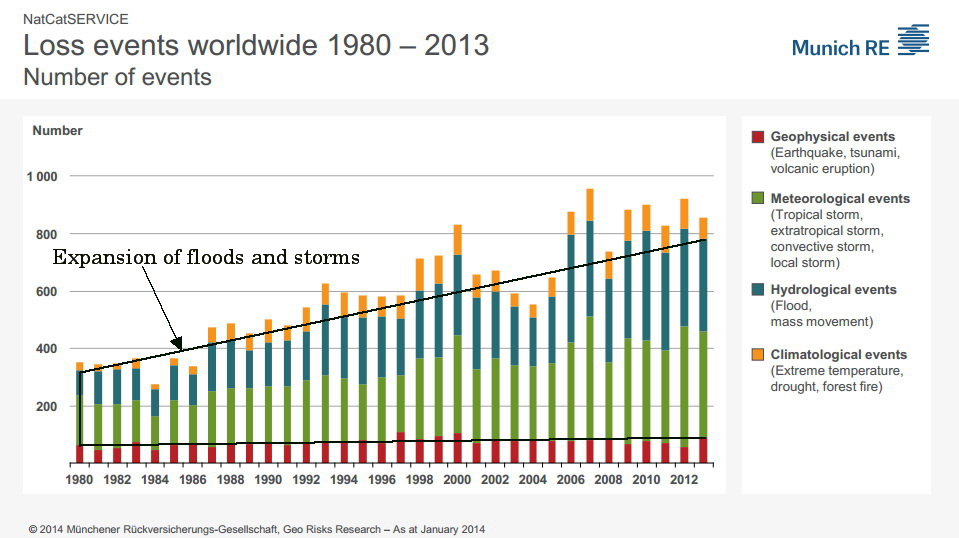
For starters, here is a chart from the world of yet another industry whose original intent–a way to spread financial risk that could overwhelm an individual to a wider community–has been perverted to massive investment pools from which any payment is not celebrated as a victory but is called a loss. Thus the chart of “Loss events worldwide 1980-2013” from the largest re-insurance company in the world, Munich Re. I use it so that any reader who might still be mired in “it’s just better reporting because of the internet” delusion about accelerating Earth changes–I heard of a person who still claimed that recently, so there must be more–can put that aside. So, not from the woo-woo world, but from the Mr. Gradgrind hard-nosed no-nonsense actuary-driven world where all things are calculated in currency and where the business model depends in great part on frightening people into buying more insurance than they need:

MunichReWeatherAndEarthChangesLines2wTextI added the cone lines highlighting the expansion of damaging floods (the blue portion of each bar) and storms (the green portion) from around 250 per year in the 1980s to around 700 per year for the last eight years. That’s a mighty clear indication of trend as opposed to outlier.

The chart does not show all damaging floods and storms, just those that caused losses for the insurance industry. The chart shows a similar acceleration in damages from “extreme temperature, drought, forest fire” (the yellow part of each bar).

It shows a fairly constant set of losses from geologic events, but this chart does not tell the true story of geologic events because, worldwide, very few have earthquake or volcanic eruption insurance, so there are relatively few loss events from these for the insurance industry.

According to those who closely monitor volcanic eruptions, these set a new all time record in 2013, with 84 volcanoes erupting, beating the previous record of 82 in 2010. There were even volcanic eruption clusters:

     Seven Volcanoes In Six Different Countries All Start Erupting Within Hours Of Each Other

And then there was this “minor problem”:

     Scientists find new volcano rumbling under Antarctica ice: 1,370 tremors: “It may blow or it may not. We don’t know.”

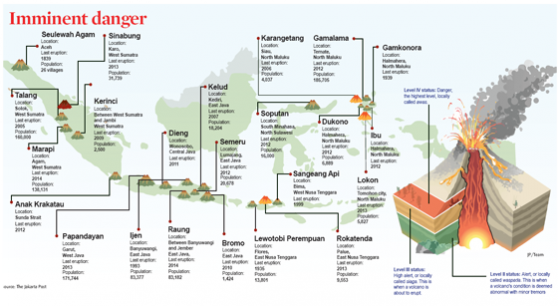
And with 32 volcanoes having already erupted this year, 2014 is off to a thundering and deadly start. After this in Indonesia:

     Villagers run for their lives as Sinabung volcano kills 16 in Indonesia

there was this from the Jakarta Post:

     19 more volcanoes on alert

Jakartavolcanoefeb4.img_assist_custom-560x306

     Electric universe: Pyroclastic flow from Sinabung volcanic eruption last month produced string of ‘tornados’

Here is a video link to those tornadoes.

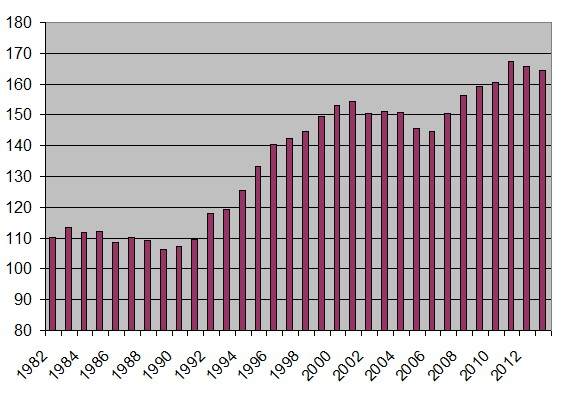
If I had all the data to chart volcanic eruptions, it would likely look very much like this chart of the 10-year average of earthquakes of magnitude 6.0 or greater, updated with 2013 data:

EarthquakesMag6_2013

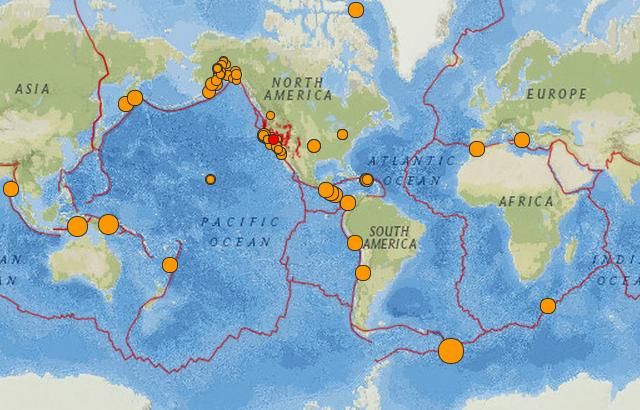
These days, the planet has one of these potentially damaging earthquakes on average every two and a half days, though more typically they come in clusters as well:

     Global outbreak of strong earthquakes on anniversary 9.0 Fukushima earthquake

quake_map

There were no significant tsunamis in 2013, so my previous comment from the end of 2012 still seems appropriate:

According to data at the NOAA Global Historical Tsunami Database, which has records going back to 2000 BC, there have been 34 tsunamis with a wave height greater than twenty feet over the last 400 years. Six of those, or 18%, have occurred since the year 2000…In the Twentieth Century, there was a tsunami with a twenty foot wave height about once every ten years. In this century, it has happened once every two years, resulting in the deaths of a quarter million people despite the fact that none of these tsunamis struck a major city.

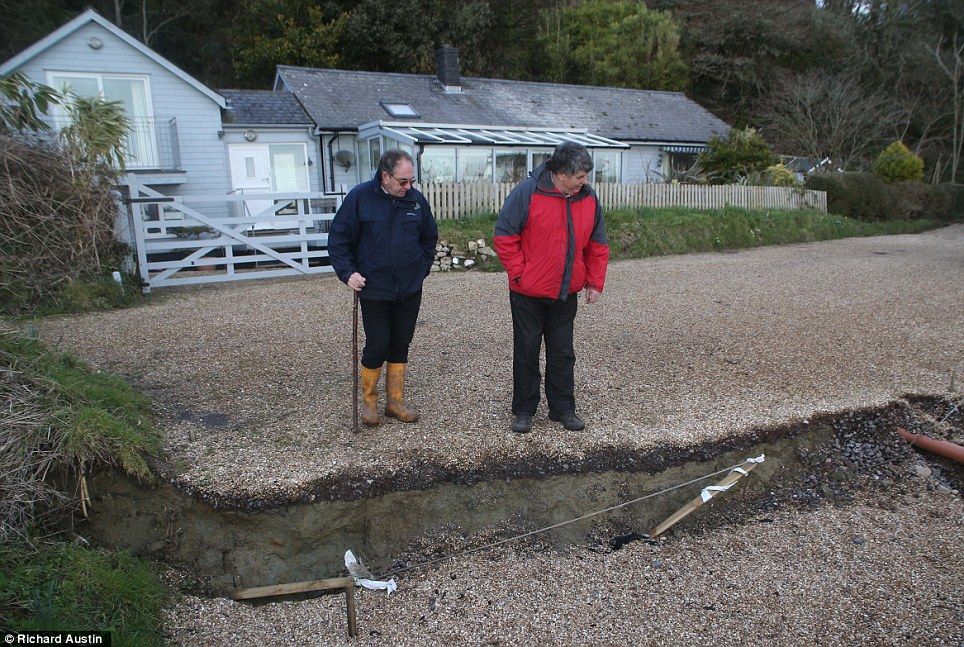
Sinkholes have continued unabated, though in the rain-drenched UK, there have been multiple large land movements:

     Huge cracks appear in Jurassic Coast a third of a mile inland after landslide in UK

UKarticle_2570052_1BE7D39F000005

And given that the world saw a very strange outbreak of mid-Winter brush and forest fires:

     Despite hurricane and record flooding, fire crews dealing with large bog fire near Aberystwyth, Wales

     Winter wildfire weirdness continues: Firefighters tackle 100-acre grass fire near Shawnee, Oklahoma

     Wildfire in western Broward burns 350 acres, Florida

     Are ‘drought conditions’ really to blame for winter wildfire outbreak across U.S.? Wildfire breaks out in Florida marshland‏

     Another wildfire in Norway: Fire on Norwegian coast destroys 140 buildings

     Fire devours historic Norwegian village, 90 people hospitalized

     Many Tibetan monasteries and famous sites destroyed this winter by mysterious ‘wildfires’

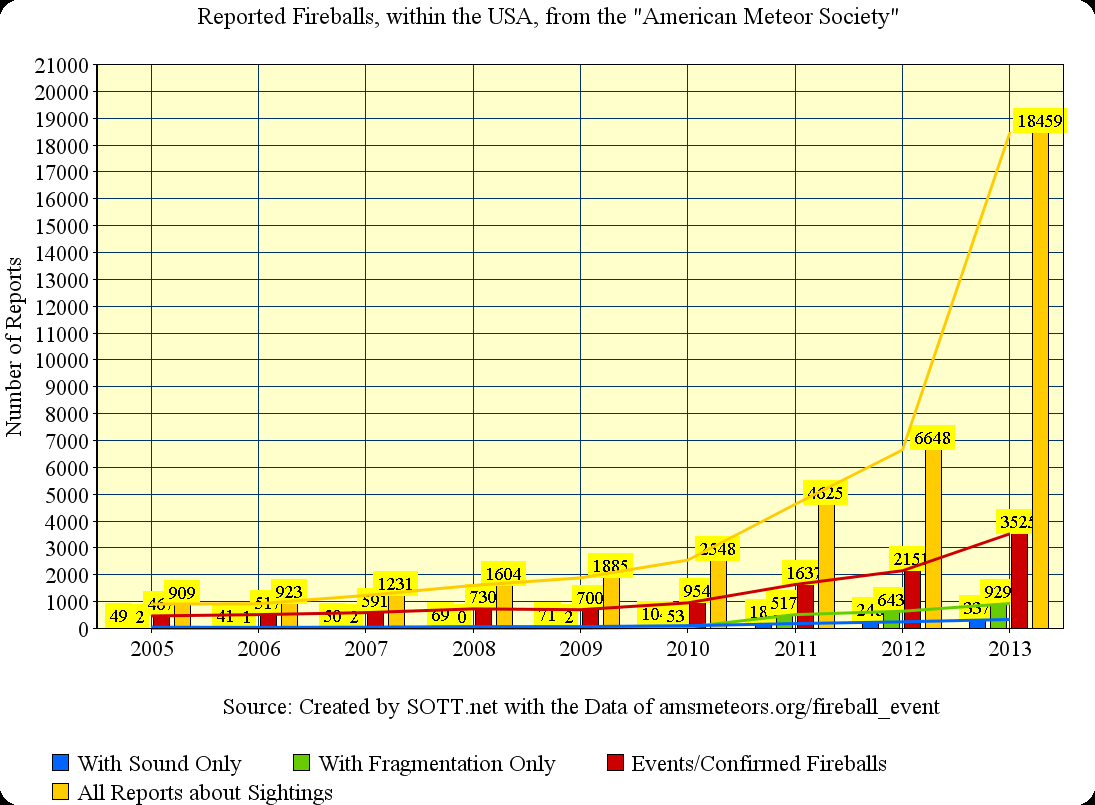
     Take cover! Meteor fireballs rain down across U.S. – Outbreaks of wildfires reported

it seems I would be remiss in not mentioning that meteor fireball sightings have been increasing dramatically in recent years. Confirmed sightings doubled from 2011 to 2013:

FireballsEnglish_Version_2014_6

Do I report all this to frighten? Not at all. I report it because it is the reality in which we are living; because I have learned the hard way that standing firm in the face of nasty powerful trends is very high risk behavior and usually turns out poorly; and because I want those who read Thundering Heard–who are presumably open to the idea that the accelerating changes we are seeing in most fields of life are related and are very important for humanity and for each of us–to stay alive so that, after the collapse of the financial system, they are ready to help rebuild society based on principles that include wisdom, creative intelligence, and compassion rather than the rampant and self-defeating materialism that is disintegrating our precarious “civilization.” (The quotes around civilization refer to Gandhi’s remark: “What do I think of Western civilization? I think it would be a very good idea.”)

So as I say to my younger cats when they bound out the door at night to face the local wildlife: Be careful out there.

What’s up with the metals? Part 2

Someone asked me whether I “was still in favor of gold.” The answer is an unqualified Yes. One easy reason is that almost every country on the planet is trying to drive down the value of their paper currency. So if you live in the US, it looks like this, and this is based on the US Government’s statistics for price inflation and we all know that they have every reason to play games to make this number look a lot lower than it really is, so you can safely increase each of these number by 50%:

CPI_Since_2000

The first column, CPI, says plenty: That if you live in the US, since the year 2000, the purchasing power of your money, of your salary, has lost 39%. And this is during a period that they claim has had “low inflation”! And the US Federal Reserve is currently on record as saying they are trying to create more inflation. So when you own US Dollars, or items denominated in Dollars such as US stocks and bonds, or items in currencies pegged to the US Dollar, realize that this is only going to get worse. The same is true for the purchasing power of the other currencies.

* * *

The post What’s up with the metals? Part 1 showed that some notable gold bears had turned bullish and that unprecedented demand for physical gold continued. Despite the strong demand, gold then had the bargain price of $1,237 per ounce, having just bounced up from $1,181 on the last day of 2013. Price went to $1,355 Monday and has pulled back to $1,338 today.

The strong demand for physical bullion, coins, and jewelry, documented in Part 1, has continued. Despite record-breaking demand in 2013, Chinese demand year-to-date is 51% higher than demand to this point in 2013. Mints around the world are working overtime:

     U.K. Royal Mint Runs Out of Sovereign Gold Coins on Demand

The U.K.’s Royal Mint, which traces its history back more than 1,000 years, ran out of 2014 Sovereign gold coins as prices near a six-month low led to “exceptional demand.”

     Gold Mint Runs Overtime in Race to Meet World Coin Demand

Austria’s mint is running 24 hours a day as global mints from the U.S. to Australia report climbing demand for gold coins…

Austria’s Muenze Oesterreich AG mint hired extra employees and added a third eight-hour shift to the day in a bid to keep up with demand. Purchases of bullion coins at Australia’s Perth Mint rose 20 percent this year through Jan. 20 from a year earlier. Sales by the U.S. Mint are set for the best month since April, when the metal plunged into a bear market.

Global mints are manufacturing as fast as they can…“The market is very busy,” Lang said. “We can’t meet the demand, even if we work overtime.

So, if demand for physical gold is so strong, how could there possibly be such a price drop as happened in 2013?  The answer is simple really. They have created a paper gold market that is hundreds of times larger than the physical gold market. By larger I mean in terms of the dollar value of trading in these two markets. People trade paper that has more or less of a connection with gold (sometimes none at all), and it is in these large markets that the price of gold is set. Most of the participants in these paper gold markets believe that they could, if they wished, convert these pieces of paper into physical gold, that the pieces of paper are claims on real gold. But in reality, only a tiny fraction of them could succeed in converting their claims into real metal. There just isn’t enough metal to go around.

If you think I exaggerate, check this chart, which I’ll explain below. It describes the action at the COMEX, the primary gold price-setting exchange in the US:

COMEX_OwnersPerOz

The key phrase on the chart is “Owners Per Ounce,” which for the COMEX is now at 111 owners per ounce of gold in the vault! That is, for each ounce of gold in the COMEX vaults (the blue line in the upper section of the chart), 111 contracts exist that allow the owners of those contracts to demand delivery of that single ounce of gold. We all understand that banks operate with only a little cash on hand for all the deposits they’ve taken, called a fractional reserve system. The COMEX is the same, worse actually: percentagewise, they keep a lot less gold around than the banks keep cash on hand.

(Please skip this paragraph if you already understand what 111 owners per ounce means!) Let me explain: The COMEX is a futures trading exchange where people trade gold and other commodities. Futures exchanges were created to be a meeting place between producers of a commodity and its end users. In January of any year, for example, a producer of wheat can agree to sell wheat in the future, in September, at a specified price to a cereal company. Both the wheat farmer and the cereal company know that they can make a reasonable profit on their operations if the farmer supplies, and the cereal maker takes delivery of, wheat at the pre-arranged price when that wheat is ready in September, so they make the deal. That’s called a futures contract. It promises both delivery and payment in the future at set price, and that’s great. But the futures exchanges are now dominated by big money speculators who have no intention of producing or taking delivery of anything. The chart above reflects this reality. The COMEX vault is supposed to have gold to back up the gold trading that takes place on that exchange. As you can see in the upper panel of the chart, back in 2006 they had over 5 million ounces backing up the contracts. Now that amount has fallen by 93% to only 370,000 ounces as more people realize that they better stop trading paper and get their hands on the real stuff.  Currently, for all the futures contracts to buy and sell gold on the exchange, they only have 1 ounce for every 111 contracts in existence. These contracts are paper gold, a huge synthetic supply of fake gold.  If everyone decided to make their claim for real gold (similar to a run on bank), only 1 ounce would be available for every 111 claims. Such an attempt would drive the price of physical gold into the stratosphere. On a typical day last week, 55,000 of these paper contracts traded hands. That represents 5,500,000 ounces of paper gold traded each day just at the COMEX. That trading sets the price for gold in the US. But it’s possible that no one demanded delivery of gold from the COMEX on that same day. So the trading that sets the price is really for cash, not for gold. And this paper trading involves a lot of borrowing, that is, leverage.  One can easily prove this crazy situation by contacting a futures broker and creating an account with $8,000 in that account. One could then buy or sell (they call it selling short) a futures contract for 100 ounces of gold. At today’s price of $1,338 per ounce, 100 ounces of gold is worth $133,800. So as far as COMEX is concerned, you are using your $8,000 gambling stake to control $133,800 worth of gold. And this “gold” can be sold, driving down the price. Seems crazy, but it’s literally true.

So if you or I can control 100 ounces for $8,000, imagine what JP Morgan and Goldman Sachs can control with the many billions of printed money they receive from the Federal Reserve, printed money that has not been lent out to boost the economy but is being used as collateral for trading. They can push markets in whatever direction they want. The same is true for central banks, but on an even greater scale: They have no limit on the amount of cash they can print up, so they can overwhelm any market anytime they wish.

The COMEX sets the price in the US. In London, it’s the LBMA (London Bullion Market Association) which is more than 7 times larger than the COMEX in terms of the dollar value of daily paper gold trading. The LBMA admitted a couple of years ago that, like the COMEX today, their leverage ratio was over 100 to 1. And the gold market in Switzerland is just as large as the LBMA, but it is run privately by the Swiss banks, so they publish no statistics. All told there are 40 futures exchanges in the world for trading paper gold.

Another form of paper gold is certificates for gold accounts with banks. Several of these banks have been caught charging people fees for storing gold when they are actually storing nothing at all. The banks figured they could quickly meet any claims for the gold, but when the claims came in, it took them weeks to procure the gold in the open market.

And there are stocks that hold gold, options on both those stocks and on the futures described above, gold leases, and swaps contracts. The latter are private contracts and they may actually dwarf all of the rest of the paper gold claims in terms of their stated dollar value (their “notional value,” as it is called) because the central banks, like the US Federal Reserve and the Bank for International Settlements, often use swaps for their trading. What, central banks trading gold? In September, the French Central Bank admitted:

We are still active in the gold market for our own account…meaning that we are in the market nearly on a daily basis.

In that same paper, the Bank of France said they owned 2,500 tons of physical gold and that they had no plans to sell it. So what are they trading daily? Paper gold, for profit.

Sometimes people go way too far with these contracts. People thought that Bear Stearns went bankrupt in 2008 because of the mortgage market. But the astute article What Really Happened to Bear Stearns by Ted Butler explains that it was actually bad trading in gold and silver that took them down: they had massive bets that the prices of gold and silver would go down, but instead the prices shot up by a lot over a few months instead. 

BearStearnsGold

The chart above is the price of gold from 2004-2008. Notice how the price was moving up strongly prior to the collapse of Bear Stearns. Guess who picked up all of the assets and trading positions of Bear Stearns as it went bankrupt. Why our “good friends” at the company implicated in, and fined for, manipulating just about every market around since then: JP Morgan. They picked up Bear’s assets for about 6 cents on the dollar. Notice the smashdown of the gold price as soon as Morgan was in charge. The price smashdown was even worse in silver. Here’s the chart from 2004-2008 for silver:
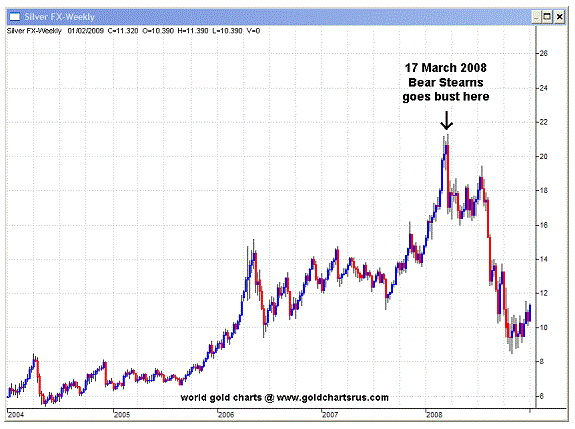
BearStearnsSilver

It sure makes one wonder whether JP Morgan was involved in both moving the price up to bankrupt Bear Stearns, and then smashing it down once they had taken over Bear and inherited all those bets that the prices of gold and silver would drop.

Getting back to our discussion. All of these contracts taken together are called derivatives because they derive their value from the underlying value of gold. Guess who owns most of them now:

     Market Cornered: JPMorgan Owns Over 60% Notional Of All Gold Derivatives

What? Isn’t it illegal to corner a market? Don’t the regulators come down hard on anyone trying to corner a market? Yes, but as long as it isn’t gold or silver. JP Morgan is allowed to corner gold and silver because it serves the interests of those who still want the US Dollar to dominate the world so that the US can continue to exercise its “exorbitant privilege” of printing paper to trade for the real goods of other countries. So if someone like Morgan and the central banks weren’t suppressing the prices of gold and silver, it would make the Dollar and the other paper currencies look bad, and those in charge won’t allow that.

To show you how off base these government people and economists are, when Nixon took the world off of what remained of the gold standard in 1971, his chief economist was the “great” Milton Friedman. Friedman told Nixon and others that gold was deriving its value from the US Dollar, not the other way around, and that as soon as Nixon severed the link between gold and the Dollar, that the price of gold would actually fall quite a lot. He was entirely wrong, as government economists so often are, as gold never looked back again at its then-current price of $35 per ounce.

These government types have always hated gold for one reason: it inhibits their ability to wage war. We’ve covered it before: governments started going off the very-successful gold and silver standards in order to fight World War 1. That war would have been over in a few months, but that wasn’t good enough for the warmongers, they had to kill off millions of people over four years to serve their greed.

We’ll talk more about governments and gold later, including their failed attempts to suppress gold in the past, in Part 3. But you know that comment above about the gold price going into the stratosphere when people with all these paper contracts rush to convert them to physical gold? That will happen. It’s inevitable, as more and more people lose confidence in governments, banks, and the blizzard of paper claims they have created. That COMEX chart above–where it shows that the physical gold backing up the paper trading is down by 93%–says that the process is already well underway. Best to get your gold and silver before all those folks with the paper contracts try to get some because, at that point, it will be tough to find real gold at any price.
“Britain faces choice of saving town or country from floods”

That title is a quote from the chairman of the UK Environment Agency informing people that there is no way the country has the money to save–that is, build flood defenses for–both city and rural areas:

     Britain faces choice of saving town or country from floods, says agency chief

What’s happening in Britain is a perfect example of what people in an increasing number of regions are facing: a relentless parade of major, deadly storms. Decades back, England was William Blake’s “green and pleasant land,” celebrated for its mild weather with the occasional major storm. Now it’s a rare week that doesn’t have 100mph winds strafing some part of the British Isles. Here’s a bit of high surf in Wales:

UK124826

(Photo source: Huge waves smash into British coastline, swells up to 75 feet recorded off-shore, UK government considers establishing tsunami-warning system)

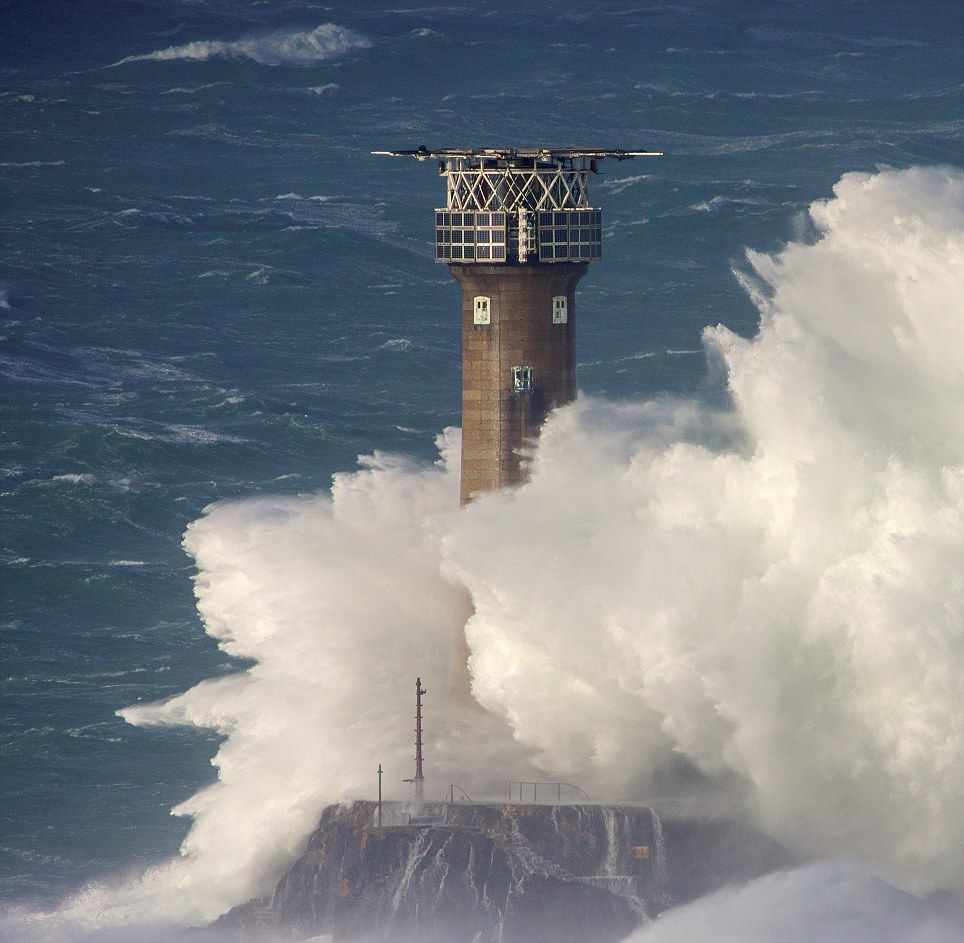
And a lighthouse in Cornwall:

Cornwallarticle_2554557_1B4C531B000005

(Photo source: UK storms: While some FLY in 80 mph winds, others wade through murky water to salvage what little they have left (amazing photos) )

Even where houses are not on coasts or in flood plains, 1.6 million homes are said to be at risk of flooding from the water table rising.

From the BBC:

     10 key moments of the UK winter storms

And CNN:

     Atlantic storm brings more misery to drenched Britain: heaviest rainfall in 250 years

     UK government sends 5,000 military personnel to flood zones as hurricanes keeping coming

Somerset1622103_214327935429018_188120

(Photo source: UK Floods Could Last Months, Scientist Warns  )

*  *  *

Food For Thought

The bigger question is whether the UK Environment Agency will be able to save town or country. In my view, they won’t have the time or money to save either. How often do people have to hear about unprecedented winds, rain, and waves–storms that almost everyone now realizes are ramping up in intensity, not receding–before they move away from coasts, flood plains, and low-lying areas? Perhaps some few will move to high ground, but it’s almost certain that most will not. Most, even faced with complete destruction of their homes, show a Monty Pythonesque “bravado and derring-do” and vow to rebuild on the same spot, egged on by clueless newscasters and politicians. As someone who studies cycles, I conclude that, if every culture on the planet has, in their oral and written traditions, reports of floods that totally cleanse the land, there is a reason. And it isn’t because there was one really big worldwide flood. It’s that cyclically, repeatedly, the Earth’s surface gets an intensive cleansing. From the way we are treating the planet, isn’t it obvious why? If the Earth didn’t do this cyclic cleansing of its own surface, would there be any humans here at all? As I said: food for thought. I know many will reject such thinking. All I am suggesting is that eyes and minds be kept open to the steadily emerging evidence.

For example, the British storms have swept away the sand from many beaches. Here’s a story that the storms uncovered human footprints from 800,000 years ago. If that’s correct, then we could be talking about lots of cycles:

     Ancient footprints dating back 800,000 years found in Norfolk


134 Countries

That’s the number of countries in which US Special Forces (you know, Green Berets, Navy Seals, etc.) took actions in 2013. That’s the number to which a US spokesman admitted, the number may be higher. That’s 70% of the countries in the world. From Nick Turse:

Since September 11, 2001, U.S. Special Operations forces have grown in every conceivable way, from their numbers to their budget. Most telling, however, has been the exponential rise in special ops deployments globally. This presence — now, in nearly 70% of the world’s nations — provides new evidence of the size and scope of a secret war being waged from Latin America to the backlands of Afghanistan, from training missions with African allies to information operations launched in cyberspace.

In the waning days of the Bush presidency, Special Operations forces were reportedly deployed in about 60 countries around the world. By 2010, that number had swelled to 75, according to Karen DeYoung and Greg Jaffe of the Washington Post. In 2011, Special Operations Command (SOCOM) spokesman Colonel Tim Nye told TomDispatch that the total would reach 120. Today, that figure has risen higher still.

In 2013, elite U.S. forces were deployed in 134 countries around the globe, according to Major Matthew Robert Bockholt of SOCOM Public Affairs. This 123% increase during the Obama years demonstrates how, in addition to conventional wars and a CIA drone campaign, public diplomacy and extensive electronic spying, the U.S. has engaged in still another significant and growing form of overseas power projection. Conducted largely in the shadows by America’s most elite troops, the vast majority of these missions take place far from prying eyes, media scrutiny, or any type of outside oversight, increasing the chances of unforeseen blowback and catastrophic consequences…

Formally established in 1987, Special Operations Command has grown steadily in the post-9/11 era.   SOCOM is reportedly on track to reach 72,000 personnel in 2014, up from 33,000 in 2001.

There’s a lot more in the full article.