More shackles readied for deployment

Darth Summers made a speech on Nov. 8 to a gathering of economists at the IMF. My guess is that they had Darth (OK, Larry) give the speech because he doesn’t currently hold a position with any institution that could then be blamed and hated for the policy promoted in the speech. (Here’s the speech, though I don’t recommend it.) However, I think it wise to consider the speech an official announcement of the latest wicked that this way comes.

The policy is that savers will soon be hit with negative interest rates. Now Larry didn’t say this directly, he slithered around it and offered the “clear justification” for it. But in reviews of what his admirers called a “brilliant” speech, the admirers were quite clear in their understanding: negative interest rates…in cashless society! That was the full policy implication.

So people would have to pay the bank interest on their own savings. So if the negative interest rate were -3%, if you had $100 in your account, you’d have to pay the bank $3 in interest. And just in case anyone had any ideas of getting their savings out of the banks, well, get their savings out into what? In a cashless society, your money would simply be an electronic entry in an account. Getting your money “out” would mean spending it. Which is the problem that Summers and his fiends say they are trying to solve: how to get people to spend, spend, spend their money. They say there isn’t enough “aggregate demand.” Don’t have any money? Then borrow some, it’s really cheap. But in any case, spend!

Of course, this would also mean that when the government borrows money, the interest rate would be negative for them as well. The more money they borrowed, the more money they would collect as the lenders paid them interest!

Now it goes without saying, though I’ll say it anyway, that if you went to borrow some money, this negative interest rate thing would not apply to you. You’d still have to pay interest on your loan. This negative thing would only be for them, that is, the banks and governments. Oh, and large corporations, how could I leave them out. But not you or me. Whether borrower or lender be, either way, we’d have to pay. Know what the average interest rate consumers are paying on their $846 billion in outstanding credit card debt? 13%. Do you think the banks are going to give up that bonanza?

Now any rational person might think: They’ll never do it! Negative interest rates would wreck every pension fund in the world. And so they would: pension funds are all dependent on collecting interest to meet their future obligations. But too bad. If people can’t collect pensions, then they’ll have to stay in the workforce. And with all that competition for jobs, companies can pay lower and lower and lower wages. Why do you think they outsource work across the world! Do you think this paragraph goes to far? Then consider this: Collecting Donations For Wal-Mart Employees That Cannot Afford Thanksgiving Dinner?

At the Wal-mart on Atlantic Boulevard in Canton, Ohio employees are being asked to donate food items so that other employees that cannot afford to buy Thanksgiving dinner will be able to enjoy one too.

So, they think that taxing people’s savings, both in their bank accounts and in their pensions, will get the economy on a sound footing again. Because that’s what these policies are, they are taxes, part paid to government and part to the banks. So why don’t they just say that? Two reasons: first, people tend to get angry about new taxes and they tend to vote out whoever levies new taxes; and, the group at the Summers speech are economists, and all economists know that raising taxes squelches economic growth. So they can’t call it a tax or everyone would point out that the policy is anti-growth. Which it is. But logic left the room of mainstream economics years ago. They maintain their lofty positions as Machiavelli advised: they serve their governing masters well. So these policies have nothing to do with logic. The governing masters keeping their power, that’s what it’s all about. And these economists know who spreads the caviar on their toast points. These policies are designed only to preserve the powermonger status quo.

Plus, they are fairly sure it will be a long time before the public catches on. They can just repeat over and over that this is for jobs and growth, and the majority, desperate for good news, will believe it. And in this ploy, the economists are likely correct. They have been engaged in multi-$trillion Quantitative Easing (money printing) for years and, according to a Reuters poll, three quarters of Americans don’t even know what QE is. And people weren’t asked to explain it, they were given a multiple choice question, so 20% could have answered correctly just by random choice!

Twelve percent of respondents thought QE was a computer-assisted program that the Fed uses to manipulate the dollar. Another 11 percent thought it was part of the Dodd-Frank Wall Street reform legislation enacted following the crisis.

So the economists of The Powers That Be figure they can obfuscate their way through just about anything.

So let’s get this straight. These thieves want to steal people’s savings and pensions. So that people must remain as wage slaves till they drop, filling a growing labor pool being paid wages that are declining in all of the developed economies. And they’ll be great fodder for the upcoming war economy, grateful for the opportunity to build weapons that kill in better and better ways. While the rich and powerful get more caviar, as shown on the chart below. The dark brown line is the average stock price of retail for the rich: Tiffany, Coach, and LVMH. Those stocks have risen 500% since their 2009 lows and are over 30% above their former peak in 2007. The blue line is Macy’s, Kohl’s, and JC Penney, where the disappearing middle class shops. Those stocks are up 100% since 2009 and are still 30% below their former peak in 2007:
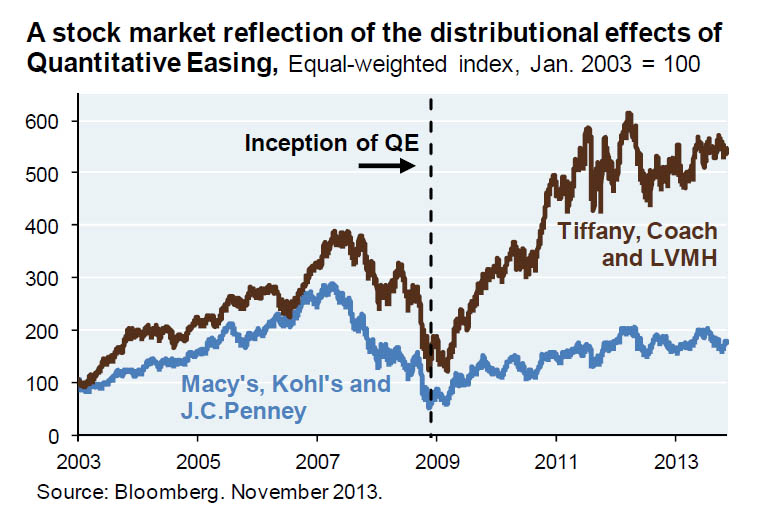
QE effect on shoppers

That is a great demonstration of who is receiving all that newly printed money and who is not. These folks want more slaves. And the ability to bomb into chaos any region that does not offer up its people into the slave pool.

Finally, a Fed Whistleblower

The claim has been made repeatedly here and elsewhere–a claim derided as conspiracy theory by the mainstream–that the US Federal Reserve has one purpose: to protect the game of the big banks. Everything else they say and do is cover for that single goal.

Thankfully, a Fed insider has offered excellent confirmation, including apologies to taxpayers for his actions. Everyone with the slightest interest in how the world actually works should read the full article by this fellow.

As background: Talk about an insider, this guy was in charge of the program through which the Fed purchased $1.2 trillion of mortgage backed securities (MBS) from the banks in 2009-2010. The Fed conjured up new electronic currency to pay for this. They call that Quantitative Easing (QE) instead of money printing because such lying does succeed in fooling most of the people most of the time.

In 2009, these MBS “assets” were called toxic assets by anyone with a fondness for truth because they were large packages of mortgages backed by sub-prime and other mortgage loans that were not being re-paid, and by residential real estate collateral that was plummeting in value. In other words, the big banks peddling and holding these assets were insolvent, bankrupt, in part because of the plunging value of their MBS. So, the Fed came to the rescue, of course, buying up toxic MBS from the big banks and paying many times the pennies-on-the-dollar actual street prices of these securities (Don’t you just love the BS terminology that pervades the financial sector?) to make the banks appear less bankrupt.

Here are some choice quotes from Andrew Huszar, a true Wall St and Federal Reserve insider:

We went on a bond-buying spree that was supposed to help Main Street. Instead, it was a feast for Wall Street.

I can only say: I’m sorry, America. As a former Federal Reserve official, I was responsible for executing the centerpiece program of the Fed’s first plunge into the bond-buying experiment known as quantitative easing. The central bank continues to spin QE as a tool for helping Main Street. But I’ve come to recognize the program for what it really is: the greatest backdoor Wall Street bailout of all time

My part of the story began a few months later. Having been at the Fed for seven years, until early 2008, I was working on Wall Street in spring 2009 when I got an unexpected phone call. Would I come back to work on the Fed’s trading floor? The job: managing what was at the heart of QE’s bond-buying spree—a wild attempt to buy $1.25 trillion in mortgage bonds in 12 months. Incredibly, the Fed was calling to ask if I wanted to quarterback the largest economic stimulus in U.S. history.

This was a dream job, but I hesitated. And it wasn’t just nervousness about taking on such responsibility. I had left the Fed out of frustration, having witnessed the institution deferring more and more to Wall Street…

In its almost 100-year history, the Fed had never bought one mortgage bond. Now my program was buying so many each day through active, unscripted trading that we constantly risked driving bond prices too high and crashing global confidence in key financial markets. We were working feverishly to preserve the impression that the Fed knew what it was doing.

It wasn’t long before my old doubts resurfaced. Despite the Fed’s rhetoric, my program wasn’t helping to make credit any more accessible for the average American. The banks were only issuing fewer and fewer loans. More insidiously, whatever credit they were extending wasn’t getting much cheaper. QE may have been driving down the wholesale cost for banks to make loans, but Wall Street was pocketing most of the extra cash.

From the trenches, several other Fed managers also began voicing the concern that QE wasn’t working as planned. Our warnings fell on deaf ears. In the past, Fed leaders—even if they ultimately erred—would have worried obsessively about the costs versus the benefits of any major initiative. Now the only obsession seemed to be with the newest survey of financial-market expectations or the latest in-person feedback from Wall Street’s leading bankers and hedge-fund managers. Sorry, U.S. taxpayer.

Trading for the first round of QE ended on March 31, 2010. The final results confirmed that, while there had been only trivial relief for Main Street, the U.S. central bank’s bond purchases had been an absolute coup for Wall Street. The banks hadn’t just benefited from the lower cost of making loans. They’d also enjoyed huge capital gains on the rising values of their securities holdings and fat commissions from brokering most of the Fed’s QE transactions. Wall Street had experienced its most profitable year ever in 2009, and 2010 was starting off in much the same way.

You’d think the Fed would have finally stopped to question the wisdom of QE. Think again. Only a few months later—after a 14% drop in the U.S. stock market and renewed weakening in the banking sector—the Fed announced a new round of bond buying: QE2…

Where are we today? The Fed keeps buying roughly $85 billion in bonds a month, chronically delaying so much as a minor QE taper. Over five years, its bond purchases have come to more than $4 trillion. Amazingly, in a supposedly free-market nation, QE has become the largest financial-markets intervention by any government in world history…

And the impact? Even by the Fed’s sunniest calculations, aggressive QE over five years has generated only a few percentage points of U.S. growth. By contrast, experts outside the Fed, such as Mohammed El Erian at the Pimco investment firm, suggest that the Fed may have created and spent over $4 trillion for a total return of as little as 0.25% of GDP (i.e., a mere $40 billion bump in U.S. economic output). Both of those estimates indicate that QE isn’t really working.

Unless you’re Wall Street. Having racked up hundreds of billions of dollars in opaque Fed subsidies, U.S. banks have seen their collective stock price triple since March 2009. The biggest ones have only become more of a cartel: 0.2% of them now control more than 70% of the U.S. bank assets…

So the big-bank rich got very much richer. What a surprise. A perfect strategy, still in full implementation in plain site, by a Fed fulfilling its real goal. The full article is here.

The quotes above might as well be directly from those derided for years as Fed conspiracy theorists. The latest survey I saw said that 74% of US citizens favor a full audit of the Fed, which is a private bank masquerading as a quasi-government agency, owned by the big banking families of the world, and which has the concession from the US Congress to print money. (Nice concession, eh?) But those 74% will likely be ignored. 90% of US citizens were against the TARP bank bailout in 2009, but it became law anyway. The people’s wishes are meaningless when it comes to the criminal partnership between Wall St and Washington DC.

Huszar didn’t name names or produce documents, so unlike other US whistleblowers, he likely won’t be jailed or hauled into endless court proceedings. But maybe this will encourage others to speak up about the Fed, perhaps even to reveal the truly nefarious aspects of this organization and its owners. And maybe someday the politicians who take millions from Wall St will become whistleblowers and tell us what marching orders they are given when they pocket those funds. Hey, a person can imagine! There’s no law against that….Is there?

US Government shut down, except…

The US Government claims to be shut down, but that doesn’t apply to the military complex:

     Hagel Orders Civilian Pentagon Workers To Return to Work

So 350,000 civilian contractors will rejoin active duty soldiers, to whom no shutdown was applied.

And apparently the Department of Defense granted 94 new contracts on the day prior to the shutdown.

Recently, the US Federal Reserve threatened to slow down, to taper, the money printing, but they backed off on that idea at the last minute. And now the military is at full strength despite a government shutdown. Seems they are making it pretty obvious about what’s on tap. This is a very simple logical progression that has happened before:

1. An economy based on money which is debt must always grow or the interest on the debt cannot be paid.

2. When too much debt is accumulated, the economy groans under the burden, interest and principal on some of the debt cannot be paid, and the economy begins to implode.

3. Authorities put money printing into hyper-drive to try to fill the holes, to overcome this collapse, but this tactic fails. Currently, the money printers themselves are dismayed about the poor results from all that printing.

4. So to stimulate an economy in end-of-cycle death throes, the authorities resort to war.

In my view, this too will fail.

In early September, when the Military Times surveyed US troops on whether they supported US air strikes on Syria, 75% were opposed. And they were opposing air strikes; it seems highly likely that there would be even greater opposition to an invasion. US politicians have been running these troops ragged with one campaign after another, and it is taking its toll in terms of suicide and substance abuse:

In fact, prescription drug abuse doubled among U.S. military personnel from 2002 to 2005 and almost tripled between 2005 and 2008.

Alcohol abuse is the most prevalent problem and one which poses a significant health risk. A study of Army soldiers screened 3 to 4 months after returning from deployment to Iraq showed that 27 percent met criteria for alcohol abuse…

Drug or alcohol use frequently accompanies mental health problems and was involved in 30 percent of the Army’s suicide deaths from 2003 to 2009 and in more than 45 percent of non-fatal suicide attempts from 2005 to 2009.

Many people are increasingly aware that most major US war participations were preceded by false flag attacks, for example, the Lusitania for WW1, Pearl Harbor for WW2, the Gulf of Tonkin for Viet Nam, and 9/11 for the War on Terror. Many are weary of the repeated war campaigns that promise to bring democracy and bring only death and chaos. And people are increasingly aware that the economy–to which so many bow down as some kind of Moloch that must be served now no matter what the human and long-term costs–is a system for enslaving many for the mega-profits of a few. How long before people realize that murderous warmongering is simply an extension of that profiteering?

It seems clear that they will start a major war. They will have to counter war weariness among both civilians and military, and we all know how they do that. And they do need people’s support to carry this out. So once the war has started, the question will be: how long will people support it? Will people go along with these dark forces of war–for emotional reasons, or to get and keep a job in the war economy–or will they stand up and put an end to it?

An Important Whistleblower Event in the Metals

The news came out Friday at 2:00pm (circled on the chart below) that two JP Morgan employees have submitted to the government strong documentary evidence about how JP Morgan illegally manipulates prices in the precious metals markets:

     Morgan Whistleblowers Confess Bank Manipulates Gold & Silver

As you can see on this chart of Friday’s price action in gold from Kitco.com, those few traders who remained at their posts late Friday afternoon thought this was a big deal, and they ran the price of gold up $20 in the final three hours of trading:

Gold Friday13thedThey are right. This is a big deal. Why?

1. The last time compelling evidence of JP Morgan’s price suppression of the metals emerged into public view was March, 2010 when London trader Andrew Maguire told everyone that he had submitted hard evidence to the government about such manipulation, including sitting with them and showing them in real time just when and how the manipulation is carried out:

It was no coincidence gold didn’t look back from that day and it moved up over $800, from under $1,100, to (over) $1,900.  And silver moved up (an astonishing) $33, from under $17, to almost $50 in the same (time) period.

Someone tried to run Maguire down with a car two days later; he was hit by that car, but survived.

2. Many people have supplied evidence of manipulation of the metals to the US government agency that is supposed to take action about such crimes, the CTFC (Commodity Futures Trading Commission), but none, at least not that I know of, were employees of JP Morgan with direct inside information.

3. The CFTC has stonewalled the evidence received to date by staging an investigation of these allegations. The problem is, it’s been in progress for almost five years now. They haven’t taken a single action from this “investigation.” And why should they? Anyone known by Wall St to support such an action would be prevented from entering the “revolving door” and getting a cushy and highly-paid job at one of the Wall St firms as soon as their CFTC gig is over. And it is more than highly likely that the government itself is in collusion regarding the suppression of metals prices, so how can a lesser known agency point out that the US Treasury and Federal Reserve are involved in the scheme. But what was revealed Friday was that the CFTC received the data from the Morgan employees more than a year ago, in June 2012, and still they have taken no action. This will substantially increase pressure on the agency to take at least some sort of public action.

4. Allegations of price suppression in the metals markets have long been greeted as conspiracy theory by the mainstream despite the fact that government participants from the infamous Gold Pool of the 1960s admitted that they manipulated the gold price on a regular basis, though as with almost all government people, they only admitted to this after retirement or posthumously.  But with so many conspiracy theories recently being shown as conspiracy fact, and with JP Morgan getting caught in multiple illegal actions over the last few years, it is now getting tougher for anyone to claim that Morgan is not acting illegally in any market in which they participate.

The “paper gold” market (futures, options, ETFs, etc.) has been used for years to manipulate prices in the physical gold market, so much so that increasing demand for physical gold is often met by a falling paper gold price, turning all economic theory of supply and demand upside down.

The Powers That Be of the USA will do whatever they can to maintain what is rightly called the “exorbitant privilege” of having the US Dollar as the world reserve currency, which enables the US to print money to purchase real goods from the rest of the world. Part of their strategy has been to suppress the price of the precious metals to mask the deteriorating value of the Dollar. Another aspect is to keep the price of the metals very volatile to scare people out of the metals; they want to make the metals look unstable and the Dollar look comparatively stable.

Last year, the State of South Carolina considered adding gold as an investment to the state’s coffers and rejected the idea because their research showed that the precious metals are a manipulated market so they could not trust the metals as an investment. The state treasurer told the legislature this:

“Similar to other commodities, the value of gold and silver is determined by supply and demand, as well as speculation. The Federal Reserve, London Bullion Market Association, JP Morgan Chase, and HSBC Holdings have practiced fractional-reserve banking and engaged in naked short selling causing artificial price suppression.

So this testimony from JP Morgan employees is a major step toward gold and silver trading freely without government interference. No matter how old you are, gold has traded freely during your current lifetime for at most a few months at a time on a couple of rare occasions. If you hang in here for awhile longer, you will see it trade freely. And its price will be, to quote a great friend, magnificent.

A Tale of Two Countries

I see a beautiful city and a brilliant people rising from this abyss, and, in their struggles to be truly free, in their triumphs and defeats, through long years to come, I see the evil of this time…making expiation for itself and wearing out…
― Charles Dickens, A Tale of Two Cities

In 2005, economist Raghuram Rajan, 42 years old at the time, delivered a speech at the annual meeting of the crowned heads and elder statespeople of central banking telling them how those in attendance were brewing up a wicked credit crisis. After the speech, former US Treasury Secretary Lawrence Summers led the charge against Rajan, describing himself as “someone who finds the basic, slightly Luddite premise of this paper to be largely misguided.” According to Bloomberg:

Summers also said “while I think the paper is right to warn us of the possibility of positive feedback and the dangers that it can bring about in financial markets, the tendency toward restriction that runs through the tone of the presentation seems to me to be quite problematic.”

We all know now that Rajan was right and Summers, who had spent several years helping to tear down any restrictions on the gambling and deception by Wall St banks, was wrong in many ways.

India just made Rajan–who clearly saw the financial crisis coming and had the courage and intelligence to publicly state his case to those who were aiding and abetting it–the new head of India’s central bank, the Reserve Bank of India.  And Obama is considering appointing Summers–who aided and abetted the ongoing financial crisis mightily and who didn’t see it coming–the next head of the US central bank, the Federal Reserve. Summers is also infamous for abruptly resigning as the President of Harvard after losses in the endowment fund, his public statement that women are unable to learn science and math as well as men, and a no-confidence motion from the faculty.

Obama’s alternate candidate for the next head of the Federal Reserve is said to be Janet Yellen. She testified to Congress that she didn’t see the financial crisis coming either. Yellen was in charge of the Federal Reserve Bank of San Francisco from 2004 through 2010. So she was one of the top regulators presiding over the ramping up of the deranged lending that supported the real estate bubble in her territory that included California, Nevada, and Arizona.

So India has appointed someone with a track record of getting economic things right, and who is willing to risk career to state truth about a seriously dysfunctional status quo. And the US is poised to appoint someone who not only got it wrong about the financial crisis, but who, it could easily be argued, was on the team of architects who helped to create it. Worse still, Summers and Yellen have been in positions of financial power since and have done little to solve those architectural problems that still plague the system. My guess is that they have resisted real solutions.

One would think that Obama would prefer to appoint someone like Rajan, who had seen the financial crisis coming. But that is not the way things work in the US. Those who saw it coming would be similar to Rajan in clearly pointing out the structural problems in the US system, and that would seriously step on the toes of the rich and powerful. That is not tolerated at this time in the US.

And this is not limited to the financial sphere. Obama just appointed Director of National Intelligence James Clapper to head a commission to review the practices of the NSA despite the fact that Clapper lied at a Senate hearing in March, telling the Senate that the NSA does not collect the phone records of millions of Americans. He has since apologized for his lie. But how can such a person be expected to objectively review the practices of the NSA? Clearly, this is strictly political theater.

India has its problems. In Rajan’s first speech on the job, he went right after the corruption that is plaguing India’s economic system. India, a nation on the rise, is trying to solve its problems. The US, on the other hand, looks like it has no intention of arresting its own decline.

A Forecast for the Next Eleven Years

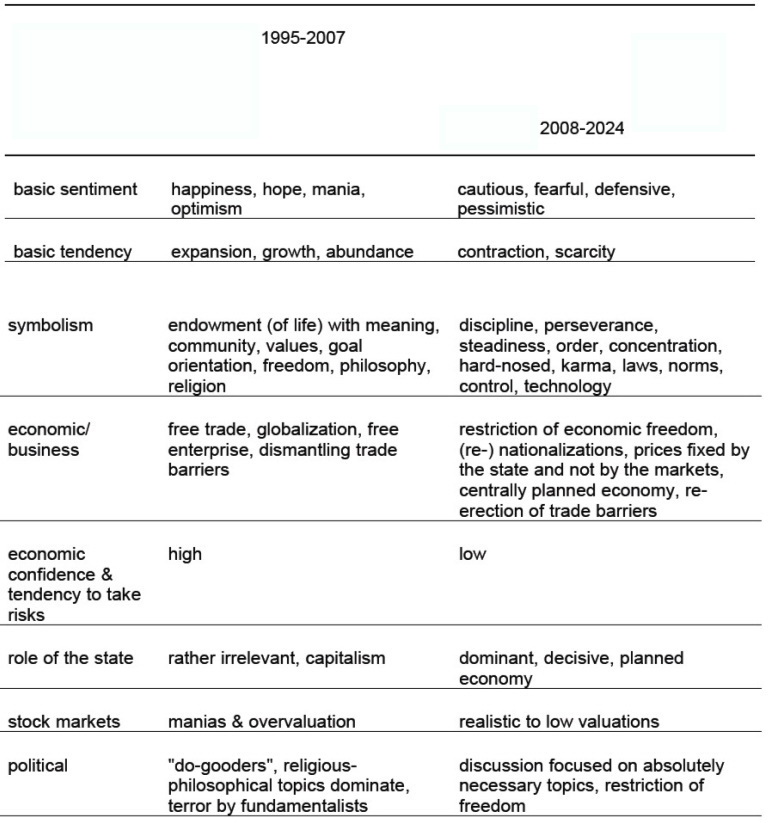
Today we’ll review one of the single best pieces of economic / political / social analysis I’ve been lucky enough to see. Read this post and you’ll have an extremely important input for how the world will proceed over the next eleven years. How can I make such a statement? Because this analysis landed on my screen in December, 2007, and it covered the time period from 1995 through 2024, and it has been working extremely well. I promised more about cycles. This is from the world of cycles.

Understand this analysis and you will understand what Ben Bernanke of the US Federal Reserve has publicly admitted has been befuddling him and his colleagues.

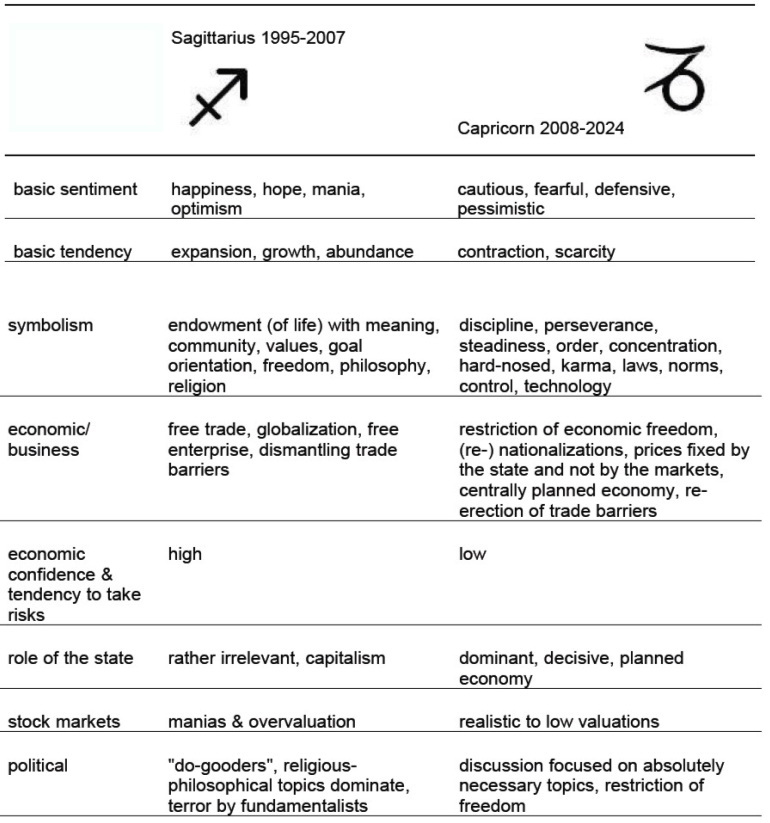
At the time of publication at the end of 2007, this analysis said that we had reached a major turning point: That while the period from 1995 through 2007 had been characterized by optimism (think of all the “new era” talk), manias (think bubbles in stocks and real estate), high confidence, free enterprise, free trade, globalization, unfettered capitalism, and so forth–all of which had clearly been at the forefront during that period–that the period from 2008 through 2024 would be characterized by caution, fear, contraction, pessimism, restrictions on freedom, economies planned by the state, trade barriers, low confidence, and so forth. Here is part of what was presented:

Manfred_Pluto_Switch_ed

To put it mildly, an awful lot of people would have benefited if they had known about this huge switch that did occur, just as predicted, in January 2008. It really was as if, at the end of 2007, someone threw a big switch and changed things dramatically. Central bankers and politicians around the world are still scratching their collective balding heads about why all of the things they used to do in the past, things that would work to stimulate economies, are barely working today. At first they used their old tried-and-true methods–lowering interest rates, feigning confidence, stuffing cash into the banks, spending money on stimulus plans–and they got an anemic recovery at best. So they pulled out the really big guns. “Unconventional” methods, as they call them. Also known collectively as printing money. Lots of it. Enough since 2009 that they have basically tried to add the equivalent of one year of the US economy to the global economy.

What has it got them? Well, since the printed money went into buying assets rather than creating jobs, the rich and their vendors–Sotheby’s, Porsche, Armani, et al–have done very well. Everyone else, not so well. The huge divide between rich and poor is widening at an accelerating pace. Historically, that has always been a dangerous setup. You can only push people so far before they push back. Sometimes fiercely. Overall, what it got them was continuing recession and debt crises in Europe, a US economy with paltry growth at best, and China joined the club of getting themselves over-indebted to keep their economy growing, but now that excess of debt is coming back to bite them and their economy is rapidly losing steam. Japan remains in near-continuous recession no matter what they do.

Since the analysis above has been working remarkably well for 18 years, it makes a whole lot of sense to figure that it will keep working for the next eleven years. That was the claim for this cycle, that it would have two phases, one from 1995 through 2007, and the second, radically different in tone, from 2008 through 2024.

What could be the cause, the source, of such an influential cycle, one that seems to have changed the energetic tone for the majority of people, from excessive optimism from 1995–2007, to caution from 2008–2024? Let’s show more about what the top of that table looked like when presented in December 2007, right at the point of the big switch:

Manfred_Pluto_Switch_ed2

The table was astrological in nature.  It showed what was about to happen as Pluto moved  from Sagittarius into Capricorn.

This outstanding piece of analysis was put forth by Manfred Zimmel through his web site  in his Forecast Issue for the year 2008. At the web site, you can sign up for his free newsletter or paid subscription service. The information above was given to his paid subscribers only.

Now I know that some readers here have a low opinion of astrology. I would say two things about that: First, I agree that popular astrology as shown in daily newspapers and glossy magazines is worse than useless. Second, as with most complex fields of endeavor, there is a small group of practitioners doing excellent work and a much larger group of practitioners who do not. But excluding astrology from one’s view of the world precludes access to information like the above, which can be exceptionally useful in guiding real world decisions. Also, it can provide an outstanding “truth filter” for claims about the world. For example, the article at this link contains five predictions Bernanke made in 2008 that, armed with the information above, one could see at the time that these were more than likely to be wrong. They turned out to be, in fact, entirely wrong:

1/10/08 — The Federal Reserve is not currently forecasting a recession. WRONG

2/27/08 — I expect there will be some failures [among smaller regional banks]… Among the largest banks, the capital ratios remain good and I don’t anticipate any serious problems of that sort among the large, internationally active banks that make up a very substantial part of our banking system. WRONG

4/2/08 — In separate comments, Mr. Bernanke went further than he had in the past, suggesting that the Fed would remain aggressive and vigilant to prevent a repetition of a collapse like that of Bear Stearns, though he said he saw no such problems on the horizon. WRONG

6/10/08 — The risk that the economy has entered a substantial downturn appears to have diminished over the past month or so. WRONG

7/16/08 — [Fannie Mae and Freddie Mac are] adequately capitalized. They are in no danger of failing… [However,] the weakness in market confidence is having real effects as their stock prices fall, and it’s difficult for them to raise capital. WRONG, they needed bailouts to the tune of $160 billion.

The point here is that automatically excluding information because of its source can put a person at a distinct disadvantage in understanding how the world works and where it is heading. Anyone who has read more than a couple of my posts knows that I regularly give the US Federal Reserve a well-deserved lambasting for its lies, its attempts to get over-indebted people to borrow and spend more, and its only real goal: protecting the stranglehold that the large banks have on our society. But I used one of their reports in 2005 to decide when to sell out of real estate. They published a great research paper in 2005 that analyzed the history of maybe 30 real estate booms and busts from many countries. They said that real estate bubbles popped in the following manner: once sales volume peaked, price peaked, on average, six months later. US sales volume peaked in October 2005, and the US price peak was in June 2006, so their estimate was quite good. I took their research seriously and sold in Feb 2006. They, however, did not take their own research very seriously, at least in their public statements. Here are some quotes from Bernanke in 2007 (I won’t bother putting the WRONG label after each.):

7/1/2005CNBC interview:

INTERVIEWER: Tell me, what is the worst-case scenario? We have so many economists coming on our air saying ‘Oh, this is a bubble, and it’s going to burst, and this is going to be a real issue for the economy.’ Some say it could even cause a recession at some point. What is the worst-case scenario if in fact we were to see prices come down substantially across the country?

BERNANKE: Well, I guess I don’t buy your premise. It’s a pretty unlikely possibility. We’ve never had a decline in house prices on a nationwide basis. So, what I think is more likely is that house prices will slow, maybe stabilize, might slow consumption spending a bit. I don’t think it’s gonna drive the economy too far from its full employment path, though.

10/20/05: BERNANKE: House prices have risen by nearly 25 percent over the past two years. Although speculative activity has increased in some areas, at a national level these price increases largely reflect strong economic fundamentals. (Ha!)

So, acting on the Fed’s research can be very helpful. Acting on their opinions and forecasts is a mistake. They aren’t trying to help you, they are trying to help the banks. Anyone who understands that distinction can put Fed forecasts in the proper perspective.

So the next time you hear rosy predictions about the great recovery that is turning out to be perennially “just around the corner,” whether those predictions are from someone who is mistaken or someone with malevolent intent, now you can understand that what these forecasters are up against is this: for an economy based on debt to grow, they need to get people to borrow more money. And until 2024, people are under the influence of Pluto in Capricorn, and most of them don’t really want to take on more debt. Quite the contrary, a lot of them have replaced the notion of “how much debt can I qualify for” with a wish to have less debt. Many have now seen the slavery of debt and they didn’t like what they saw.

Perhaps after 2024 the economists will be able to stimulate the majority’s “animal spirits” again. The question is: can this financial system, which depends on the constant growth of debt, survive through 2024 with people not wanting more and more debt?  I decided quite some time ago that the answer is no and persistently take those pleasant actions that ready a person for financial system collapse.  I take the influence of this Pluto “big switch” as a small but important part of the energetic change bringing us the long-awaited Transition.

Thanks to Manfred Zimmel for permission to reprint this excellent piece of research.

Accelerating Truth

Most people have been trained to internalize only those ideas that come from honchos, that is, political and religious big shots, “experts,” very rich people, celebrities, etc. The powermongers capitalize on this when faced with criticism of the system by often resorting to what the logicians call ad hominem attacks, that is, they deflect attention from the criticism by attacking the person delivering it, attempting to undermine that person’s credibility. They characterize the malcontents as crazy, unpatriotic, uninformed, uneducated, or as crackpots, charlatans, imbeciles, demons, and so forth, while never addressing the issue at hand.

So for a more general public understanding of the nature of our system, it helps when people considered to be honchos start publicly discussing what is in fact going on. Other honchos are less likely to try to pull the ad hominem attack on one of their own. In other words, truth about the nature of our system needs to emerge from the blogosphere and into the mainstream. This process is accelerating.

Below is a link to an amazing video showing Columbia Professor Jeffrey Sachs speaking to a conference organized by the US Federal Reserve:

     Columbia Economist Dr. Jeffrey Sachs speaks candidly on monetary reform

He begins by reporting that he was just at a meeting with foreign ambassadors at the UN who were asking:

“Why are we taking advice from the people who have managed the financial system so badly?”

He goes on to say that while people expect economists to talk about statistics and monetary issues, that the real problem with the system is as follows:

We have a mountain of criminal and fraudulent behavior…The amount of utter criminality and financial fraud is absolutely enormous…This is what’s called the American financial system at the moment.  It’s an unregulated essentially lawless environment…

This is a profound failure of government…

I regard the moral environment as pathological…

We have a corrupt politics to the core. Both parties are up to their necks in this. It really doesn’t have anything to do with right wing or left wing. The corruption, as far as I can see, is everywhere.

Sachs follows that by saying that he meets with the top Wall St CEOs on a regular basis and the common feature he observes is that these people believe they can do anything they want, legal or not, with impunity. And that given their takeover of the politicians and regulators, they are correct!

Now this isn’t coming from MIT’s Prof. Noam Chomsky–who, let’s face it, was decades ahead of all of us in pointing out the criminality of the corporate/political system–it’s coming from a highly respected Columbia professor.

For a few years now, the money printing central banks such as the US Federal Reserve (the central banks have directly printed at least $16 trillion and counting) have been told by bloggers that this money is not supporting jobs and the economy, but rather that it is going to the rich who are bidding for financial assets and causing bubbles in multiple asset markets including stocks, bonds, and real estate. People like Ben Bernanke, his henchman, and academic and Wall St economists have denied this.

But now we find out, from a Freedom of Information Request by Bloomberg and from a leaked Fed document, that the banking insiders who advise the Fed are finally saying the same thing that the continuously-discredited bloggers have been saying all along: that the money printing is creating bubbles in farmland prices and student loans, and:

There is also concern about “an unsustainable bubble in equity and fixed-income markets given current prices.

And for years, bloggers have said that the central banks cannot possibly stop printing more and more money or the whole edifice will crumble, another charge that is roundly derided. The Fed has claimed repeatedly that it has the tools to undo all the money printing so that it will never cause a problem. But now their own banker advisory panel says that if the Fed stops printing, it “may be painful for consumers and businesses…” and thatthe Fed may now be perceived as integral to the housing finance system.” In other words, if the Fed stops printing, the “housing finance system” will collapse. Which it would. In a heartbeat.

People like Matt Taibbi of Rolling Stone have been stalwart in documenting the ongoing manipulations in the interest rate, municipal bond, derivatives, and oil markets. And others have offered very strong evidence of manipulation of the stock market and precious metals markets. Taibbi recently wrote that “everything is rigged.” The US Bond market, the largest in the world, is certainly rigged: the Federal Reserve itself buys 75% of the bonds issued by the US Treasury. And the Fed announces, at the start of each month, which days it will be buying bonds through the Wall St firms in the coming month. The stock market always rises on those days. Always. Why? Because the Wall St firms take that money, leverage it up by further borrowing, and buy stocks. The Fed wants exactly that: they believe that a rising stock market makes people feel a “wealth effect” and therefore they will go out and spend more money in the real economy.
So finally, along comes one the largest banks in the world, Deutsche Bank, saying:

We would stress that we fully understand why the authorities wouldn’t want free markets to operate today as the risk of a huge global default and unemployment cycle would still be very high.

And a recent member of the Federal Reserve Board, Kevin Warsh, said that their money printing is not working and they are losing credibility:

…over the last several years, [the Fed] has over-promised and under-delivered, and the bank’s most important asset – credibility – is under attack.

One would think that, if their strategy isn’t working, that they have other tools they can bring to bear. That’s what they tell us. But Warsh says, “There is no Plan B.”

Bloggers have been warning that European banks are insolvent and getting worse all the time. Now the European Central Bank itself admits that the “euro zone’s slumping economy and a surge in problem loans were raising the risk of a renewed banking crisis.”

Here is an interview with the President of the Chicago Mercantile Exchange, that place where they trade paper and electronic instruments that have an increasingly tenuous connection with physical things like gold, silver, copper, oil, etc. From the interview:

What’s interesting about gold, when we had that big break two weeks ago we saw all the gold stocks trade down significantly, we saw all the gold products (ed: futures) trade down significantly, but one thing that did not trade down, was gold coins, tangible real gold.  That’s going to show you, people don’t want certificates, they don’t want anything else.  They want the real product.

Then there is the supposed eternal juggernaut of the Chinese economy that will keep all the other floundering countries afloat. Much of that juggernaut has been propelled by debts taken on by local governments to promote the economy in their areas. But now the Financial Times reports this:

A senior Chinese auditor has warned that local government debt is “out of control” and could spark a bigger financial crisis than the US housing market crash.

Zhang Ke said his accounting firm, ShineWing, had all but stopped signing off on bond sales by local governments as a result of his concerns.

Last but not least, an insider is finally speaking up about nuclear power plants in the NY Times:

All 104 nuclear power reactors now in operation in the United States have a safety problem that cannot be fixed and they should be replaced with newer technology, the former chairman of the Nuclear Regulatory Commission said on Monday…

The position of the former chairman, Gregory B. Jaczko, is not unusual in that various anti-nuclear groups take the same stance. But it is highly unusual for a former head of the nuclear commission to so bluntly criticize an industry whose safety he was previously in charge of ensuring.

This system is coming apart at the seams. Insiders and whistlebowers are finally describing the details. The US Government realizes this and is desperately trying to keep whistleblowers from telling the truth by filing charges against them and trying to ruin their lives. Ultimately, it won’t work. I just hope that everyone reading here takes those actions they need to take. By the time the collapse is on the television Nightly News and Page 1 of the newspapers, with the system honchos all claiming “No one could have seen this coming,” it will be too late.

Update on Metals, Deposit Confiscation, and Capital Controls

…one goal is to get to the point where all market participants understand with certainty that if a large SIFI (systemically important financial institution) were to fail, the losses would fall on its shareholders and creditors
–Governor Jeremy C. Stein, US Federal Reserve Board, Regulating Large Financial Institutions, speech at a conference sponsored by the International Monetary Fund, April 17, 2013

* * *

“Bank creditors,” as it happens, is a class of people that includes bank depositors. Everything about the rhetoric of banking is designed to obscure this. You deposit money in your bank account…But what you’ve really done is loaned the money to the bank…
Slate.com

A big price drop in the precious metals. So let’s see, on Thursday, April 11:

     CEOs of biggest U.S. banks to meet with Obama on Thursday

and the big selling in metals took place on Friday, April 12 and Monday, April 15.  No chance of any causation in that correlation. Nah. Move along. As Leslie Nielsen said, “Nothing to see here.

Anyway, with all that selling, there must be lots of inventory of coins around. That’s what they teach in Econ 101, right? That if a price is plunging, it’s because people are dumping large quantities of that item onto the market.

But there isn’t lots of inventory. Inventory is very tight, sold out in many cases. Delivery lead times are out to five or six weeks, and that’s if you can even place an order for what you want.  Big-volume dealers like Tulving.com are entirely out of one-ounce silver coins minted by any country, and they have been since April 15. You can scroll down this page at their web site to see how many items they normally sell are currently sold out.

And these people make a living buying and selling lots of coins. They really want to do a lot of business. And they are happy to buy right now, but they can’t sell lots of items because there aren’t any available.

This scramble to buy physical bullion coins is going on worldwide.

In Australia:

     Golden times for Perth Mint

The volume of business that we’re putting through is way in excess of double what we did last week,” Treasurer Nigel Moffatt said, without giving precise figures. “There’s been people running through the gate.”

In Japan:

     As global price slumps, “Abenomics” risks drive Japan gold bugs

But on Tuesday, buyers outnumbered sellers by a wide margin. At Ginza Tanaka, the headquarters shop of Tanaka Holdings, gold buyers waited for as long as three hours for a chance to complete a transaction.

In India:

     India’s Response To The Gold Sell Off: A Massive Buying Frenzy

In China:

     Chinese Gold & Silver Exchange Society Runs Out of Gold…Importing from Switzerland and London

Now we discover that the Chinese Gold & Silver Exchange Society has essentially sold out of gold bullion, and must wait until Wednesday for shipments to arrive from Switzerland and London.

     Gold Buying Frenzy Continues: China, Japan, And Australia Scramble For Physical

In the US:

     US Mint Sells Record 63,500 Ounces Of Gold In One Day

According to today’s data from the US Mint, a record 63,500 ounces, or a whopping 2 tons, of gold were reported sold on April 17th alone, bringing the total sales for the month to a whopping 147,000 ounces or more than the previous two months combined with just half of the month gone.

     Bullion Shortages Develop As Retail Demand Skyrockets

…on Monday there was such chaos in the markets that some of the larger wholesale dealers had to shut down at various times because of the massive demand on the buy side… Gold and silver buyers are still outpacing sellers by a stunning 50 to 1.  There were premium increases on everything bullion related.  The wholesalers are now telling us four to six weeks on silver maple leafs, and wholesalers quit taking orders on one ounce silver rounds.

In Canada and Europe:

     Massive Run On Physical Gold & Silver At UBS & Scotiabank

At the Bank of Nova Scotia in Toronto the gold window has been absolutely swamped. I have confirmed there were people lined up in droves recently for multiple-hours at a time to buy gold and silver bars and coins….

“I then confirmed with UBS today in Zurich, Switzerland, that they are experiencing exactly the same thing. They told me people are waiting in long lines for bullion related bars and coins. The physical market is incredibly tight…

In Switzerland:

     Refiners Can’t Keep Up With Massive Global Gold Demand

If you look at our company, as just one example, we did not have one single seller in the last few weeks.

So during this takedown in gold and silver there wasn’t one single seller, only buyers….

If we turn to the Swiss refiners, Eric, the premium over spot for physical gold is rocketing. Swiss refiners are unable to keep up with the demand for immediate delivery. They are working flat out, including the weekend, and still can’t keep up.

The Swiss refiners are seeing global demand coming in from everywhere, especially from the Middle-East and the Far-East. So, again, this proves that the artificial manipulation of paper gold has nothing to do with the physical market.
–Egon von Greyerz, Matterhorn Asset Management

So, with all that buying interest in real physical gold and silver, why has the price been falling? Because the two largest trading venues on the planet for metals, the LBMA (London Bullion Market Assoc.) and the COMEX in the US, are the places where the price of gold is currently set. And 99% or more of the trades there that are said to be related to gold are not for the physical metal, they are futures contracts that are traded for cash, not physical gold. In other words, these are very large trading casinos. But like the banks, they are fractional reserve systems. In other words, if everyone who had a futures contract for gold actually wanted physical gold for their contract, there would not be anywhere near enough gold to go around. Even supporters of the LBMA admit there is maybe 1% physical gold backing all these contracts. So that’s even more leverage than is used at most banks. A lot more.

Monday, April 15 was a good example. Andrew Maguire–an LBMA trader and whistleblower who the Powers That Be ran down, but did not kill, with a car in 2011 right after Andrew gave testimony on silver price manipulation to the authorities—reported that on Monday, there was a period during which 155 tons of gold was sold on the LBMA in one hour. I can tell you for sure that no one who owned or was the custodian for 155 tons of physical gold would sell it in a panic into a falling market. This was selling of futures contracts that will be settled in cash. They have little or nothing to do with physical gold. People in charge of 155 tons of real gold do not sell in a panic. If they wanted to sell—and such a thing would be quite unusual these days when even central banks are net buyers of physical gold—they would do so carefully, trying to get the best price. They would sell on days when the price was rising, not falling. This is the way anyone with a strong profit motive sells, they hire good traders to sell over time when they can get the best price. They do not panic dump their holdings regardless of price.

In fact, Maguire reports that central banks picked up 55 tons of physical gold during that one hour period when 155 tons worth of paper gold contracts were sold.

Here are Maguire’s comments about Monday, April 15.

At some point, this charade will fall apart. The price of physical gold will separate from the price quoted in these paper instruments. This is already visible when one needs to buy coins at a premium above the spot price of the metal. During these smashdown selloffs (we’ve seen these before in 2006 and 2008), the premium above the quoted spot price for physical gold and silver rises, sometimes to as much as 50% above the spot price if you want prompt delivery. During those periods, the price for physical coins is not the quoted spot price, it is the spot price plus the premium, and that price can be substantially higher. These are the indications of the separation of the paper and physical gold and silver prices to come.

The press duly reported nearly the same quote from representatives of all of the banks. Yes, reps from those same banks that met with Obama on April 11. “Gold has lost its safe haven status. “ “Gold is no safe haven.” And on and on. They should have dressed them up in silly costumes and they could have danced and sang together, at least that would have been entertaining.

So why do they want to scare you out of, or away from, gold and silver? Two main reasons:

First, so that you cough up your goods so they can buy them on the cheap.

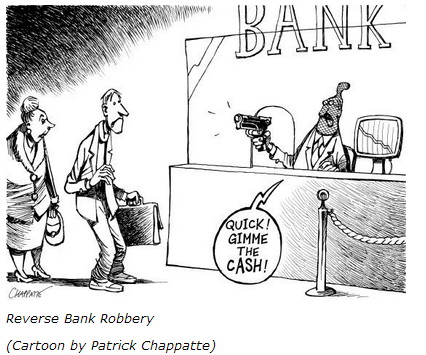
Second, when they go to “Cyprus” your accounts, that is, when they want to confiscate some of your money, they want it easily available with a few keystrokes. Confiscating gold and silver coins would be inconvenient at best, dangerous at worst.

Do you think “they’ll never do that here”? Here is the overall order of events in Cyprus:

1. On Feb 10, the Financial Times published the plan for the confiscation of depositor money in Cyprus called Radical rescue proposed for Cyprus.

2. On Feb 11, the Central Bank of Cyprus posted a letter shown at this link saying that the Financial Times article was incorrect, that confiscating depositor money was against the constitution, etc.

3. In mid-March, the confiscation of depositor money was announced.

4. The Cyprus parliament voted against it.

5. The central bank of the EU overruled the Parliament of Cyprus and went ahead with the confiscation. So democracy and the constitution were thrown out the window along with the promises.

On the day after the confiscation, the new head of the EU finance ministers, Jeroen Dijsellbloem, gave not one, but two interviews in the mainstream press in which he said the Cyprus bank resolution was a new template for such actions. From Reuters:

A rescue programme agreed for Cyprus on Monday represents a new template for resolving euro zone banking problems and other countries may have to restructure their banking sectors, the head of the region’s finance ministers said.

The rest of the EU and IMF politicians nearly had a baby on the public stage. For the next three weeks, all they would say was that Cyprus was not a template. We should have put them in a chorus line too. Even Dijsellbloem tweeted that he didn’t say what he said.

But then a member of the US Federal Reserve Board, Governor Jeremy C. Stein, said that if a Too Big to Fail bank failed, that private investors and creditors would have to bear the losses. His speech was on April 17, well after the Cyprus event wherein depositors were ruled as “creditors” of the bank. These people choose their words carefully. I hope everyone out there listens to them carefully.

And it’s worth remembering this: In the US, for example, the bank insurance fund held by the FDIC has $25 billion. That’s the amount insuring $9 trillion worth of deposits.  So that’s 370 times more deposits than the amount in the insurance fund. And the insured banks have an additional $297 trillion in exposure to derivatives. So that’s almost 12,000 times more than the amount in the insurance fund. Very safe and sound, eh? Now you know why the authorities have just hinted that banks won’t be simply bailed out anymore; people’s deposits will be bailed in. Just remember, they’ve put you on notice now that you need to determine whether or not your bank is safe. People who spend their whole lives trying to do that can’t figure out which banks are truly safe anymore, but so what, you are now supposed to be able to do that. You can see a chart of the FDIC situation here. And you can find out a little about the safety of any US bank at the Safe and Sound section here. I am not aware of what is available publicly available for bank analysis in other countries.

Also part of the Cyprus event were strong restrictions on how much money a person could take out of Cyprus, the dreaded capital controls. This is also part of the template. When that happens, people are stuck in their own currency even if it tumbles mercilessly in value. When people tried to switch their money into the electronic currency Bitcoins because it recognizes no borders, it doubled the price of Bitcoins in a few weeks. TPTB then smashed down the price of Bitcoins as well, to show people that there is “no safe haven.”

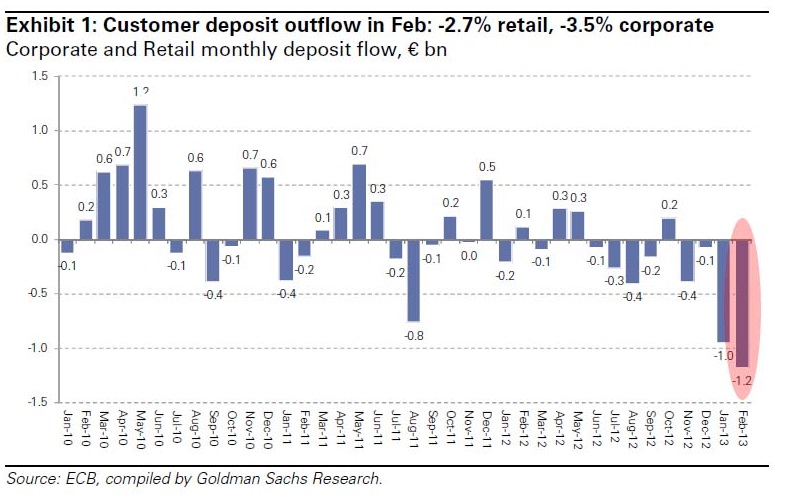
Throughout history, currency devaluations, capital controls, and asset confiscations are denied until after they have happened. Governments typically say, “Sorry, we didn’t want to do that, but we had no choice.” You need to either anticipate them or be a connected government crony. Here’s a chart of monthly deposits into and withdrawals from the Cypriot banking system. The large withdrawals in January and February show the strong likelihood that some people were given advance notice:

CyprusOutflows

Most people were not given advance notice; if the time comes, you and I will be in that group.

Lots of people are showing that they understand. As the stories above show, people were waiting in line for metals at these prices across the globe. We have seen this play before. Sometimes the elites smash down the prices of metals. Did I see it coming? Nope. Can they do it again? Yep. But as the rising price of gold over the last 12 years proves, they can’t push it down too far. If they do, the Asians and regular people will end up owning all of the gold. And the banksters won’t like that at all since they know the financial (per)version of the golden rule: he who has the gold makes the rules.

Lots of regular people on the planet take these price smashes as a gift. I think these people are smart.

Here is Jim Sinclair’s latest comment on the topic: The US Will Be Cyprused & We Will See $50,000 Gold.

And the recently-released video The Secret World of Gold, while not perfect, has Andrew Maguire briefly explaining how gold and silver prices are manipulated, and brings up the interesting question of whether there is any real gold (and not just gold-plated tungsten bars) at the US gold depository at Ft Knox. Channeled information agrees that Ft Knox is empty of real gold.  It will be a very interesting day when the world finds out about that.

CashGrab1

What is the Transition? Part 5

ACCELERATION

People’s Perception of Time

Everyone whom I have asked, including young people, feels like time is speeding up, like the day, the week, the year starts, and “before you know it,”, it’s gone. People feel like they have little time to carry out their plans. I would guess that this not universal, but perhaps it is.

Technology

And everyone, or certainly close to it, is aware of Moore’s Law, that the number of transistors that can fit on a chip doubles every two years. And Intel’s David House added that processor performance would double every 18 months. This acceleration in performance, and the fact that the price for that performance has steadily dropped, has changed the world in magnificent ways that have been difficult to envision at any point in time. People like Ray Kurzweil are famous for utilizing this increasing performance and for having made some prescient estimates of the impact of this exponential increase in price/performance, though some of his predictions have been wide of the mark, and it seems his general view that processors will outdistance human intelligence is destined to fail as well since a pathway to program a machine to have a higher self, intuition, noble emotions, will, self-awareness, and a sense of humor seems unavailable, to put it mildly.

Exponential, parabolic trends

As we did with the weather and Earth changes, let’s look at some data.

Money

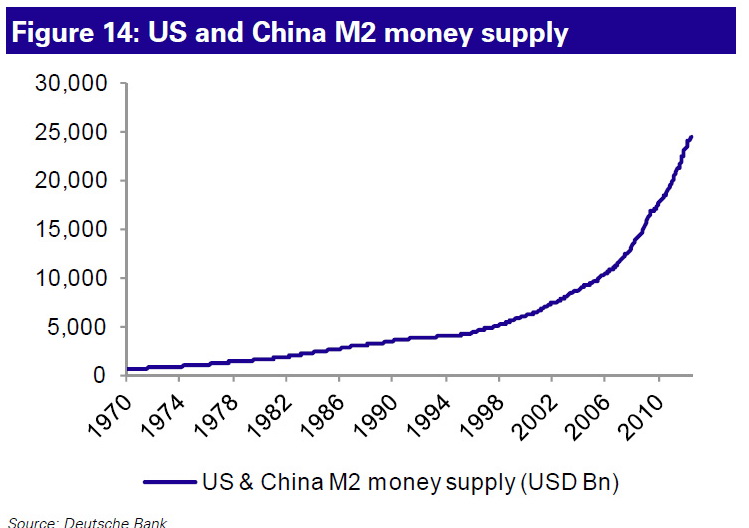
It took the USA until 1990, that is, over 200 years, to create the first trillion US dollars.  The rate of money growth had increased so much by 2007 that it took less than a year to create each additional trillion.  Now, it’s seemingly all in day’s (OK, maybe a month’s) work. Here’s a chart of the money supply in the US and China combined:

USChinaMoneySupply

Yep, between the US and China, that’s $25 trillion floating around.

Another way to look at things is this: From 1971 to 2007, the world economy grew fourfold. Over the same period, the amount of money floating around increased forty-fold. And central banks were just leaving the proverbial starting gate in 2007; the continuing financial crisis had just begun, and the response was, and continues to be: Print Money!

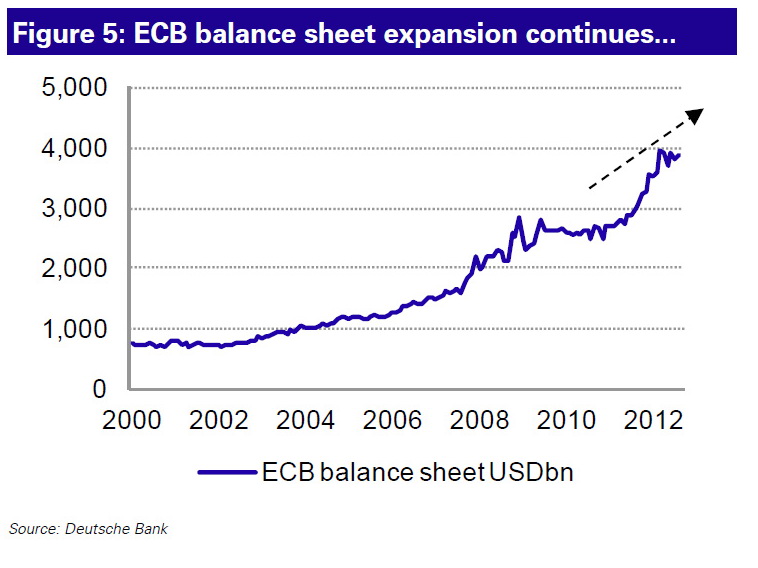
And don’t think the Europeans want the euro to be left out of this print-a-thon:

ECB_BS

And the Japanese just joined the US and the Eurozone saying they would print “whatever it takes” to get their economy humming again.

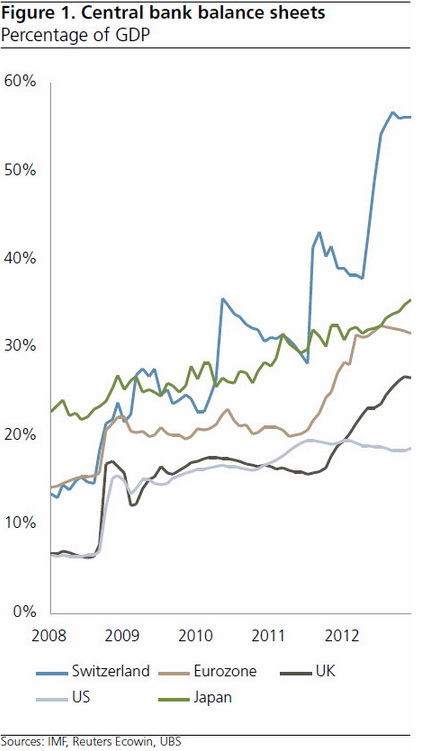
And the Swiss!?!? The most pronounced money printing line on this chart (in light blue) represents Switzerland, purported to be so conservative about money. Ah, the good old days! No longer. For the size of their economy, they are the current money-printing front-runner by a wide margin:

CentralBankBalanceSheets

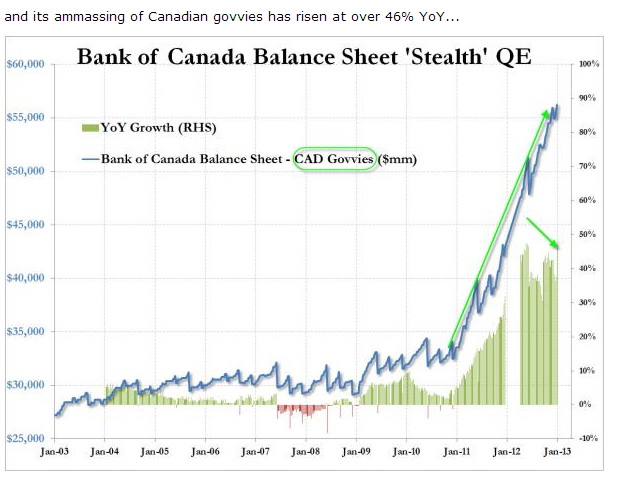
Et tu, Canada? (from zerohedge.com)

CanadaPrinting

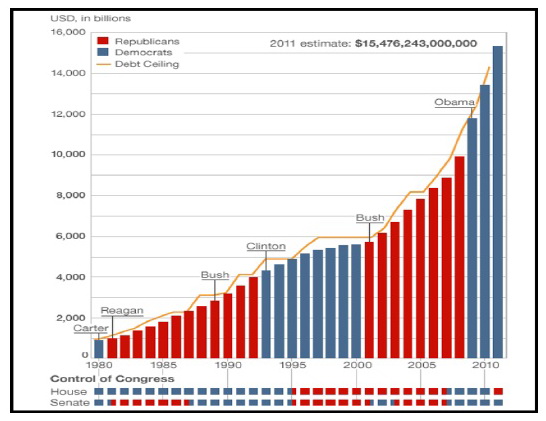
And this has little to do with political parties, as shown on this chart of federal government debt in the US:

USDebt_DemsRepubs

though I would ask that you note the super-acceleration of this trend that started in the year 2000.

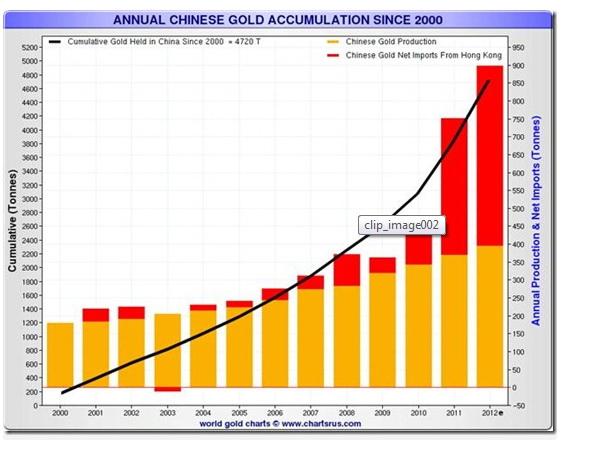
And in today’s world, the Chinese are the ones doing the heavy lifting in terms of manufacturing, so they are collecting a lot of this printed paper money, in other words, the West prints paper, sends it to China, and gets real goods in return. But the Chinese aren’t stupid, they are well aware of how much more of this paper is being created. So what’s their solution? To get real:

ChineseGoldAccum

The Chinese mine more gold than any other country now—none of which leaves the country–and they import even more physical gold from other countries. Insiders at the London Bullion Market Association, the leading venue in the world for trading physical gold, say that the Chinese are vacuuming out the London gold warehouses. And the Chinese are scouring the planet to buy mines, wells, and so forth, especially in Africa

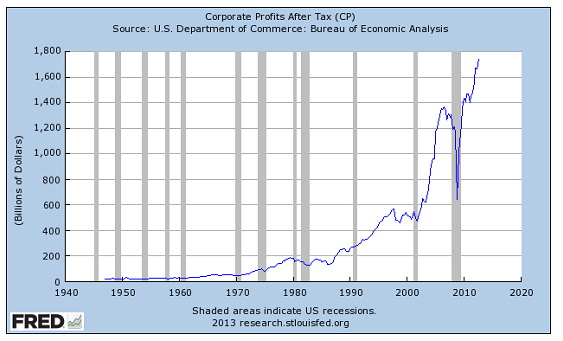
But really, one would think that, with all this money floating around—there must be at least 200 times the money around now versus 1971–everyone must be rich! But we know that’s hardly the case. Sure, there are other parabolic charts, like the one for corporate profits:

CorporateAfterTaxProfits

The corporations seem to be doing quite well. And US banks had profits of $35 billion in the fourth quarter of 2012 alone. (Yes, the same banks that needed those big bailouts. As a group, they had a total of four quarters where they weren’t profitable. It’s been business as usual ever since. And they are hard at work telling legislators, as they bribe them, that any new regulations will seriously hurt their business.)

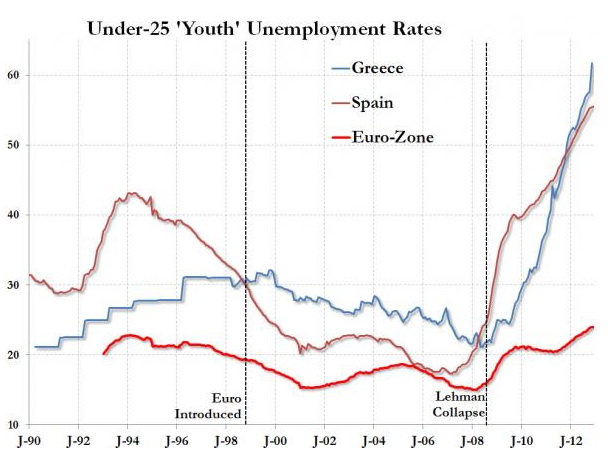
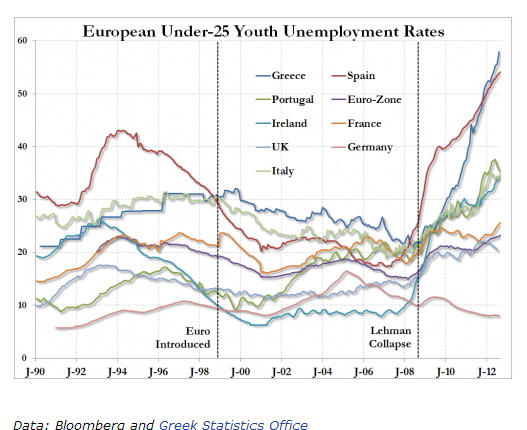
But other parabolic charts tell a different story. Here’s one for youth unemployment in the Eurozone (from zerohedge.com):


GreekYouthUnemployment

Yes, that’s over 60% youth unemployment in Greece, with Spain right behind.

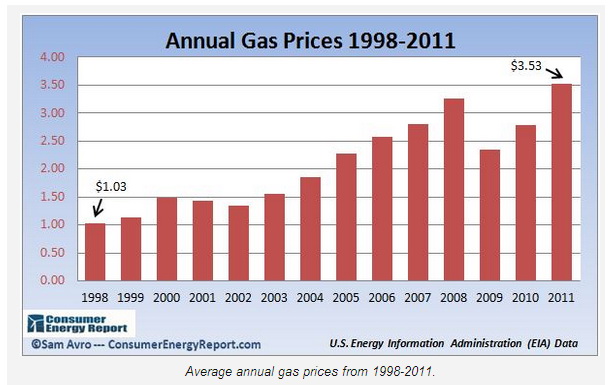
And gasoline prices are “doing great”—for the oil companies, that is. Here’s the price chart for the US, with gas up 243% since 1998:

GasPrices

That chart is only through 2011, but since US gas prices just registered their highest ever price for a February here in 2013, this trend does not seem to be in jeopardy.

And the Food Price Index of the UN Food and Agriculture Organization is up 132% since the year 2000, with the all-important cereals/grains index up 190%. This is putting an extreme and accelerating squeeze on the budgets of the poor around the world.

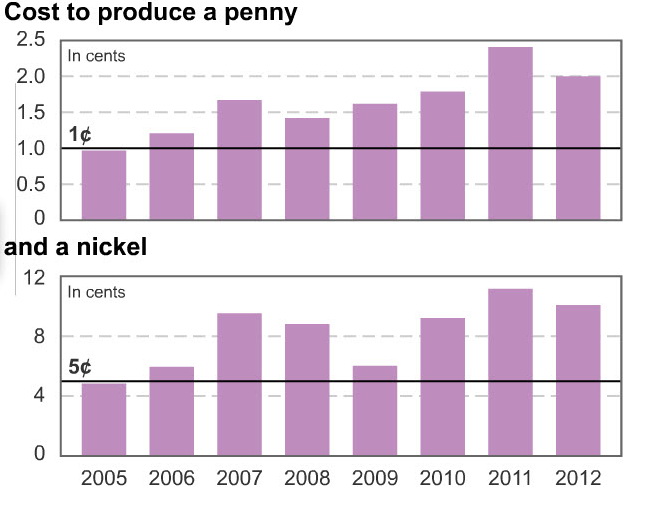
This article contains the chart below showing that in 2005, it cost the US government one penny to mint a penny and one nickel to mint a nickel. Now, after all that money printing, it costs twice as much:

PennyAndNickel

resulting in a loss of $436 million for the Government of the US (GUS) to mint pennies and nickels since 2006.

So it seems clear that the accelerating money printing is accelerating the cost of real things that people need: gasoline, food, the metals that go into manufactured products, and so forth.

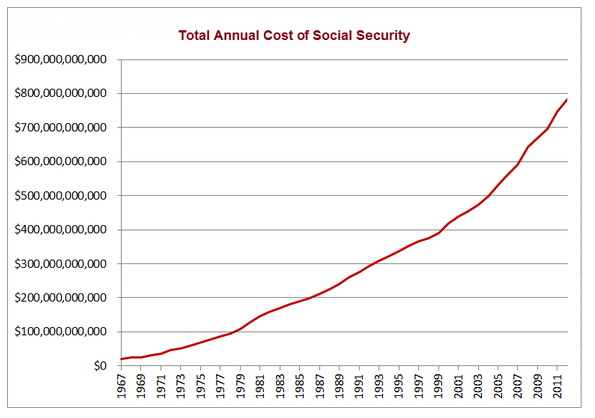
Here’s the accelerating cost of Social Security in the US:

SSA_TotalCost

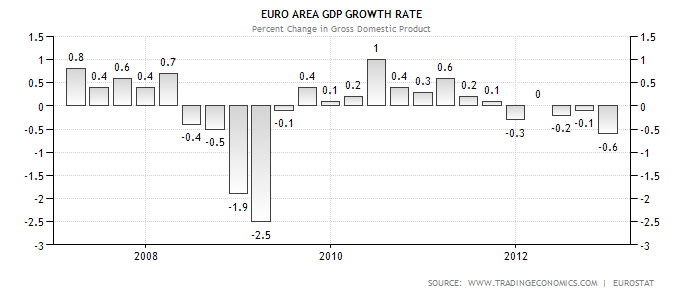
Well, we saw the accelerating youth unemployment in the Eurozone above. And the EU just announced that its overall unemployment rate is 12%. And, as this chart shows, there hasn’t been any growth in the EU economy since late 2011 (chart source):

EU_GDP

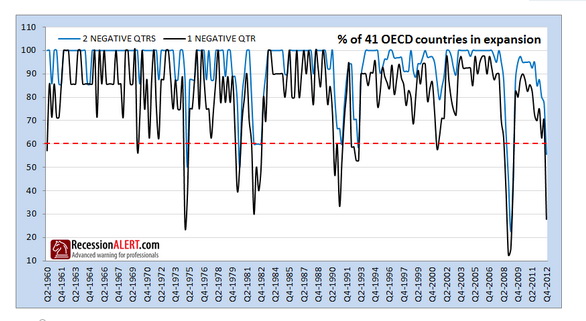
In the US, GUS says the economy hit stall speed (0% “growth”) in the Fourth Quarter 2012. Here is a chart that shows that, of the 41 largest national economies in the world, only 18% of them expanded in the Fourth Quarter of 2012:

OECD_Expanders

Astute chart readers will notice that such a reading corresponds with the worst recessions (1973-74, 1981-82, and 2008-2009) of the last 50 years, so now you know why the central banks have started printing even more money–yes, accelerating!

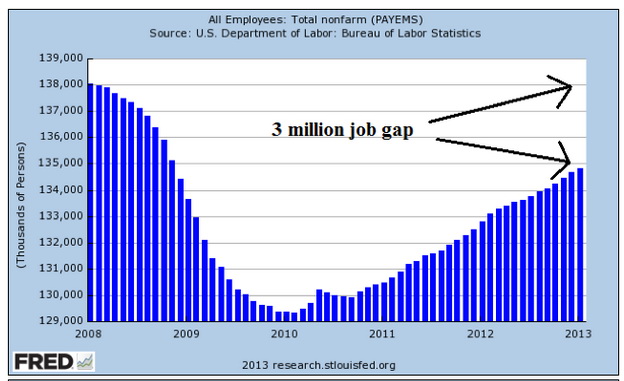
How is it going for jobs in the US? As this chart shows,  the US is still 3 million jobs short of where things were in 2008:

JobsUS

Even worse, as the next chart shows, the large increase in the number of people working part-time means that a lot of the apparent job gains shown on the previous chart are part-time rather than full-time jobs:

PartTimeUS

If you think it’s only uneducated people who are suffering from all this, check this:

     Number Of PhD Recipients Using Food Stamps Surged During Recession

The number of PhD recipients on food stamps and other forms of welfare more than tripled between 2007 and 2010 to 33,655, according to an Urban Institute analysis cited by the Chronicle of Higher Education. The number of master’s degree holders on food stamps and other forms of welfare nearly tripled during that same time period to 293,029, according to the same analysis.

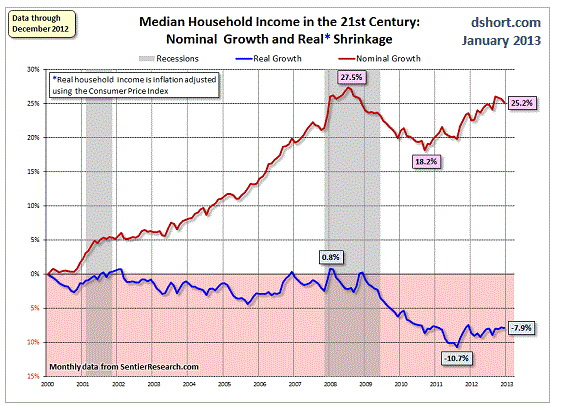
These job difficulties are reflected in household income in the US. The following chart shows two problems. While the red line shows income growth since 2000, it is still lower than it was at the start of the financial collapse in 2007. And the blue line shows household income adjusted for inflation. When GUS-calculated inflation is taken into account, income for the average household is 8% lower than it was 13 years ago:

RealIncome

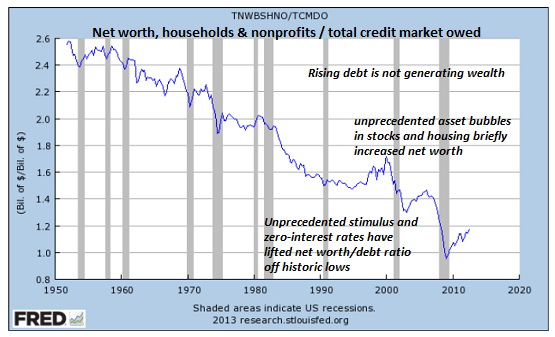
Here is a chart of US household net worth (annotated by Of Two Minds) compared to all of the debt that has been created, showing that all of that debt is not making people richer:

NetWorthbyDebt

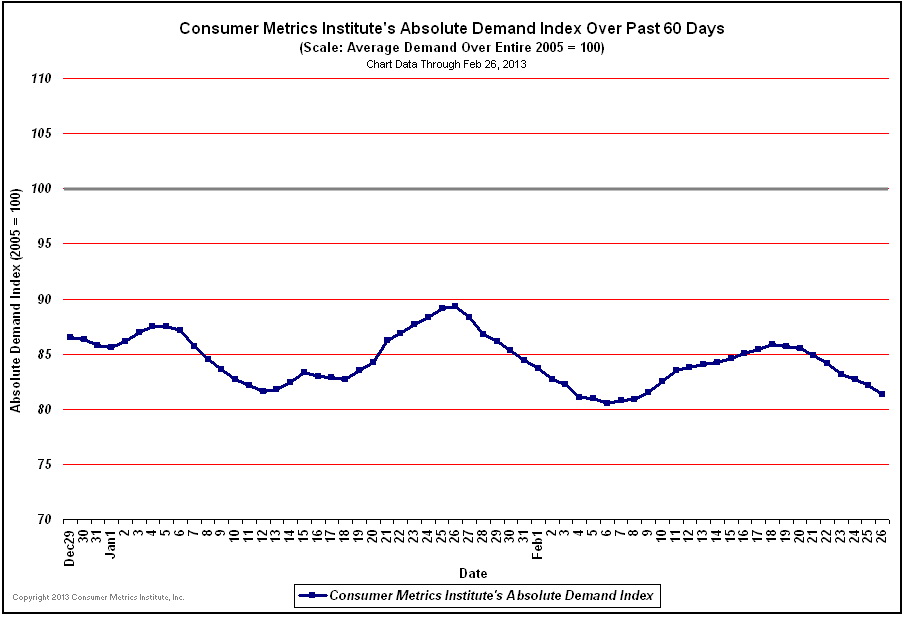
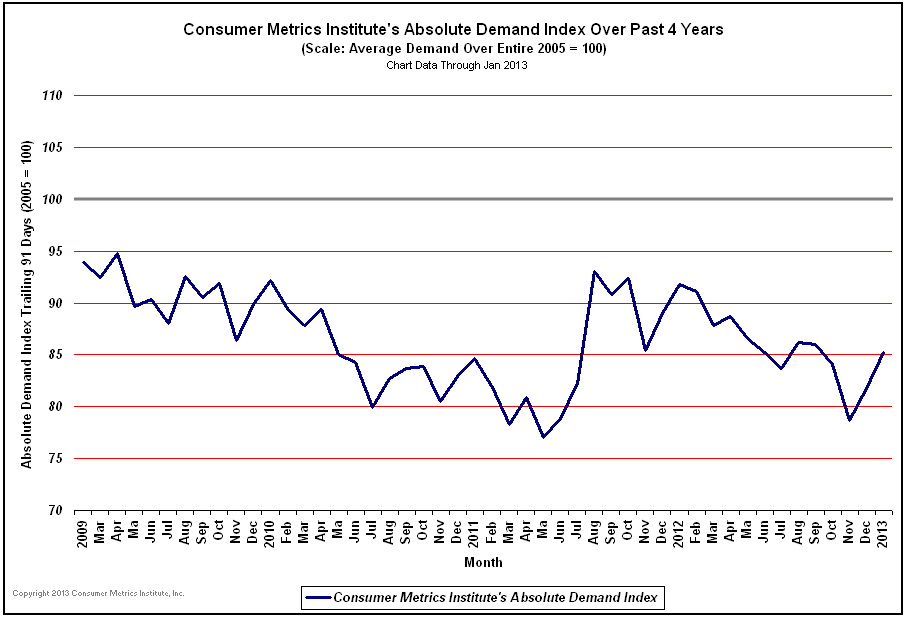
All of these economic charts were compiled by governments who, as we’ll show in a future post on the acceleration in lying, have a strong vested interest (it’s literally and even proudly called MOPE by academics—Management of Perception Economics) in making things look better than they are. In that light, I ask that you consider the following two charts compiled by a private bunch of computer geek types at a place called Consumer Metrics Institute. They thought, in this time of highly-networked business, that it was silly to have to wait until governments spent months collecting data before telling us what happened some months back, that the data could be collected and reported in near-real-time. If you wish, you can find out what they do at their FAQ.

But what they essentially do is track, in real time, discretionary purchases for things like automobiles, housing, vacations, durable household goods and investments.

These two charts show the trend in these purchases where a value of 100 would equal the same level of purchasing as was taking place in 2005. The first chart is the last 60 days:

CMIRecent

And the second chart is of the last three years:

CMILong

So, both charts show their index hovering around 85 or lower, which means that this large portion of the US consumer economy is 15% smaller than it was in 2005! Perhaps that aligns better with the income and net worth charts shown above rather than the rosy “we’re in a wonderful economic recovery” MOPE spewed by minions of The Powers That Be.

So what it looks like is that all that money printing is making a select few richer and, by driving up the prices of real goods, squeezing regular people—whose income is falling and who spend a far greater percent of their income on real goods. And the Western central banks say it isn’t their fault that people are rioting in countries where people’s costs for food have gone from 40% to 80% of their income. Nope, they aren’t driving prices up at all with their money printing, it’s those “evil speculators.” Well, perhaps it is evil speculators, but they are aided and abetted by a vast surplus of gambling chips supplied by the central banks.

There’s more to come. Stay tuned for Part 6.

Cliff Posers, and the Incredible Shrinking US Pie

If the politicians in Washington DC didn’t bring suffering to so many people, their posing with respect to this “fiscal cliff” would be laughable.

First, none of them intends to do anything substantive about the biggest problem of all: the Trillion Dollars the US spends each year on its war machine to maintain its rapidly fading pretense that Earth is part of the US Empire.

Second, none of them are including in their fake calculations the five additional bailouts that they all know are either already in play or right on the doorstep. The four new ones:

  • US Postal Service—losing $ billions every quarter
  • FHA—after “quasi-government” housing stimulus and campaign-finance corporations Fannie Mae and Freddie Mac went bust because they had enabled millions of insane mortgages, the FHA took over their role and rose from relative obscurity to be the new Federal backer extraordinaire of insane mortgages. As predicted by honest observers, it now needs a bailout.
  • PBGC—the Pension Benefit Guarantee Corp is now operating in the red.
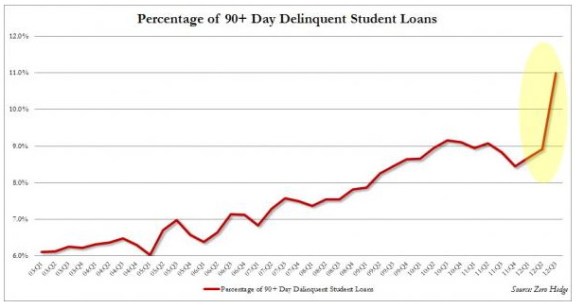
  • Student Loans—with the default rate now going exponential, everyone involved in this $ Trillion market will need a bailout. Check the trend on this chart of the 90-day default rate:

StudentLoanDefaultRate

The government headline admits that 11% of these loans are in default, but a reading of the fine print says it’s closer to 22%. That’s 22% of a $ Trillion in loans.

And the bailout that is already well underway:

Social Security—What? Some politicians claim the SSA is good through 2033. Strange claim, given that SSA will run $162 billion in the red for 2012. Well, they say it’s “only” a $47 billion deficit because there was a special payment from the Treasury of $115 billion to offset the “temporary” payroll tax cut. And if you think this year is some exception, the deficit for 2011, before the payroll tax cut, was $46 billion. One of the largest problems for Social Security is this: as cash was paid into the program into what was supposed to be the Social Security Trust Fund, the government spent that money and put IOU’s in the Trust Fund. Well, given the ultra-low interest rates paid on government IOU’s due to the low interest rate regimes run by Greenspan and Bernanke, the Trust Fund is earning at least $700 billion less in interest over the next 10 years than they thought they would be earning. So that thing about SSA being OK though 2033? Oops. For a look at the unhappy calculations, see this.

So how did this happen?

Here is a huge contributor: As reported by the World Bank, government statistics collected from around the world—and pretty much everyone agrees that government stats are just a bit biased to the upside—say that the global economy grew by a total of 9% from 2001 through 2011. By those same stats, in 2001, the US economy was 32% of the total world economy. By 2011, the US economy was just 22% of the world economy. That’s a huge 32% reduction in global market share for the US. These calcs are here.

So the question is: How does a country have its economy shrink by 32% in terms of its share of the world economic pie and yet keep spending a $ trillion a year on war and keep all of its benefit programs and government agencies intact? Doesn’t this lead to some type of breaking point? Normally, yes. But so far, the solution has been simple: the country borrows the money. In 2001, the US owed $6 Trillion. Now it owes over $16 Trillion. But won’t people stop lending to such a country? Yes, but the Federal Reserve prints up new money and buys the excess new debt authorized by Congress and issued by the US Treasury. For the next three years, the Fed admits to planning to buy virtually all of it. See Treasury Scarcity to Grow as Fed Buys 90% of New Bonds. Simple? Yes. Sustainable? Not in the recorded history of this planet.

So when you hear the cliff posers from both parties trying to score political points, remember that what they aren’t talking about is far larger than what they are talking about. And that what they aren’t talking will have a far bigger impact on all of us.