JFK and the Federal Reserve

It turns out that the 50th anniversary of JFK’s assassination is the 100th anniversary of the birth of the Federal Reserve at a secret meeting at Jekyll Island, Georgia, USA. Coincidence? Perhaps. But perhaps someone was trying to send a very specific message about who is in charge.

Here’s a quote about Jekyll Island:

The New York Times later noted, on May 3, 1931, in commenting on the death of George F. Baker, one of J.P. Morgan’s closest associates, that “Jekyll Island Club has lost one of its most distinguished members. One-sixth of the total wealth of the world was represented by the members of the Jekyll Island Club.” Membership was by inheritance only.

The Federal Reserve was created on Jekyll Island in complete secrecy by, who else, representatives of the big NY and European banking families. It gave the Federal Reserve the power to create the nation’s currency. This was unconstitutional then and now since the US Constitution delegated that power solely to Congress and that section of the Constitution has never been amended.

It turns out that JFK used Executive Order 11110 in an attempt to return the power to create US money to the US Treasury. He correctly saw that the US debt was building; that this would be bad for the country; that US money should be created directly by the Treasury and backed by gold and/or silver, not loaned into existence by the Federal Reserve, causing the US to have to pay interest on every dollar created. And there is absolutely no good reason for that “loaning into existence”, except from the point of view of those who do the loaning, namely the banks, who make astronomical profits from this process, saddling the US and its citizens with ever-increasing debt from which there is no escape.

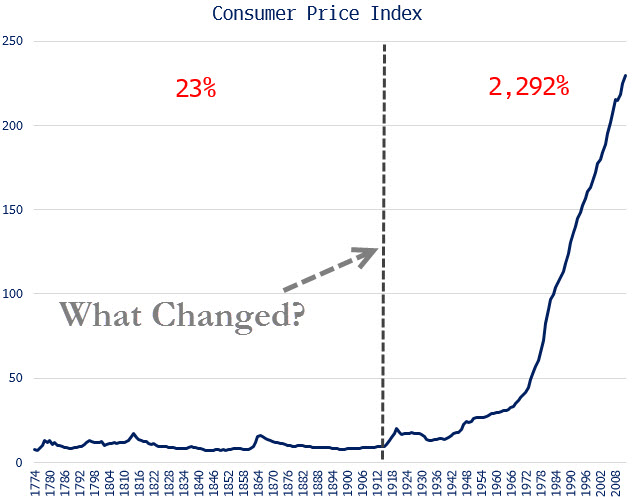
As this chart shows, the US Consumer Price Index was remarkably steady until the creation of the Federal Reserve in 1913. It has been on an explosive upward path ever since, leading most people alive today to believe that inflation and price increases are normal. They are not!

inflationhere20131122

Here is a quote about JFK in the book Crossfire:

Another overlooked aspect of Kennedy’s attempt to reform American society involves money. Kennedy apparently reasoned that by returning to the constitution, which states that only Congress shall coin and regulate money, the soaring national debt could be reduced by not paying interest to the bankers of the Federal Reserve System, who print paper money then loan it to the government at interest. He moved in this area on June 4, 1963, by signing Executive Order 11110 which called for the issuance of $4,292,893,815 in United States Notes through the U.S. Treasury rather than the traditional Federal Reserve System. That same day, Kennedy signed a bill changing the backing of one and two dollar bills from silver to gold, adding strength to the weakened U.S. currency.

Here is a well-written account of the activities at Jekyll Island that created the Federal Reserve. It is the source of the NY times quote above.

And here is an account of JFK’s Executive Order. It is the source of the quote above about Kennedy’s attempt to change this situation.

And on the question about coincidence, another US President issued currency directly, with no interest due to anyone; Abraham Lincoln was also assassinated while in office.

I salute Abraham Lincoln and John F. Kennedy, warriors for our freedom.

More shackles readied for deployment

Darth Summers made a speech on Nov. 8 to a gathering of economists at the IMF. My guess is that they had Darth (OK, Larry) give the speech because he doesn’t currently hold a position with any institution that could then be blamed and hated for the policy promoted in the speech. (Here’s the speech, though I don’t recommend it.) However, I think it wise to consider the speech an official announcement of the latest wicked that this way comes.

The policy is that savers will soon be hit with negative interest rates. Now Larry didn’t say this directly, he slithered around it and offered the “clear justification” for it. But in reviews of what his admirers called a “brilliant” speech, the admirers were quite clear in their understanding: negative interest rates…in cashless society! That was the full policy implication.

So people would have to pay the bank interest on their own savings. So if the negative interest rate were -3%, if you had $100 in your account, you’d have to pay the bank $3 in interest. And just in case anyone had any ideas of getting their savings out of the banks, well, get their savings out into what? In a cashless society, your money would simply be an electronic entry in an account. Getting your money “out” would mean spending it. Which is the problem that Summers and his fiends say they are trying to solve: how to get people to spend, spend, spend their money. They say there isn’t enough “aggregate demand.” Don’t have any money? Then borrow some, it’s really cheap. But in any case, spend!

Of course, this would also mean that when the government borrows money, the interest rate would be negative for them as well. The more money they borrowed, the more money they would collect as the lenders paid them interest!

Now it goes without saying, though I’ll say it anyway, that if you went to borrow some money, this negative interest rate thing would not apply to you. You’d still have to pay interest on your loan. This negative thing would only be for them, that is, the banks and governments. Oh, and large corporations, how could I leave them out. But not you or me. Whether borrower or lender be, either way, we’d have to pay. Know what the average interest rate consumers are paying on their $846 billion in outstanding credit card debt? 13%. Do you think the banks are going to give up that bonanza?

Now any rational person might think: They’ll never do it! Negative interest rates would wreck every pension fund in the world. And so they would: pension funds are all dependent on collecting interest to meet their future obligations. But too bad. If people can’t collect pensions, then they’ll have to stay in the workforce. And with all that competition for jobs, companies can pay lower and lower and lower wages. Why do you think they outsource work across the world! Do you think this paragraph goes to far? Then consider this: Collecting Donations For Wal-Mart Employees That Cannot Afford Thanksgiving Dinner?

At the Wal-mart on Atlantic Boulevard in Canton, Ohio employees are being asked to donate food items so that other employees that cannot afford to buy Thanksgiving dinner will be able to enjoy one too.

So, they think that taxing people’s savings, both in their bank accounts and in their pensions, will get the economy on a sound footing again. Because that’s what these policies are, they are taxes, part paid to government and part to the banks. So why don’t they just say that? Two reasons: first, people tend to get angry about new taxes and they tend to vote out whoever levies new taxes; and, the group at the Summers speech are economists, and all economists know that raising taxes squelches economic growth. So they can’t call it a tax or everyone would point out that the policy is anti-growth. Which it is. But logic left the room of mainstream economics years ago. They maintain their lofty positions as Machiavelli advised: they serve their governing masters well. So these policies have nothing to do with logic. The governing masters keeping their power, that’s what it’s all about. And these economists know who spreads the caviar on their toast points. These policies are designed only to preserve the powermonger status quo.

Plus, they are fairly sure it will be a long time before the public catches on. They can just repeat over and over that this is for jobs and growth, and the majority, desperate for good news, will believe it. And in this ploy, the economists are likely correct. They have been engaged in multi-$trillion Quantitative Easing (money printing) for years and, according to a Reuters poll, three quarters of Americans don’t even know what QE is. And people weren’t asked to explain it, they were given a multiple choice question, so 20% could have answered correctly just by random choice!

Twelve percent of respondents thought QE was a computer-assisted program that the Fed uses to manipulate the dollar. Another 11 percent thought it was part of the Dodd-Frank Wall Street reform legislation enacted following the crisis.

So the economists of The Powers That Be figure they can obfuscate their way through just about anything.

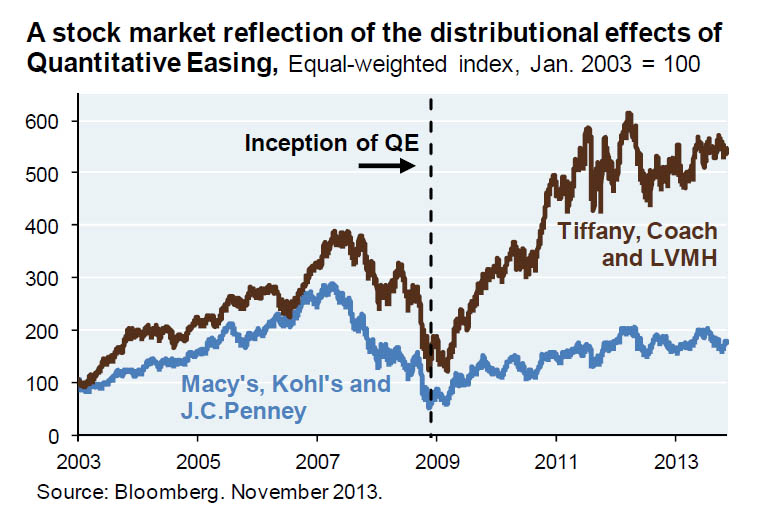
So let’s get this straight. These thieves want to steal people’s savings and pensions. So that people must remain as wage slaves till they drop, filling a growing labor pool being paid wages that are declining in all of the developed economies. And they’ll be great fodder for the upcoming war economy, grateful for the opportunity to build weapons that kill in better and better ways. While the rich and powerful get more caviar, as shown on the chart below. The dark brown line is the average stock price of retail for the rich: Tiffany, Coach, and LVMH. Those stocks have risen 500% since their 2009 lows and are over 30% above their former peak in 2007. The blue line is Macy’s, Kohl’s, and JC Penney, where the disappearing middle class shops. Those stocks are up 100% since 2009 and are still 30% below their former peak in 2007:

QE effect on shoppers

That is a great demonstration of who is receiving all that newly printed money and who is not. These folks want more slaves. And the ability to bomb into chaos any region that does not offer up its people into the slave pool.

Finally, a Fed Whistleblower

The claim has been made repeatedly here and elsewhere–a claim derided as conspiracy theory by the mainstream–that the US Federal Reserve has one purpose: to protect the game of the big banks. Everything else they say and do is cover for that single goal.

Thankfully, a Fed insider has offered excellent confirmation, including apologies to taxpayers for his actions. Everyone with the slightest interest in how the world actually works should read the full article by this fellow.

As background: Talk about an insider, this guy was in charge of the program through which the Fed purchased $1.2 trillion of mortgage backed securities (MBS) from the banks in 2009-2010. The Fed conjured up new electronic currency to pay for this. They call that Quantitative Easing (QE) instead of money printing because such lying does succeed in fooling most of the people most of the time.

In 2009, these MBS “assets” were called toxic assets by anyone with a fondness for truth because they were large packages of mortgages backed by sub-prime and other mortgage loans that were not being re-paid, and by residential real estate collateral that was plummeting in value. In other words, the big banks peddling and holding these assets were insolvent, bankrupt, in part because of the plunging value of their MBS. So, the Fed came to the rescue, of course, buying up toxic MBS from the big banks and paying many times the pennies-on-the-dollar actual street prices of these securities (Don’t you just love the BS terminology that pervades the financial sector?) to make the banks appear less bankrupt.

Here are some choice quotes from Andrew Huszar, a true Wall St and Federal Reserve insider:

We went on a bond-buying spree that was supposed to help Main Street. Instead, it was a feast for Wall Street.

I can only say: I’m sorry, America. As a former Federal Reserve official, I was responsible for executing the centerpiece program of the Fed’s first plunge into the bond-buying experiment known as quantitative easing. The central bank continues to spin QE as a tool for helping Main Street. But I’ve come to recognize the program for what it really is: the greatest backdoor Wall Street bailout of all time

My part of the story began a few months later. Having been at the Fed for seven years, until early 2008, I was working on Wall Street in spring 2009 when I got an unexpected phone call. Would I come back to work on the Fed’s trading floor? The job: managing what was at the heart of QE’s bond-buying spree—a wild attempt to buy $1.25 trillion in mortgage bonds in 12 months. Incredibly, the Fed was calling to ask if I wanted to quarterback the largest economic stimulus in U.S. history.

This was a dream job, but I hesitated. And it wasn’t just nervousness about taking on such responsibility. I had left the Fed out of frustration, having witnessed the institution deferring more and more to Wall Street…

In its almost 100-year history, the Fed had never bought one mortgage bond. Now my program was buying so many each day through active, unscripted trading that we constantly risked driving bond prices too high and crashing global confidence in key financial markets. We were working feverishly to preserve the impression that the Fed knew what it was doing.

It wasn’t long before my old doubts resurfaced. Despite the Fed’s rhetoric, my program wasn’t helping to make credit any more accessible for the average American. The banks were only issuing fewer and fewer loans. More insidiously, whatever credit they were extending wasn’t getting much cheaper. QE may have been driving down the wholesale cost for banks to make loans, but Wall Street was pocketing most of the extra cash.

From the trenches, several other Fed managers also began voicing the concern that QE wasn’t working as planned. Our warnings fell on deaf ears. In the past, Fed leaders—even if they ultimately erred—would have worried obsessively about the costs versus the benefits of any major initiative. Now the only obsession seemed to be with the newest survey of financial-market expectations or the latest in-person feedback from Wall Street’s leading bankers and hedge-fund managers. Sorry, U.S. taxpayer.

Trading for the first round of QE ended on March 31, 2010. The final results confirmed that, while there had been only trivial relief for Main Street, the U.S. central bank’s bond purchases had been an absolute coup for Wall Street. The banks hadn’t just benefited from the lower cost of making loans. They’d also enjoyed huge capital gains on the rising values of their securities holdings and fat commissions from brokering most of the Fed’s QE transactions. Wall Street had experienced its most profitable year ever in 2009, and 2010 was starting off in much the same way.

You’d think the Fed would have finally stopped to question the wisdom of QE. Think again. Only a few months later—after a 14% drop in the U.S. stock market and renewed weakening in the banking sector—the Fed announced a new round of bond buying: QE2…

Where are we today? The Fed keeps buying roughly $85 billion in bonds a month, chronically delaying so much as a minor QE taper. Over five years, its bond purchases have come to more than $4 trillion. Amazingly, in a supposedly free-market nation, QE has become the largest financial-markets intervention by any government in world history…

And the impact? Even by the Fed’s sunniest calculations, aggressive QE over five years has generated only a few percentage points of U.S. growth. By contrast, experts outside the Fed, such as Mohammed El Erian at the Pimco investment firm, suggest that the Fed may have created and spent over $4 trillion for a total return of as little as 0.25% of GDP (i.e., a mere $40 billion bump in U.S. economic output). Both of those estimates indicate that QE isn’t really working.

Unless you’re Wall Street. Having racked up hundreds of billions of dollars in opaque Fed subsidies, U.S. banks have seen their collective stock price triple since March 2009. The biggest ones have only become more of a cartel: 0.2% of them now control more than 70% of the U.S. bank assets…

So the big-bank rich got very much richer. What a surprise. A perfect strategy, still in full implementation in plain site, by a Fed fulfilling its real goal. The full article is here.

The quotes above might as well be directly from those derided for years as Fed conspiracy theorists. The latest survey I saw said that 74% of US citizens favor a full audit of the Fed, which is a private bank masquerading as a quasi-government agency, owned by the big banking families of the world, and which has the concession from the US Congress to print money. (Nice concession, eh?) But those 74% will likely be ignored. 90% of US citizens were against the TARP bank bailout in 2009, but it became law anyway. The people’s wishes are meaningless when it comes to the criminal partnership between Wall St and Washington DC.

Huszar didn’t name names or produce documents, so unlike other US whistleblowers, he likely won’t be jailed or hauled into endless court proceedings. But maybe this will encourage others to speak up about the Fed, perhaps even to reveal the truly nefarious aspects of this organization and its owners. And maybe someday the politicians who take millions from Wall St will become whistleblowers and tell us what marching orders they are given when they pocket those funds. Hey, a person can imagine! There’s no law against that….Is there?

A Cycle that Says “Get Ready”

There haven’t been many posts here lately, in part because it looks to me like we are on the precipice of major changes. So I’ve been spending some time finalizing my own preparations in terms of food (backup supplies and the infrastructure for growing more), electricity, water, and so forth. (Hint, hint.) Many think (hope?) that The Powers That Were can keep this all going for years. With the clear acceleration of infighting among the elites, to me that seems like a very bad bet.

So I found this post from Deflation Land to be interesting in terms of us being right on the cusp of major changes:

     Why I stopped worrying and learned to love the currency collapse

“For the past 300 years, the historical pattern has been for the era marked by a century to continue into the following century by fourteen or fifteen years.

“Let me explain. Everyone knows that the 19th Century, its uprightness, its optimism and sense of purpose, the halcyon days of British Empire, came to an end with World War I, starting in 1914 and building to a nasty crescendo by 1916. The 20th Century had arrived, and it had some real horrors in store for us.

“But if we return back another hundred years, we notice that the 18th Century ends in 1815 with the final defeat of Napoleon, that final project of the Enlightenment and of the French Revolution.  With the Congress of Vienna in 1814-1815, we have a new Europe along the lines of Metternich’s plan, and the 19th Century at last is here.

“In 1713 and 1714, we have the Treaties of Utrecht, Baden, and Rastatt, bringing an end to the era of Spain as a major power, and the rise of the Habsburgs.  Louis XIV dies in 1715, after reigning for 72 years.  The Baroque period is over, and we are now firmly in the 18th Century.

“We still live in the 20th Century…We still live in an era of Pax Americana, the old republic very much a strained and tired Empire now, with the U.S. Dollar as the world’s reserve currency.

“That is going to change.

“The next task for History is to dismantle the untenable structures and institutions put in place by late Modernity, which have been extended now as far as they can go. Our debt-based monetary system will collapse, our unbacked fiats will be worthless. The debts and unmeetable obligations will all default.

“There are ironies and great contradictions as the former home and hope of Liberty becomes viciously unfree and increasingly despotic. Our leaders no longer govern, but try instead to rule us — they are less legitimate with each passing day, their laws corrupt or worse. They are nearly finished, and will be swept away with the tide.

“Just as in 1914, the internationalist system will break down, dashing the hopes of the would-be first-world nations. We will probably have a pretty good war as well, or many local ones worldwide. These transitions tend to involve war.”

*  *  *  *  *

Combine the above with the Wheeler War Cycle and other war cycles discussed here, and it looks like our current faux stability–in which the gears of government and the economy grind on and on with little progress in any direction–will, within months, be a memory. The full Deflation Land article is here.

The Money Noose Tightens Further

The desperate folks in government are looking for money everywhere. In fact, at the last two G20 meetings, the richest 20 nations seemed able to agree on only one thing: that they will automate the trading of financial records with each other to try to catch corporations and individuals who are trying to avoid taxes. Other than that, the meetings were said to have a lot of bickering over Syria, NSA global spying, the Japanese debasing their currency faster than other regions, and so forth.

The International Monetary Fund, whose employees pay no taxes at all on their own salaries, is recommending a 10% wealth tax on all European Union citizens. Why? “..to restore debt sustainability.” In other words, they are admitting that EU countries are drowning in unpayable debt loads, so they advise snatching 10% of the wealth of everyone in those countries to pay off some national debts. And what will that 10% wealth grab accomplish? They say it will restore national debt levels to where they were in 2007. 2007?!? Wasn’t that the precipice of the financial crisis? They don’t seem to understand that countries were already drowning in too much debt in 2007, which was one of the primary enabling factors of the financial crisis. They say this is a one-time wealth grab. But after they grab that 10% of people’s money and it fixes nothing, what will they advise then? Grabbing 20% perhaps? More? Very likely.

Poland joined Argentina, Hungary, Ireland, Cyprus, and France in confiscating people’s pension assets. The Polish government grabbed national bonds held in pension funds managed by private sector money managers (think IRA or 401K managers ) and pulled them into the public sector pension program. Why? To count those bonds as government assets rather than debts so that their debt to GDP ratio looks better so they can borrow more money more cheaply in the open market. (Now you might think: why would bond  investors fall for such pathetic tricks? Why indeed. Don’t ask me. These “investors” are probably the same people who had money with Madoff.)

And Chase has told lots of its small business and individual clients that they can no longer use wire transfers to transfer money out of the country. If this sounds to you like progress along the lines of the dreaded currency controls, then you are being rational and astute. Currency controls, through which people are prohibited from moving their money out of its home country, are a plague on people when a country’s currency is plummeting in value. Ask people in Argentina how that feels, they’ve been through it twice.

Governments tried printing and borrowing lots of money to boost economies so they could collect more taxes. This has backfired: the economies barely grew while the debt continues to grow wildly.  Here’s what it looks like in the US, where the debt is the red line and the economy the blue line:

Debt_GDP

Some people, like Dick Cheney and Paul Krugman, say “who cares,” but the problem is, debts costs money, that is, you have to pay interest on the debt and you have to pay back the principal. And when the debt load keeps increasing faster than the economy, and faster than tax collections, it’s a classic case of unsustainability. Which is why governments are now starting to confiscate. They want more money, folks. They want to get it from you. Protect yourself accordingly.

Basis of the Financial System

Because understanding it is so crucial to people gaining freedom, there have been multiple attempts here at Thundering Heard to explain key aspects of the financial system. If anyone still feels at all mystified by this topic, the latest video by Mike Maloney does a good job of clearly explaining the true basis of the current system:

          The Biggest Scam In The History Of Mankind – Hidden Secrets of Money Episode 4

US Government shut down, except…

The US Government claims to be shut down, but that doesn’t apply to the military complex:

     Hagel Orders Civilian Pentagon Workers To Return to Work

So 350,000 civilian contractors will rejoin active duty soldiers, to whom no shutdown was applied.

And apparently the Department of Defense granted 94 new contracts on the day prior to the shutdown.

Recently, the US Federal Reserve threatened to slow down, to taper, the money printing, but they backed off on that idea at the last minute. And now the military is at full strength despite a government shutdown. Seems they are making it pretty obvious about what’s on tap. This is a very simple logical progression that has happened before:

1. An economy based on money which is debt must always grow or the interest on the debt cannot be paid.

2. When too much debt is accumulated, the economy groans under the burden, interest and principal on some of the debt cannot be paid, and the economy begins to implode.

3. Authorities put money printing into hyper-drive to try to fill the holes, to overcome this collapse, but this tactic fails. Currently, the money printers themselves are dismayed about the poor results from all that printing.

4. So to stimulate an economy in end-of-cycle death throes, the authorities resort to war.

In my view, this too will fail.

In early September, when the Military Times surveyed US troops on whether they supported US air strikes on Syria, 75% were opposed. And they were opposing air strikes; it seems highly likely that there would be even greater opposition to an invasion. US politicians have been running these troops ragged with one campaign after another, and it is taking its toll in terms of suicide and substance abuse:

In fact, prescription drug abuse doubled among U.S. military personnel from 2002 to 2005 and almost tripled between 2005 and 2008.

Alcohol abuse is the most prevalent problem and one which poses a significant health risk. A study of Army soldiers screened 3 to 4 months after returning from deployment to Iraq showed that 27 percent met criteria for alcohol abuse…

Drug or alcohol use frequently accompanies mental health problems and was involved in 30 percent of the Army’s suicide deaths from 2003 to 2009 and in more than 45 percent of non-fatal suicide attempts from 2005 to 2009.

Many people are increasingly aware that most major US war participations were preceded by false flag attacks, for example, the Lusitania for WW1, Pearl Harbor for WW2, the Gulf of Tonkin for Viet Nam, and 9/11 for the War on Terror. Many are weary of the repeated war campaigns that promise to bring democracy and bring only death and chaos. And people are increasingly aware that the economy–to which so many bow down as some kind of Moloch that must be served now no matter what the human and long-term costs–is a system for enslaving many for the mega-profits of a few. How long before people realize that murderous warmongering is simply an extension of that profiteering?

It seems clear that they will start a major war. They will have to counter war weariness among both civilians and military, and we all know how they do that. And they do need people’s support to carry this out. So once the war has started, the question will be: how long will people support it? Will people go along with these dark forces of war–for emotional reasons, or to get and keep a job in the war economy–or will they stand up and put an end to it?

An Important Whistleblower Event in the Metals

The news came out Friday at 2:00pm (circled on the chart below) that two JP Morgan employees have submitted to the government strong documentary evidence about how JP Morgan illegally manipulates prices in the precious metals markets:

     Morgan Whistleblowers Confess Bank Manipulates Gold & Silver

As you can see on this chart of Friday’s price action in gold from Kitco.com, those few traders who remained at their posts late Friday afternoon thought this was a big deal, and they ran the price of gold up $20 in the final three hours of trading:

Gold Friday13thedThey are right. This is a big deal. Why?

1. The last time compelling evidence of JP Morgan’s price suppression of the metals emerged into public view was March, 2010 when London trader Andrew Maguire told everyone that he had submitted hard evidence to the government about such manipulation, including sitting with them and showing them in real time just when and how the manipulation is carried out:

It was no coincidence gold didn’t look back from that day and it moved up over $800, from under $1,100, to (over) $1,900.  And silver moved up (an astonishing) $33, from under $17, to almost $50 in the same (time) period.

Someone tried to run Maguire down with a car two days later; he was hit by that car, but survived.

2. Many people have supplied evidence of manipulation of the metals to the US government agency that is supposed to take action about such crimes, the CTFC (Commodity Futures Trading Commission), but none, at least not that I know of, were employees of JP Morgan with direct inside information.

3. The CFTC has stonewalled the evidence received to date by staging an investigation of these allegations. The problem is, it’s been in progress for almost five years now. They haven’t taken a single action from this “investigation.” And why should they? Anyone known by Wall St to support such an action would be prevented from entering the “revolving door” and getting a cushy and highly-paid job at one of the Wall St firms as soon as their CFTC gig is over. And it is more than highly likely that the government itself is in collusion regarding the suppression of metals prices, so how can a lesser known agency point out that the US Treasury and Federal Reserve are involved in the scheme. But what was revealed Friday was that the CFTC received the data from the Morgan employees more than a year ago, in June 2012, and still they have taken no action. This will substantially increase pressure on the agency to take at least some sort of public action.

4. Allegations of price suppression in the metals markets have long been greeted as conspiracy theory by the mainstream despite the fact that government participants from the infamous Gold Pool of the 1960s admitted that they manipulated the gold price on a regular basis, though as with almost all government people, they only admitted to this after retirement or posthumously.  But with so many conspiracy theories recently being shown as conspiracy fact, and with JP Morgan getting caught in multiple illegal actions over the last few years, it is now getting tougher for anyone to claim that Morgan is not acting illegally in any market in which they participate.

The “paper gold” market (futures, options, ETFs, etc.) has been used for years to manipulate prices in the physical gold market, so much so that increasing demand for physical gold is often met by a falling paper gold price, turning all economic theory of supply and demand upside down.

The Powers That Be of the USA will do whatever they can to maintain what is rightly called the “exorbitant privilege” of having the US Dollar as the world reserve currency, which enables the US to print money to purchase real goods from the rest of the world. Part of their strategy has been to suppress the price of the precious metals to mask the deteriorating value of the Dollar. Another aspect is to keep the price of the metals very volatile to scare people out of the metals; they want to make the metals look unstable and the Dollar look comparatively stable.

Last year, the State of South Carolina considered adding gold as an investment to the state’s coffers and rejected the idea because their research showed that the precious metals are a manipulated market so they could not trust the metals as an investment. The state treasurer told the legislature this:

“Similar to other commodities, the value of gold and silver is determined by supply and demand, as well as speculation. The Federal Reserve, London Bullion Market Association, JP Morgan Chase, and HSBC Holdings have practiced fractional-reserve banking and engaged in naked short selling causing artificial price suppression.

So this testimony from JP Morgan employees is a major step toward gold and silver trading freely without government interference. No matter how old you are, gold has traded freely during your current lifetime for at most a few months at a time on a couple of rare occasions. If you hang in here for awhile longer, you will see it trade freely. And its price will be, to quote a great friend, magnificent.

A Tale of Two Countries

I see a beautiful city and a brilliant people rising from this abyss, and, in their struggles to be truly free, in their triumphs and defeats, through long years to come, I see the evil of this time…making expiation for itself and wearing out…
― Charles Dickens, A Tale of Two Cities

In 2005, economist Raghuram Rajan, 42 years old at the time, delivered a speech at the annual meeting of the crowned heads and elder statespeople of central banking telling them how those in attendance were brewing up a wicked credit crisis. After the speech, former US Treasury Secretary Lawrence Summers led the charge against Rajan, describing himself as “someone who finds the basic, slightly Luddite premise of this paper to be largely misguided.” According to Bloomberg:

Summers also said “while I think the paper is right to warn us of the possibility of positive feedback and the dangers that it can bring about in financial markets, the tendency toward restriction that runs through the tone of the presentation seems to me to be quite problematic.”

We all know now that Rajan was right and Summers, who had spent several years helping to tear down any restrictions on the gambling and deception by Wall St banks, was wrong in many ways.

India just made Rajan–who clearly saw the financial crisis coming and had the courage and intelligence to publicly state his case to those who were aiding and abetting it–the new head of India’s central bank, the Reserve Bank of India.  And Obama is considering appointing Summers–who aided and abetted the ongoing financial crisis mightily and who didn’t see it coming–the next head of the US central bank, the Federal Reserve. Summers is also infamous for abruptly resigning as the President of Harvard after losses in the endowment fund, his public statement that women are unable to learn science and math as well as men, and a no-confidence motion from the faculty.

Obama’s alternate candidate for the next head of the Federal Reserve is said to be Janet Yellen. She testified to Congress that she didn’t see the financial crisis coming either. Yellen was in charge of the Federal Reserve Bank of San Francisco from 2004 through 2010. So she was one of the top regulators presiding over the ramping up of the deranged lending that supported the real estate bubble in her territory that included California, Nevada, and Arizona.

So India has appointed someone with a track record of getting economic things right, and who is willing to risk career to state truth about a seriously dysfunctional status quo. And the US is poised to appoint someone who not only got it wrong about the financial crisis, but who, it could easily be argued, was on the team of architects who helped to create it. Worse still, Summers and Yellen have been in positions of financial power since and have done little to solve those architectural problems that still plague the system. My guess is that they have resisted real solutions.

One would think that Obama would prefer to appoint someone like Rajan, who had seen the financial crisis coming. But that is not the way things work in the US. Those who saw it coming would be similar to Rajan in clearly pointing out the structural problems in the US system, and that would seriously step on the toes of the rich and powerful. That is not tolerated at this time in the US.

And this is not limited to the financial sphere. Obama just appointed Director of National Intelligence James Clapper to head a commission to review the practices of the NSA despite the fact that Clapper lied at a Senate hearing in March, telling the Senate that the NSA does not collect the phone records of millions of Americans. He has since apologized for his lie. But how can such a person be expected to objectively review the practices of the NSA? Clearly, this is strictly political theater.

India has its problems. In Rajan’s first speech on the job, he went right after the corruption that is plaguing India’s economic system. India, a nation on the rise, is trying to solve its problems. The US, on the other hand, looks like it has no intention of arresting its own decline.

The Demise of Lies, Part 2

In Part 1, the focus was primarily on economic, political, and legal lies in the USA. This time, let’s check in on Europe:

     Euro crisis is over, says France’s Francois Hollande

The President of France was begging for money in Japan—politicians and bankers figure that if Japan is going to print money faster than anyone, they might as well go there and ask for some of it—and declared that the “Euro crisis is over.” This joins the regular chorus from Euro-politicians who have been claiming that “Europe is fixed” for years. And last week, the French head of the IMF, Christine Lagarde, speaking in Lithuania– which the Euro-pols are trying to sucker into the Euro fold—said there would be “a brilliant future for the Eurozone and the Euro.” Every time there is the tiniest uptick in any economic statistic, a Euro-pol will be out there claiming that the EU recession is over.

So let’s take a look. Maybe things are getting better! The OECD—the Organisation for Economic Co-operation and Development, a statistics agency for the largest 34 national economies in the world, also known as “the rich countries club”—just came out with a report on employment in all of their member countries. “The social scars of the crisis are far from being healed,” said OECD Secretary-General Angel Gurría at the launch of the report in Paris.  Oops. Somehow that doesn’t sound like “fixed.” Here is a quote from a summary of the OECD report by Martin Armstrong:

The OECD has made it clear that the greatest obstacle to reduced unemployment remains the horrible labor markets in Europe, whose abysmal performance over the past five years has opened the door for extreme political movements and massive civil unrest. Looking at Southern Europe, Portugal’s jobless rate “has more than doubled from a pre-crisis average (for the years 2005-08) of 7.7% to a a projected 18.6% in 2014.” In Greece and Spain, the numbers are even more outrageous with the Greek pre-crisis average of 8.7% to a forecast 28.4% next year…This level is above the peak 25% in the USA during the Great Depression. The picture in Spain has jumped from 9.3% to 28.0%, also exceeding the peak levels on the whole of the Great Depression.

So things are bad, perhaps dangerously so, in Portugal, Greece, and Spain. What about Italy, whose national debt bomb ranks among the top five in the world?

     Crisis is closing ‘134 retail outlets’ a day in Italy

(ANSA) – Rome, June 19 – Each day 134 shops, restaurants and bars close in recession-hit Italy, retail association Confesercenti said on Wednesday. Confesercenti, which represents small and medium-sized businesses in the retail and tourism sectors, said 224,000 enterprises had closed their shutters since the start of the global economic crisis in 2008.

“It’s a massacre,” said Confesercenti President Marco Venturi.

“Every day five green grocers, four butchers, 42 clothes shops, 43 restaurants and 40 bars and catering business close down”.

Hmmm, if retail is awful, maybe their industrial output is better? Nope, it’s fallen by 25% since 2008 and is back to where it was in the 1970’s:

     Italy’s industrial output falls back to 1970s

Maybe France is better. Here’s a report from an analyst known for generally being a rather optimistic fellow:

     Charles Gave: “France Is On The Brink of A Secondary Depression”

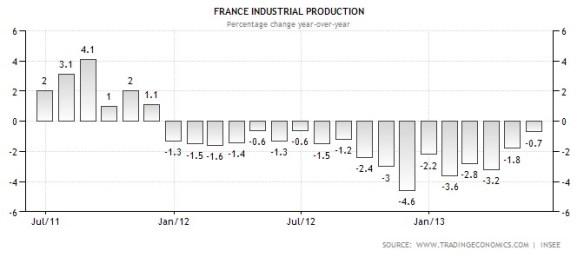
Here’s a chart of French Industrial Production. Notice it’s all minus signs for the last 18 months:
France_IP

(Chart source)

And the fellow “tasked with fighting tax evasion by President Francois Hollande” has been brought up for charges of, what else, tax evasion:

     France’s ex-budget minister Jerome Cahuzac ‘tried to invest 15 million euros’

Mr Cahuzac was charged with tax fraud after he admitted owning an undeclared foreign bank account containing some 600,000 euros ($770,000) last month.

However, Swiss public television network RTS reported on its website that the former leading Socialist once tried to deposit many times that amount, citing unidentified banking sources… Swiss newspaper Tages Anzeiger also claimed that when Mr Cahuzac decided to transfer money to Singapore in 2009 he provided a falsified tax certificate.

Mr Cahuzac, a cabinet heavyweight who had been tasked with fighting tax evasion by President Francois Hollande, finally admitted to having a foreign bank account last week, following weeks of denials.

But surely, if the “euro crisis is over,” then Italy, Spain, France, Greece, and Portugal must be the exceptions, overall Europe must be doing fine, right? Oops:

     European car sales sink to 20-year low in first half

European car sales slumped to their lowest six-months total in 20 years in the first half of 2013, with a 6.3 percent drop in June.

Ah, it must be that the European countries have been tightening their belts: austerity! They must be paying down their debts, that must be what they mean by “fixed”? Nope:

     Euro Area Government Debt Rises To New Record High

• Euroarea: 92.2%, up from 88.2% a year ago
• Greece: 160.5%, up from 136.5% a year ago
• Italy: 130.3%; up from 123.8% a year ago
• Portugal: 127.2%, up from 112.3% a year ago
• Ireland: 125.1%, up from 106.8% a year ago
• Spain: 88.2%, up from 73.0% a year ago
• Netherlands: 72.0%, up from 66.7% a year ago

Speaking of liars, the Spanish banks should be up for some kind of award. What they want to do is this: They have lots of losses from the ongoing real estate crash in Spain. If these banks ever become profitable again, they will be able to offset those losses against future profits for tax purposes. Fine. But what they want is to count those future tax offsets as capital. Now. You know, capital, something they can use to write new loans, to prove they are safe, etc. This is equivalent to you or me saying, “I bought some Apple stock at $690 back in September and sold it for a loss at $400 in June. Since I’ll get tax writeoffs for this loss for years to come, I want the bank to count that loss as money in my bank account now.” This is how rotting with lies the world banking system is, folks. If you been reading Thundering Heard, you can’t say you haven’t been warned about this. Accounting is one of the great new forms of lying.

     Spanish Banks Petition To Convert Historical Losses Into Bank Capital

Well, what should we expect in a country where the ruling party has been operating a giant slush fund where rich folks and companies deposit money into the slush fund and it gets distributed to the party politicians. The President has been denying his involvement for two years, but now they have text messages showing his connection:

     European Political Crisis Spreads – Leaked Texts Prove Rajoy Link To Illegal Party Funding

Even the IMF, infamous for its incorrect optimistic forecasts, has a tough time coming up with a rosy outlook for Spain:

     IMF forecasts alarming Spain unemployment outlook

Spain will be stuck with an unemployment rate above 25 per cent for at least five more years, according to a forecast by the International Monetary Fund.

And Portugal, which has already been bailed out and is held up as an example of a bail-out success story, is going to need a new bailout by mid-2014, likely to the tune of $76 billion, to keep afloat. Perhaps the EU has commissioned a new Liars’ Dictionary with a new definition of the word success.

And the way they do their bailouts in the EU is quite curious: the European Central Bank (ECB) is not supposed to directly bail out countries. So they inject cash into that country’s insolvent banks in the form of loans. Those banks then buy the bonds of their insolvent government. And everyone looks more solvent. The ECB lies and says it is not printing money. Yet the balance sheet of the ECB is over $3 trillion, up from a far smaller amount in 2008. If the money isn’t being printed, where is it coming from, the Money Tree??? In other words, where did the $3 trillion come from?

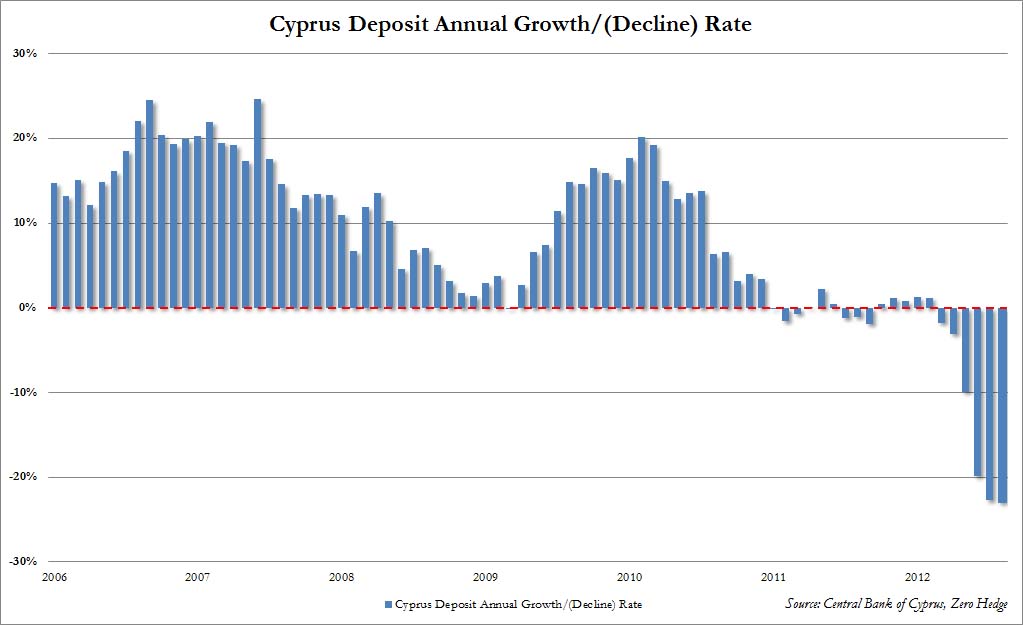
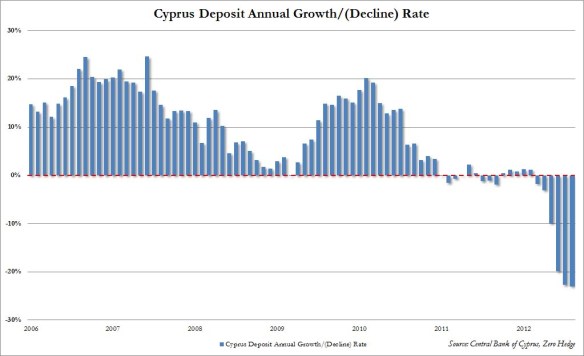
Back to countries: Cyprus is fixed as well. Sure, people lost 47.5% of their bank deposits, but they were given stock in their bank, surely that is working out. Nope, it turns out no one wants to keep their money in those banks and they are withdrawing as much as they are allowed to withdraw:

     Cyprus Deposits Plunge At Fastest Rate In History
Cyprus Deposits 3

And in Greece, wow, things just keep getting worse:

     Greece Laying off 25,000 State Workers

     Greek Unemployment, Non-Performing Loans Soar To Fresh Record Highs

     Greek Youth Unemployment Soars To Record 65%

     On The Ground In Athens: “Too Many People Are Committing Suicide”

So I think we really need to ask President Hollande and Ms. Lagarde and the other Euro-politicians: Fixed for whom? Clearly not for the people. Perhaps they mean it is fixed for them! Most of the Eurozone office-holders were not even elected, they were appointed. Yet they are running around eating caviar at endless summit meetings and handing down regulations most of which are not reviewed by any referendum or democratically-elected institution. Sounds more like royalty than democracy. And come to think of it, an awful lot of law and regulation in the US now arrives by Executive Order, agency regulation, and court order, not by debate and voting. So what’s going on here? Has democracy become a mere facade? Are we witnessing the return of royalty? Is all the attention lavished in the media on Kate and William and what they are wearing today as they take their baby for a stroll some kind of diversion to make this all more palatable?
trickle down

Next time, let’s look at lies in the Land of the Rising Radiation, Japan.