A Tale of Two Countries

I see a beautiful city and a brilliant people rising from this abyss, and, in their struggles to be truly free, in their triumphs and defeats, through long years to come, I see the evil of this time…making expiation for itself and wearing out…
― Charles Dickens, A Tale of Two Cities

In 2005, economist Raghuram Rajan, 42 years old at the time, delivered a speech at the annual meeting of the crowned heads and elder statespeople of central banking telling them how those in attendance were brewing up a wicked credit crisis. After the speech, former US Treasury Secretary Lawrence Summers led the charge against Rajan, describing himself as “someone who finds the basic, slightly Luddite premise of this paper to be largely misguided.” According to Bloomberg:

Summers also said “while I think the paper is right to warn us of the possibility of positive feedback and the dangers that it can bring about in financial markets, the tendency toward restriction that runs through the tone of the presentation seems to me to be quite problematic.”

We all know now that Rajan was right and Summers, who had spent several years helping to tear down any restrictions on the gambling and deception by Wall St banks, was wrong in many ways.

India just made Rajan–who clearly saw the financial crisis coming and had the courage and intelligence to publicly state his case to those who were aiding and abetting it–the new head of India’s central bank, the Reserve Bank of India.  And Obama is considering appointing Summers–who aided and abetted the ongoing financial crisis mightily and who didn’t see it coming–the next head of the US central bank, the Federal Reserve. Summers is also infamous for abruptly resigning as the President of Harvard after losses in the endowment fund, his public statement that women are unable to learn science and math as well as men, and a no-confidence motion from the faculty.

Obama’s alternate candidate for the next head of the Federal Reserve is said to be Janet Yellen. She testified to Congress that she didn’t see the financial crisis coming either. Yellen was in charge of the Federal Reserve Bank of San Francisco from 2004 through 2010. So she was one of the top regulators presiding over the ramping up of the deranged lending that supported the real estate bubble in her territory that included California, Nevada, and Arizona.

So India has appointed someone with a track record of getting economic things right, and who is willing to risk career to state truth about a seriously dysfunctional status quo. And the US is poised to appoint someone who not only got it wrong about the financial crisis, but who, it could easily be argued, was on the team of architects who helped to create it. Worse still, Summers and Yellen have been in positions of financial power since and have done little to solve those architectural problems that still plague the system. My guess is that they have resisted real solutions.

One would think that Obama would prefer to appoint someone like Rajan, who had seen the financial crisis coming. But that is not the way things work in the US. Those who saw it coming would be similar to Rajan in clearly pointing out the structural problems in the US system, and that would seriously step on the toes of the rich and powerful. That is not tolerated at this time in the US.

And this is not limited to the financial sphere. Obama just appointed Director of National Intelligence James Clapper to head a commission to review the practices of the NSA despite the fact that Clapper lied at a Senate hearing in March, telling the Senate that the NSA does not collect the phone records of millions of Americans. He has since apologized for his lie. But how can such a person be expected to objectively review the practices of the NSA? Clearly, this is strictly political theater.

India has its problems. In Rajan’s first speech on the job, he went right after the corruption that is plaguing India’s economic system. India, a nation on the rise, is trying to solve its problems. The US, on the other hand, looks like it has no intention of arresting its own decline.

Accelerating Truth

Most people have been trained to internalize only those ideas that come from honchos, that is, political and religious big shots, “experts,” very rich people, celebrities, etc. The powermongers capitalize on this when faced with criticism of the system by often resorting to what the logicians call ad hominem attacks, that is, they deflect attention from the criticism by attacking the person delivering it, attempting to undermine that person’s credibility. They characterize the malcontents as crazy, unpatriotic, uninformed, uneducated, or as crackpots, charlatans, imbeciles, demons, and so forth, while never addressing the issue at hand.

So for a more general public understanding of the nature of our system, it helps when people considered to be honchos start publicly discussing what is in fact going on. Other honchos are less likely to try to pull the ad hominem attack on one of their own. In other words, truth about the nature of our system needs to emerge from the blogosphere and into the mainstream. This process is accelerating.

Below is a link to an amazing video showing Columbia Professor Jeffrey Sachs speaking to a conference organized by the US Federal Reserve:

     Columbia Economist Dr. Jeffrey Sachs speaks candidly on monetary reform

He begins by reporting that he was just at a meeting with foreign ambassadors at the UN who were asking:

“Why are we taking advice from the people who have managed the financial system so badly?”

He goes on to say that while people expect economists to talk about statistics and monetary issues, that the real problem with the system is as follows:

We have a mountain of criminal and fraudulent behavior…The amount of utter criminality and financial fraud is absolutely enormous…This is what’s called the American financial system at the moment.  It’s an unregulated essentially lawless environment…

This is a profound failure of government…

I regard the moral environment as pathological…

We have a corrupt politics to the core. Both parties are up to their necks in this. It really doesn’t have anything to do with right wing or left wing. The corruption, as far as I can see, is everywhere.

Sachs follows that by saying that he meets with the top Wall St CEOs on a regular basis and the common feature he observes is that these people believe they can do anything they want, legal or not, with impunity. And that given their takeover of the politicians and regulators, they are correct!

Now this isn’t coming from MIT’s Prof. Noam Chomsky–who, let’s face it, was decades ahead of all of us in pointing out the criminality of the corporate/political system–it’s coming from a highly respected Columbia professor.

For a few years now, the money printing central banks such as the US Federal Reserve (the central banks have directly printed at least $16 trillion and counting) have been told by bloggers that this money is not supporting jobs and the economy, but rather that it is going to the rich who are bidding for financial assets and causing bubbles in multiple asset markets including stocks, bonds, and real estate. People like Ben Bernanke, his henchman, and academic and Wall St economists have denied this.

But now we find out, from a Freedom of Information Request by Bloomberg and from a leaked Fed document, that the banking insiders who advise the Fed are finally saying the same thing that the continuously-discredited bloggers have been saying all along: that the money printing is creating bubbles in farmland prices and student loans, and:

There is also concern about “an unsustainable bubble in equity and fixed-income markets given current prices.

And for years, bloggers have said that the central banks cannot possibly stop printing more and more money or the whole edifice will crumble, another charge that is roundly derided. The Fed has claimed repeatedly that it has the tools to undo all the money printing so that it will never cause a problem. But now their own banker advisory panel says that if the Fed stops printing, it “may be painful for consumers and businesses…” and thatthe Fed may now be perceived as integral to the housing finance system.” In other words, if the Fed stops printing, the “housing finance system” will collapse. Which it would. In a heartbeat.

People like Matt Taibbi of Rolling Stone have been stalwart in documenting the ongoing manipulations in the interest rate, municipal bond, derivatives, and oil markets. And others have offered very strong evidence of manipulation of the stock market and precious metals markets. Taibbi recently wrote that “everything is rigged.” The US Bond market, the largest in the world, is certainly rigged: the Federal Reserve itself buys 75% of the bonds issued by the US Treasury. And the Fed announces, at the start of each month, which days it will be buying bonds through the Wall St firms in the coming month. The stock market always rises on those days. Always. Why? Because the Wall St firms take that money, leverage it up by further borrowing, and buy stocks. The Fed wants exactly that: they believe that a rising stock market makes people feel a “wealth effect” and therefore they will go out and spend more money in the real economy.
So finally, along comes one the largest banks in the world, Deutsche Bank, saying:

We would stress that we fully understand why the authorities wouldn’t want free markets to operate today as the risk of a huge global default and unemployment cycle would still be very high.

And a recent member of the Federal Reserve Board, Kevin Warsh, said that their money printing is not working and they are losing credibility:

…over the last several years, [the Fed] has over-promised and under-delivered, and the bank’s most important asset – credibility – is under attack.

One would think that, if their strategy isn’t working, that they have other tools they can bring to bear. That’s what they tell us. But Warsh says, “There is no Plan B.”

Bloggers have been warning that European banks are insolvent and getting worse all the time. Now the European Central Bank itself admits that the “euro zone’s slumping economy and a surge in problem loans were raising the risk of a renewed banking crisis.”

Here is an interview with the President of the Chicago Mercantile Exchange, that place where they trade paper and electronic instruments that have an increasingly tenuous connection with physical things like gold, silver, copper, oil, etc. From the interview:

What’s interesting about gold, when we had that big break two weeks ago we saw all the gold stocks trade down significantly, we saw all the gold products (ed: futures) trade down significantly, but one thing that did not trade down, was gold coins, tangible real gold.  That’s going to show you, people don’t want certificates, they don’t want anything else.  They want the real product.

Then there is the supposed eternal juggernaut of the Chinese economy that will keep all the other floundering countries afloat. Much of that juggernaut has been propelled by debts taken on by local governments to promote the economy in their areas. But now the Financial Times reports this:

A senior Chinese auditor has warned that local government debt is “out of control” and could spark a bigger financial crisis than the US housing market crash.

Zhang Ke said his accounting firm, ShineWing, had all but stopped signing off on bond sales by local governments as a result of his concerns.

Last but not least, an insider is finally speaking up about nuclear power plants in the NY Times:

All 104 nuclear power reactors now in operation in the United States have a safety problem that cannot be fixed and they should be replaced with newer technology, the former chairman of the Nuclear Regulatory Commission said on Monday…

The position of the former chairman, Gregory B. Jaczko, is not unusual in that various anti-nuclear groups take the same stance. But it is highly unusual for a former head of the nuclear commission to so bluntly criticize an industry whose safety he was previously in charge of ensuring.

This system is coming apart at the seams. Insiders and whistlebowers are finally describing the details. The US Government realizes this and is desperately trying to keep whistleblowers from telling the truth by filing charges against them and trying to ruin their lives. Ultimately, it won’t work. I just hope that everyone reading here takes those actions they need to take. By the time the collapse is on the television Nightly News and Page 1 of the newspapers, with the system honchos all claiming “No one could have seen this coming,” it will be too late.

Transition Update: Extreme Stress in the Animal Kingdom

Forests precede civilizations…deserts follow them.
–Francois-Rene de Chateaubriand, 1768-1848

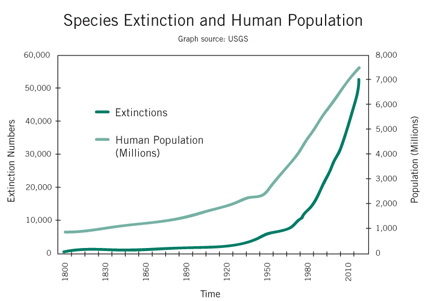
What is the effect of acceleration in the animal kingdom? What is the Transition? Part 3 showed a chart of the acceleration, the parabolic rise, of species extinction. And while that level of abstraction is important to grasp, seeing the details is another matter. The following articles, collected from the web over just the last four weeks, help to bring home the reality of the current stresses on the animal kingdom. Mass deaths are happening across the world, across many species. These incidents show that we’ve gone way beyond the proverbial “canary in the coal mine.” This is not business as usual.

Animals are suffering from direct poisoning by pesticides and fungicides, direct exploitation by people, habitat destruction, severe storms, weather pattern changes, pollution, cell phone tower disruption of the magnetic spectrum used by animals for navigation, ocean acidification, etc etc. But many cases remain inexplicable, even after investigations.

     Worst-ever right whale die-off continues to puzzle

Scientists still don’t know why hundreds of baby southern right whales are turning up dead around Patagonia…

     32 swans found dead at New Lake, Dunganaghy, Ireland

A spokesperson for the Department of Agriculture, Food and the Marine told Donegal Now that … it was still too early to say what had caused the multiple deaths.

     One-Third of U.S. Honeybee colonies died last winter, threatening food supply

Nearly one in three commercial honeybee colonies in the United States died or disappeared last winter, an unsustainable decline that threatens the nation’s food supply.

Multiple factors – pesticides, fungicides, parasites, viruses and malnutrition – are believed to cause the losses, which were officially announced today by a consortium of academic researchers, beekeepers and Department of Agriculture scientists.

     German lake full of dead carp baffles officials

Volunteers have pulled 25 tonnes of dead carp out of a lake in eastern Germany – there are so many, locals are running out of boats. Regional officials have admitted they are baffled – only carp seem to be dying in the lake.

     3 more dolphins die in Indian River Lagoon

Biologists removed three more dead bottlenose dolphins in the Indian River Lagoon Monday, bringing this year’s total lagoon bottlenose body count to at least 30.

The National Oceanic and Atmospheric Administration already has declared the 100 or so manatee deaths in the lagoon since mid-2012 an Marine Mammal Unusual Mortality Event. The declaration triggers NOAA’s own formal investigation. The federal agency is examining whether the dolphin and manatee deaths might be connected.

     Hundreds of dead fish wash up on Beaver Lake

It’s estimated that more than 7,000 pounds of dead fish – mostly catfish, sunfish and bass – have been taken out of Beaver Lake. But what caused this unusually large fish kill is still a mystery.

     Thousands of dead fish reported in Indian River Lagoon in southern St. Lucie County, Florida

Tony DiChristofaro of Stuart, said he saw “thousands and thousands of dead fish coming ashore” about 2 p.m. Thursday as he was walking along the lagoon beach.

DiChristofaro said the dead fish extended along the shoreline for about a mile.

     More than 1000 birds now dead as result of coastal chemical spill in UK

The substance has been identified as polyisobutene (PIB) by researchers at Plymouth University. It is the second time in just three months that PIB has killed hundreds of seabirds in the South West.

     Video: Thousands of dead jelly fish at Umargam Beach

Seen in April 2013 there were thousands of dead jelly fish seen on sea beach of Umargam.

     Big freeze – UK livestock death toll hits 100,000

English, Scottish and Welsh sheep losses in April were 50% higher than April 2012 costing 35,000 extra lives

Welsh cattle losses in April were more than double 2012’s equivalent to almost 2,700 head

Cattle losses in England and Scotland in April were about a quarter more than 2012 (23% and 25% to 13,800 and 9,700 head respectively)

Cattle losses for England, Scotland and Wales were up 34% and more than 7,000.

     Central Africa elephant population down 62% in 10 years

Poaching on an “industrial” scale has slashed the elephant population in the countries of central Africa by nearly two-thirds…

     Weather changes impact migrating birds

Experts say there has been an increase in the number of migratory birds falling from the sky in the region.

     Health defects found in fish exposed to Deepwater Horizon oil spill, three years later

With researchers from Louisiana and South Carolina, the scientists found that Gulf killifish embryos exposed to sediments from oiled locations in 2010 and 2011 show developmental abnormalities, including heart defects, delayed hatching and reduced hatching success. The killifish is an environmental indicator species, or a “canary in the coal mine,” used to predict broader exposures and health risks.

     Dead dolphins and shrimp with no eyes found after BP clean-up

Hundreds of beached dolphin carcasses, shrimp with no eyes, contaminated fish, ancient corals caked in oil and some seriously unwell people are among the legacies that scientists are still uncovering in the wake of BP’s Deepwater Horizon spill.

     Cocktail of multiple pressures combine to threaten the world’s pollinating insects

     Mysterious dead fish at Eagles Mere Lake, Pennsylvania

     Dead birds “falling from the sky” in Port Arthur, Texas neighborhood

     Hundreds of birds die of starvation after spring snowstorm in Colorado

     Manatee deaths at Indian River Lagoon, Florida: Questions abound in mysterious deaths of manatees, pelicans

     Minnesota man watches as waxwings began ‘dropping out of the sky’

     Hawaii: Kaua’i coral disease worsening, says doctor

     100 dolphins wash up on Italian coast after being hit by killer strain of measles

     Storm kills 10 thousand birds in Jhenidah, Bangladesh

     Wales: Worry over marsh horses ‘dropping dead like flies’

     Update: More than 12,000 birds crashed in Utah’s Dugway proving grounds

     Australia: Oyster crop hit by unknown disease

     Enduring winter tough on migratory birds in Great Plains

     China’s Animal Apocalypse Spreads To Dogs

     238 pigs and 89 dogs “suddenly dead” in Chinese village

     Sea lion strandings climb, scientists still stumped

     Australia: Another fish kill stinks out Wonnerup

     Snow storm: Sheep death toll reaches 20,000 in Northern Ireland

     Bird jams: Long winter sends migratory flocks into tailspin in Germany

     Over 100 dead birds found in Danville & Pittsylvania County

Different species of birds found dead in Trinidad shortly after mysterious mass vulture deaths

     Peru: 10 Dolphins found dead in northern beaches

     150 Black vultures mysteriously die in Chaguaramas, Trinidad

     Rare birds killed off after migration north sees them face freezing temperatures back in UK

     Over 8,000 dead sheep removed from Northern Ireland farms following record Spring snowfall

     Mass death of multiple sea creatures along east coast of UK

     ‘Tonnes’ of dead fish found on Swedish lake

     Video of grieving pink dolphin mother underscores plight of disappearing species

“There were about four or five dolphins in the water and it seemed at first as if they were trying to get hold of something and support it,” said Ho Tak-ching, 34, a guide with Hong Kong Dolphinwatch. “It really wasn’t normal behaviour.”

The dolphins were trying to help a mother support the body of her dead calf and stop it slipping below the water’s surface.

Grieving and unable to accept their calves’ deaths, the mother dolphins will spend up to two weeks trying to keep them on the surface of the water, exhausting themselves and going without food as other dolphins rally to help them.

The events above were from just one month. It seems more than likely that there are many, many more incidents that are unseen and unreported. And of course it’s true that our physical bodies are subject to many of the same stresses plaguing the animals. But hey, as long as lots of people are shopping, things must be fine.

What is the Transition? Conclusion

Now you can’t say that no one ever told you.
–David Daniels

In Part 7, I promised predictions for this installment. And there will be predictions. The important question is: predictions based on what? The web and the media present piles of predictions, most of which turn out to be wrong.

So based on what? Evidence; and a model of how things work. Most predictions go awry because they aren’t based on either. Or if they are said to be based on models, the models are flawed.

Evidence is what Part 1 through Part 7 were all about. And all of us, consciously or not, operate from models of what the world is like. If we walk into a dark room and flip a light switch, we are operating from a model of the world where electricity is flowing into a building with wires connected to lights controlled by switches, and flicking a switch–that often sits precisely where we expect it to be even if we’ve never entered that room–lights one or more light bulbs. We have all sorts of such models in our heads having to do with gravity, internal combustion engines, computers, shoelaces, banks, the properties of water, etc. When correct, these models have predictive abilities that make our interactions with the world relatively easy and efficient compared to operating without such models.

So these models lead to predictions about the future, and when correct, they yield excellent results. When we turn the key in a vehicle ignition, we expect the engine to start, and typically we aren’t disappointed. Thus we made a prediction about the future, one that has generally turned out to be true. Perhaps not every time. Once in awhile, the car might not start. But the results are good enough, the model reliable enough, that we rarely “give it a second thought.”

In my view, this scales up to the major aspects of our lives. Though it does seem that, the larger the scale, the greater the disagreements people have on the topic. Yet I contend that getting large-scale models right is important and possible. When we get the large scale models wrong, life can be unnecessarily confusing and difficult; when we get them right, the results can be profound.

Bias, the bringer of difficulty

We all like to think we aren’t biased, but on this planet at this time, that is a rare achievement. It runs deeper than we like to admit. Were that not true, the mystics would not have to advise us to pierce the veil. Without bias, we would likely see that there is no veil.

Let’s look at a good example of why people have a tough time getting large scale models right. This is one where, were it a multiple-choice question on a standardized test, most highschoolers would get it right. But on this one, the “masters of Wall St” got it wrong. Big time.

Several decades ago, one researcher pointed out that the economy of the USA operates on a roughly 25 year recession/depression cycle, that is, roughly every 25 years, there is either a recession or depression. Yes, there could be recessions at other times, but you could rely on the idea that one would happen roughly every 25 years.  This cycle has been active since early in the 1800s and predicted that there would be a recession or depression starting ideally in December, 2007. I told a number of people about this ahead of time, and few thought the idea had merit despite the historical track record, part of which looked like this at the time:

9/1857: very serious recession 6/1857-12/1858 (18 months contraction)
2/1882: depression 3/1882-5/1885 (38 months contraction)
7/1906: serious recession 5/1907-6/1908 (13 months contraction)
10/1932: serious depression 8/1929-3/1933 (43 months contraction)
7/1958: recession 8/1957-4/1958 (8 months contraction)
12/1981: very serious recession 7/1981-11/1982 (16 months contraction)
12/2007:

Every August, George Soros has a meeting at his Long Island estate for the biggest movers and shakers on Wall St. By August 2007, the sub-prime mortgage market was already falling to pieces. Soros asked his 21 guests, people who have the money to buy the purportedly best research on the planet, whether the current situation would lead to a recession in the US. Twenty of twenty-one said no recession. But right on schedule for the 25 year cycle, a recession started in December 2007. Some say we are still in the depression that started then, and there is good evidence for that.

So how come people would ignore such a prescient cycle with a long and excellent track record? First, because while most people are well aware of being surrounded by cycles such as heartbeats, breathing, night and day, moon phases, ocean tides, the seasons, years, birth and death, to name just a few cycles to which we are subject, they believe that such cycles couldn’t possibly apply to an economy, that such thinking is equivalent to voodoo. Second, the researcher who was the first to publish about this cycle was Edgar Cayce, and to most hard-nosed Wall St people who think they are operating by logic and science, how could Edgar Cayce possibly be right about anything.  What they think of as hard-nosed is actually thick-skulled because Cayce was right about plenty of things. But he doesn’t fit their constrained view of “logic and science,” so out goes Cayce and anyone like him. While it would be fun to say “too bad for them,” when their firms failed in 2008, it was the rest of us who got stuck with the bill for bailing them out so they could keep their bonuses, stock options, and corporate jets.

So as we all know, in 2008 we got a humdinger (serious academic term) of a recession despite the bad models being used by the Wall St mavens and people like Fed Chairman Ben Bernanke that said we would not get a recession. So why did the masters of Wall St and most others dismiss such information? Probably because, if they heard the source of the prediction, most would discount something from Edgar Cayce because it was information channeled from the other side. And “everyone knows” that stuff is only for new age goofballs. So the real answer is: bias. People would rather hang onto their bias than admit that correct information is useful if they despise the source.

Oddly, another researcher, Manfred Zimmel of www.amanita.at, later figured out the basis for Cayce’s information. OK, check your biases. For some of you, this is about to get worse. Here’s that same recession/depression series from above exactly as I first saw it, presented by Manfred, in 2006:

Ø conjunction 9/1857: very serious recession 6/1857-12/1858 (18 months contraction)
Ø conjunction 2/1882: depression 3/1882-5/1885 (38 months contraction)
Ø conjunction 7/1906: serious recession 5/1907-6/1908 (13 months contraction)
Ø conjunction 10/1932: serious depression 8/1929-3/1933 (43 months contraction)
Ø conjunction 7/1958: recession 8/1957-4/1958 (8 months contraction)
Ø conjunction 12/1981: very serious recession 7/1981-11/1982 (16 months contraction) – last deep recession
Ø conjunction 12/2007:

Yep, you guessed it (heh), the cycle is actually the Jupiter-Pluto conjunction cycle. So an astrological model has reared it head! Yikes, so if the Wall Streeters had heeded either the channeled or the astrological model for this cycle, they could have saved their firms tens of billions in losses and turned 2008 into a year of tens of billions in profits by aligning their trading with the idea that a recession was very likely. This is not a stretch since there were hedge funds that did make billions from the financial collapse in 2008.

If a model is clearly working in significant ways, it is useful to ask whether allegiance to one’s biases is more important than being on the right side of major trends on this planet. One of the worst things a person can do in this rapidly-evolving environment is get in front of a major negative trend and stay put thinking that trend is not important. Millions have gone bankrupt in recent years doing just that. In the markets, they call it picking up pennies in front of a bulldozer. Sometimes having a good or bad model is a matter of life or death, for example, a bad model about the nature of the Nazi party brought horrific suffering and the deaths of many millions. (Side note: Thundering-Heard.com exists because I think understanding and heeding good models versus bad ones could very well be a matter of life or death over the next few years, or perhaps even months.)

Handling predictions

One more brief topic, and then on to predictions about the Transition: What is a person supposed to do when they hear a prediction about the world? Assuming that they want to do anything at all, here is an approach from some people whose livelihood depends on their expert handling of predictions. When you hear a prediction:

1. Put aside the natural human propensity for wanting to know immediately whether the prediction is correct. This is emotion coming to the fore. All of the remaining steps are about eliminating emotion from this process so that rationality, research, and observation can take their rightful place.

2. Consider the prediction a script about how the future will unfold.

3. After giving it some thought, assign a rating, say from 1 to 100, on whether you think the predicted event can possibly emerge from current conditions. If it has any chance of emerging, write down the script and place it in your script pile wherein scripts about the future are sorted by your numeric ranking. If there is no chance that the event can arise from current conditions, then throw it out.

4. If the outcome of a script would be important to you, do research on the topic and, if it is appropriate based on your research, adjust your numeric ranking for the prediction in the future script pile. If there is a way to investigate the track record of the person making the prediction, and on the internet there often is, this can help a lot in rating a prediction. People with a bad track record are typically operating from a narrow or faulty model and usually continue doing so. Few people, especially people who have achieved some fame using one model, will admit their errors and find a better model.

5. Watch as evidence about all of your scripts unfolds and adjust your script pile accordingly, tossing out scripts where emerging events show a script to be faulty, and upwardly adjusting the numeric rankings of those scripts where the evidence is pointing to the idea that they might be right.

Through this process, predictions that are false are discarded and those that are true rise to the top of the pile. Emotions are kept at bay, biases fall as evidence accumulates, observation and logic guide the process. And you learn a lot about how the world works.

The Evidence

So what have we observed?

1. Acceleration, evident in a wide variety of ways, including:

2. Weather extremes and wildness, including floods, windstorms, typhoons/hurricanes, tornadoes, heat waves, droughts, superstorms, etc. The insurance industry reports a greater than tripling of “loss-related weather events” since 1980. (Part 1)

3. Earthquakes of magnitude 6.0 or greater up more than 50% since 1990. (Part 1)

4. Tsunamis up fivefold in this century versus the last. (Part 1)

5. Volcanic eruptions clearly on the rise. (Part 1)

6. Magnetic poles on an accelerating shift accompanied by hemispheric temperature changes . (Part 2)

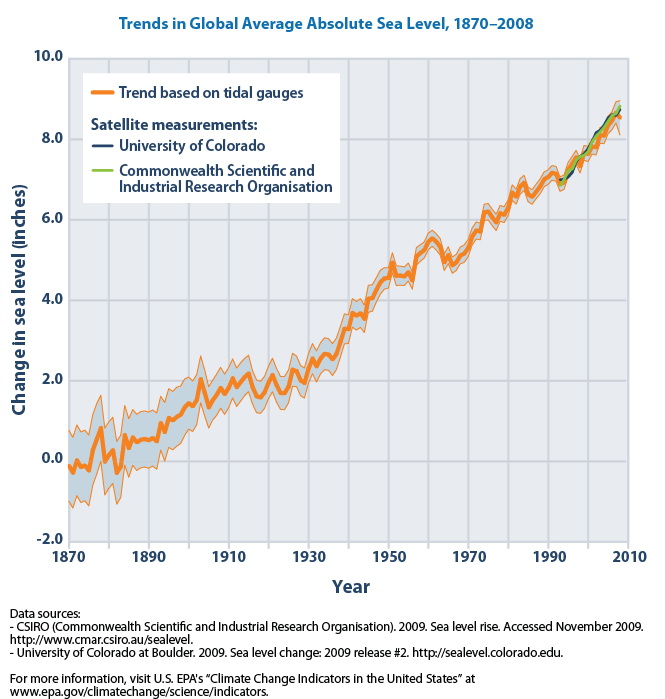
7. Sea level rise. (Part 3)

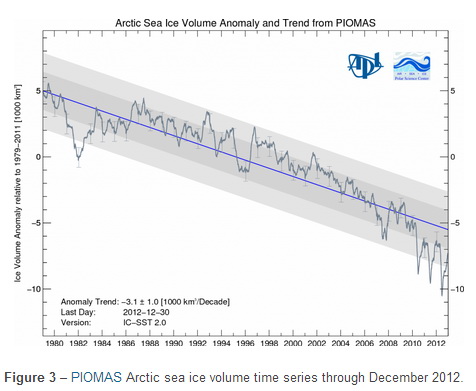
8. Species extinction rising exponentially along with rising human population. (Part 3)

9. Sinkholes increasing rapidly enough to go from obscurity to the mainstream media. (Part 4)

10. Asteroid encounters appear to be on the rise. (Part 4)

11. Nuclear plants compromised by the increasing earth and weather changes causing problems for people. (Part 4)

12. People’s perception of time as speeding up. (Part 5)

13. An exponential rise in the price/performance of technology. (Part 5)

14. Exponential growth in money, debt, and unemployment. (Part 5)

15. Exponential growth in the amassing of physical gold by those, such as China and the oil sheikdoms, who supply real goods for all this printed money. (Part 5)

16. Relentless growth in the prices of real goods such as food and fossil fuels in response to the massive influx of printed money.

17. Despite an exponential increase in money printing, borrowing, and spending by governments to simulate economies, these same economies remain moribund and these tactics clearly show diminishing returns. (Part 5)

18. The “age of truth” brings increasing revelations of lies and truth. (Part 6)

And with people, acceleration is bringing increases in (Part 7):

19. Communication/connectedness.

20. Inner work.

21. Insistence on knowledge over belief.

22. Group consciousness.

23. A changing attitude toward the physical sciences.

And increasing exploration of (Part 7):

24. Healing methods.

25. The energetic nature of everything.

26. That energy is different at different locations on the planet.

27. The multi-plane nature of life.

28. Interaction with nature intelligences.

29. People changing from “what can I get” to “what can I do to help.”

And accelerating (Part 7):

30. General insanity.

31. Use of legal and illegal drugs and of alcohol to cope with acceleration.

Predictions

OK, so where will this lead us? Does anyone have a model that accounts for accelerating change in most if not all aspects of life on this planet? A model which we might then be able to look to for guidance about the future, from which we could actually expect some reliability?

Surprisingly, yes.  In early 2007, I was fortunate enough to run into such a model described in a book published in 2003. It went into my script pile at the time. Given that the book had been published four years earlier, I was able to evaluate whether a portion of its predictions were coming true or not, and they definitely were. I was already convinced prior to reading the book that we were likely to experience an all-out collapse of the financial system within 5 to 7 years. The book entirely agreed with that perspective, but it took things way beyond the financial world and covered the topic of the Transition from historical, geologic, meteorological, political, educational, occult, and cosmological perspectives, to name a few.  And this wasn’t a book of vague wishy-washy predictions that could be interpreted several ways. It was exceedingly specific. Here is what it said—and this was in 2003, before the explosive growth of sub-prime mortgages being sold to anyone who could fog a mirror, with those mortgages being packaged up and sold to institutions across the world as blue-ribbon, good-as-gold, AAA-rated securities—about the real estate bubble. And this was when almost all people considered real estate a perfect investment, something whose price could never go down, something that was definitely not a bubble at all:

Many who pulled their money out of the stock market…rushed to invest these funds in real estate, but again this mad rush created yet another bubble of inflated real estate. Finance companies, mortgage brokers, and banks readily accorded mortgage loans to these buyers. Once they obtained the signature of the borrower on the loans papers, they sold the mortgages to non-bank secondary mortgage companies. In order to purchase these mortgages, these secondary mortgage companies borrowed money by issuing bonds and derivatives on these bonds.

In essence, though this convoluted maze of borrowing, these non-bank financial institutions…own indirectly most properties purchased with a mortgage…

As the world economy deflates, more and more people will lose their jobs, they will default on their house mortgage payments, and be thrown out into the streets. The sinister secondary mortgage companies will take possession of the property.

When mortgage defaults reach a critical mass, the secondary mortgage companies will collapse leaving a wasteland of properties. This will spell the end of the financial grip the Dark Forces hold on the world, and the towers of finance they have spent centuries to build will fall one by one like dominoes.

So what we have here is an exceedingly accurate description of the work-in-progress that is the real estate bubble and its associated derivatives taking down the financial system. Lots of “dominoes” have already fallen. In 2007, Wall St had five big investment banks. The sub-prime mortgage collapse took three of them to insolvency—Merrill Lynch, Bear Stearns, and Lehman Bros—which were either broken up or absorbed into other companies, and it would have taken down the last two, Goldman Sachs and JP Morgan, but the government temporarily stabilized them by saying the they were now backed by FDIC deposit insurance even though they had never before paid a penny into the FDIC insurance program. In fact, they had shunned the FDIC program because they wanted less regulation.

As tracked by the Mortgage Lender Implod-o-Meter, 388 US and 13 non-US mortgage lenders have gone belly up so far. This includes giants such as “secondary mortgage companies” Fannie Mae and Freddie Mac and lenders such Countrywide, Washington Mutual, and Wachovia Mortgage. (The full list is here.) And now with sinister companies like Blackrock rushing in to buy foreclosed houses, the game is not completely over, but it won’t be long before the dominoes have all fallen.

Anyway, back to this book I’ve been speaking of. Of the 31 trends identified above, this book covered 26 of them, and for all I know, I may have forgotten references to the other five.

The book is The Sanctus Germanus Prophecies, Volume 1 by Michael Mau. It was followed by Volume 2 in 2006, and Volume 3 in 2009. The books can be purchased here or here.

There are a lot of books out there these days that are really highly-padded versions of what  could be a five or ten page article.  Mau’s books are not in that category, as demonstrated by the quote above, that is, the real estate crisis was discussed in detail on one page and that was it, the author moved on to other topics.  So an attempt to summarize the vast array of information in these books will do them serious injustice, but I will make the attempt anyway as a conclusion to this series of posts. The best advice, of course, is to read the books:

We are living in a period of transition during which much that impedes humanity’s evolution—warmongering, the manipulation/exploitation for power and profit of the many by a very few, the intentional distraction of people from their higher self, and so forth–will be cleared away. Energetic acceleration and earth changes will assure that this clearing/cleansing process takes place. The transition is a normal period of relative rest in the vast multi-billion year evolutionary cycle of our solar system called the manvantara in which people evolve through hundreds and even thousands of incarnations. Many people, called lightbearers in these books, incarnated now with the intention of helping people through this turbulent process and preserving, through the period of the transition, that which is conducive to people’s true evolution. The overall goal of the transition is to place humanity in a new golden age in which people can pursue soul liberation with excellent support and without interference. Getting to that golden age requires the dissolution of those organizations that serve the interests of those who seek to control everyone else for their own power and for material acquisition far beyond what any person would need during a lifetime. Since these organizations are not going quietly, we are dealing with increasing turbulence during which all people will have to decide where they stand with respect to war and the array of slaveries that permeate civilization. The degree of turbulence that can be expected is strongly related to whether or not people wake up and stand on the side of freedom and conscious evolution.

Volume 2 lists twelve regions on the planet that are called spiritual regions, higher elevation areas away from the coasts that, while not immune to the earth changes, are relatively safe with respect them, and which are conducive to lightbearers retrieving those abilities they cultivated in prior incarnations.

Here are some highlights from the timetable at the back of Volume 2:

2005-2012:

  • Severe worldwide economic and financial crisis
  • World economy hits bottom and stays there, all conventional efforts to revive it fail
  • Water-related catastrophes: tsunamis, hurricanes, rise in sea level, floods of lowlands and coastal areas
  • Spiritual Regions on higher ground begin to develop: initial preparations

2013-2020:

  • Water-related catastrophes multiply making more and more low-lying areas uninhabitable
  • Massive population displacements to higher ground
  • Spiritual Regions take hold as lightbearers find their way there
  • Period of Reconstruction: Transitional societies begin to consolidate in the Spiritual Regions

2021-2080

  • Indications of major continental shifts, rifts, and movements begin to perturb the earth’s surface

There is a lot more to these books that what I’ve summarized here. They place the Transition in a perspective that ranges from the innermost to the cosmic. They say that, far from being over, that we are early in many of the accelerating trends identified above. These books have risen to the top of my “script pile.” They have become a stable platform from which to view the changes and turbulence in the world, and have given me confidence that life on this planet can and will be changed, and vastly for the better, and that this goal is way beyond worth working for. These days, when I hear a prediction–and I do seek out a lot of them–if it clearly conflicts with the information in these books, I relegate it to the category of “very unlikely,” and that repeatedly works very well.

One of the main reasons that so many predictions go awry is because they are drawn from experience of a small slice of life. We hear predictions all the time about finance, politics, weather, health, the use of energy, the environment, social trends, and now even meteors and comets. I contend that so many of those predictions go awry because they work from a narrow band and fail to take into account the larger context. Most would relate to maybe one or a few of the 31 trends identified above. Mau’s books place almost all of these individual trends in the context of a much larger one.

And seeing all of these trends in their larger context is precisely what we need right now as change permeates, well, just about everything! A narrowly focused model has no chance of accounting for across-the-board acceleration in, for example, finance, earth changes, mass shootings, and the emergence of truth.

So what’s a person to do about all this?

It is truly up to each person.

What would I do? I will provide a detailed post about that soon where I will contend that a wait-and-see attitude about these changes is no longer appropriate. Life is, as usual, being very kind by giving us a preview of exactly how this will all unfold by not bringing change all at once, but by ramping up all of these trends. But it’s up to us to read the signs and take action.

In the mean time, if you haven’t done so already, you may want to do your own research on these topics. If you come to some understandings, an action plan may naturally emerge from what you learn.

One piece of advice I would give is to never underestimate the power of an accelerating trend. As trends become obviously exponential, they can be quite breathtaking in their speed, power, and scope. As a friend from Cyprus told me: “On Friday night, when we went to sleep, everything was normal. On Saturday, we were told that the banks were closed and that we would have very restricted access to our bank accounts and that we might lose a lot of our the money.” When things change these days, they can change radically and quickly.

There are suggestions for dealing with the collapse of the financial system in the post What then can we do?.

And I leave you with outstanding comments on this topic from Gandhi: View the Forces of Nature bringing Earth Changes as Opportunity to Change the World.

Thanks very much for reading this long series and this long post.
What is the Transition? Part 7

In the context of the Transition, what are the detectable trends with people?

COMMUNICATION / CONNECTEDNESS: Enabled by the internet and by the radical expansion of telecommunication and video technologies, there is explosive growth in communication. Some communicate almost constantly, staying connected during nearly all waking hours. This is bringing an exponentially growing exchange of information that is making it increasingly difficult for people and organizations to hide information. Beyond the use of technology, some report finding an increasing ability to connect and communicate telepathically.

INNER WORK: People’s interest in inner work is flooding across the planet. Sure, some are searching for an inner secret to magically obtain a Maserati, and yes the world sometimes seems to be nearly-drowning in materialistic striving, but a large and growing number of people are realizing the importance of their inner life and the need to cultivate their insight in this realm.

This can be seen by the remarkable growth of people practicing meditation. Clear examples are organizations such as the Self Realization Fellowship founded by Yogananda, which has 500 centers in 54 countries. Even the Economist magazine stated that Sai Baba–whose organization is said to have centers in 166 countries–could have as many as 100 million followers. And there are thousands of other groups, large and small, teaching meditation, chanting, breathing, and other techniques for the cultivation of inner insight and being. Millions of people have been to therapy. Millions do Qi gong, yoga, or similar disciplines daily. There is explosive growth in this trend.

INSISTENCE ON KNOWLEDGE OVER BELIEF: For many, belief is no longer sufficient, they insist on going by knowledge gained from their own experience. This has resulted in a steady exodus from some of the traditional, belief-oriented religions into the inner work traditions, where experience is typically emphasized over belief. As a side-effect, this is making life more difficult for political parties, the mainstream media, and self-appointed or committee-sanctioned “experts” as people become less likely to simply believe the proclamations of an authority figure in favor of something that corresponds with their own experience.

GROUP CONSCIOUSNESS: Over the last 150 years, we’ve seen the strong emergence of people’s awareness that they belong to groups, communities that have nothing to do with the nation-states delivered to us by local geography and our history of war. Women’s movements and civil rights movements were created to secure equal rights. Labor movements began with the idea that commerce is a field where all participants can win, not just a few on the backs of the many. The environmental movement was begun by those who saw all humans as a group with the right to clean air, clean water, unpolluted land. The peace movement began with the idea that all people are in a group with the right to not be killed or maimed for the political and financial gain of small powerful cliques. Most humans see that groups can accomplish things an individual never could, spelling doom for the idea of “every man for himself.” Some spiritual traditions see all of us as one without separation, that what happens to one happens to all. All of these developments indicate an expansion of consciousness beyond the formerly limiting sense of group defined by family or nationality.

A CHANGING ATTITUDE TOWARD THE PHYSICAL SCIENCES: Most people are rightly respectful of the accomplishments of the physical sciences. But many are increasingly unsatisfied because these same sciences leave so much of life poorly explained. Even within their own fields of study, for example, biologists can’t explain photosynthesis; physicists don’t know the nature of the “dark matter” that they admit comprises at least 85% of the mass of the universe; mapping the human genome has raised at least as many questions as it answered; Western medical sciences are at a loss in the face of many diseases; and so forth. Many are transitioning themselves into intellectual and experiential research into realms which adherents of strictly physical science say do not exist because those realms cannot reliably be detected or measured using physical plane equipment. But Thomas Kuhn eloquently showed in his landmark 1962 book The Structure of Scientific Revolutions that the science of any period operates within a paradigm that excludes “non-standard” thinking despite the fact that new discoveries typically arise from what the keepers of the paradigm consider non-standard thinking. But some of these defenders of the paradigm can become almost religiously dogmatic about their worldview so that non-standard thinkers are often derided and almost invariably deprived of funds by lack of employment and grant money. This exerts a major drag on scientific progress. Thus many people seek direct experience of realms, planes of existence, that lie outside the boundaries to which the physical sciences claim life is limited.

HEALING: Unsatisfied with restricting themselves to the limitations and dangers of Western medical practices, many people are transitioning to receiving and giving energy-based healing techniques delivered physically or telepathically, and thereby enjoying the benefits of healing methods based on the presence of meridians and chakras, of direct treatment of the etheric, astral, and lower mental bodies, and so forth. For some, this path is opened by the inability of Western medicine to cure their problem, for example, rosacea, a difficulty for which conventional medicine has no solution, but which is often completely cured by acupuncture.

Strict defenders of the medical status quo go out of their way, ostensibly in the name of the alleviation of suffering, to put certain alternative practitioners out of business, even in jail, despite testimony from hundreds or even thousands that their suffering has been relieved by such an alternative. What they often say is that there have been no double-blind studies to verify the technique and therefore all reported healing can be written off to the “placebo effect.” But what does it mean that there is a placebo effect, that we even need double-blind studies? It means that people have, within themselves, the ability heal themselves with their own minds. This is not an endorsement by me that people completely forsake Western medicine and rely only on their ability to heal themselves, but simply to point out the obvious fact that the entire apparatus of double-blind studies is a testament to people’s ability to heal themselves, an absolute proof of mind over matter. So in the name of relieving suffering, some people cause more of it, a lot more of it, by hounding, persecuting, and prosecuting methods where there is ample testimony and evidence of the relief of suffering.

ALL IS ENERGY: More people are transitioning themselves to a deeper understanding of what we are told in school—everything is energy—but which many ignore, clinging to a mechanical world view where a bunch of dead billiard balls bouncing off one another somehow create an expanding multitude of galaxies inhabited by multitudes of intelligent beings. Some take this farther, seeing all life as alive, from the tiniest particle to the Sun and beyond.

SENSING ENERGIES AT DIFFERENT LOCATIONS: More people are transitioning themselves to sensing differences in energy at different locations on the planet and concluding that some places are, because of these differences, more conducive to inner work, and to the retrieval of all of their capabilities, than others.

EXPERIENCE OF MULTIPLE PLANES: Some people are transitioning themselves to experience the multiple planes of life that humans can touch, exploring both the perils and vast riches of planes other than the physical.

INTERACTION WITH NATURE INTELLIGENCES: Inspired by work at places like Findhorn and Perelandra, many report startling horticultural results when they elicit direct help from those intelligences that are the true designers and builders in nature, enabling a true working with nature rather than against it.

WHAT CAN I DO TO HELP: Some people are transitioning themselves from a “what can I get” approach to life to an approach that asks “what am I capable of, what can I bring to the table, what can I do to help?” Almost invariably these people seem to get a lot more help than people who are focused solely on “what can I get.”

* * *

There probably is no need to spend much time documenting the fact that acceleration is driving a lot of people insane. Proof can easily be obtained by watching the news or doing a “channel surf” on television. Clearly, events such as mass shootings are accelerating, as can be seen from this and this. And there have been additional shootings since those lists were published.

It’s clear that a lot of people are attempting to deal with acceleration by sedation via legal and illegal drugs and alcohol.  Here are some quotes from just one US state agency web site:

“Unintentional poisonings in North Carolina have more than tripled in the last decade, and 7 out of 10 of those poisonings are from narcotics.”

“Prescription drug abuse is the leading cause of accidental death in North Carolina.”

“National research now shows teens using marijuana more than 20 times a month (heavily) has increased 80 percent in the last three years.”

Acceleration as usual.

And in a deeply tragic insanity of our time, for exhibiting non-standard behavior, a lot of schoolchildren are being given drugs like Ritalin and drugs said to be anti-psychotic. Children are having a difficult time coping, so what do we do? We numb their minds and bodies. This sounds like tactics of a severely repressive dictatorial regime, and yet it is being brought to us by the medical industrial complex and educational system in allegedly free societies. If there is any greater evidence that the powers that be want us all to keep our heads down and just keep munching another clump of grass, I don’t know what it is. Stalin would be very intrigued.

If one takes the time to investigate almost any field of endeavor on the planet at this time—food, politics, finance, medicine, business, legal, education, media, military, fossil fuels, transportation, and so forth—it doesn’t take long before one encounters insanity. There is an upcoming post on this topic that will be called “Runaway Trains.”

In Part 8, we will explore what these current conditions and trends can be expected to yield going forward, in terms of both turbulence and benefits. In other words, we can get to predictions.

What is the Transition? Part 6

You know that thing about time accelerating? As of today, nearly one-fifth of 2013 is in the past!

The Age of Truth

If truth does set us free, then far greater freedom is on the way due to the accelerating emergence of truth. The controllers of the major systems on our planet react to both, that is, they react to the emerging truth by repeated attempts to squelch free expression on the internet and on the streets, and by well-funded propaganda and disinformation campaigns; and they combat emerging freedom by surveillance cameras (1.6 million in the UK alone!), repudiation of laws that protect individual freedom, complete tracking of people’s electronic activities, drone surveillance, and so forth. All under the rubrics of national security, public safety, copyright protection, and so forth. In the US, it appears that this is likely to get worse:

     CIA Head Sworn In On Draft Constitution WITHOUT Bill of Rights

One problem with a discussion of the emergence of truth: On this planet, at this time, when the light of truth shines, it reveals a lot of lies. Many have come to see lies as standard operating procedure, so lies are accelerating in their frequency and boldness. This is a problem for two reasons: lies generally have consequences, victims, that is, they often do damage; and much that goes on in our world is based on trust, for example, when you buy something, you trust that it will work as advertised, and the vendor who sells it to you trusts that your form of payment has value. What is the general consequence of an increasing breakdown in trust resulting from increased lying?

Some lies are easy—once they are exposed. Horsemeat being sold as beef all over Europe comes to mind. Though this fish thing will be tougher to sort out:

     New Study Shows 59% of “Tuna” Sold in the U.S. Isn’t Tuna

Other lies are more tricky because either there is a powerful constituency that supports the lie, or most people want it to be true even if it isn’t, or both. That is the category of lie described in the first major post on this site, The financial system is based on twelve promises that are lies, which described the lies at the foundation of what is called our financial system; and how the recognition of just one of those lies—the lie that real estate prices always goes up—came within hours of dissolving the world’s current financial system.

Governments lie so often now that more and more people assume that anything the government bothers to comment about in public is a lie. It would help their case if they weren’t so obvious, though sometimes one has to do at least the amount of digging that would be required on a standard reading comprehension test to uncover them.

There is a great example of a “policy lie,” and likely the often-associated “lying to keep one’s job,” at this link. It’s of interest here because we used the government’s own database to show the truth of this topic in Part 1. The post reports on a US Geological Survey study that says more people will die from earthquakes during this century than the last. But it is known from repeated examples that it is USGS policy to say that earthquakes are not increasing. So the article dutifully states that it isn’t because earthquakes are increasing that more people will die, but rather because of increasing population density in seismically vulnerable buildings. But the article blows its own policy case. They state that there were seven catastrophic earthquakes in the Twentieth Century, so that’s one every fourteen years. And then they state, and I quote: “Four catastrophic earthquakes have already struck since the beginning of the 21st century.” So that’s one every three years! So the “population density in vulnerable buildings” took a threefold leap right around the year 2000?! Nice try. This is science by policy–and keeping one’s salary or grant money flowing–rather than science by data. Such “science” is unfortunately all too common in our world.

So why does the USGS have a policy that can be easily shown to be a lie using their own database? For one, I’m sure they are correct in thinking that most people are not going to actually go look at the data, so they can say what they want about it and most people will believe it: “It’s from the government. It’s from a scientist. It must be true. What’s on TV?” For another, governments seem to think that keeping people calm is a high priority. Perhaps they correctly believe that they get to stay in power longer when the people are calm. But as each of their lies is uncovered, what they derided as “conspiracy theory” becomes conspiracy fact and they have an accelerating loss of credibility.

The same applies to billionaires. If you see or hear about them saying an investment is bad or good, assume that they are talking their book.  In other words, if they say in public that some investment is fabulous, it means that they own a boatload of it and now want to get rid of it, selling it to anyone who will listen.  And if they deride an investment, they are trying to knock down its price so they can buy more of it cheaper. George Soros was caught doing this with respect to gold twice in just over a year.  Twice he made somewhat nebulous but definitely negative public comments about gold. In both cases, in the quarter following his comment, his hedge fund strongly increased their position in gold as its dollar price fell. These purchases are only revealed well after the fact, so they can’t be uncovered in real time. But if a billionaire bothers to hit the airwaves with investment commentary, assume that they are talking their book. One exception to this idea is Jim Rogers, but he is unusual.

Over the last six weeks, we found out more about the world’s Too Big to Jail treatment of banker crime. In the US, first the Assistant Attorney General said right on TV that he didn’t prosecute the big banks because he worried about the economic fallout:

     Assistant Attorney General Admits On TV That In The US Justice Does Not Apply To The Banks

And then the Attorney General himself, Eric “Place” Holder, admitted the same in testimony before the US Congress:

     Eric Holder: Some Banks Are So Large That It Is Difficult For Us To Prosecute Them

Holder: But I am concerned that the size of some of these institutions becomes so large that it does become difficult for us to prosecute them when we are hit with indications that if you do prosecute, if you do bring a criminal charge, it will have a negative impact on the national economy, perhaps even the world economy. And I think that is a function of the fact that some of these institutions have become too large.

So, big money gets a free pass from what is supposed to be the Department of Justice.

There are entire industries that live by lies:

The tobacco industry is famous for it.

The nuclear power industry, creators of vast quantities of waste that will be deadly toxic for thousands of years, has in recent years been trying to characterize itself as “green”! And there were people who are supposedly environmentalists who fell for it. It took the catastrophe at Fukushima to take at least some of the wind out of their sails.

And the oil industry is a barrel of laughs along these lines. Let’s take the case of alcohol fuel, aka ethanol. Everyone in the US now “knows”–because it was covered this way by both the liberal and the conservative press, so people think it must be true—that it takes more energy to produce ethanol than one can get from the end product. And it drives up the price of food for everyone. And it wrecks engines. So ethanol is bad.

Would it surprise you to find out that all of that “information” is vigorously and continuously disseminated by the American Petroleum Institute in a well-financed campaign to malign ethanol? That it is based on a series of studies by a single person, Cornell Professor David Pimentel (more “science”!) who is the only investigator who claims that ethanol has a negative return on energy invested and whose faulty calculations are strongly at odds with other investigators? That Brazil’s conversion from gasoline to ethanol turned the country from a struggling importer of expensive energy to a net exporter of same? That the oiligarchy regime of Bush and Cheney implemented the ethanol program in a way that was sure to make ethanol look bad? That Henry Ford wanted all cars and trucks to be powered by ethanol, not gasoline, but that a ruthless campaign by John D. Rockefeller made that impossible? Including the fact that Rockefeller funded groups who created Prohibition of alcohol as a drink in the US not because he was against people drinking alcohol but because he wanted to bankrupt the major alcohol distillers in the US (he succeeded) so he could supply oil as the transport fuel of choice? That there are farmers across the globe who distill their own ethanol on their farm and successfully run all of their machinery with it? That alcohol is clean-burning, creating no particulate pollution? So again now, what is it that we “know” about ethanol and how inferior it is to petroleum fuel? Have the engines in all of the cars in Brazil been destroyed because they are burning ethanol? It turns out that, using permaculture, it is possible to become energy independent without driving up the cost of food for anyone. In the late 1970s, PBS funded a nine-part series by David Blume on precisely how to do that. They broadcast the first two episodes. All of their oil company donors said that if they continued airing the series, those oil companies would pull all funding forever. PBS folded under the pressure, even to the point of destroying all copies of the tapes, none of which exist today.

In real estate, it’s always a good time to buy. (I was planning to do a post with that as the title, but I don’t have to, Jim Quinn of the Burning Platform did that, and he did an outstanding job):

     IT’S ALWAYS THE BEST TIME TO BUY

If prices are rising, it is claimed that they will always rise forever. If prices are falling, then they said to be a great bargain.  Some blogs refuse to report the exaggerations that are alleged to be statistical reports from the US National Association of Realtors. At the end of every year, the NAR quietly revises the data it reported for the past year. For several years running, they have “adjusted” the number of existing home sales down by around 800,000 per year. So they report big, increasing, “better than expected” numbers all year, only to quietly admit the truth after each year is done. (The use of “better than expected” when reporting dismal statistics in news headlines deserves a post of its own, but let’s agree to pass on that.) You’ve probably all seen the monthly headlines generated by the NAR. But have you ever seen a headline about the NAR annual revisions? Certainly not in the mainstream media.

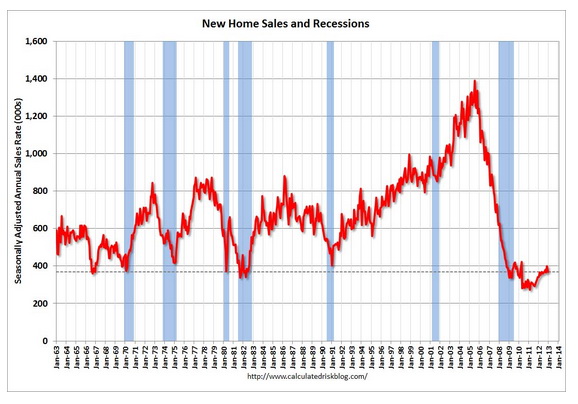
When you see some headline like “Highest New Home Sales in Three Years,” just remember this next chart. Yes, the highest level in three years. But this is a market trying to lift its face out of the mud:

NewHomeSales

Here is Jim Quinn’s comment on that chart:

The media, NAHB, and certain bloggers look at this chart and declare that new home sales are up 20% from 2011 levels. Sounds awesome. I look at this chart and note that 2011 was the lowest number of new home sales in U.S. history. I look at this chart and note that new home sales are 75% below the peak in 2005. I look at this chart and note that new home sales are lower today than at the bottom of every recession over the last fifty years. I look at this chart and note that new home sales are lower today than they were in 1963, when the population of the United States was a mere 189 million, 40% less than today’s population. Do you see any signs of a strong housing recovery in this chart?

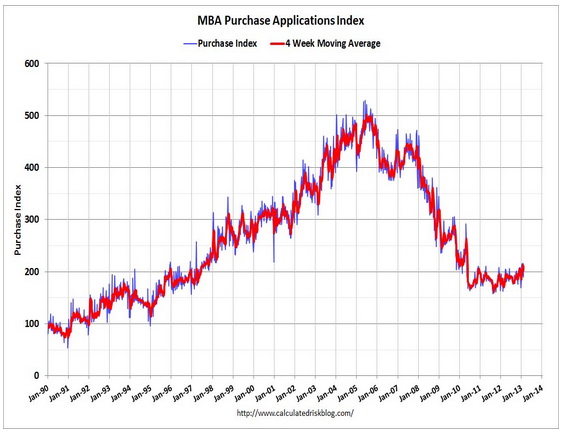
OK, when one includes existing homes sales, the picture is a little better, here’s the chart of mortgage applications for purchase of a home in the US:

MortgageAppsToBuy

So that’s back to 1997 levels. But Jim Quinn correctly notes this:

JP Morgan, Blackrock, Citi, Bank of America, and dozens of other private equity firms have partnered with Fannie Mae and Freddie Mac, using free money provided by Ben Bernanke, to create investment funds to buy up millions of distressed properties and convert them into rental properties, further reducing the inventory of homes for sale and driving prices higher. Only the connected crony capitalists on Wall Street are getting a piece of this action.

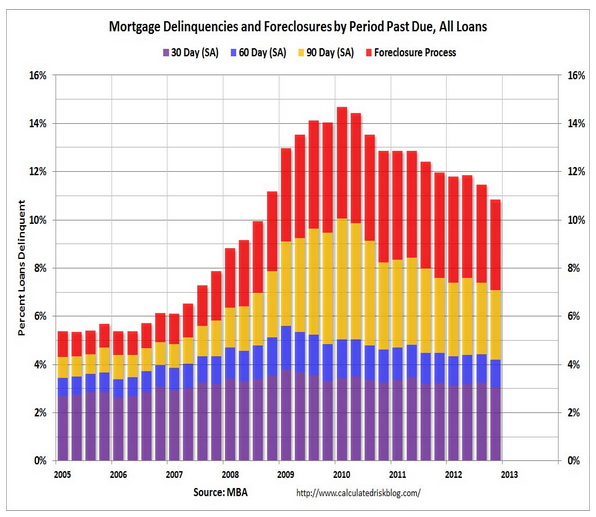
So what just happened? Through a well-orchestrated bubble followed by a continuing foreclosure fest, shown here:

Foreclosures

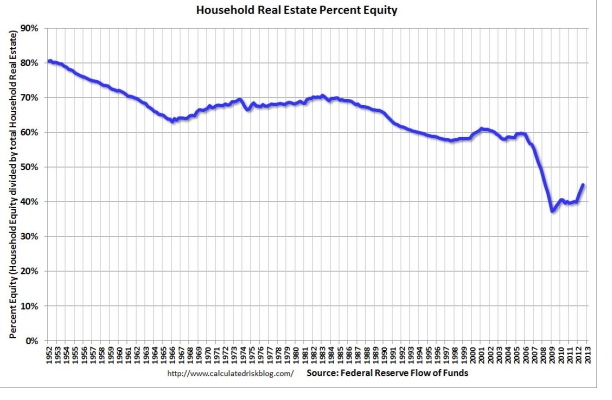
residential real estate ownership in the US is being transferred from Main St to Wall St., facilitated by free money from the US Federal Reserve. Here’s the ownership percentage of regular people in the housing stock in the US:

housholdrealestateequity

So that number has dropped from 80% to 43%. How does that trend look to you? Do you think all of this government real estate assistance, said to be for the benefit of regular people, is for regular people or for Wall St? And this is the system that most people hope remains intact.

And speaking of free money from the Federal Reserve, and indeed, all central banks, the next time you see meek and mild Ben Bernanke on TV telling you he’s doing it all for you, remember who gets free money from him and who does not. The big banks get free money. You and I do not. But, if you are a citizen of the US, you might think, well at least he’s giving money to American banks. But that’s less than half true. Much of Ben’s “quantitative easing” (i.e., the fashionable cover term for money printing) has gone directly into the coffers of European banks via their American branches. Why? The US Federal Reserve is a private corporation among whose major shareholders are large European banking families. And the European banks have a lot of bad loans and their depositors are wising up and withdrawing their deposits:

     Euro-Land Banks In Trouble

A recent study by Ernst & Young has revealed that euro-land banks in the aggregate now hold € 918 billion (US $1.23 trillion) in non-performing loans…

Of course we’ve all heard from the European politicians that everything has been fixed in Europe, though even a cursory look shows that to be a lie.

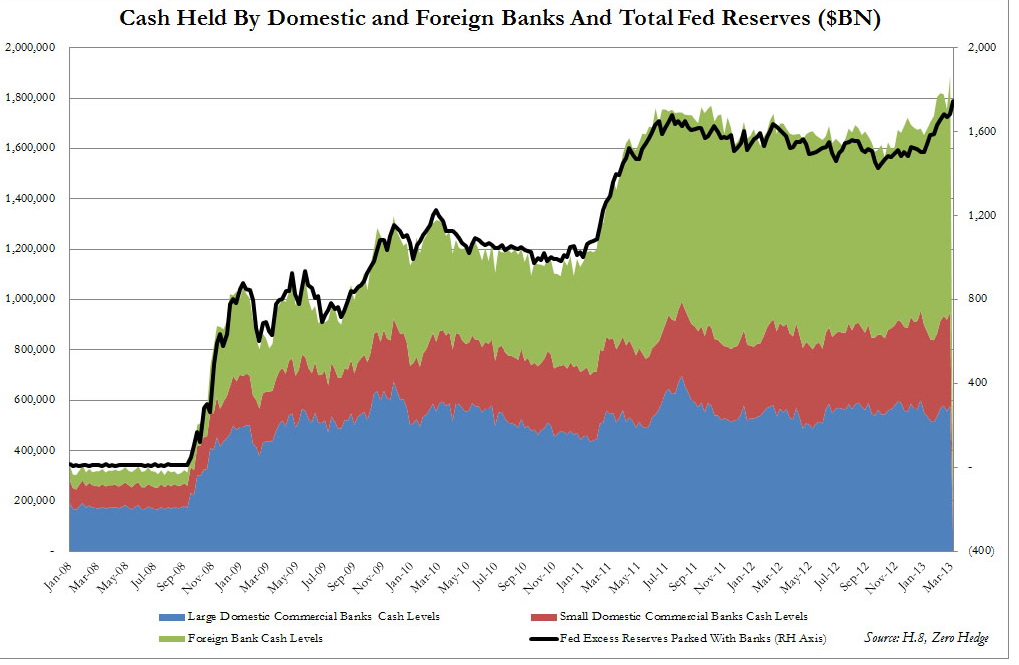
So Ben Bernanke is printing up US Dollars to bail out European banks. He testified to Congress in 2011 that he was not and would not bail out European banks. But those who track the Fed’s money printing have demonstrated that what was called QE2 (Quantitative Easing 2) did not show up on the balance sheet of US banks, it showed up on the balance sheets of the American branches of large European banks, and this has continued. The benefit to the European banks is shown here in green, correlated with the amount of money printing the Fed has done shown as the black line:

EuropeanBankCashFeed

That chart is from:

     Fed Injects Record $100 Billion Cash Into Foreign Banks Operating In The US In Past Week

And speaking of lying, there is a law against what the Federal Reserve is doing. The law says the Fed can’t buy Treasury Bonds directly from the US Treasury. There’s a reason for this: when the Fed prints up new money to buy US Treasury bonds, which is the borrowing of the Government of the US, it’s called “monetizing the debt,” a clear Ponzi scheme where one hand borrows and the other hand prints to enable the borrowing. There’s a law against this because many countries have gone down the tubes once they traveled that road of money printing. Their currency value ultimately went to zero. So what does the Fed do to circumvent the law? They have one of the big NY banks buy the Bonds from the Treasury and then they buy the Bonds from the big NY bank three days later. So the Fed circumvents the law and NY banks get nice commissions and the US Congress gets more free money.  And your income and savings are worth less and less.

     Fed Buys Back 30 Year Bond Auctioned Off Last Thursday

And the politicians and economists who support money printing claim they are Keynesians, that is, that they follow the principles of economist John Maynard Keynes. But they cherry-pick Keynes work, only using that which supports what they want to do anyway, ignoring the rest. Here is a quote from Keynes:

By a continuing process of inflation, governments can confiscate, secretly and unobserved, an important part of the wealth of their citizens. By this method they not only confiscate, but they confiscate arbitrarily; and, while the process impoverishes many, it actually enriches some. … Those to whom the system brings windfalls… become “profiteers” who are the object of the hatred…. the process of wealth-getting degenerates into a gamble and a lottery.

Lenin was certainly right. There is no subtler, no surer means of overturning the existing basis of society than to debauch the currency. The process engages all the hidden forces of economic law on the side of destruction, and does it in a manner which not one man in a million is able to diagnose.

Does that sound like someone who thought money printing was a good idea? Clearly, politicians think all this underhanded dealing is justified:

     Berlusconi: “Bribes Are Necessary – They Are Not Crimes”

This section could go on for days, but let’s stop, though I would like to mention that I think it is advisable that people give consideration to those things derided by  powermongers and their minions in the press as “conspiracy theory.” Many things that the mainstream attempted to relegate to this scrap heap have turned out to be true (here’s a link to an account of 33 of them).

Just one example: Many supposed conspiracies are rejected under the heading that too many people would have to know about it and that this large number of people could never keep it secret. This whole rejection methodology was blown out of the water with the LIBOR scandal where at least dozens of traders at several major banks conspired over decades to manipulate the interest rates on which trillions of dollars of contracts are based. Testimony has been given in the US and the UK that people told the central banks of their respective countries about this manipulation as early as 2008 and the central banks did worse than nothing: The Bank of England is said to have encouraged the practice. Clearly the profit motive was enough to keep this conspiracy operating and quiet for decades. So when you hear that price fixing takes place, with or without government collusion, in fossil fuels, pharmaceuticals, stocks markets, precious metals markets, and so forth, it actually appears to be irrational now to think that price fixing is not taking place. When there is big money to be made, there is big price manipulation in play. All this stuff about “free markets” is a thick, giant smokescreen designed by to increase the power of those who already have it but who crave even more.

However, between insider whistleblowers and great investigative researchers (typically outside the mainstream media that is primarily a compliant tool of those in power), using internet communication as a conduit, discovery and dissemination of truth is clearly on a meteoric rise.

This trend is strongly supported, in my view, by the accelerating increase in the number of people who recognize that individual inner work is beneficial and necessary. People who do the work to identify and become independent of lies they once blindly accepted as true, who continue working to understand the ways in which they fall for illusion, become acceleratingly tough to trick! We will take a look at this and other fabulous developments in Part 7.

What is the Transition? Part 5

ACCELERATION

People’s Perception of Time

Everyone whom I have asked, including young people, feels like time is speeding up, like the day, the week, the year starts, and “before you know it,”, it’s gone. People feel like they have little time to carry out their plans. I would guess that this not universal, but perhaps it is.

Technology

And everyone, or certainly close to it, is aware of Moore’s Law, that the number of transistors that can fit on a chip doubles every two years. And Intel’s David House added that processor performance would double every 18 months. This acceleration in performance, and the fact that the price for that performance has steadily dropped, has changed the world in magnificent ways that have been difficult to envision at any point in time. People like Ray Kurzweil are famous for utilizing this increasing performance and for having made some prescient estimates of the impact of this exponential increase in price/performance, though some of his predictions have been wide of the mark, and it seems his general view that processors will outdistance human intelligence is destined to fail as well since a pathway to program a machine to have a higher self, intuition, noble emotions, will, self-awareness, and a sense of humor seems unavailable, to put it mildly.

Exponential, parabolic trends

As we did with the weather and Earth changes, let’s look at some data.

Money

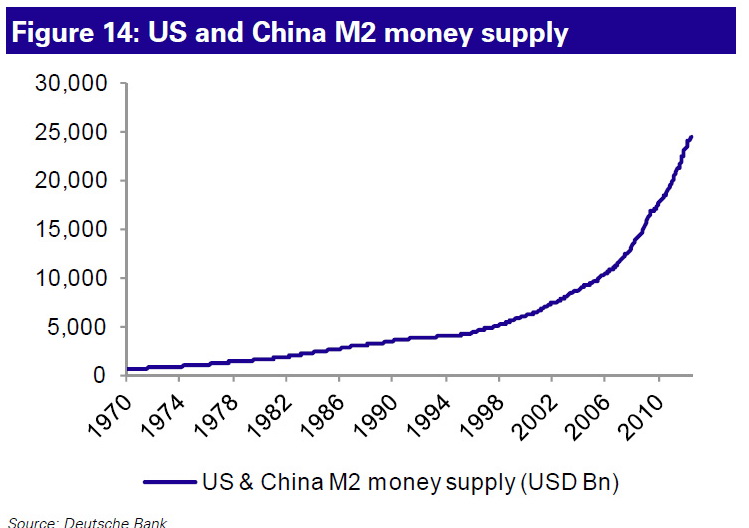
It took the USA until 1990, that is, over 200 years, to create the first trillion US dollars.  The rate of money growth had increased so much by 2007 that it took less than a year to create each additional trillion.  Now, it’s seemingly all in day’s (OK, maybe a month’s) work. Here’s a chart of the money supply in the US and China combined:

USChinaMoneySupply

Yep, between the US and China, that’s $25 trillion floating around.

Another way to look at things is this: From 1971 to 2007, the world economy grew fourfold. Over the same period, the amount of money floating around increased forty-fold. And central banks were just leaving the proverbial starting gate in 2007; the continuing financial crisis had just begun, and the response was, and continues to be: Print Money!

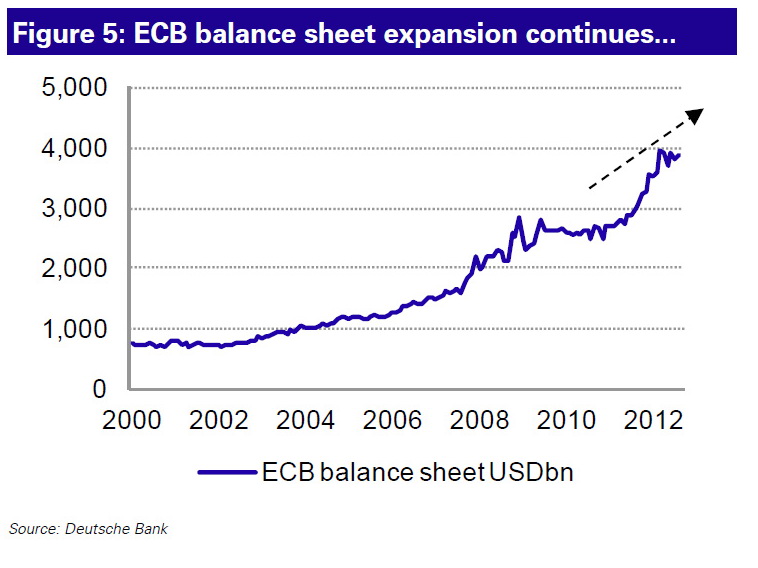
And don’t think the Europeans want the euro to be left out of this print-a-thon:

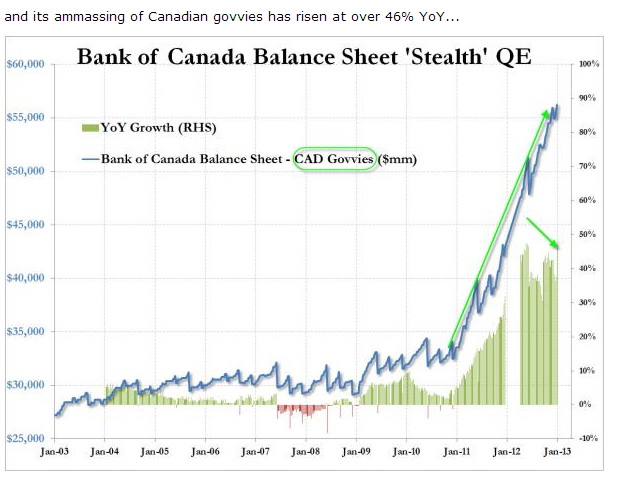
ECB_BS

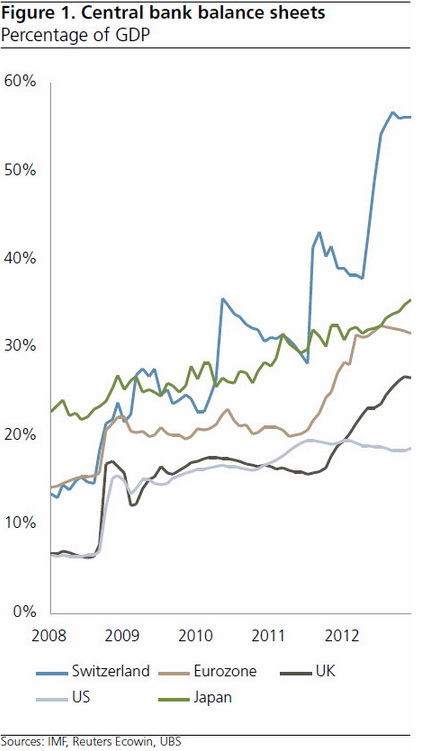
And the Japanese just joined the US and the Eurozone saying they would print “whatever it takes” to get their economy humming again.

And the Swiss!?!? The most pronounced money printing line on this chart (in light blue) represents Switzerland, purported to be so conservative about money. Ah, the good old days! No longer. For the size of their economy, they are the current money-printing front-runner by a wide margin:

CentralBankBalanceSheets

Et tu, Canada? (from zerohedge.com)

CanadaPrinting

And this has little to do with political parties, as shown on this chart of federal government debt in the US:

USDebt_DemsRepubs

though I would ask that you note the super-acceleration of this trend that started in the year 2000.

And in today’s world, the Chinese are the ones doing the heavy lifting in terms of manufacturing, so they are collecting a lot of this printed paper money, in other words, the West prints paper, sends it to China, and gets real goods in return. But the Chinese aren’t stupid, they are well aware of how much more of this paper is being created. So what’s their solution? To get real:

ChineseGoldAccum

The Chinese mine more gold than any other country now—none of which leaves the country–and they import even more physical gold from other countries. Insiders at the London Bullion Market Association, the leading venue in the world for trading physical gold, say that the Chinese are vacuuming out the London gold warehouses. And the Chinese are scouring the planet to buy mines, wells, and so forth, especially in Africa

But really, one would think that, with all this money floating around—there must be at least 200 times the money around now versus 1971–everyone must be rich! But we know that’s hardly the case. Sure, there are other parabolic charts, like the one for corporate profits:

CorporateAfterTaxProfits

The corporations seem to be doing quite well. And US banks had profits of $35 billion in the fourth quarter of 2012 alone. (Yes, the same banks that needed those big bailouts. As a group, they had a total of four quarters where they weren’t profitable. It’s been business as usual ever since. And they are hard at work telling legislators, as they bribe them, that any new regulations will seriously hurt their business.)

But other parabolic charts tell a different story. Here’s one for youth unemployment in the Eurozone (from zerohedge.com):


GreekYouthUnemployment

Yes, that’s over 60% youth unemployment in Greece, with Spain right behind.

And gasoline prices are “doing great”—for the oil companies, that is. Here’s the price chart for the US, with gas up 243% since 1998:

GasPrices

That chart is only through 2011, but since US gas prices just registered their highest ever price for a February here in 2013, this trend does not seem to be in jeopardy.

And the Food Price Index of the UN Food and Agriculture Organization is up 132% since the year 2000, with the all-important cereals/grains index up 190%. This is putting an extreme and accelerating squeeze on the budgets of the poor around the world.

This article contains the chart below showing that in 2005, it cost the US government one penny to mint a penny and one nickel to mint a nickel. Now, after all that money printing, it costs twice as much:

PennyAndNickel

resulting in a loss of $436 million for the Government of the US (GUS) to mint pennies and nickels since 2006.

So it seems clear that the accelerating money printing is accelerating the cost of real things that people need: gasoline, food, the metals that go into manufactured products, and so forth.

Here’s the accelerating cost of Social Security in the US:

SSA_TotalCost

Well, we saw the accelerating youth unemployment in the Eurozone above. And the EU just announced that its overall unemployment rate is 12%. And, as this chart shows, there hasn’t been any growth in the EU economy since late 2011 (chart source):

EU_GDP

In the US, GUS says the economy hit stall speed (0% “growth”) in the Fourth Quarter 2012. Here is a chart that shows that, of the 41 largest national economies in the world, only 18% of them expanded in the Fourth Quarter of 2012:

OECD_Expanders

Astute chart readers will notice that such a reading corresponds with the worst recessions (1973-74, 1981-82, and 2008-2009) of the last 50 years, so now you know why the central banks have started printing even more money–yes, accelerating!

How is it going for jobs in the US? As this chart shows,  the US is still 3 million jobs short of where things were in 2008:

JobsUS

Even worse, as the next chart shows, the large increase in the number of people working part-time means that a lot of the apparent job gains shown on the previous chart are part-time rather than full-time jobs:

PartTimeUS

If you think it’s only uneducated people who are suffering from all this, check this:

     Number Of PhD Recipients Using Food Stamps Surged During Recession

The number of PhD recipients on food stamps and other forms of welfare more than tripled between 2007 and 2010 to 33,655, according to an Urban Institute analysis cited by the Chronicle of Higher Education. The number of master’s degree holders on food stamps and other forms of welfare nearly tripled during that same time period to 293,029, according to the same analysis.

These job difficulties are reflected in household income in the US. The following chart shows two problems. While the red line shows income growth since 2000, it is still lower than it was at the start of the financial collapse in 2007. And the blue line shows household income adjusted for inflation. When GUS-calculated inflation is taken into account, income for the average household is 8% lower than it was 13 years ago:

RealIncome

Here is a chart of US household net worth (annotated by Of Two Minds) compared to all of the debt that has been created, showing that all of that debt is not making people richer:

NetWorthbyDebt

All of these economic charts were compiled by governments who, as we’ll show in a future post on the acceleration in lying, have a strong vested interest (it’s literally and even proudly called MOPE by academics—Management of Perception Economics) in making things look better than they are. In that light, I ask that you consider the following two charts compiled by a private bunch of computer geek types at a place called Consumer Metrics Institute. They thought, in this time of highly-networked business, that it was silly to have to wait until governments spent months collecting data before telling us what happened some months back, that the data could be collected and reported in near-real-time. If you wish, you can find out what they do at their FAQ.

But what they essentially do is track, in real time, discretionary purchases for things like automobiles, housing, vacations, durable household goods and investments.

These two charts show the trend in these purchases where a value of 100 would equal the same level of purchasing as was taking place in 2005. The first chart is the last 60 days:

CMIRecent

And the second chart is of the last three years:

CMILong

So, both charts show their index hovering around 85 or lower, which means that this large portion of the US consumer economy is 15% smaller than it was in 2005! Perhaps that aligns better with the income and net worth charts shown above rather than the rosy “we’re in a wonderful economic recovery” MOPE spewed by minions of The Powers That Be.

So what it looks like is that all that money printing is making a select few richer and, by driving up the prices of real goods, squeezing regular people—whose income is falling and who spend a far greater percent of their income on real goods. And the Western central banks say it isn’t their fault that people are rioting in countries where people’s costs for food have gone from 40% to 80% of their income. Nope, they aren’t driving prices up at all with their money printing, it’s those “evil speculators.” Well, perhaps it is evil speculators, but they are aided and abetted by a vast surplus of gambling chips supplied by the central banks.

There’s more to come. Stay tuned for Part 6.

What is the Transition? Part 4

After a brief mention of other natural changes, I would like to move on and treat a difficult trend that is at the intersection of human activity and earth changes, followed by discussions of the effects of acceleration on people.

Other Earth Changes

There are other observable changes in the natural world such as:

–SINKHOLES: There has been a rapid increase in reports of sinkholes. No one keeps statistics on these, at least not yet. But ask yourself: twenty years ago, how often did you hear about sinkholes? Now, it’s tough to go a week or two without a report:

     Chinese village suffers over 20 sinkholes in five months

     In just one month, more than 40 huge sinkholes open up all over Harrisburg, Pennsylvania’s capital, but the city is too broke to fix them

     Russia: Giant Sinkhole in Dagestan

     Giant sinkhole swallows building in Bundaberg, Queensland, 10 more at risk

     Amazing pics of a hole that opened up the earth 

     Enormous sinkhole swallows buildings in Guangzhou, China

Sinkholes are becoming a worrying problem in China. In 2007, there were 54 sinkhole collapses, and by 2009, that number was all the way up to 129. According to one estimate, between July 21st and August 12th 2012, 99 sinkhole collapses occurred just in Beijing.

     The Great Collapse: crust weakening, slipping, and collapsing across the planet – UK, Spain, Kashmir, China, U.S.

–ASTEROIDS, fireballs in the sky: The world of youtube has been showing what appears to be quite an increase in meteorites/fireballs over the last several years. Within the last three months, however, these have gone mainstream media:

     Newfound Asteroid Buzzes Earth Inside Moon’s Orbit — Asteroid 2012 XE54 was discovered in December just two days before passing Earth inside the moon’s orbit;

Then there was the meteor that hit Russia on Feb 14, shown all over the web, including here and here; and,

     2012 DA14, which passed inside the orbit of geosynchronous communication satellites, missing the planet by 17,000 miles on Feb 15.

–COMETS: Of the many comets that pass the earth each year–most of them not visible to the naked eye–there is great interest among comet-watchers in one scheduled for this year, called 2012 S1 (ISON), which has the potential to become exceedingly bright and which some comet watchers claim will have important influences on Earth.

We will delay further discussion of this asteroid and comet phenomenon for the upcoming section of this series that deals with Predictions, though it seems worthwhile to note that Russia and all of us were very lucky: that meteorite in Russia exploded near Chelyabinsk where large amounts of nuclear waste and dangerous industrial chemical wastes are stored. We are all fortunate that the meteorite did not strike these directly, which leads in to the next topic.

Nuclear Power Plants

Virtually all nuclear power plants are situated adjacent to a body of water that is typically used to cool the plant. With the major trend increases in storms, floods, tsunamis, and earthquakes documented in Part 1 and Part 2, combined with decades of “profits above all else” at many of the corporations running these nuke plants, to say that this situation is dangerous requires a new category well beyond understatement.

     US: Flood Berm Collapses at Nebraska Nuclear Plant

Nuc578314d46fa641a9940e57967a65d6

     UK nuclear sites at risk of flooding, report shows

As many as 12 of Britain’s 19 civil nuclear sites are at risk of flooding and coastal erosion because of climate change, according to an unpublished government analysis obtained by the Guardian.

Nine of the sites have been assessed by the Department for Environment, Food and Rural Affairs (Defra) as being vulnerable now, while others are in danger from rising sea levels and storms in the future.

And of course we all know more than we ever wanted to know about what happens when a tsunami hits a nuke plant. If anyone thinks the Fukushima problem is over, they have been ignoring the news flow on that topic. Even in the unlikely event that there are no additional difficulties from the cores and spent fuel at Fukushima, the damage from the original event is not over:

     Tokyo almost as irradiated as Fukushima

     Bluefin Tuna Caught Near California Still Radioactive Years After Fukushima

     Meet Mike, The Most Radioactive Fish Ever From Fukushima

     More Fukushima nuclear pollution to hit U.S. starting in 2015

     Study: Contaminated water from Fukushima reactors could double radioactivity levels of US coastal waters in 5 years — “We were surprised at how quickly the tracer spread” (PHOTO & VIDEO)

While many consider Fukushima to be a one-off event, it seems to me that logic dictates that the acceleration in earth changes plus the location of these plants next to water means that we have an extremely unfortunate emerging trend on our hands.

In Part 5, I’ll begin treatment of the human side of acceleration and the Transition.

What is the Transition? Part 3

Sea Level Rise

Have you ever seen a film of a three mile by one mile chunk of glacier falling into the sea? If not, and if you have four minutes to spare, now you can, by clicking on this link for an excerpt from the film Chasing Ice, which concludes, by the way, with a classic example of acceleration.

It helps to see films like that since the noise in the media on sea level rise is nearly deafening. A $120 million war chest can be used to make a lot of noise:

     Secret funding helped build vast network of climate denial thinktanks

Folks like these, joined by the industry spawned by the fossil fuel companies and oil exporting countries, stridently deny lots of things about climate change. In fact, some of them claim that we are right on the verge of a new ice age.  They often seem to feel the need to yell rather loudly to drown out stories like this:

     Satellites reveal sudden Greenland ice melt

     Melt ponds cause the Arctic sea ice to melt more rapidly

And charts like this that show the longer term trend for Arctic sea ice (source):

ArcticSeaIceTrend

and of course the chart of sea level rise itself:

GlobalSeaLevelTrend

Claims and counter-claims aside, there are, undeniably, people losing their homes to rising sea levels:

     Papua New Guinea: Carteret Islands: ‘The sea is killing our island paradise’

The people of the Carterets, for 300 years ignored by all but a few passers-by, can lay claim to a dubious distinction: within the next six months, some 240 of them – 40 families – will leave for good, driven from their homes by sea-level rise. In five years, half of the population, estimated at 2,500 people, is expected to have been evacuated to bigger, less vulnerable islands, some of the first refugees displaced as a result of man-made global warming. Some believe the islands will be uninhabitable by 2015.

     The view from beneath the waves: climate change in the Solomon Islands

The smaller outer islands in the Solomon Islands are already seeing devastating impacts of the rising sea level. The impact of climate change is already affecting the rural population of Solomon Islands, an archipelago of eight bigger islands and hundreds of small, mostly uninhabited islands…Taro, the staple root crop in Ontong Java atoll, is dying due to salinity of the swamp and sandy soil. And graves at the Tuo village cemetery, an island in the eastern Solomons have been exposed by eroding waves.

During the 1980s the burial place was about 50m away from the beach. Today the beach is about 1m with only one cross remaining as the rising sea had washed most away.

     Vanishing point

Unless Tuvaluans adopt the lifestyle of the Marsh Arabs and build their houses on stilts over water, and that’s where they live 24 hours a day, eventually most, if not all, of the island will become uninhabitable.

     Micronesia: A Third Kind of Nation, Written Off?

“Even the dead are no longer safe in my country,” Micronesia’s Ambassador to the UN told ABC News at his mission’s offices on a rainy day in New York.

He gave us recent digital photos of his home islands.

In one, a man stands shin-deep out in a calm and sunny sea … where a cemetery used to be.

In others, colorful traditional burial grounds spill out of a wave-eroded bank onto the tiny remaining beach, and water surges inland past tumbled houses.

     Sea change: the Bay of Bengal’s vanishing islands

     Paradise lost?

The tiny Pacific island nation of Palau is a paradise on earth. This band of several hundred islands is home to some of the world’s most stunning marine life, and to the twenty thousand people who live there.

But like many low-lying nations across the world, Palau is threatened by the effects of climate change and sea-level rise.

Palau’s coasts are being eroded, its local farmlands tainted by seawater, and its valuable reefs threatened. Johnson Toribiong, President of Palau, calls the damage he’s witnessing “a slow-moving tsunami.”

Kiribati, the Maldives, Torres Strait Islands, Cook Islands, many small islands of the Philippines, and the inhabited areas Barbados–all are getting inundated.

And it isn’t just the small islands that are having trouble. Large cities like Jakarta are facing dual difficulties: sinking land from the draining of freshwater aquifers combined with rising sea levels (source):

Experts in Indonesia are preparing to build a huge wall to stop the ocean from swamping parts of Jakarta.

Some suburbs in the capital already go underwater when there is a big tide but the problem is expected to get even worse.

Jakarta is sinking by up to 10 centimetres a year and Indonesia’s national disaster centre says with oceans rising, large parts of the city, including the airport, will be inundated by 2030.

Flooding and high tides are already causing problems for some residents in the city of 10 million people.

New York is still suffering the effects of the elevated storm surge from Superstorm Sandy.

London completed the Thames Barrier in the early 1980s to deal with rising tides boosted by increasingly powerful storms. They raise the barrier in the Thames when rising ocean waters threaten to flood London and the Thames Valley. In the 1980s, they raised the barrier 4 times; in the 1990s, 35 times; and from 2000 through 2010, 80 times.

And according to Scientific American, Shanghai, which means “above the sea” is finding itself on its way to being below the sea. The city has spent billions of dollars fending off the encroachment of the sea:

But the city’s biggest concern remains the slow, steadily mounting threat that comes from sea level rise. Higher tides are washing away the precious delta soil upon which the city’s foundations are built, and water supplies are becoming more tainted as seawater intrudes more deeply into the fresh water of the Yangtze.

Species Extinction

It seems that major changes in conditions on the planet give rise to the extinction of a large number of species. This has happened five times in the last several hundred million years. The most recent such event saw the demise of the dinosaurs. Some observers—such as the US Geological Survey for the chart below—offer data that points to the idea that we are in the middle of the sixth such mass species extinction event:

SpeciesExtinction

This indicates that the changes we are experiencing are way beyond trivial.

Here is Part 4.

What is the Transition? Part 1

I have made reference to “the Transition.” Before trying to describe its essence, it will be useful to first review aspects of the Transition, in other words, some of its identifiable characteristics. One aspect that runs through all of the others is acceleration, as you will see.

EARTH CHANGES

EARTHQUAKES

Below is a chart of how much shaking the planet has experienced from strong earthquakes for the last 30 years. This chart sums up the Richter values for all earthquakes of magnitude 6.0 or greater for each year. The earthquakes are summed rather than simply counted so that larger earthquakes have slightly greater weight on the chart. To show the trend, the column for each year shows the 10-year average of all that shaking. The trend is unmistakable—things started to really scale up in the early 1990’s:

EarthquakeTrend

The data for this chart was assembled from a straightforward query of the USGS (US Geological Survey) database at their Global Earthquake Search page.

After the massive Japan earthquake and aftershocks of 2011 (it is worth watching this video graphical display of the world’s 2011 earthquakes, especially if you live in the Ring of Fire), there were fewer earthquakes in 2012. However, 2013 is off to a very fast start, as shown in part in this link from Feb 2:

Earth reeling from eight major earthquakes striking in 5 days

And since that post on Feb 2, there have been an 8.0, a 7.0, a 6.4, and a 6.3 in the Solomon Islands, a 6.9 in Japan, and a 6.9 in Columbia.

TSUNAMIS

Earth doesn’t typically see a lot of large tsunamis, but their occurrence has ramped up fivefold in recent years. According to data at the NOAA Global Historical Tsunami Database, which has records going back to 2000 BC, there have been 34 tsunamis with a wave height greater than twenty feet over the last 400 years. Six of those, or 18%, have occurred since the year 2000:

Year Location Water Height Deaths
2000 GREENLAND 50.0
2004 INDONESIA 50.9   226,898
2006 INDONESIA 20.9         802
2009 SAMOA 22.4         192
2010 CHILE 29.0         156
2011 JAPAN 38.9    15,854

In the Twentieth Century, there was a tsunami with a twenty foot wave height about once every ten years. In this century, it has happened once every two years, resulting in the deaths of a quarter million people despite the fact that none of these tsunamis struck a major city. The NOAA’s database shows that even a tsunami less than five feet in height can kill thousands. With 23% of the world’s people living in what is called the “near coastal zone,” tsunamis are likely the single most life-threatening Earth-change phenomenon on the planet.

VOLCANISM

Due to the great behavioral variations of active volcanoes, the tracking of volcanism is not as mathematically rigorous as that for earthquakes and tsunamis. There is a site jointly sponsored by the Smithsonian and the USGS that reports on volcanic activity in the latest week. Here is their list for the week of 30 January–5 February 2013:

New Activity/Unrest:

  • Colima, México
  • Etna, Sicily (Italy)
  • Paluweh, Lesser Sunda Islands (Indonesia)
  • Rabaul, New Britain
  • Reventador, Ecuador
  • White Island, New Zealand

Ongoing Activity:

  • Batu Tara, Komba Island (Indonesia)
  • Chirpoi, Kuril Islands (Russia)
  • Copahue, Central Chile-Argentina border
  • Karymsky, Eastern Kamchatka (Russia)
  • Kilauea, Hawaii (USA)
  • Kizimen, Eastern Kamchatka (Russia)
  • Lokon-Empung, Sulawesi
  • Sakura-jima, Kyushu
  • Santa María, Guatemala
  • Shiveluch, Central Kamchatka (Russia)
  • Tolbachik, Central Kamchatka (Russia)

So, their list is all from the Pacific Rim and Italy. According to some who track this carefully, after a total of 77 volcanic eruptive events for all of the year 2012, there were 44 volcanic eruptive events recorded just in the month of January 2013.

Here are some volcano-related headlines shown on the SOTT.NET Earth Changes page in just the last couple of weeks:

The Great Awakening? Ten volcanoes awaken in one week

Indonesia’s Mount Lokon volcano shaken by double eruptions

Puyehue-Cordon Caulle volcano erupts in Chile

Tavurvur volcano erupts in Papua New Guinea, ash cloud diverts flights

Hawaii’s Mount Kilauea lava lake hits new record high

Manam volcano (Papua New Guinea): Large explosive eruption sending ash plume to 45,000 ft altitude

Campi Flegrei supervolcano raising anxiety among Italian residents

WEATHER EXTREMES (Storms, Floods, Heat Waves, etc.)

Does anyone on the planet need to be told that storms are ramping up in size, intensity, and frequency, resulting in unprecedented flooding? And that heat waves have taken on new intensities and duration? Is there anyone still claiming, “It’s just the internet, nothing has changed, we just have better reporting.”? Anyone making such claims would be well-advised to review the recent history of the global insurance industry. The venerable Lloyd’s of London almost went bankrupt in the mid-1990’s after 350 years of annual profits. They said they had to completely revamp their weather catastrophe calculations because the actuarial data on which they had relied for 300 years (!) was no longer applicable.

Below are some quotes from September 2010 on the web site of Munich Reinsurance, the largest re-insurance company in the world.  Reinsurers sell insurance to other insurance companies to cover catastrophic losses:

Munich Re’s natural catastrophe database, the most comprehensive of its kind in the world, shows a marked increase in the number of weather-related events. For instance, globally there has been a more than threefold increase in loss-related floods since 1980 and more than double the number of windstorm natural catastrophes…

Prof. Peter Höppe, Head of Munich Re’s Geo Risks Research/Corporate Climate Centre: “It’s as if the weather machine had changed up a gear.”

Heavy rain and flash floods are affecting not only people living close to rivers but also those who live well away from traditionally flood-prone areas.

And then things accelerated further. By October 2012, Munich Re reported that the numbers were even larger. They reported that weather-related loss events in North America had grown fivefold over the past three decades, and that there was “an increase factor of 4 in Asia, 2.5 in Africa, 2 in Europe, and 1.5 in South America.”

There are literally thousands of headlines available to demonstrate this idea further, here are just a few:

Cyclone frequency in Indonesia increases 28-fold since 2002

Global warming – or something much worse? Australia adds new colour to temperature maps

The temperature forecast for next Monday by Australia’s Bureau of Meteorology is so unprecedented – over 52C – that it has had to add a new colour to the top of its scale, a suitably incandescent purple.

Aus_New_Color

Tornado slams into Italian steel plant – video

To give you an idea how rare tornadoes are in Italy, four tornadoes in total were recorded in the 17th, 18th and 19th centuries, three were recorded in the 20th century and four were recorded since 2008 alone, with two of those coming in 2012.

And the damage is not limited to single instances, it is cumulative in many areas, for example, the US East Coast:

Former USGS scientist: Coastal cities are ‘sitting ducks’ for next big storm

“We have left our coasts sitting ducks, and Sandy destroyed these natural protections,” she said.

In the space of a few hours, Sandy blew through the sand dunes that had served as natural protections for communities up and down the Atlantic coast.

“Basically these dunes build up over geologic time, and yet the superstorm wore them down over a couple of days, and it is going to take geologic time again to build them back up,” McNutt said.

For those who are more video oriented, this youtube poster does a good job of grabbing news video of weather extremes and earth changes from around the world each month. These can be useful to watch since they can remind just how quickly, under the tremendous distraction of daily life, we forget what’s been happening:

Extreme Weather Events and Earth Changes DECEMBER 2012

The November installment includes Superstorm Sandy. Since the news media typically won’t cover a weather story unless there is a body count to report, few are aware that Lower Manhattan in New York City is still seriously impaired, with skyscrapers running from emergency generators on the street because their basements are still flooded.

RISING TIDES – WITH PERPLEXITY THE SEA AND WAVES ROARING NOVEMBER 2012

FIRE AND ICE – EXTREME WEATHER EVENTS AND EARTH CHANGES JANUARY 2013

(While I applaud SOTT.NET and the maker of the youtubes above, fidockave213, for their excellent work at collecting earth change information, I am not aligned with their editorial views.)

Part 2 describes a huge weather shift taking place on the planet that almost no one is talking about!