What is the Transition? Part 4

After a brief mention of other natural changes, I would like to move on and treat a difficult trend that is at the intersection of human activity and earth changes, followed by discussions of the effects of acceleration on people.

Other Earth Changes

There are other observable changes in the natural world such as:

–SINKHOLES: There has been a rapid increase in reports of sinkholes. No one keeps statistics on these, at least not yet. But ask yourself: twenty years ago, how often did you hear about sinkholes? Now, it’s tough to go a week or two without a report:

     Chinese village suffers over 20 sinkholes in five months

     In just one month, more than 40 huge sinkholes open up all over Harrisburg, Pennsylvania’s capital, but the city is too broke to fix them

     Russia: Giant Sinkhole in Dagestan

     Giant sinkhole swallows building in Bundaberg, Queensland, 10 more at risk

     Amazing pics of a hole that opened up the earth 

     Enormous sinkhole swallows buildings in Guangzhou, China

Sinkholes are becoming a worrying problem in China. In 2007, there were 54 sinkhole collapses, and by 2009, that number was all the way up to 129. According to one estimate, between July 21st and August 12th 2012, 99 sinkhole collapses occurred just in Beijing.

     The Great Collapse: crust weakening, slipping, and collapsing across the planet – UK, Spain, Kashmir, China, U.S.

–ASTEROIDS, fireballs in the sky: The world of youtube has been showing what appears to be quite an increase in meteorites/fireballs over the last several years. Within the last three months, however, these have gone mainstream media:

     Newfound Asteroid Buzzes Earth Inside Moon’s Orbit — Asteroid 2012 XE54 was discovered in December just two days before passing Earth inside the moon’s orbit;

Then there was the meteor that hit Russia on Feb 14, shown all over the web, including here and here; and,

     2012 DA14, which passed inside the orbit of geosynchronous communication satellites, missing the planet by 17,000 miles on Feb 15.

–COMETS: Of the many comets that pass the earth each year–most of them not visible to the naked eye–there is great interest among comet-watchers in one scheduled for this year, called 2012 S1 (ISON), which has the potential to become exceedingly bright and which some comet watchers claim will have important influences on Earth.

We will delay further discussion of this asteroid and comet phenomenon for the upcoming section of this series that deals with Predictions, though it seems worthwhile to note that Russia and all of us were very lucky: that meteorite in Russia exploded near Chelyabinsk where large amounts of nuclear waste and dangerous industrial chemical wastes are stored. We are all fortunate that the meteorite did not strike these directly, which leads in to the next topic.

Nuclear Power Plants

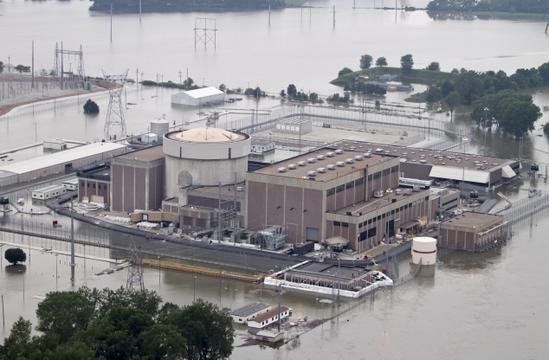
Virtually all nuclear power plants are situated adjacent to a body of water that is typically used to cool the plant. With the major trend increases in storms, floods, tsunamis, and earthquakes documented in Part 1 and Part 2, combined with decades of “profits above all else” at many of the corporations running these nuke plants, to say that this situation is dangerous requires a new category well beyond understatement.

     US: Flood Berm Collapses at Nebraska Nuclear Plant

Nuc578314d46fa641a9940e57967a65d6

     UK nuclear sites at risk of flooding, report shows

As many as 12 of Britain’s 19 civil nuclear sites are at risk of flooding and coastal erosion because of climate change, according to an unpublished government analysis obtained by the Guardian.

Nine of the sites have been assessed by the Department for Environment, Food and Rural Affairs (Defra) as being vulnerable now, while others are in danger from rising sea levels and storms in the future.

And of course we all know more than we ever wanted to know about what happens when a tsunami hits a nuke plant. If anyone thinks the Fukushima problem is over, they have been ignoring the news flow on that topic. Even in the unlikely event that there are no additional difficulties from the cores and spent fuel at Fukushima, the damage from the original event is not over:

     Tokyo almost as irradiated as Fukushima

     Bluefin Tuna Caught Near California Still Radioactive Years After Fukushima

     Meet Mike, The Most Radioactive Fish Ever From Fukushima

     More Fukushima nuclear pollution to hit U.S. starting in 2015

     Study: Contaminated water from Fukushima reactors could double radioactivity levels of US coastal waters in 5 years — “We were surprised at how quickly the tracer spread” (PHOTO & VIDEO)

While many consider Fukushima to be a one-off event, it seems to me that logic dictates that the acceleration in earth changes plus the location of these plants next to water means that we have an extremely unfortunate emerging trend on our hands.

In Part 5, I’ll begin treatment of the human side of acceleration and the Transition.

What is the Transition? Part 3

Sea Level Rise

Have you ever seen a film of a three mile by one mile chunk of glacier falling into the sea? If not, and if you have four minutes to spare, now you can, by clicking on this link for an excerpt from the film Chasing Ice, which concludes, by the way, with a classic example of acceleration.

It helps to see films like that since the noise in the media on sea level rise is nearly deafening. A $120 million war chest can be used to make a lot of noise:

     Secret funding helped build vast network of climate denial thinktanks

Folks like these, joined by the industry spawned by the fossil fuel companies and oil exporting countries, stridently deny lots of things about climate change. In fact, some of them claim that we are right on the verge of a new ice age.  They often seem to feel the need to yell rather loudly to drown out stories like this:

     Satellites reveal sudden Greenland ice melt

     Melt ponds cause the Arctic sea ice to melt more rapidly

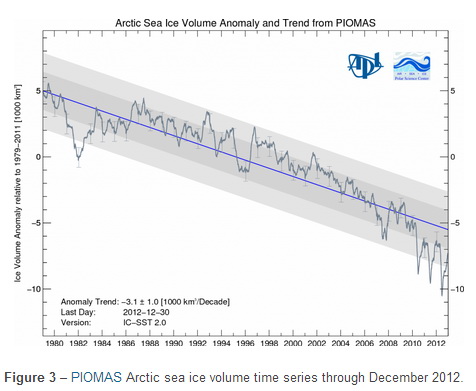
And charts like this that show the longer term trend for Arctic sea ice (source):

ArcticSeaIceTrend

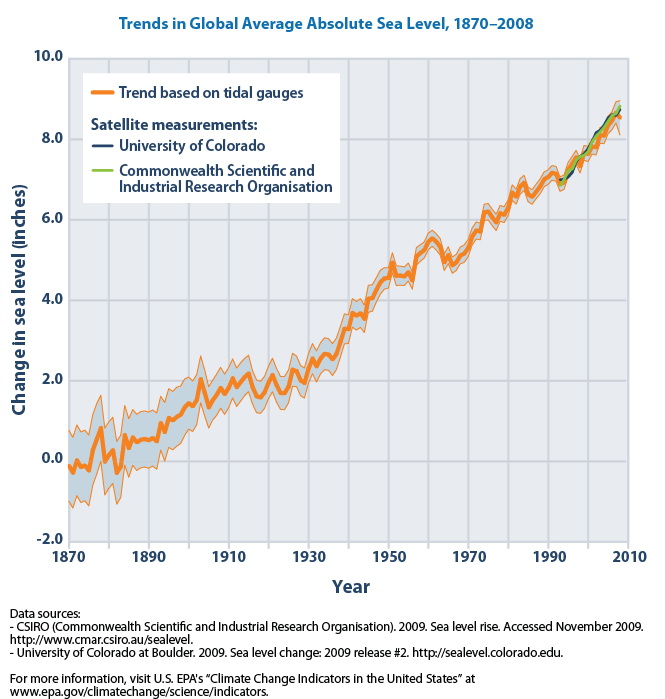
and of course the chart of sea level rise itself:

GlobalSeaLevelTrend

Claims and counter-claims aside, there are, undeniably, people losing their homes to rising sea levels:

     Papua New Guinea: Carteret Islands: ‘The sea is killing our island paradise’

The people of the Carterets, for 300 years ignored by all but a few passers-by, can lay claim to a dubious distinction: within the next six months, some 240 of them – 40 families – will leave for good, driven from their homes by sea-level rise. In five years, half of the population, estimated at 2,500 people, is expected to have been evacuated to bigger, less vulnerable islands, some of the first refugees displaced as a result of man-made global warming. Some believe the islands will be uninhabitable by 2015.

     The view from beneath the waves: climate change in the Solomon Islands

The smaller outer islands in the Solomon Islands are already seeing devastating impacts of the rising sea level. The impact of climate change is already affecting the rural population of Solomon Islands, an archipelago of eight bigger islands and hundreds of small, mostly uninhabited islands…Taro, the staple root crop in Ontong Java atoll, is dying due to salinity of the swamp and sandy soil. And graves at the Tuo village cemetery, an island in the eastern Solomons have been exposed by eroding waves.

During the 1980s the burial place was about 50m away from the beach. Today the beach is about 1m with only one cross remaining as the rising sea had washed most away.

     Vanishing point

Unless Tuvaluans adopt the lifestyle of the Marsh Arabs and build their houses on stilts over water, and that’s where they live 24 hours a day, eventually most, if not all, of the island will become uninhabitable.

     Micronesia: A Third Kind of Nation, Written Off?

“Even the dead are no longer safe in my country,” Micronesia’s Ambassador to the UN told ABC News at his mission’s offices on a rainy day in New York.

He gave us recent digital photos of his home islands.

In one, a man stands shin-deep out in a calm and sunny sea … where a cemetery used to be.

In others, colorful traditional burial grounds spill out of a wave-eroded bank onto the tiny remaining beach, and water surges inland past tumbled houses.

     Sea change: the Bay of Bengal’s vanishing islands

     Paradise lost?

The tiny Pacific island nation of Palau is a paradise on earth. This band of several hundred islands is home to some of the world’s most stunning marine life, and to the twenty thousand people who live there.

But like many low-lying nations across the world, Palau is threatened by the effects of climate change and sea-level rise.

Palau’s coasts are being eroded, its local farmlands tainted by seawater, and its valuable reefs threatened. Johnson Toribiong, President of Palau, calls the damage he’s witnessing “a slow-moving tsunami.”

Kiribati, the Maldives, Torres Strait Islands, Cook Islands, many small islands of the Philippines, and the inhabited areas Barbados–all are getting inundated.

And it isn’t just the small islands that are having trouble. Large cities like Jakarta are facing dual difficulties: sinking land from the draining of freshwater aquifers combined with rising sea levels (source):

Experts in Indonesia are preparing to build a huge wall to stop the ocean from swamping parts of Jakarta.

Some suburbs in the capital already go underwater when there is a big tide but the problem is expected to get even worse.

Jakarta is sinking by up to 10 centimetres a year and Indonesia’s national disaster centre says with oceans rising, large parts of the city, including the airport, will be inundated by 2030.

Flooding and high tides are already causing problems for some residents in the city of 10 million people.

New York is still suffering the effects of the elevated storm surge from Superstorm Sandy.

London completed the Thames Barrier in the early 1980s to deal with rising tides boosted by increasingly powerful storms. They raise the barrier in the Thames when rising ocean waters threaten to flood London and the Thames Valley. In the 1980s, they raised the barrier 4 times; in the 1990s, 35 times; and from 2000 through 2010, 80 times.

And according to Scientific American, Shanghai, which means “above the sea” is finding itself on its way to being below the sea. The city has spent billions of dollars fending off the encroachment of the sea:

But the city’s biggest concern remains the slow, steadily mounting threat that comes from sea level rise. Higher tides are washing away the precious delta soil upon which the city’s foundations are built, and water supplies are becoming more tainted as seawater intrudes more deeply into the fresh water of the Yangtze.

Species Extinction

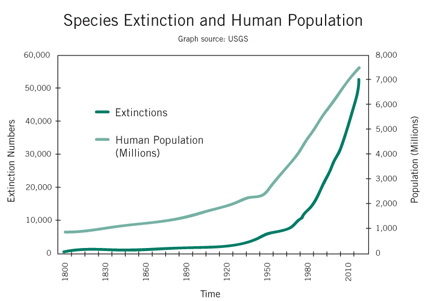
It seems that major changes in conditions on the planet give rise to the extinction of a large number of species. This has happened five times in the last several hundred million years. The most recent such event saw the demise of the dinosaurs. Some observers—such as the US Geological Survey for the chart below—offer data that points to the idea that we are in the middle of the sixth such mass species extinction event:

SpeciesExtinction

This indicates that the changes we are experiencing are way beyond trivial.

Here is Part 4.

What is the Transition? Part 2

An Important Weather SHIFT

This is not a contribution to the raging global warming debate in which some people who pretend to be civilized threaten those who disagree with them with torture and death.

And it’s about a weather trend, not what happened last week in one place.

This is about a global weather shift. And if this shift is correctly described below, then it has major consequences. But almost no one is talking about it.

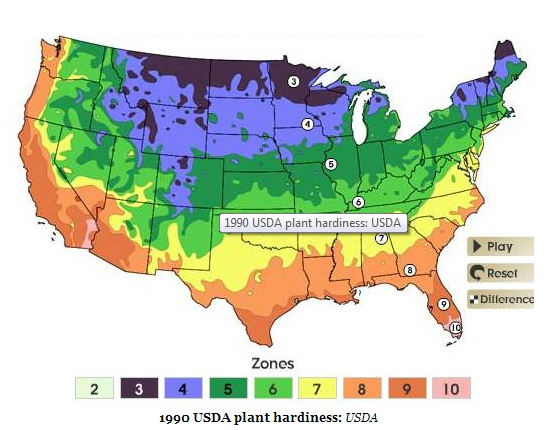
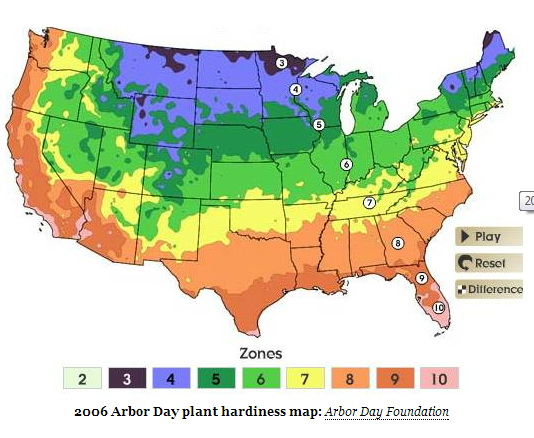
In their local areas, this shift has been apparent to North American gardeners for years, as they have been increasingly able to grow plants farther north than previously possible. The first map below is the USDA (US Dept. of Agriculture) Plant Hardiness Zone map published in 1990. It told gardeners what plants would survive in their geographical zone, but gardeners learned to “cheat” the zones in recent years, growing plants rated for one zone south of their garden. The second map below was a revised zone map published by the Arbor Day Foundation in 2006 because they knew the USDA 1990 map was seriously out of date (the maps are from Mother Jones):

USDA1990ArborDay2006Notice how Zones 3 and 4, for example, shifted north, in some places by hundreds of miles, indicating warmer temperatures farther north.

In 2012, the USDA published their own new zone map and admitted that the “new map is generally one 5-degree Fahrenheit half-zone warmer than the previous map throughout much of the United States.” So they admitted that the lowest temperature to be expected in many areas was five degrees F greater in 2012 than it was in 1990!

That same warming trend was bringing heat and drought farther north each year. For a decade, Northern Mexico has been struggling with heat and drought. In 2010 and 2011, this condition moved into Texas with a vengeance, bringing scorching heat and a lot of wildfires. In 2011, the wildfires spread to New Mexico and Arizona, with Colorado often experiencing smoke from these fires. In 2012, winter temperatures averaged six to seven degrees F above normal in Colorado, and by Spring, the fires arrived en masse in Colorado and Utah, and by Summer, even into Wyoming and Montana:

     Colorado farmers are facing disaster

During the Summer, more than 60% of the counties of the lower 48 states of the US were declared drought disaster areas.  And this Winter has been far milder than normal in most of the US:

     U.S. Agriculture Secretary: 2013 already a drought disaster

America’s first official disaster areas of 2013 were designated because 597 counties have experienced severe drought conditions for eight consecutive weeks, according to the U.S. Drought Monitor.

Last year, 2,245 counties in 39 states were declared disasters by the USDA. With continued drought projected for much of the United States, farmers may have another hard year ahead of them.

     2 Great Lakes hit lowest water level on record

…the lakes…declined 17 inches since January 2012.

     Chicago expected to tie record for lack of snow

Chicago’s mild winter reaches another milestone on Tuesday: 319 days without an inch of snow falling.

That ties the record set in 1940. Wednesday will break the record and, with temperatures forecast to surge into the 50s Friday and Saturday, the record streak will continue.

     Low water may halt Mississippi River transport next week

And a good summary:

     2012 was hottest year on record for Lower 48 states

The average temperature was 3.3 degrees higher than in the 20th century…

Last year was the hottest year on record for the contiguous 48 states, marked by near-record numbers of extreme weather events such as drought, wildfire, tornadoes and storms, according to the National Oceanic and Atmospheric Administration.

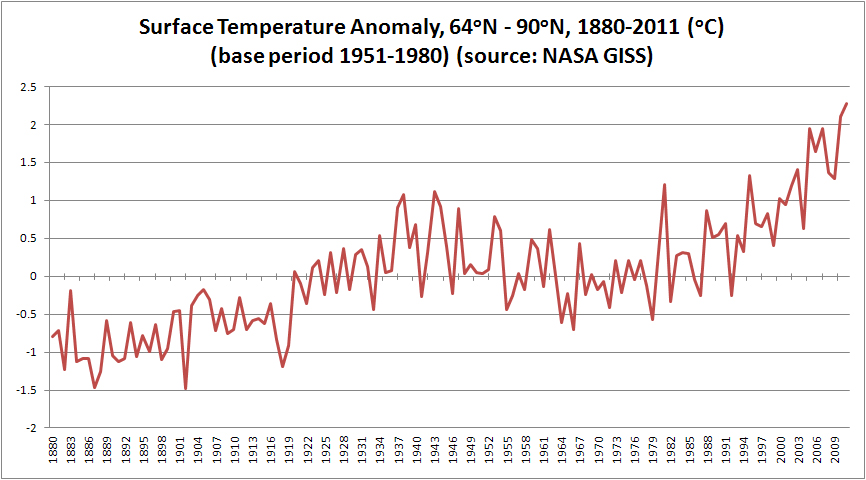
And surface temperatures in the Arctic have been rising for years. Here is the longer-term chart:

arctice-north-latitudes-surface-temp-trend-annual-thru2011

While the US heats up, Canada’s winters become more mild, and the surface temperature rises in the Arctic, there have been increasingly fierce and deadly winters over the last few years on the other side of the North Pole, especially in eastern Europe. From 2012:

     Europe death toll rises in big freeze

     Blizzards hit eastern Europe hard

And from 2013:

     Pyrenees ski resorts top world snow charts with over 7 meters (23 feet) of snowfall in one month

     Heaviest snowfall in many years hits Polish-Slovakian border

     Snowiest winter in 100 years paralyzes Moscow

     New satellite image shows the unusually frigid and snowy conditions that blanketed much of Great Britain

     Heavy snowfall closes dozens of roads in Turkey

     Record snowfall closes lifts and roads in the Pyrenees

     Snowpocalypse Russia: ‘Snow tsunami’ swallows streets, cars, buildings

     Europe hit by blizzards, air traffic havoc, deaths

     Croatia snowfall shatters record set in 1861

     Snow blankets parts of Middle East, Jerusalem

     ‘Lowest temperaure in Bangladesh’s history’ brings at least 80 deaths

     Unprecedented cold spell breaks 50-year records in Pakistan

     Heavy snow, torrential rain, gale-force winds batter Greece

     Russian Trans-Caucasian highway closed due to heavy snowfall

     China’s extreme cold snaps records

     More than 100 dead as cold snap hits India

     Record cold snap grips Korean Peninsula

     Coldest winter in decades for Russia with snow as much as 5 meters (16½ ft) deep – Plows cannot reach roads to clear them

And I can go back to 2012 headlines and find a lot more of the same, though, as usual (as always???), the trend accelerated in 2013.

Admittedly, claiming trend changes for weather is a dicey business. Weather has a knack for frustrating those who declare trends. But there is strong evidence for a rather persistent procession of heat marching north toward the geographic North Pole in the Western Hemisphere and cold moving south from the Pole in the Eastern Hemisphere.

So, if that’s right, what could be the cause?

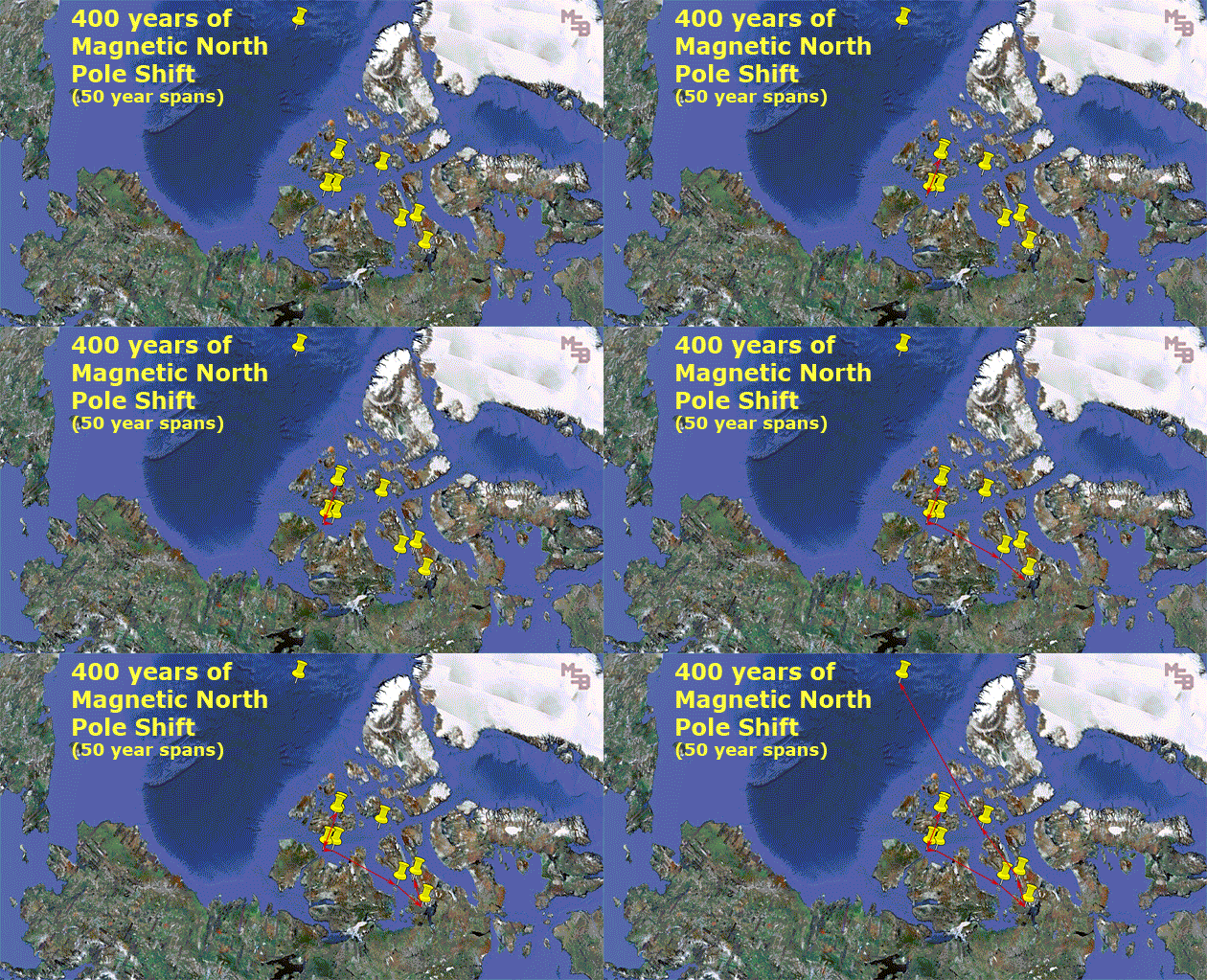
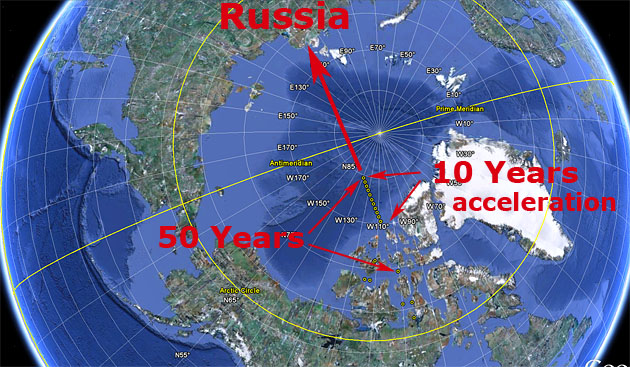
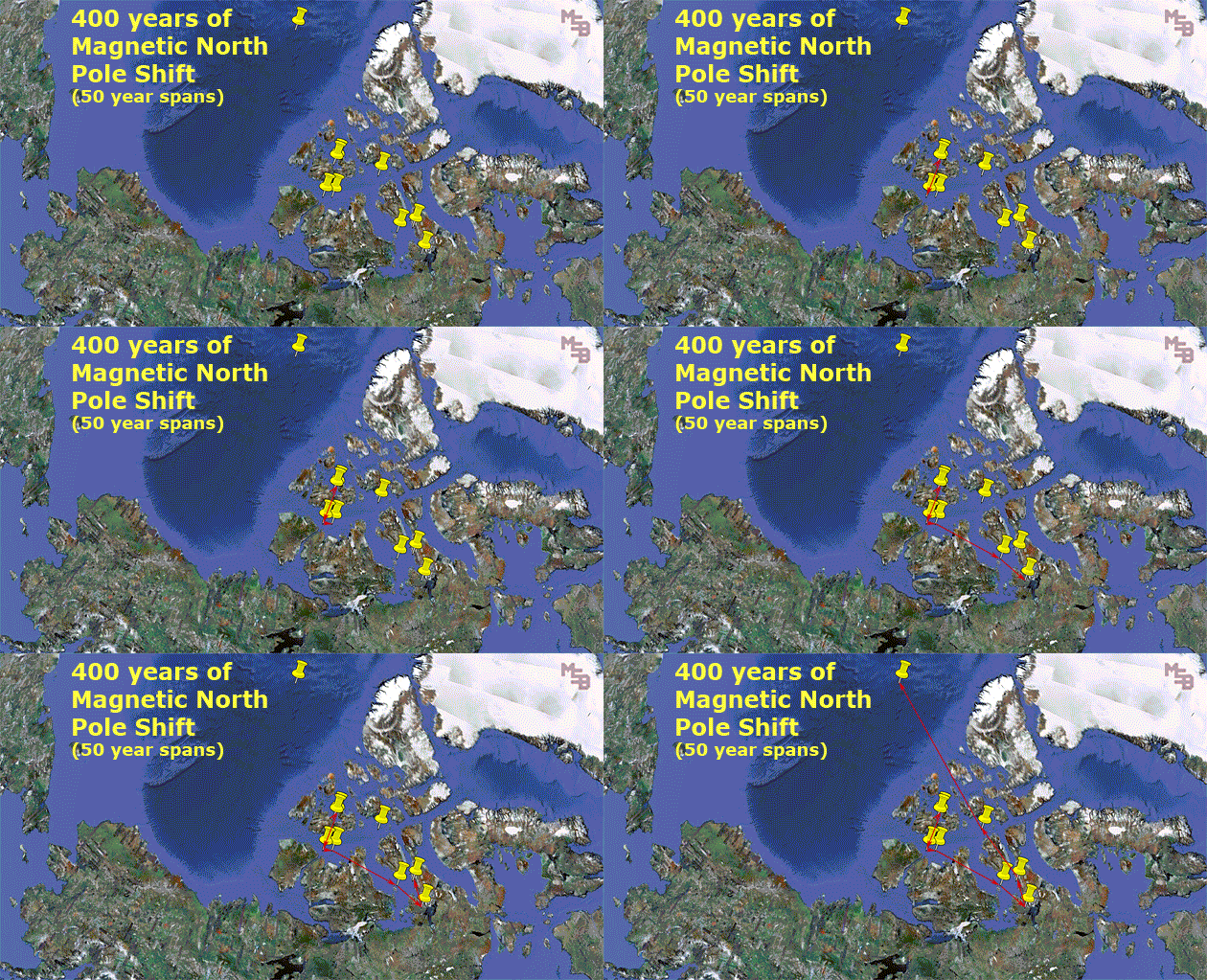
Well, there’s another well-known phenomenon making a similar directional march. Here are some graphics from ModernSurvivalBlog.com that track the movement of the magnetic North Pole, with the data supplied by conventional scientific organizations such as NOAA. Here is an animated gif of the movement over the last 400 years:

magneitic-north-pole-shift-400-years (1)

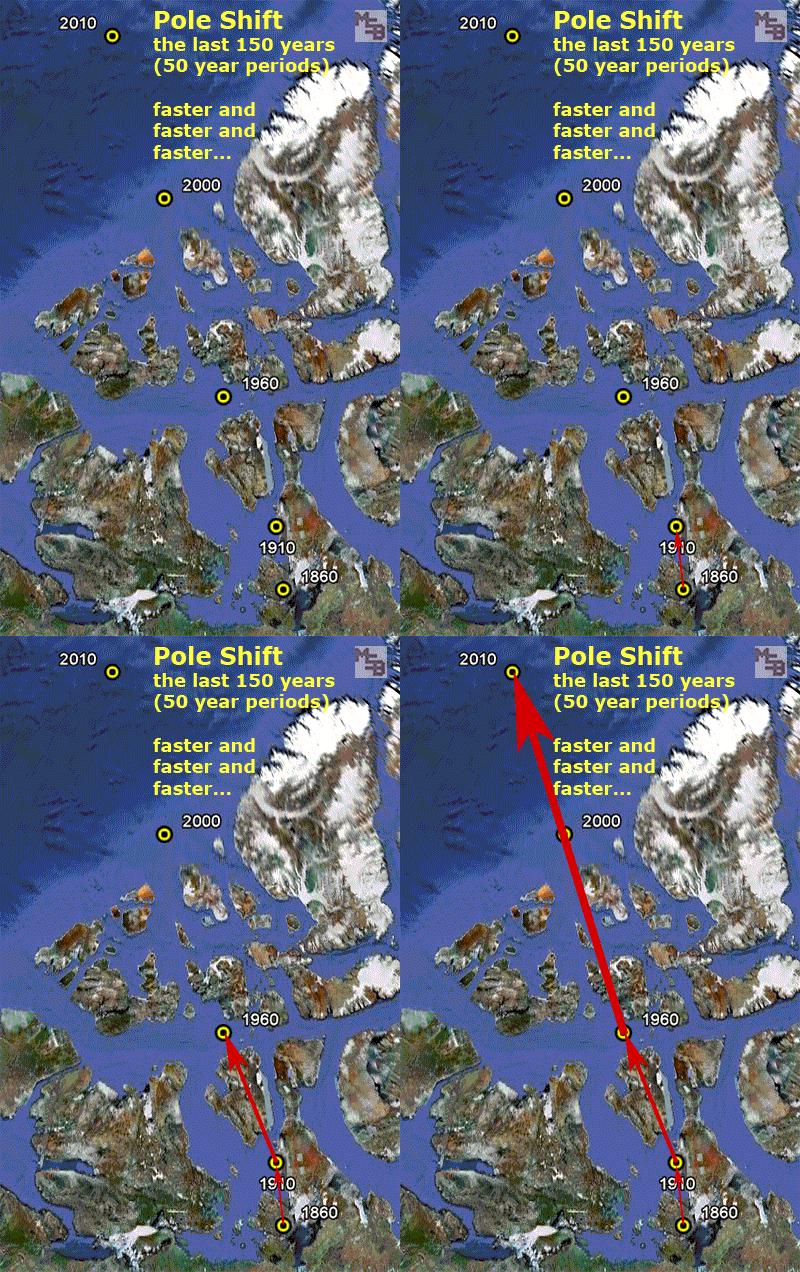
And here’s the last 150 years:

magneitic-north-pole-shift-50-year-periods-last-150-years

And over the last 50 years:
magnetic-north-pole-is-heading-to-russia

From the creator of these graphics:

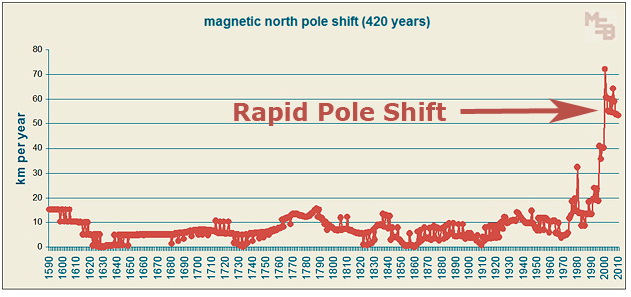
Since 1860, the magnetic pole shift has more than doubled every 50 years…During the past 10 years, the magnetic north pole has shifted nearly half of the total distance of the past 50 years!

Here’s another way to look at the accelerated movement:

MagneticPoleShiftHistory

Where is the pole heading? In the direction of Siberia. All this is not woo-woo information, airports that paint magnetic compass readings on their runways are having to repaint those number every several years.

What’s happening is that, depending on where you are, a compass reading can change by one degree every five years.

The magnetic South Pole is doing the same type of movement away from the geographic South Pole, having moved off the land mass of Antarctica years ago.

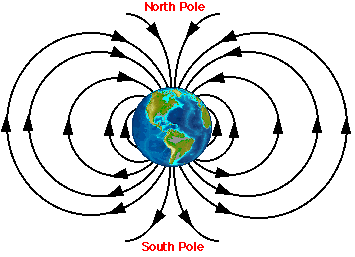
Most simplified graphics of the Earth’s magnetic field look something like this:

Earth_geomag

So the question is: Is weather moving with the movement of the magnetic poles? Another way to frame the question: At the magnetic poles, the Earth’s magnetic field captures charged particles flowing from the Sun on the solar wind and directs them toward the surface, an effect visible in the extreme northern and southern latitudes as the Aurora Borealis and Aurora Australis. Is the same energetic pattern also delivering the coldness of space to the planet’s surface? Or is it the relative thinness of the magnetosphere at the magnetic poles?

Well, if it’s correct that this coldness is moving with the magnetic poles, why should anyone care? Because if substantial coldness is moving away from the traditional locations of the geographic poles in Arctic and the Antarctic, then it would seem that the ice at the geographic poles would melt far more quickly than most would expect before equivalent new formations of ice could develop, particularly in the South Pacific where there is no landmass nearby. Perhaps I am uninformed, but I have not heard that such an effect is being accounted for in anyone’s climate change model. And as shown at the beginning of this post, the movement of heat north through North America from the south is proceeding rapidly. If this continues, or more likely accelerates, there might be a whole lot more melting of polar ice caps than previously expected, raising sea levels faster than almost anyone anticipates.

And perhaps my effort above was feeble, but there is a lot of evidence out there for this weather shift. So why are so few talking about it? Clearly, because it doesn’t fit people’s models of how things work. Magnetic pole movement is straight out of conventional science, while the idea that it would impact the weather is not. The solution for most? Ignore the evidence.

What is the Transition? Part 3 is here.

What is the Transition? Part 1

I have made reference to “the Transition.” Before trying to describe its essence, it will be useful to first review aspects of the Transition, in other words, some of its identifiable characteristics. One aspect that runs through all of the others is acceleration, as you will see.

EARTH CHANGES

EARTHQUAKES

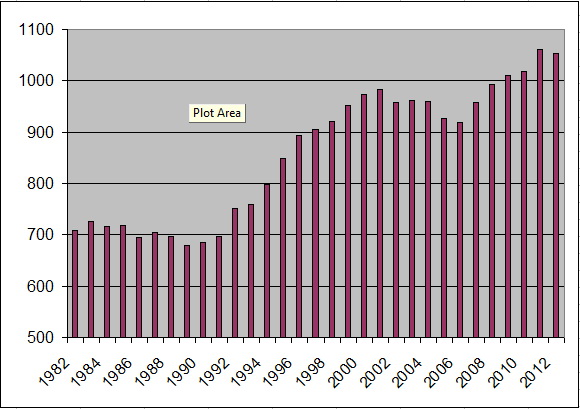
Below is a chart of how much shaking the planet has experienced from strong earthquakes for the last 30 years. This chart sums up the Richter values for all earthquakes of magnitude 6.0 or greater for each year. The earthquakes are summed rather than simply counted so that larger earthquakes have slightly greater weight on the chart. To show the trend, the column for each year shows the 10-year average of all that shaking. The trend is unmistakable—things started to really scale up in the early 1990’s:

EarthquakeTrend

The data for this chart was assembled from a straightforward query of the USGS (US Geological Survey) database at their Global Earthquake Search page.

After the massive Japan earthquake and aftershocks of 2011 (it is worth watching this video graphical display of the world’s 2011 earthquakes, especially if you live in the Ring of Fire), there were fewer earthquakes in 2012. However, 2013 is off to a very fast start, as shown in part in this link from Feb 2:

Earth reeling from eight major earthquakes striking in 5 days

And since that post on Feb 2, there have been an 8.0, a 7.0, a 6.4, and a 6.3 in the Solomon Islands, a 6.9 in Japan, and a 6.9 in Columbia.

TSUNAMIS

Earth doesn’t typically see a lot of large tsunamis, but their occurrence has ramped up fivefold in recent years. According to data at the NOAA Global Historical Tsunami Database, which has records going back to 2000 BC, there have been 34 tsunamis with a wave height greater than twenty feet over the last 400 years. Six of those, or 18%, have occurred since the year 2000:

Year Location Water Height Deaths
2000 GREENLAND 50.0
2004 INDONESIA 50.9   226,898
2006 INDONESIA 20.9         802
2009 SAMOA 22.4         192
2010 CHILE 29.0         156
2011 JAPAN 38.9    15,854

In the Twentieth Century, there was a tsunami with a twenty foot wave height about once every ten years. In this century, it has happened once every two years, resulting in the deaths of a quarter million people despite the fact that none of these tsunamis struck a major city. The NOAA’s database shows that even a tsunami less than five feet in height can kill thousands. With 23% of the world’s people living in what is called the “near coastal zone,” tsunamis are likely the single most life-threatening Earth-change phenomenon on the planet.

VOLCANISM

Due to the great behavioral variations of active volcanoes, the tracking of volcanism is not as mathematically rigorous as that for earthquakes and tsunamis. There is a site jointly sponsored by the Smithsonian and the USGS that reports on volcanic activity in the latest week. Here is their list for the week of 30 January–5 February 2013:

New Activity/Unrest:

  • Colima, México
  • Etna, Sicily (Italy)
  • Paluweh, Lesser Sunda Islands (Indonesia)
  • Rabaul, New Britain
  • Reventador, Ecuador
  • White Island, New Zealand

Ongoing Activity:

  • Batu Tara, Komba Island (Indonesia)
  • Chirpoi, Kuril Islands (Russia)
  • Copahue, Central Chile-Argentina border
  • Karymsky, Eastern Kamchatka (Russia)
  • Kilauea, Hawaii (USA)
  • Kizimen, Eastern Kamchatka (Russia)
  • Lokon-Empung, Sulawesi
  • Sakura-jima, Kyushu
  • Santa María, Guatemala
  • Shiveluch, Central Kamchatka (Russia)
  • Tolbachik, Central Kamchatka (Russia)

So, their list is all from the Pacific Rim and Italy. According to some who track this carefully, after a total of 77 volcanic eruptive events for all of the year 2012, there were 44 volcanic eruptive events recorded just in the month of January 2013.

Here are some volcano-related headlines shown on the SOTT.NET Earth Changes page in just the last couple of weeks:

The Great Awakening? Ten volcanoes awaken in one week

Indonesia’s Mount Lokon volcano shaken by double eruptions

Puyehue-Cordon Caulle volcano erupts in Chile

Tavurvur volcano erupts in Papua New Guinea, ash cloud diverts flights

Hawaii’s Mount Kilauea lava lake hits new record high

Manam volcano (Papua New Guinea): Large explosive eruption sending ash plume to 45,000 ft altitude

Campi Flegrei supervolcano raising anxiety among Italian residents

WEATHER EXTREMES (Storms, Floods, Heat Waves, etc.)

Does anyone on the planet need to be told that storms are ramping up in size, intensity, and frequency, resulting in unprecedented flooding? And that heat waves have taken on new intensities and duration? Is there anyone still claiming, “It’s just the internet, nothing has changed, we just have better reporting.”? Anyone making such claims would be well-advised to review the recent history of the global insurance industry. The venerable Lloyd’s of London almost went bankrupt in the mid-1990’s after 350 years of annual profits. They said they had to completely revamp their weather catastrophe calculations because the actuarial data on which they had relied for 300 years (!) was no longer applicable.

Below are some quotes from September 2010 on the web site of Munich Reinsurance, the largest re-insurance company in the world.  Reinsurers sell insurance to other insurance companies to cover catastrophic losses:

Munich Re’s natural catastrophe database, the most comprehensive of its kind in the world, shows a marked increase in the number of weather-related events. For instance, globally there has been a more than threefold increase in loss-related floods since 1980 and more than double the number of windstorm natural catastrophes…

Prof. Peter Höppe, Head of Munich Re’s Geo Risks Research/Corporate Climate Centre: “It’s as if the weather machine had changed up a gear.”

Heavy rain and flash floods are affecting not only people living close to rivers but also those who live well away from traditionally flood-prone areas.

And then things accelerated further. By October 2012, Munich Re reported that the numbers were even larger. They reported that weather-related loss events in North America had grown fivefold over the past three decades, and that there was “an increase factor of 4 in Asia, 2.5 in Africa, 2 in Europe, and 1.5 in South America.”

There are literally thousands of headlines available to demonstrate this idea further, here are just a few:

Cyclone frequency in Indonesia increases 28-fold since 2002

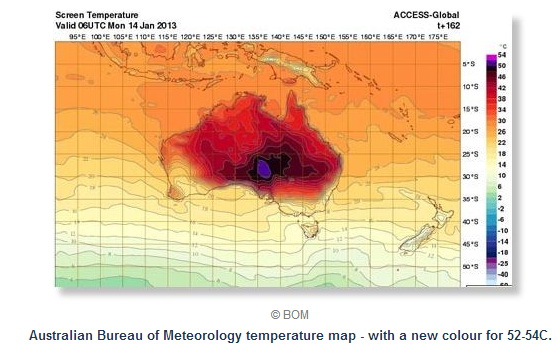
Global warming – or something much worse? Australia adds new colour to temperature maps

The temperature forecast for next Monday by Australia’s Bureau of Meteorology is so unprecedented – over 52C – that it has had to add a new colour to the top of its scale, a suitably incandescent purple.

Aus_New_Color

Tornado slams into Italian steel plant – video

To give you an idea how rare tornadoes are in Italy, four tornadoes in total were recorded in the 17th, 18th and 19th centuries, three were recorded in the 20th century and four were recorded since 2008 alone, with two of those coming in 2012.

And the damage is not limited to single instances, it is cumulative in many areas, for example, the US East Coast:

Former USGS scientist: Coastal cities are ‘sitting ducks’ for next big storm

“We have left our coasts sitting ducks, and Sandy destroyed these natural protections,” she said.

In the space of a few hours, Sandy blew through the sand dunes that had served as natural protections for communities up and down the Atlantic coast.

“Basically these dunes build up over geologic time, and yet the superstorm wore them down over a couple of days, and it is going to take geologic time again to build them back up,” McNutt said.

For those who are more video oriented, this youtube poster does a good job of grabbing news video of weather extremes and earth changes from around the world each month. These can be useful to watch since they can remind just how quickly, under the tremendous distraction of daily life, we forget what’s been happening:

Extreme Weather Events and Earth Changes DECEMBER 2012

The November installment includes Superstorm Sandy. Since the news media typically won’t cover a weather story unless there is a body count to report, few are aware that Lower Manhattan in New York City is still seriously impaired, with skyscrapers running from emergency generators on the street because their basements are still flooded.

RISING TIDES – WITH PERPLEXITY THE SEA AND WAVES ROARING NOVEMBER 2012

FIRE AND ICE – EXTREME WEATHER EVENTS AND EARTH CHANGES JANUARY 2013

(While I applaud SOTT.NET and the maker of the youtubes above, fidockave213, for their excellent work at collecting earth change information, I am not aligned with their editorial views.)

Part 2 describes a huge weather shift taking place on the planet that almost no one is talking about!

A Quick Note on Them

We are creating a detailed future post on Them. You know, The Powers That Be/Were. It will make a strong point that those in the true ruling class on this planet have intelligence and will. And these abilities are well-honed in them. In part because that’s all they have. They are not in the least hampered in their pursuit of power by those abilities that are highly valued by the vast majority of us, namely compassion, wisdom, love, and an allegiance to peace and freedom for all. They simply don’t have these things. That is what’s so tough to understand about them. If you think these statements are incorrect, please read this article:

Poor In India Starve As Politicians Steal $14.5 Billion Of Food

Slings and Arrows

To be or not to be, that is the question:
Whether ’tis nobler in the mind to suffer
The slings and arrows of outrageous fortune,
Or to take arms against a sea of troubles
And by opposing, end them.
Shakespeare, Hamlet

Sometimes slings and arrows feel very difficult indeed. But sometimes, and I guess some would say always, they are our friends, as they help to end pernicious cycles. Our increasingly-being-shown-as-notorious financial system is experiencing its end-of-cycle as its lies and chief liars are exposed, as major world banks have been shutting down public access to their systems for days at a time, as criminal hackers have figured out how to pilfer billions from the accounts of high net worth individuals at banks, etc.

We documented the base-level lies in The financial system is based on twelve promises that are lies. But each and every week now, more of the operational lies of the system are revealed.

Matt Taibbi of Rolling Stone reported on a court case showing that the big banks have for decades criminally deceived participants in the municipal bond market, robbing cities, towns, hospitals, etc. of interest payments due to them: The Scam Wall Street Learned From the Mafia.

Too bad that cities and towns are going broke, the banksters must get their bonuses. And their posh offices. Drive around any city in the industrialized world. Who has the largest and fanciest buildings, whose buildings dominate the skylines? Banks and insurance companies. Check it out. But I digress. Back to the latest slings and arrows.

Everyone has probably heard about the LIBOR scandal where the big banks–and it is looking like most or all of them–colluded in criminal fashion to manipulate interest rates. The LIBOR rate is used to calculate the interest rates on myriad types of loans including mortgages, business loans, credit card rates, etc. It is used as the basis for hundreds of trillions of dollars worth of derivatives. The top executives at Barclay’s were the first to be caught, but now RBS has been fined, and Deutsche Bank is under investigation. Others will follow. And the fired CEO of Barclay’s, Bob Diamond, has publicly stated that he was told to manipulate LIBOR by the guy who is second in command at the Bank of England, Paul Tucker. How long before we find out the US Federal Reserve was giving out the same kinds of orders for illegal acts?

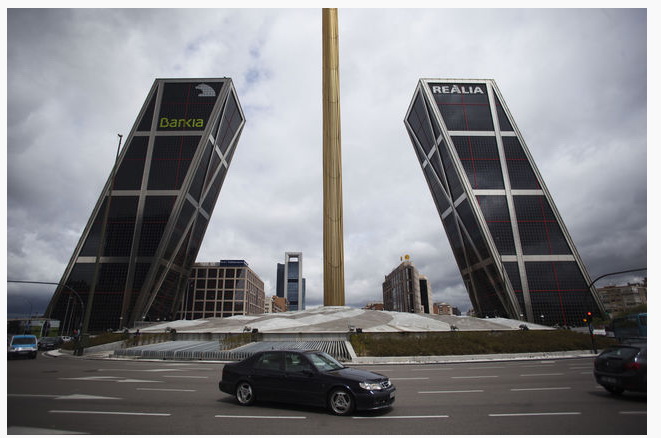
And speaking of investigations, how about Spain investigating the top executives of  Bankia, headquarters pictured here, I kid you not:

Photo from Mike Krieger’s site.

A year ago, when they were selling stock in the bank to the public, these executives touted Bankia’s greatness. They stated two months ago that everything was fine, in fact profitable, at Bankia. Within a few weeks, it was determined that the bank needed a $19 billion bailout.

And it looks like JP Morgan has been caught pulling an Enron, manipulating the electric power market in California and the Midwest: JPMorgan’s Role in Power Market Comes Under Scrutiny.

The Vatican can’t resist joining the financial criminality party, assisted, of course, by JP Morgan: Catholic Church Fears Growing Vatican Bank Scandal.

We also have the mystery of large banks shutting their systems to any public access. RBS, one of the biggest UK banks, had a major “system outage” for days that halted the processing of just about everything including credit and debit cards, ATMs, payroll checks, account balance inquiries, i.e., everything! See: As RBS’ ATM “Glitch” Enters Fifth Day, The Bailed Out Bank Issues A Statement.

And yesterday the largest bank in Russia stopped all public access to its systems, so no credit or debit cards swipes would work, no on-line transactions, etc.: RBS ‘Glitch’ Goes Airborne As Biggest Russian Bank Halts All Credit, Debit Card Operations.

RBS gave a potentially plausible explanation of their outage in testimony to the UK Treasury: RBS gives more detail on IT failure train wreck.

However, it seems suspicious that the biggest bank in Russia also had to shut out the public. Perhaps it had something to do with criminal hackers figuring out how to initiate wire transfers from the accounts of high net worth individuals at 60 banks! Haven’t heard of that one? It broke in the news about two weeks ago and was promptly “disappeared” from many websites. As of this minute, the story is still currently available at the Times of India: Cyber criminals may have siphoned off 2 billion euros from 60 banks. From the article:

The study highlighted a highly sophisticated, multi-tiered, global financial fraud ring that is comprised of at least a dozen groups using active and passive automated transfer systems to steal high value amounts from high balance accounts.

“This fraud empire, dubbed Operation High Roller, has impacted every class of financial institution: credit union, large global bank and regional bank, using smaller and less detectable automated transactions,” McAfee said in a statement.

Could it be that these banks recognize that they are being hacked, and their accounts drained, and they have no way to stop it other than preventing all public access to their systems? And why did coverage of this story virtually disappear? That’s an easy one: When criminal hackers hear that a class of juicy targets is hackable, it’s like pouring blood into water near sharks, they all want a piece of the action.  And we can’t have depositors getting nervous about their deposits when the whole system is based on confidence.

Perhaps the problem isn’t hacking. But then how could these large bank systems, famous for their redundancies, backups, and all-around bulletproofness, fail in such catastrophic ways? Could it be that the Sun has decided to make a statement or two about who really runs this sector of the universe? Did 18 M-class solar flares over three days cause glitches in these systems? (Eighteen (18) M-Class Flares Within Last 72 Hours) Followed by an X-class solar flare? (Sunspot Region 1515 Fires Off X-Class Flare) Or are their systems based on MS-Windows? (Joke. Sort of.)

Either way, I have to wonder how people with their savings in electronic accounts feel about that. The system is based on lies. The people who run it are pulling continuous criminal capers, and it looks like they have been doing so for decades. Hackers have figured out how to drain accounts electronically. And the Sun may even be contributing to bank computer mayhem, with NASA admitting that the Sun will be ramping up its activity into mid-2013.

We think it best to consider all of these as indications of a system that is in something beyond peril. It is going down. It will fail. It’s only a matter of time. The pace of slings and arrows impacting the system is accelerating.

Let’s recall that people value money because it is a medium of exchange through which a wild variety of good and services can be exchanged in some comparable way; and a store of value providing one way to save the energy expended in work today to meet needs at some future time. Our current paper currencies (Dollar, Euro, Pound, Yen, etc.) are masters of exchange, but are cascading toward failure as stores of value. Some who have studied the history of money say–and I have no way to verify this–that the longest reigning currency regime based on unbacked paper lasted 41 years. Well, the world went fully into unbacked paper currency in 1971. Add 41 years and you get 2012. Can we set a new record? Perhaps. But the system is showing so many signs of being in its death throes, why take the chance?

People keeping their savings in the banking/brokerage system reminds me of the old Eddie Murphy comedy routine where he asks about movies like Poltergeist and Amityville Horror, “When there’s a ghost in the house, why don’t white people just leave the house?” If profanity offends you, don’t go to the link.

We have all been warned. Over and over. And the warnings are increasingly clear and loud. But we can take arms against this sea of troubles, at least for ourselves. And if we do, we’ll be in a position to help when the slings and arrows end this financial system.

Where there are things to be done, the end is not to survey and recognize the various things, but to do them.
Aristotle, Nicomachean Ethics

If You Think You’ll Get Truth

In The financial system is based on twelve promises that are lies, we mentioned that there were a number of people who understood, well before it “went public” in 2008, that the world had a major financial crisis on the docket. Dr. Michael Burry is one of those people. He and his tactics were profiled in the book The Big Short by Michael Lewis. Burry used his insight to make a great deal of money for himself and investors in his money management funds. Once Burry made that money, he knew he had made enough, he closed his funds, and quit the money management business.

Here is what he said recently while giving the commencement speech at the UCLA school of economics, available here, with this quote starting at 14:00 into the video:

In 2010, I published an op-ed in the New York Times posing what I thought was a valid question of the Federal Reserve, Congress, and the President: I saw the crisis coming, why did not the Fed? Never did any member of Congress, any member of government for that matter, reach out to me for an open collegial discussion on what went wrong or what could be done. Rather, within two weeks, all six of my defunct funds were audited. The Congressional Financial Crisis Inquiry Commission demanded all my e-mails and the list of people with whom I had conversed going back to 2003. And a little later the FBI showed up. A million in legal and accounting costs, and thousands of hours of time wasted, all because I asked questions. It seems they would pump me at gunpoint or not at all. That Summer the Federal Reserve put out a paper that concluded that nothing in the field of economics or finance could have predicted what happened with regards to the housing bust and subsequent economic fallout. Ben Bernanke continues to backfill this logic. And I fear that history is being written wrong yet again. The ignorance is willful.

This is how it is in the world these days. Those in charge in government, large corporations, and the media which they own will not tolerate truth about what is either their incompetence or their dishonesty or both. If you think you can get truth from them about what is transpiring, guess again. Relying on their claims is high risk behavior.

What then can we do? Part 2

This is the true joy in life, the being used for a purpose recognized by yourself as a mighty one; the being thoroughly worn out before you are thrown on the scrap heap; the being a force of Nature instead of…complaining that the world will not devote itself to making you happy.
—George Bernard Shaw

In Part 1, we briefly covered how “Inner Work” and buying precious metal bullion coins could be helpful in having us glide through this transition rather than struggling through it. And remember, our point here is not to frighten, but to offer ways for readers to calmly and persistently prepare for the inevitable problems that will arise from the collapse of the financial system.

In this Part 2, we will deal with “Outer Work” topics related to serious impairments of the global supply chain. Our firm expectation is that this supply chain will experience increasing turbulence and unreliability. As currently configured—though mis-configured is a better description—the supply chain is entirely dependent on the efficient functioning of the transportation fuel markets. And both it and those fuel markets depend on the proper functioning of the banking and credit systems, which will disappear when the financial system collapses.

The collapse of the financial system will not remove one bushel of corn, one apple, or one barrel of oil from the planet. The real things people need will still exist in great abundance. But the process of getting them from where they are produced to where they are needed will be disrupted, sometimes severely. Not forever. People are very clever. Supply chains will be re-established. But it will take time. And their re-establishment will not be instantaneous and smooth. And not all types of goods will be available. Some may disappear for long periods, even forever. Good riddance to some of them.

In this post, the overall recommendation is that you become far more independent of the global supply chain than most people are now. Beyond being practical and likely very beneficial from the point of view of health, this topic has philosophical dimensions. Just how dependent do you want to be on huge corporations and huge governments for your food, water, electricity, health care, etc? In our current world, most purchases are made from very large companies and at large chain stores which buy their supplies from those places on the planet where people will work for the lowest wages, where the workers have little in the way of rights, where there are few or no environmental safeguards, etc. The chain store sells these products and uses its profits to go to the centers of government power to purchase ever-increasing influence, typically with the idea of driving out competition and driving down costs to increase profits. So manufacturing is now done by the poorest, and distribution and retailing are done by the largest, limiting work and profit opportunities for everyone else, who then become more dependent for their income on government, which works on behalf of those who pay the bills of the politicians, namely the big financial institutions and the large corporations and so on—until the whole world is controlled by lumbering behemoths who operate without restraint for their own mega-profits. And nearly every transaction you have with this system is tracked and taxed, eliminating privacy and draining your financial resources to feed its insatiable appetite. And the more they know about you, the more they try to use that data to manipulate you. With every move you make away from dependence on this ever-increasing force of domination and toward local sufficiency—growing and cooking your own food, supporting farmers’ markets, buying truly local products and services, producing your own electricity and heat, living in ways that promote and deliver health rather than disease, etc.—the better off you, and those in your local community, are likely to be.

So this is not simply some survivalist approach, this is equally about transitioning life on this planet toward greater freedom for everyone. And toward sustainability versus the current trend of exponentially increasing resource consumption. So let’s get to it.

BARTER: Barter networks and barter currencies are popping up all over. These will play a vital role since it is unlikely that anyone can anticipate, let alone purchase and store, all of what they might need when the global supply chain fails.

Participating in barter networks and currencies, to understand them and to strengthen them before they are critically needed, is a service to yourself and your community. Purchasing and storing a surplus of goods that would clearly be valuable to others is one useful way to prepare for barter network participation. With some practical goods and with some precious metals coins, you will be well-prepared to participate.

And experimental participation in barter currencies is valuable preparation as well. Just as we don’t recommend keeping a substantial portion of your savings in fiat national currencies, we do not recommend placing a substantial portion of your assets in any barter currency, including the international variety such as Bitcoins. None of these currencies are backed by gold or silver, they are backed by people trusting that the currencies have value. And as we are learning from our experience with government fiat currencies, that trust can be abused by the unscrupulous and by well-intentioned but misguided players. But participating in barter currencies to a limited degree is highly recommended. They will give local communities something to fall back on when trust in national currencies dies. If that local system is well developed and well understood by many in the community, that will be a great advantage for the community. Clearly, from our recent dismal performance, humanity has a lot to understand about money, and these barter networks and currencies will play a role in helping people understand just what money is.

If there are no barter networks or barter currencies in your area, consider starting them up yourself. The barter-oriented (but also survivalist-oriented) website Alt-Market  has a map of some barter networks in the US. If you search the web for “barter networks,” there is a whole lot of info out there. If any readers are experts in this field, we would love to hear from you on this topic. And we will write about the international barter currency Bitcoins soon.

FOOD: Things have gone far enough on the planet that even one fairly large institution is recommending that its members have backup food supplies: It is a requirement of the Mormon church that each LDS household have enough food on hand for a year for each member of the household plus one other person. So if the supply chain fails, everyone head for Salt Lake City. OK, just kidding. But the Mormons are onto something here. Major cities in industrialized countries are known to have a three day supply of food in the region of the city. If re-supply is shut off, the shelves will be empty in a heartbeat. So learning to buy, store, and cycle your own food supply will be very useful. And it does take a little learning. Store what you actually eat and that has some shelf life. Cycle it in to your daily use, eating what was purchased earliest first and adding newly-purchased supplies to the tail end of your own “supply chain.” People tend to make two mistakes when they undertake this task:

  • storing food they never eat: If you don’t eat canned cheese now, you probably won’t want to eat it later.
  • failing to cycle stored food into daily use: thus the stored food goes bad and gets thrown out.

For fresh foods, learn to grow your own. For lazy gardeners who don’t want to spend their life fighting weeds, learn to do raised bed gardening. The book Cinder Block Gardens is the best we know on the topic. This book will tell you how to grow your own vegetables with relative ease even if you have a full time job. And, even if you don’t have room for a formal garden, it will tell you how to do that in your driveway or a parking lot. These raised beds will work outdoors, in a greenhouse, or under a coldframe. And if, for example, you want to grow delicious cucumbers that weight two pounds each, then you’ll need to enlist the delightful help of the nature kingdom like the people at Findhorn did. Here is the website of a current public practitioner of that art and science.

Don’t have room for raised beds? Then at least learn sprouting. Some say that many survived World War II in Europe because they knew how to do sprouting. All you need for sprouting is a window not exposed to direct sunlight, a jar, water, and some sproutable seeds. Because they store and sprout so easily, whole organic lentils are a great place to start. Sprouts are packed with nutrition and energy because they are in the phase of the life cycle of a plant where nature is doing its best to give this seed a leg up in terms of getting established as a new successful plant. So they are a great source of essential nutrients and are easy to use in salads, soups, etc.

And like telling the truth, growing food can be a revolutionary act at this time. Most who grow their own food quickly migrate toward organic ways, where one takes care of the billions of critters in the soil, and the soil and sun take care of the plants. In this method, there ensues a brilliant, intricate, delicate dance of the soil critters and the plant roots, where each communicates their needs to the others and each provide materials for the others. That is the way nature grows things. Working this way, a person is quickly overjoyed and humbled by the abundance and deliciousness that nature provides. And with debris from chemtrails and radiation from Fukushima floating around our atmosphere, growing food in greenhouses may actually become necessary, so the sooner one sets up that infrastructure, the better. Further along the path to growing the way nature does is the world of permaculture, where plants work together in what some call plant guilds. All of this is movement away from industrialized agriculture where the soil is literally de-natured, that is, if an industrial farmer wants to grow corn, they try to kill everything else in the field: weeds, insects, soil critters, etc. Then they truck in bees for pollination and are surprised when the bee colonies collapse when the corn has been sprayed with neocotinoid poisons. And genetically-modified (“GMO”) corn has a terminator gene inserted so that the seed will not propagate and the farmer must buy new seed from Monsanto if they want to grow corn again next season.

And the industrial meat food chain is even worse: the animals are fattened in feed lots where they eat these industrially raised and poisoned GMO “foods,” and stand in so much manure that they have to be pumped full of antibiotics to survive. And of course those antibiotics are ingested by those who eat the meat from these animals, helping to breed antibiotic-resistant super-bugs. Ummmm, yummy!

Seriously, if you haven’t been growing any of your own food, you are missing a lot of fun and some big, delicious treats. Favorite foods grown from heirloom seeds in great soil? Wow, such food is so much better than what you can buy in stores it’ll make your mouth spin.

And speaking of heirloom non-GMO organic seeds, obtaining more of these than you need for the current season, and storing them in a cool dry place, is a great idea if you plan to grow some food, or to perhaps offer seeds to other growers. For most of us, buying seeds is the way to go. Harvesting seeds from the plants you grow is a skill that needs to be cultivated. Seed saving is an art and science, easy for some plants, quite tricky for others. For those interested, the book Seed to Seed is the bible. Heirloom seeds for purchase are best obtained from a local organic seed producer because they are suited to local conditions, but these are not available in all areas. Seeds of Change and Seed Savers Exchange are great sources for ordering seeds on the web.

And to sum up our food discussion, we see backup supplies of food with a good shelf life as something to tide people over until they are either growing their own food or have established availability of a reliable local supply. No matter how much food one has on the shelf, if one wants or needs to feed a group of people, that food will go quickly. We need to arrive at sustainable local sources.

ELECTRICITY: Our dependence on electricity is remarkable. If the electricity grid were down for an extended period of time, the repercussions would be staggering, curtailing lighting, heating, refrigeration, connecting with people by internet and phone, pumping gasoline into our cars and trucks, having our water supplies pumped to us, using debit and credit cards, getting money from ATMs, receiving a wide range of medical and dental procedures, using a wide array of electronic devices, etc. It is reasonable to say that almost all services in the modern world depend on the ready availability of electrical power. This winter, due to an ice storm that felled trees and power lines, affluent residents of parts of the US state of Connecticut had no electricity for eight days. Many were unable to heat their homes because the operation of their furnaces depends on electricity.

Would a collapse of the financial system seriously impair the electricity grid? Given that most electrical utility companies rely on the debt markets for their operation and that a great deal of electricity generation depends on the just-in-time mining and transport of fossil fuels, particularly coal—well let’s just say that the financial system collapse could give the grid some very bad days, or weeks, or more.

So being able to create at least a little electricity when the grid is unavailable will likely turn out to be very useful. And it is doable. But it’s a classic case of easier said than done.

Homeowners with some extra cash can address this problem by purchasing a solar array and related equipment that supplies some or all of their electricity. But if you buy such a system, it is worth checking carefully whether it will supply you with electricity when the grid is down. Many grid-tied photovoltaic systems won’t. By design! (Another great help from The Powers That Be.) “To protect workers” servicing the grid, many inverters are designed to cease operation when the grid is down. If you buy a system with substantial battery backup capability, it is likely to be able to operate during an extensive grid outage. But adding battery backup adds a good deal to the cost of the system, so most forego that capability. We are very much in favor of photovoltaic systems, but buyers should make sure to fully understand what their system will and won’t do.

Winds turbines can be an outstanding addition to a photovoltaic system, though they are prohibited in many urban areas—where they don’t work all that well anyway—and subdivisions.

Microhydro is the ultimate renewable energy system, producing power whether or not the sun is shining or the wind is blowing, but very few of us live on rushing water. And in places like the US, to install a microhydro system legally (some are installed “by moonlight”) requires filing applications with the federal government that can costs tens of thousands of dollars and over five years to process. (Yes, yet another great help from TPTB. Are you getting the idea that they would like us to be entirely dependent on their gargantuan energy systems? On their financial system? On their food system? On their health care system? And on…)

Homeowners and renters can purchase backup generators. We are all in favor of these as well. But again, clearly understanding what you are buying is essential. The small gasoline generators that cost $400 to $500 at the big box stores are designed to run for no more than 200 hours, at which point most of them will fail and, not being designed to be repaired, need to be junked. Some have enough power to run your refrigerator, some do not. The ones that are meant to run well for years cost over $1,000. And there is the problem of gasoline storage. If you store 20 gallons of gasoline, how many hours will that run your generator? Not a whole lot. Storing a lot of gasoline can be cumbersome and dangerous. Again, homeowners with extra cash can install generators that power their entire house, powered by propane from a large tank. Propane lasts virtually forever, so such a setup can run for thousands of hours. But this is not a great option for renters. Renters might wish to consider a tri-fuel generator from Yamaha that is large enough to power their refrigerator (and quiet enough that you and the neighbors will consider the running generator a net plus, not a minus). Tri-fuel means it can run on gasoline, propane, or natural gas. For anyone with access to a large propane tank, here is a small quiet portable generator that should run for thousands of hours if there is a good supply of propane or natural gas. This Yamaha will power a refrigerator with ease, but it will not power appliances such as dryers. But even if you don’t have access to a large tank, propane can be stored in multiple small portable containers used to power propane barbeques.

Small-scale renewable power setups that will not run appliances with motors but which will run DC LED lights, laptops, and other small electronic gizmos are available from a company named Goal Zero. Designed for campers and campsites, Goal Zero sells portable batteries, inverters, solar panels, DC LED lights that consume very little power, etc. Such setups won’t allow you to run your full-size refrigerator, but at least you can have light and computer power at night and be able to re-charge cell phones and the like.

Everyone’s circumstances truly are different when it comes to generating electricity. But in our view, it is a puzzle worth spending time and some money to solve. Ideally, it would be wonderful if we were all generating all of our own electricity from renewable sources (free energy devices would be, of course, the very best) and driving an all-electric vehicle. It would change the world in many ways. Many rightly complain about the unfortunate methods of Big Oil, Big Coal, Big Gas, and the nuclear power industry. But for now, we are their customers, so we are in on the game and it is not so easy to stop playing. But to state it again: this is a puzzle worth spending time and some money to solve.

HEALTH CARE: If you depend on medicines or supplements, obtaining a good supply is likely a very good idea. The financial crisis in Greece is leading to drug and treatment shortages there (Greek health system crumbles under weight of crisis) and Greece is surrounded by countries whose drug suppliers and health care systems are fully functioning. When the entire world financial system goes, many drugs and services are likely to be entirely unavailable in any country for some period of time. Clearly, if you do not have supplies or if you need treatment, having bullion coins or paper cash available should be a big advantage versus relying on government or insurance company promises to pay. Remember, trust in such promises will be the first part of the financial system to go.

The conventional medical system relies on the smooth functioning of the global supply chain, on government and insurance company payment systems, etc. When the economy becomes far more local as global systems fail, those who understand the health benefits available from alternative practitioners and methods—including but not limited to energetic and telepathic healing, acupuncture, Ayurveda, MMS, traditional Chinese herbal medicine, etc.—might find themselves very happy that they investigated these systems in advance to determine what works for them.

HEAT: If you live in a climate that experiences cold weather, planning for a heating method that does not rely on the functioning of the electrical grid is a great idea. It could be a life-saving idea. We highly recommend being able to safely heat with wood or propane and having an adequate supply of one of those on hand.

WATER: Since we can’t live without it for long, a reliable water supply is critical. When the Soviet Union collapsed in 1989, water company employees realized that a lot of people would die if they stopped working so most continued working without pay for several months. That was lucky. And it worked, to some extent, because Russia has plentiful supplies of the energy resources needed to keep the pumps and purifiers of a modern water system functioning. Would all of us be that lucky if the electricity grid were down for a period of time? Perhaps. But having backup supplies, or an alternative source of water that you can purify yourself without electricity, seems like a good plan. Filters such as those from Berkey and Aquarain are examples of quality filters that don’t require electricity and can purify water from almost any source. At least as long as that water hasn’t been Fukushima’ed.

HOUSEHOLD GOODS: Which household goods are considered critical is a highly personal judgment. But having some backups for the supplies you use on a daily basis seems wise. If you end up with an excess, supplies considered by many people to be necessary will make for very good barter items.

LOCATION: Where is the best to live for the future being outlined here? That is a large topic, so to not distract from the essentials described above and in Part 1, we will punt on this topic for now and cover it later in a stand-alone post.

To summarize, we recommend methodically moving away from dependence on big government and corporations and toward local sufficiency. Such moves are useful, and most find them to be a good deal of fun as well.
What then can we do? Part 1

Let’s talk about what we can do about the consequences implied in The financial system is based on 12 promises that are lies, dealing with these questions:

  1. How can we prepare for the collapse of the financial system?
  2. How can we prepare for supply chain outages and disruptions?

Preliminary Remarks

In our view, one principle involved here is quite simple: If you take some of the key steps outlined below, you will be in a position to help yourself and others. If you don’t, you will need help from others. At this point, there is still some time to choose your position, but that time is growing short.

Since this is a transition, we want be mindful of where we are coming from and where we are going to:

  • We are moving from old systems and structures that are detrimental to humanity; they are collapsing from their own growing uselessness and corruption, and we are hastening their collapse by eliminating or methodically reducing our participation, our complicity, in those systems;
  • We seek to protect ourselves and our communities during the period of collapse; and,
  • We want our actions to be positive steps toward the world we aim to create, thus we aim to “be the change” and to take actions that are wins for ourselves, humanity, and the planet.

Obviously, but perhaps worth stating: We don’t know how you should live. The suggestions in this post are based on our own thought experiments, research, and by watching how people have responded to change in recent years. Some people have found the changes difficult, others have found them liberating. The actions recommended here are some that a person might take if they wish to glide through the coming changes rather than struggle through them. Please consider each recommendation for action to be a summary. We will have future posts with greater detail on each recommendation.

And I would like to be clear about one thing: I am planning to be in a community where people are lending each other a hand so all can live well. I am not planning to live in a bunker with guns pointed in all directions. Local sufficiency is what I am aiming for. I am of the opinion that this can be achieved outside of the major metropolitan areas.

In terms of priorities on the Outer Work list below, do the precious metals thing first, today. After that, if there are things on the list that you’ve “always wanted to do,” perhaps it will be best to do those next, perhaps there is a very good reason that you’ve always wanted to do them.

Inner Work

As with all aims of consequence on the physical plane, some of the work is inner:

TURN FROM WANTS TOWARD NEEDS: In these times, does more need to be said about this?

EMBRACE CHANGE: It’s clear that those who have accepted the changes of the last several years have had a much easier time of it, inside and outside, than those who have resisted change at every turn. In our view, the pace of change is accelerating and will continue to do so, thus embracing change will become an increasingly important contributor to a positive inner state. Common forms of resistance are denial that anything is changing at all, wanting and expecting things to go “back to normal,” pretending that “nothing can be done about it so I’m not going to change anything,” etc. Beyond accepting change is its active pursuit: movement toward that life which truly and deeply makes sense to you. When enough of us are on that track, the world will be a beautifully different place.

MAINTAIN EQUANIMITY: Obviously, people can be thrown off kilter by both the acceleration and by the disappearance of societal structures on which they believe they are reliant. And “off kilter” seems to reach new heights—if the latest news stories are any indication, perhaps that should be depths—every week. So whatever activities people do to maintain their connection with what is real in them, whatever they do to raise their vibration—meditation, chanting, breathing exercises, sensing exercises, energetic healings, breathing the marrow of the sun through their crown chakra and distributing that energy inside to where it is needed, whatever … these need to be very high priority activities. Ignoring these is an increasingly high-risk strategy as we proceed through this transition.

WATCH THE TRENDS: Life is clearly telegraphing the coming changes by presenting examples of each and then ramping up their frequency and intensity. The trends are not mysterious, they are very clear. We are all being shown where all this is proceeding in finance, politics, the recognition of the need for inner work, weather changes, earth changes, nuclear energy, magnetic pole migration, etc. If you observe these trends without bias, you are unlikely to be shocked as they accelerate. Expecting trend acceleration is key. As some say in Tibet, “Recognition is liberation.”

Outer Work

MONEY: When the current financial system fails, the typical sources of money will be gone or the money they deliver will be nearly worthless due to over-printing. The solution is minted bullion coins obtained from reputable, low-cost dealers for storage controlled by you.

If you have savings denominated in fiat money, convert as much of it as you can into minted gold and silver bullion coins. Minted bullion coins means gold and silver US Eagles, Canadian Maple Leafs, Australian Kangaroos, British Kings (“Sovereigns”), Kruggerands, or so-called “junk silver,” that is, pre-1964 US dimes, quarters, and half dollars that contain 90% actual silver content. These bullion coins are typically priced at some small percent above the world spot price of the physical metal itself, though junk silver can sometimes be purchased below the spot price from a good dealer.

We are not talking about gold bars, which are far easier to counterfeit than coins. We are not talking about special proof coins, which are overpriced for their metal content. And we are DEFINITELY NOT talking about buying numismatic coins, namely those coins touted as valuable because they are old and rare. That is a world for collectors and experts. If you buy them, you are 100% certain to be overpaying for their gold or silver content, and typically overpaying by a lot. If a dealer tries to steer you toward those, steer away from that dealer.

What is wanted now are coins valued for their metal content, coins that are easily recognized for that content, coins that will have known value on the street when national currencies are dying. Avoid all “gold experts” who tell you to put 5% to 10% of your money into physical metals or who call gold an “asset class.” They do not understand the scale and scope of what’s happening. Either that or they think we are all so rich that losing 90% to 95% of our savings is somehow acceptable. If you have no savings in fiat currency and no metals, do your best to obtain what metals you can. Make it a priority to save a few dollars on a schedule and then buy a silver coin or two when you can. Your effort, perhaps your sacrifice, will be very well rewarded.

And we are talking about minted bullion coins where you control possession, not situations where you have a piece of paper that says you own some gold somewhere. Most such papers will turn out to be unreliable.

When would it be best to convert fiat savings to bullions coins? Now. Today. Here’s one method: buy as much as you can stomach buying. When you’re done, do that again. And then again. Yes, leaving a little money in regular checking accounts to cover near-term expenses is a good idea. And if you can, it is a good idea to have a few months worth of paper currency around as well since there will be a time, after the death of electronic national currencies, when many vendors won’t know the value of precious metal coins so some will still want paper currency. Our research says that it would be wise to complete this conversion process by August 2012.

If these statements on precious metals are clear, great. If they are not and you want to act soon, please e-mail and we can elaborate on tactics prior to doing a major detailed post on that topic, for which there may not be time right away.

In Part 2, we will deal with topics related to outages of the global supply chain.

Even the thieves are starting to get it

Since we are definitely small fry, below is a brief presentation by a bona fide big shot that backs up the more detailed analysis found in The financial system is based on twelve promises that are lies.

The presentation is from a former top thief hedge fund manager who retired in 2004 and now sells a newsletter for other thieves Big Money investment managers that is so expensive that we mere mortals don’t normally get to hear what he says. But yesterday the slides from one of his recent presentations were made public on Zero Hedge. One interesting note: this is from a very successful career trader with a very successful trading newsletter, that is, this is someone who knows enough about how the system functions to out-trade the rest of the thieves. He says that people have six months left to trade and then:

“That is the end of the fractional reserve banking system and of fiat money…

We have around 6 months left of trading in Western markets to protect ourselves or make enough money to offset future losses. Spend your time looking at the risks of custody, safekeeping, counterparty etc. Assume that no one and nothing is safe…

As defaults in governments and banks come to fruition, we risk a closure of the stock markets entirely and a closure of the banking system…

There would be no trade finance, no shipping finance, no finance for farmers, no leasing, no bond market, no nothing……

All that is left is the Dollar and Gold.”

That means the physical stuff you can hold in your hand, folks. Not numbers printed on an account statement.

And the Dollar is fiat money. While its physical form will likely be in use longer than its electronic versions, at some point few will want that physical form either.

Here is the presentation by Raoul Pal: The End Game.