What is the Transition? Part 5

ACCELERATION

People’s Perception of Time

Everyone whom I have asked, including young people, feels like time is speeding up, like the day, the week, the year starts, and “before you know it,”, it’s gone. People feel like they have little time to carry out their plans. I would guess that this not universal, but perhaps it is.

Technology

And everyone, or certainly close to it, is aware of Moore’s Law, that the number of transistors that can fit on a chip doubles every two years. And Intel’s David House added that processor performance would double every 18 months. This acceleration in performance, and the fact that the price for that performance has steadily dropped, has changed the world in magnificent ways that have been difficult to envision at any point in time. People like Ray Kurzweil are famous for utilizing this increasing performance and for having made some prescient estimates of the impact of this exponential increase in price/performance, though some of his predictions have been wide of the mark, and it seems his general view that processors will outdistance human intelligence is destined to fail as well since a pathway to program a machine to have a higher self, intuition, noble emotions, will, self-awareness, and a sense of humor seems unavailable, to put it mildly.

Exponential, parabolic trends

As we did with the weather and Earth changes, let’s look at some data.

Money

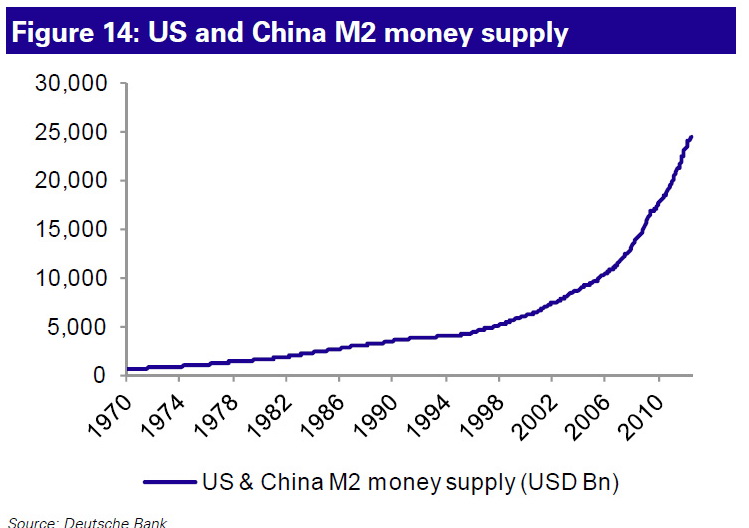
It took the USA until 1990, that is, over 200 years, to create the first trillion US dollars.  The rate of money growth had increased so much by 2007 that it took less than a year to create each additional trillion.  Now, it’s seemingly all in day’s (OK, maybe a month’s) work. Here’s a chart of the money supply in the US and China combined:

USChinaMoneySupply

Yep, between the US and China, that’s $25 trillion floating around.

Another way to look at things is this: From 1971 to 2007, the world economy grew fourfold. Over the same period, the amount of money floating around increased forty-fold. And central banks were just leaving the proverbial starting gate in 2007; the continuing financial crisis had just begun, and the response was, and continues to be: Print Money!

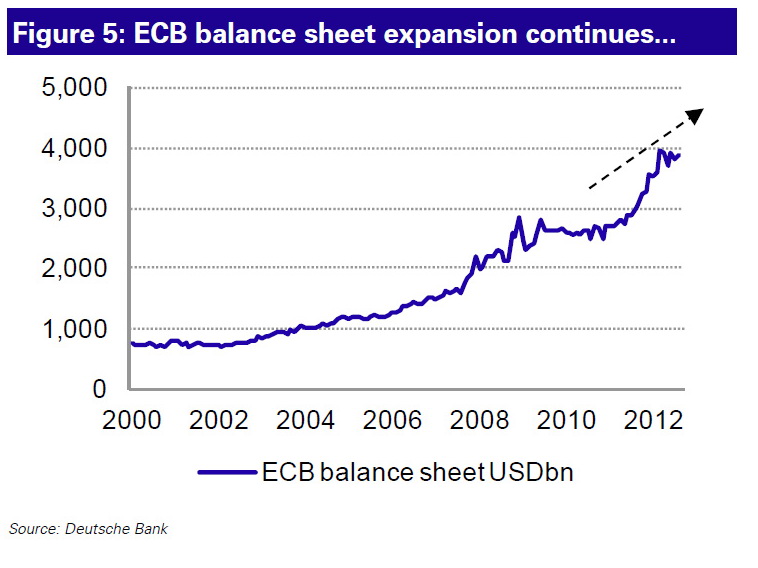
And don’t think the Europeans want the euro to be left out of this print-a-thon:

ECB_BS

And the Japanese just joined the US and the Eurozone saying they would print “whatever it takes” to get their economy humming again.

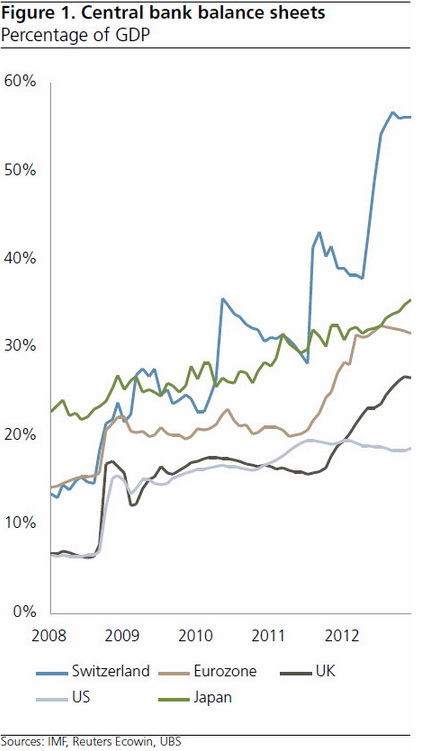
And the Swiss!?!? The most pronounced money printing line on this chart (in light blue) represents Switzerland, purported to be so conservative about money. Ah, the good old days! No longer. For the size of their economy, they are the current money-printing front-runner by a wide margin:

CentralBankBalanceSheets

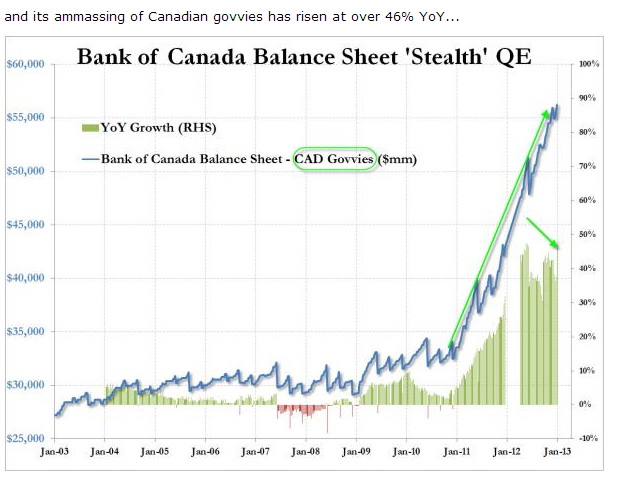
Et tu, Canada? (from zerohedge.com)

CanadaPrinting

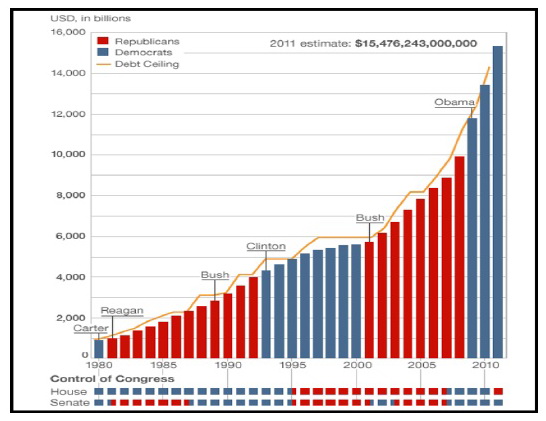
And this has little to do with political parties, as shown on this chart of federal government debt in the US:

USDebt_DemsRepubs

though I would ask that you note the super-acceleration of this trend that started in the year 2000.

And in today’s world, the Chinese are the ones doing the heavy lifting in terms of manufacturing, so they are collecting a lot of this printed paper money, in other words, the West prints paper, sends it to China, and gets real goods in return. But the Chinese aren’t stupid, they are well aware of how much more of this paper is being created. So what’s their solution? To get real:

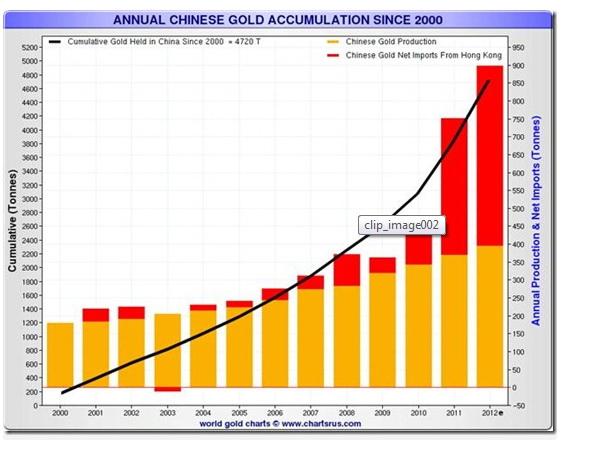
ChineseGoldAccum

The Chinese mine more gold than any other country now—none of which leaves the country–and they import even more physical gold from other countries. Insiders at the London Bullion Market Association, the leading venue in the world for trading physical gold, say that the Chinese are vacuuming out the London gold warehouses. And the Chinese are scouring the planet to buy mines, wells, and so forth, especially in Africa

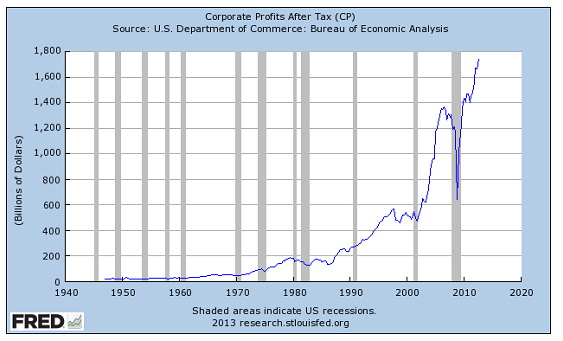
But really, one would think that, with all this money floating around—there must be at least 200 times the money around now versus 1971–everyone must be rich! But we know that’s hardly the case. Sure, there are other parabolic charts, like the one for corporate profits:

CorporateAfterTaxProfits

The corporations seem to be doing quite well. And US banks had profits of $35 billion in the fourth quarter of 2012 alone. (Yes, the same banks that needed those big bailouts. As a group, they had a total of four quarters where they weren’t profitable. It’s been business as usual ever since. And they are hard at work telling legislators, as they bribe them, that any new regulations will seriously hurt their business.)

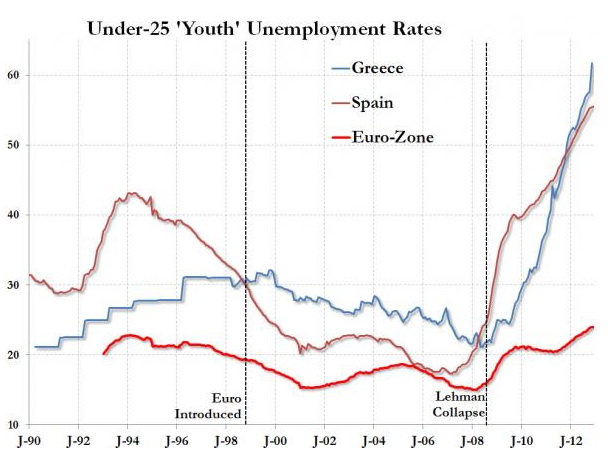
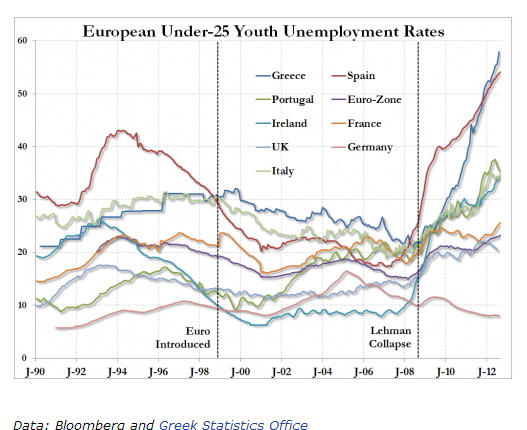
But other parabolic charts tell a different story. Here’s one for youth unemployment in the Eurozone (from zerohedge.com):


GreekYouthUnemployment

Yes, that’s over 60% youth unemployment in Greece, with Spain right behind.

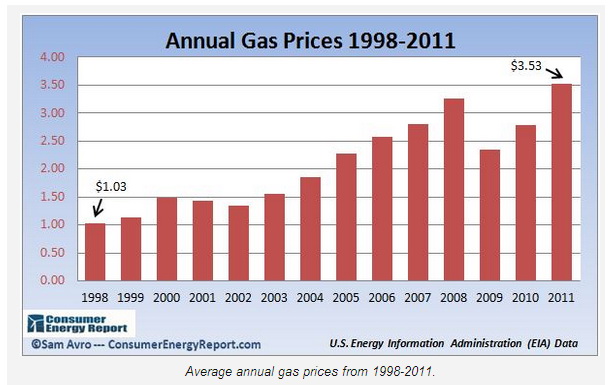
And gasoline prices are “doing great”—for the oil companies, that is. Here’s the price chart for the US, with gas up 243% since 1998:

GasPrices

That chart is only through 2011, but since US gas prices just registered their highest ever price for a February here in 2013, this trend does not seem to be in jeopardy.

And the Food Price Index of the UN Food and Agriculture Organization is up 132% since the year 2000, with the all-important cereals/grains index up 190%. This is putting an extreme and accelerating squeeze on the budgets of the poor around the world.

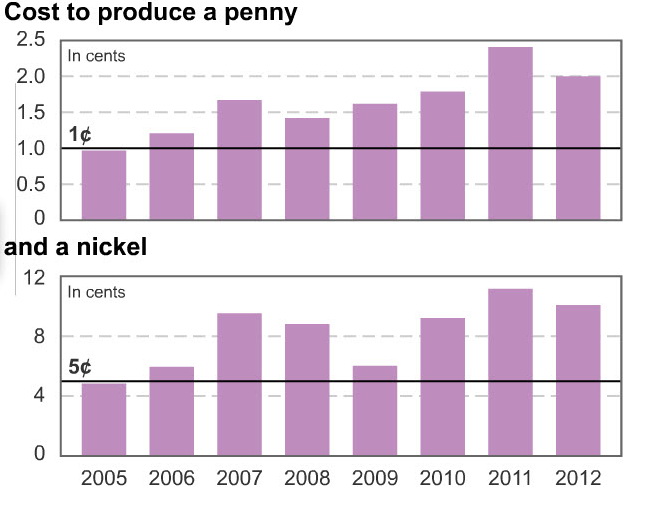
This article contains the chart below showing that in 2005, it cost the US government one penny to mint a penny and one nickel to mint a nickel. Now, after all that money printing, it costs twice as much:

PennyAndNickel

resulting in a loss of $436 million for the Government of the US (GUS) to mint pennies and nickels since 2006.

So it seems clear that the accelerating money printing is accelerating the cost of real things that people need: gasoline, food, the metals that go into manufactured products, and so forth.

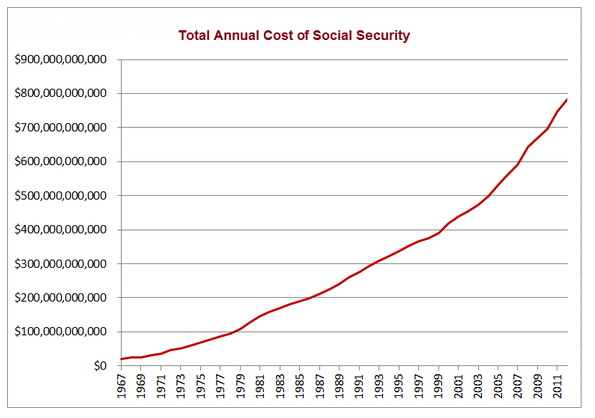
Here’s the accelerating cost of Social Security in the US:

SSA_TotalCost

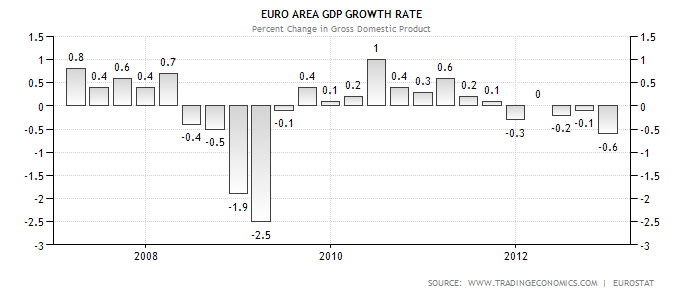
Well, we saw the accelerating youth unemployment in the Eurozone above. And the EU just announced that its overall unemployment rate is 12%. And, as this chart shows, there hasn’t been any growth in the EU economy since late 2011 (chart source):

EU_GDP

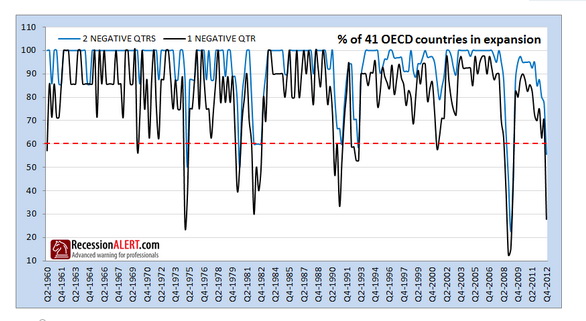
In the US, GUS says the economy hit stall speed (0% “growth”) in the Fourth Quarter 2012. Here is a chart that shows that, of the 41 largest national economies in the world, only 18% of them expanded in the Fourth Quarter of 2012:

OECD_Expanders

Astute chart readers will notice that such a reading corresponds with the worst recessions (1973-74, 1981-82, and 2008-2009) of the last 50 years, so now you know why the central banks have started printing even more money–yes, accelerating!

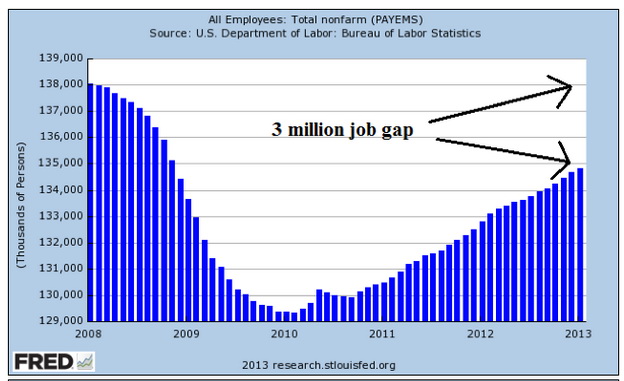
How is it going for jobs in the US? As this chart shows,  the US is still 3 million jobs short of where things were in 2008:

JobsUS

Even worse, as the next chart shows, the large increase in the number of people working part-time means that a lot of the apparent job gains shown on the previous chart are part-time rather than full-time jobs:

PartTimeUS

If you think it’s only uneducated people who are suffering from all this, check this:

     Number Of PhD Recipients Using Food Stamps Surged During Recession

The number of PhD recipients on food stamps and other forms of welfare more than tripled between 2007 and 2010 to 33,655, according to an Urban Institute analysis cited by the Chronicle of Higher Education. The number of master’s degree holders on food stamps and other forms of welfare nearly tripled during that same time period to 293,029, according to the same analysis.

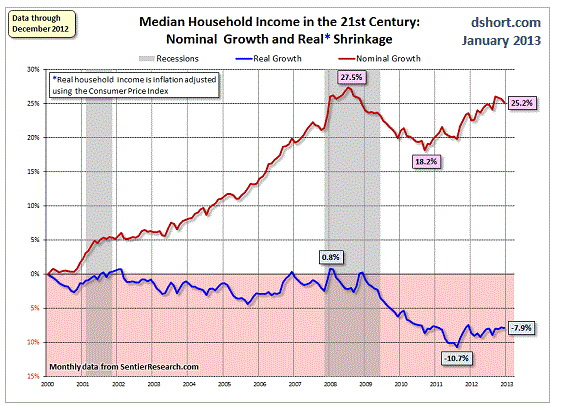
These job difficulties are reflected in household income in the US. The following chart shows two problems. While the red line shows income growth since 2000, it is still lower than it was at the start of the financial collapse in 2007. And the blue line shows household income adjusted for inflation. When GUS-calculated inflation is taken into account, income for the average household is 8% lower than it was 13 years ago:

RealIncome

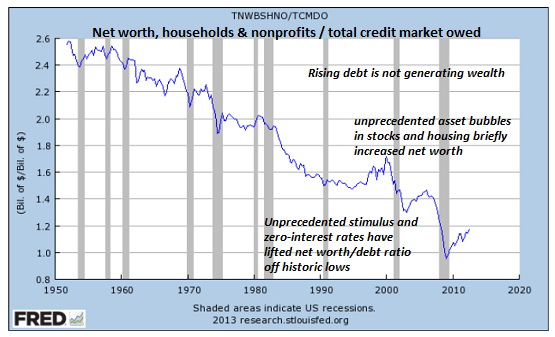
Here is a chart of US household net worth (annotated by Of Two Minds) compared to all of the debt that has been created, showing that all of that debt is not making people richer:

NetWorthbyDebt

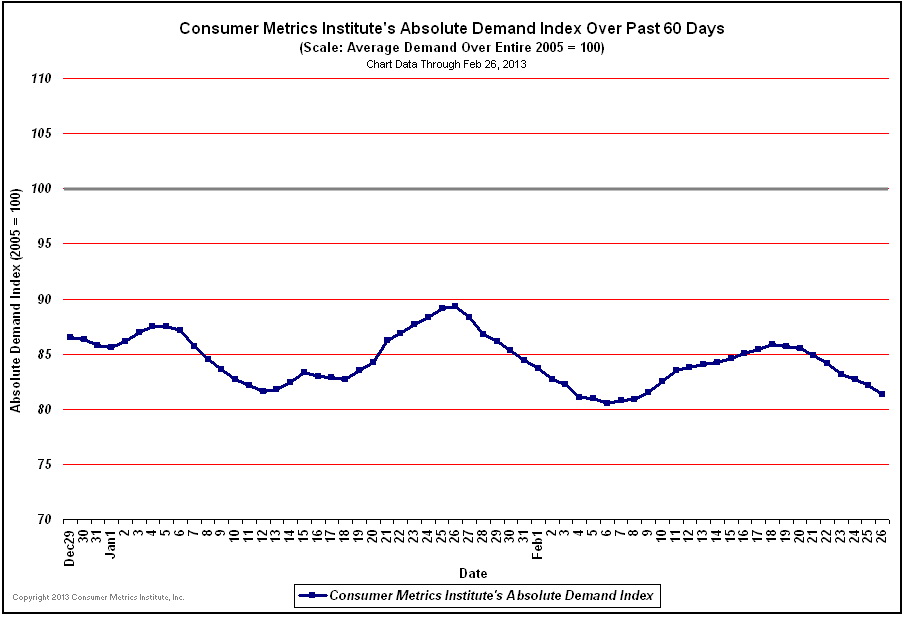
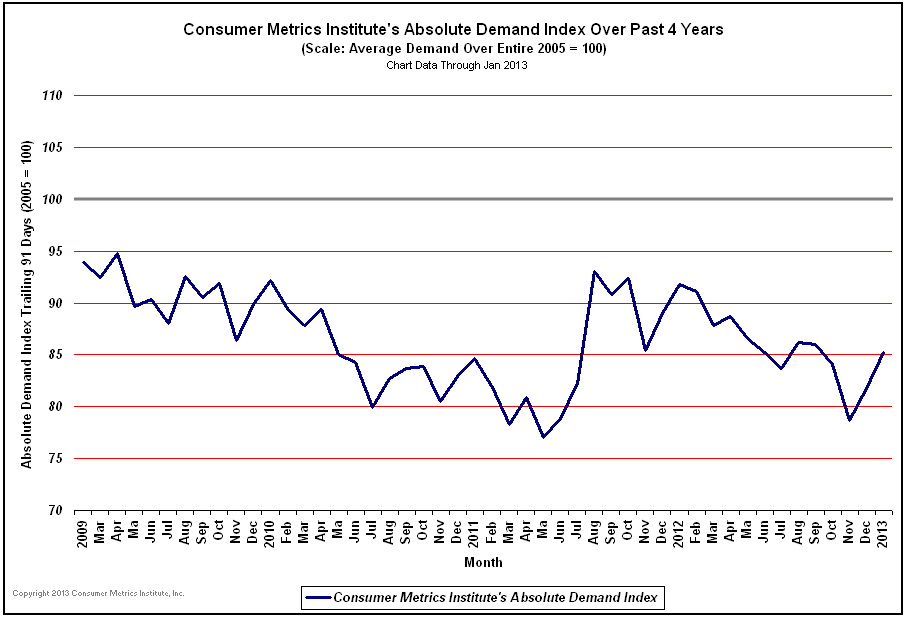
All of these economic charts were compiled by governments who, as we’ll show in a future post on the acceleration in lying, have a strong vested interest (it’s literally and even proudly called MOPE by academics—Management of Perception Economics) in making things look better than they are. In that light, I ask that you consider the following two charts compiled by a private bunch of computer geek types at a place called Consumer Metrics Institute. They thought, in this time of highly-networked business, that it was silly to have to wait until governments spent months collecting data before telling us what happened some months back, that the data could be collected and reported in near-real-time. If you wish, you can find out what they do at their FAQ.

But what they essentially do is track, in real time, discretionary purchases for things like automobiles, housing, vacations, durable household goods and investments.

These two charts show the trend in these purchases where a value of 100 would equal the same level of purchasing as was taking place in 2005. The first chart is the last 60 days:

CMIRecent

And the second chart is of the last three years:

CMILong

So, both charts show their index hovering around 85 or lower, which means that this large portion of the US consumer economy is 15% smaller than it was in 2005! Perhaps that aligns better with the income and net worth charts shown above rather than the rosy “we’re in a wonderful economic recovery” MOPE spewed by minions of The Powers That Be.

So what it looks like is that all that money printing is making a select few richer and, by driving up the prices of real goods, squeezing regular people—whose income is falling and who spend a far greater percent of their income on real goods. And the Western central banks say it isn’t their fault that people are rioting in countries where people’s costs for food have gone from 40% to 80% of their income. Nope, they aren’t driving prices up at all with their money printing, it’s those “evil speculators.” Well, perhaps it is evil speculators, but they are aided and abetted by a vast surplus of gambling chips supplied by the central banks.

There’s more to come. Stay tuned for Part 6.

Cliff Posers, and the Incredible Shrinking US Pie

If the politicians in Washington DC didn’t bring suffering to so many people, their posing with respect to this “fiscal cliff” would be laughable.

First, none of them intends to do anything substantive about the biggest problem of all: the Trillion Dollars the US spends each year on its war machine to maintain its rapidly fading pretense that Earth is part of the US Empire.

Second, none of them are including in their fake calculations the five additional bailouts that they all know are either already in play or right on the doorstep. The four new ones:

  • US Postal Service—losing $ billions every quarter
  • FHA—after “quasi-government” housing stimulus and campaign-finance corporations Fannie Mae and Freddie Mac went bust because they had enabled millions of insane mortgages, the FHA took over their role and rose from relative obscurity to be the new Federal backer extraordinaire of insane mortgages. As predicted by honest observers, it now needs a bailout.
  • PBGC—the Pension Benefit Guarantee Corp is now operating in the red.
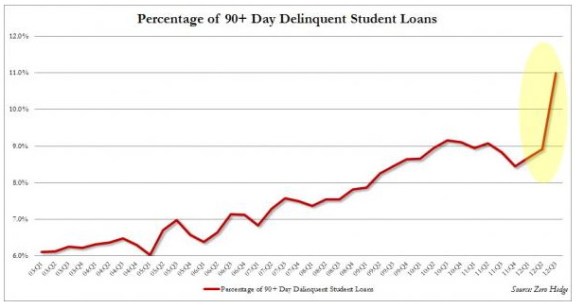
  • Student Loans—with the default rate now going exponential, everyone involved in this $ Trillion market will need a bailout. Check the trend on this chart of the 90-day default rate:

StudentLoanDefaultRate

The government headline admits that 11% of these loans are in default, but a reading of the fine print says it’s closer to 22%. That’s 22% of a $ Trillion in loans.

And the bailout that is already well underway:

Social Security—What? Some politicians claim the SSA is good through 2033. Strange claim, given that SSA will run $162 billion in the red for 2012. Well, they say it’s “only” a $47 billion deficit because there was a special payment from the Treasury of $115 billion to offset the “temporary” payroll tax cut. And if you think this year is some exception, the deficit for 2011, before the payroll tax cut, was $46 billion. One of the largest problems for Social Security is this: as cash was paid into the program into what was supposed to be the Social Security Trust Fund, the government spent that money and put IOU’s in the Trust Fund. Well, given the ultra-low interest rates paid on government IOU’s due to the low interest rate regimes run by Greenspan and Bernanke, the Trust Fund is earning at least $700 billion less in interest over the next 10 years than they thought they would be earning. So that thing about SSA being OK though 2033? Oops. For a look at the unhappy calculations, see this.

So how did this happen?

Here is a huge contributor: As reported by the World Bank, government statistics collected from around the world—and pretty much everyone agrees that government stats are just a bit biased to the upside—say that the global economy grew by a total of 9% from 2001 through 2011. By those same stats, in 2001, the US economy was 32% of the total world economy. By 2011, the US economy was just 22% of the world economy. That’s a huge 32% reduction in global market share for the US. These calcs are here.

So the question is: How does a country have its economy shrink by 32% in terms of its share of the world economic pie and yet keep spending a $ trillion a year on war and keep all of its benefit programs and government agencies intact? Doesn’t this lead to some type of breaking point? Normally, yes. But so far, the solution has been simple: the country borrows the money. In 2001, the US owed $6 Trillion. Now it owes over $16 Trillion. But won’t people stop lending to such a country? Yes, but the Federal Reserve prints up new money and buys the excess new debt authorized by Congress and issued by the US Treasury. For the next three years, the Fed admits to planning to buy virtually all of it. See Treasury Scarcity to Grow as Fed Buys 90% of New Bonds. Simple? Yes. Sustainable? Not in the recorded history of this planet.

So when you hear the cliff posers from both parties trying to score political points, remember that what they aren’t talking about is far larger than what they are talking about. And that what they aren’t talking will have a far bigger impact on all of us.

Gold Goes Mainstream

Gross: Stock and bond managers today must be alchemists: turn lead into gold. NOT likely. Too much lead (bubbled assets).
–Tweet from Bill Gross, Founder of PIMCO, which manages $1.8 trillion

**************

“Do you own gold?” “Oh yeah. I do…There’s no sensible reason not to have some.”
–Ray Dalio to the Council on Foreign Relations

This is being written to put the precious metals market in a larger context for those people who still see the world proceeding much as it has proceeded in the past, a world without the large financial and supply chain disruptions that we foresee.

Strong multi-year upmoves in the price of any asset, aka a secular bull market in that asset, go through three stages:

  1. The speculative, early-proponent phase during which the mainstream investment community ignores or derides the potential of that asset.
  2. The mainstream phase, where the mainstream decides that exposure to that asset is a good idea for just about everyone.
  3. The mania phase, where just about everyone feels that they must own that asset and will tell you so when you meet them by chance in the supermarket.

Phase 1 for gold has been marked by derision from the mainstream investment community. Quoting Keynes, they call gold the “barbarous relic.” Otherwise-intelligent economic commentators such as Nouriel Roubini have been calling for a price top in gold for several years. Some who are old enough to have experienced the gold bull market of the 1970s have been saying, “We heard all this before in the 1970s, anyone who buys gold now will regret it later.” All of these people have been wrong all along as gold and silver have powered higher in price.

During most of Phase 1, the major central banks of the world have been sellers of gold, preferring to buy government bonds of various countries (such as Greece and Spain!) to “get a return” on their money. Gold has been a far better investment for the last 12 years. Over the last three years, central banks have become net buyers of gold, to the tune of hundreds of tons per year. Most but not all of this buying has come from Asia as the western central banks have been preoccupied with printing money in a mad scramble to keep their markets afloat.

Gold has been in Phase 1 since 2001. Most in the financial community regard it as an annoyance when their clients ask about it. The price increased from $256 in 2001 to $1,911 in August, 2011.

A couple of weeks ago, Ray Dalio gave a presentation to the CFR. He was asked if he owned gold, and he said, “Oh yeah. I do.” This marked the start of Phase 2, the mainstream phase.

Who is Ray Dalio? Most people in the investment community respect him as the best active hedge fund manager on the planet. We mentioned his firm, Bridgewater Associates, in a previous post. They manage about $140 billion. Ray is highly respected in both financial and political circles.

And the CFR is the Council on Foreign Relations. If you had to pick one organization that has the most influence on the mainstream political thought in the US, it would have to be the CFR. It was founded by the Rockefellers. You have to apply for membership. There are currently 4,700 members, including Bill Clinton, Robert Zoellick, Janet Yellen, Paul Wolfowitz, Lloyd Blankfein, Jamie Dimon…in other words, the CFR is the public face of The Powers That Be/Were.

Now that all of these mainstream movers and shakers have heard from what some consider the smartest money man on the planet that owning gold is a good idea, well, if we haven’t yet convinced you to get rid of a mainstream financial advisor such as a broker, said broker is likely to be calling you in the not-too-distant future with their “innovative” idea that you should get some gold. Of course, being mainstream, they will likely advise you to own it in paper rather than physical form, which will be a big mistake, but that will be their advice. And they will advise that you put a maximum of 5% of your assets into gold or gold mining stocks. In normal times, this would characterize the mainstream phase for gold, during which its price would rise steadily for years.

More evidence that we’ve entered the mainstream phase comes from Bill Gross, known to many as the “Bond King.” Gross founded PIMCO, which manages over $1.8 trillion. Yes, that’s trillion with a T. Almost all of the money is in conservative bond funds. But here’s a tweet this week from Gross:

Gross: Stock and bond managers today must be alchemists: turn lead into gold. NOT likely. Too much lead (bubbled assets).

Note that Gross, the Bond King, is saying that stocks and bonds are bubble markets. That money managers should turn that lead into gold. Though he also says that’s not likely.
Those who hate gold claim gold is in a bubble. Great examples of bubble markets are internet stocks in 1998 through early 2000; or real estate running up to 2006; or government bonds now. Gold, on the other hand, has had a nice steady rise for years, nothing meteoric or bubble-like at all. And here is someone, Bill Gross, who may know more about bonds than anyone on the planet, saying that bonds and stocks are the bubble, not gold.

Gold can’t possibly enter a bubble until it enters Phase 3, the mania phase. During this phase, you will be regaled on a regular basis from media sources and individuals with stories of people who got rich from gold and silver. Like the stock day traders of the year 2000, or the real estate flippers of 2006, there will be lots people trading gold on a daily basis, probably at gold trading shops like the day trading shops that were operating in 1999. People will be quitting their jobs to trade precious metals to “make their fortune.” 90% of people who talk about gold will assure you that it is the surest thing on earth to guaranteed riches. CEOs of gold mining companies will be like rock stars, getting interviewed by Charlie Rose. That’s what a bubble looks like. How many people do you know who own gold and silver?

Now, with the acceleration that is all around us, it is unlikely that we will proceed through these three phases of a secular bull market as we would in normal times. It is far more likely that gold will have a meteoric rise quite soon. But if you think that the world will proceed in a conventional manner in the years to come, we have outlined the path of the precious metals for you.

So, Did You Take Care of Business?

Preparation is everything.
–David Daniels

On June 6, we posted the following quote in What then can we do? Part 1:

Our research says that it would be wise to complete this conversion process by August 2012.

What conversion process? That of converting your paper savings primarily into minted gold and silver bullion coins. When we posted that idea on June 6, the price of gold was $1,621 per ounce. From June 6 through August 20, it meandered between $1,553 and $1,629 per ounce. Then it took off to the upside and now sits at $1,774 as I write. (At the time of posting, the price is $1,766.) If you completed the process by August 20, the dollar value of your metals holdings has increased by 9% to 14% in one to three months. If you did the entire conversion late on the last day of August, the dollar value has increased by “only” 5% in a few of weeks.

The question at the top of this post is directed to those who:

  • had monetary savings in electronic accounts; and
  • who still needed to do this conversion as of June 6.

If you have still not taken care of business in this way, we would really like to hear why. You can easily piece together our e-mail address on the Contact page. Send your reasons. What have we failed to explain with sufficient clarity?

Worthless derivatives are being created by Wall St and High St at the rate of a million dollars per second! Governments have promised citizens far more than can ever be funded. If the big banks told the truth about their financial condition, all of them would be seen as insolvent. And it has been obvious for years that most countries in the world had taken on more debt than they could ever repay, and that their only strategy would be to print money. They are doing so. With extreme prejudice! We are fairly certain that you heard that the US Federal Reserve has promised to print $40 billion per month. Ad infinitum! The week before, the European Central Bank promised to print billions as needed. The Bank of Japan joined them last week in the printing campaign. Each of the things in this paragraph would be enough to dissolve the financial system. Taken together, they are an absolute guarantee.

Your paper savings and your income are being devalued by this massive ceaseless money printing. It is an act of desperation by the central bank minions of the bankster class. Their aim is to preserve the game of the big bankers, to enable those bankers to continue their game of theft from all of us. They do not have your interests in mind. Why continue to let these thieves steal from you?

Chris Martenson of PeakProsperity.com often and elegantly describes how, once people wake up to the true nature of our current societal systems, they change their life in a big way. They can’t help it. And they do not regret the changes they make. They may lose income by leaving jobs they dislike, but they pare expenses more quickly. They might need to physically move to a new area. But they begin to enjoy life more, to find the pursuit of their new aims quite nourishing on many levels.

In these times, we contend that it is not enough to wake up only on the inside or only on the outside. We need to do both. And to live from our insights in both realms.

OK, you may have missed the opportunity to buy cheaper gold and silver through August 20. But the prices of these metals, calculated as they are in paper currencies whose quantities are being increased by the minute, will be much, much higher, and sooner than most think.

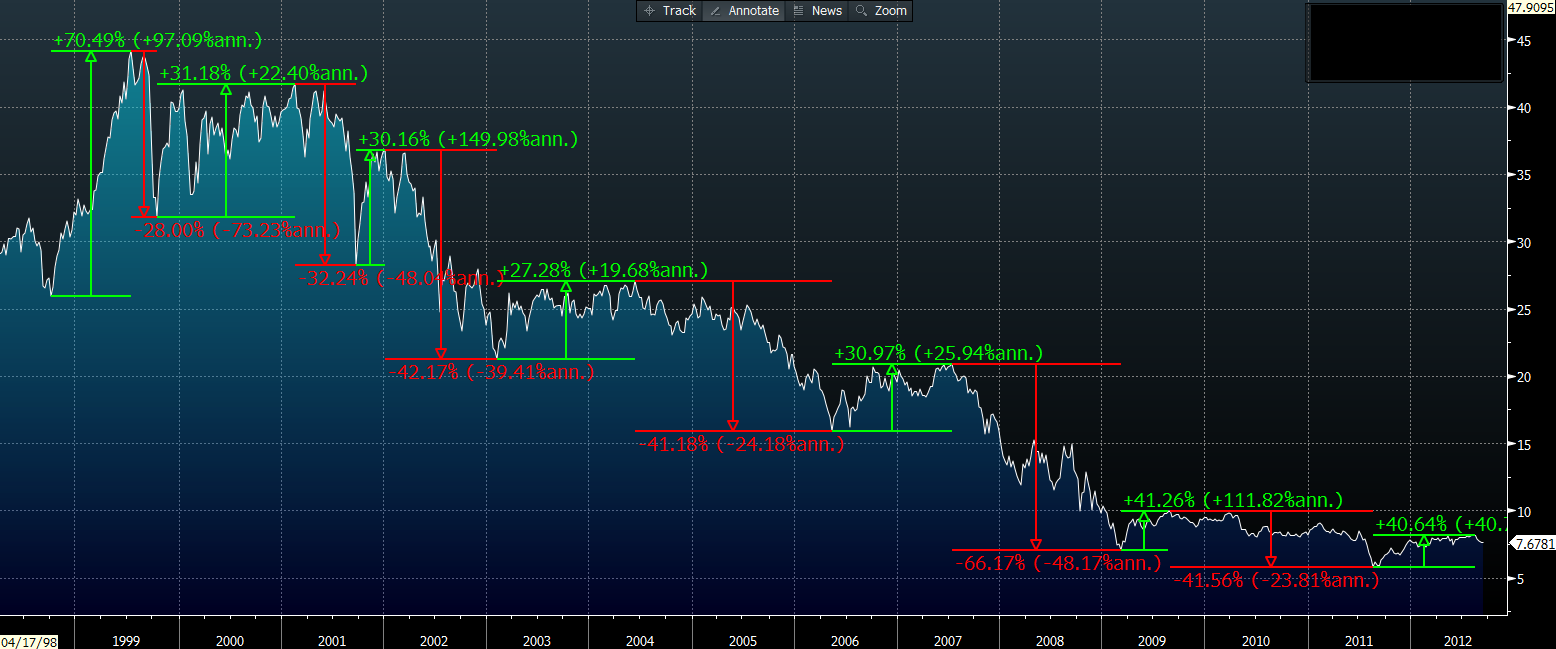
Oh, you say you prefer stocks? Here’s a chart of stock values versus gold for the last 15 years:

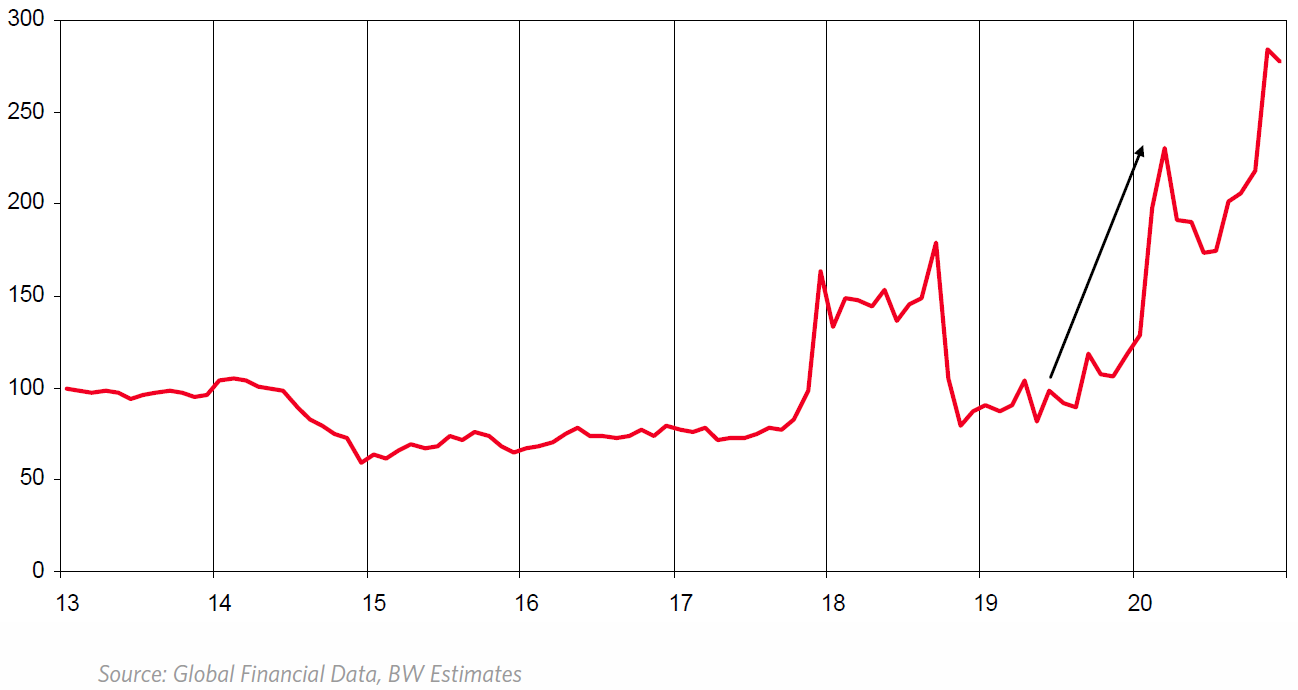
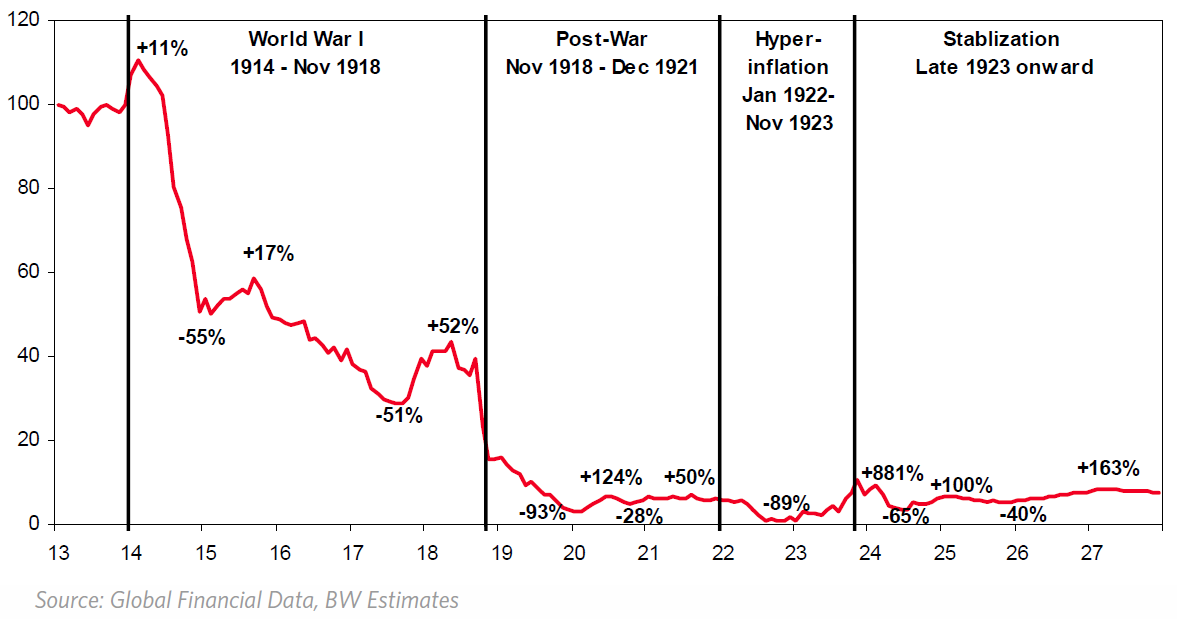
Two points: First, the chart shows gold outperforming stocks by about 4 to 1 over that period. Does holding stocks look like a great strategy? Second, many feel that stock indexes, calculated as they are in paper currencies that are declining in value, are approaching new all-time highs and they are smart to stick with them. If you are in that camp, here are two charts that might, that should, alarm you. It’s the path of stocks during another of the great money printing experiments in history, the Weimar Republic printing campaign in the 1920’s that resulted in an infamous hyperinflation. During that period, the value of the stock market went up when priced in the local currency that was being printed at will by the central bank. The chart looked like this:

In other words, to local people using the local currency, they felt like their money was increasing in value in stocks. The Zimbabwe stock index chart during the recent Zimbabwe hyperinflation looked even better. Stock index charts always looks like this or better when calculated in the local over-printed currency. But here’s what those Weimar stocks looked like to the rest of the world, a world that was still on the gold standard to some degree at the time:

If you think this bears some resemblance to the first chart above, the chart of US stocks priced in gold, then you are getting the picture. At the end of a hyperinflation, stocks crash mercilessly in real value as the currency loses all value. In other words, those who stay in stocks stand to lose almost all of their purchasing power! They might appear to have a lot of dollars. But those dollars will be very near worthless.

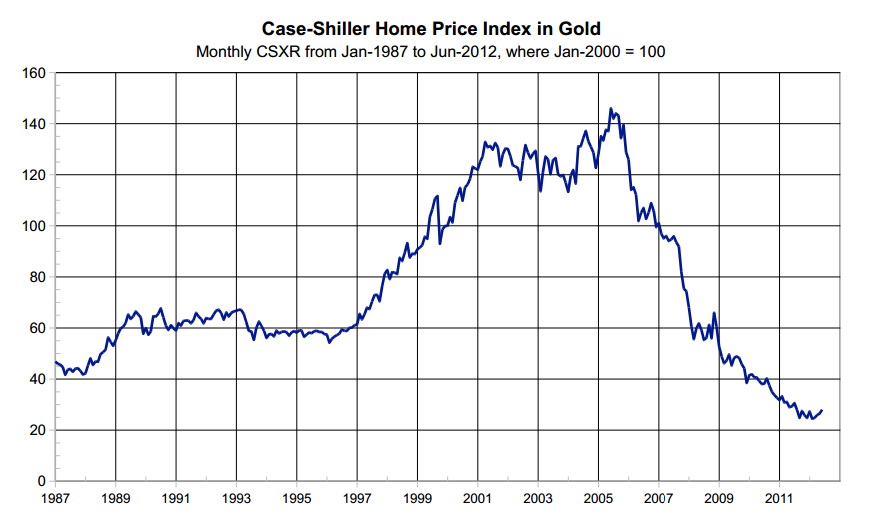
And real estate? As we’ve said before, productive real estate from which you can live independently is a great idea. All other real estate is a very bad bet from a financial point of view. Since the real estate bust began in 2006, as retorts to our advice to sell, we have been hearing: Yes, real estate has gone down, but not in my state. Which was then replaced by: Yes, real estate has gone down, but not in my area. Which has been replaced by: Yes, real estate has gone down, but not in my neighborhood. Here’s the chart of US Real Estate priced in gold going back to 1987:

If you understand this chart, you can see that US real estate is worth about half what it was worth in 1987—when priced in real money, that is, gold.  At the end of the Weimar episode, it is said that you could buy an entire city block of real estate in Berlin for one ounce of gold.  We are rapidly moving along that path. Since the real estate price peak, gold has outperformed real estate by about 6 to 1. And the real estate price collapse is happening while the authorities are madly printing money! If real estate were the inflation hedge that its proponents claim, real estate prices should be soaring. Alas, at least no one is claiming that such prices are soaring. But the proponents misunderstand this real estate “asset class.” Its prices are floating on a sea of debt. Once governments can no longer support that debt, prices will drop like a stone. And residential real estate was never supposed to be an “asset class.” It was supposed to be lived in!

Were the charts above prepared by some wild-eyed blogger? No, the first is from Bloomberg, the second and third were prepared by the premier hedge fund in the world,  manager of well over $100 billion of client money, Bridgewater Associates.  All three charts were cited here on ZeroHedge, which, in our view, is wonderfully wild-eyed. The fourth chart is from PricedInGold.com.

Our June 6 advice about completing metals purchases by August was tactical in nature: we spent years in the land of the trading thieves and one earns a knack for detecting those time-price areas where people can get lower prices. We wanted any reader who had not yet completed their buying campaign to get the benefit of lower prices.

But soon we face something that is likely to be quite different. By the second half of October, events with systemic-level impacts are likely to arise, leading to significantly greater difficulty and/or expense in the acquisition of physical metals. If we had not completed our own buying campaign quite awhile ago, we would be completing it by mid-October.

Again, from our previous posts, here is a summary of what we see coming to your current favorite planet:

  1. Electronic accounts (bank accounts, brokerage accounts, mutual funds, etc.) are found to be empty after the implosion of the derivatives market, so there are no transactions via ATM’s, credit cards, checks, on-line payment systems, etc.
  2. During a transitional period, people and businesses still accept national paper currencies—in hard cash form only, all electronic transactions will not be trusted—while barter, local barter currencies, and minted gold and silver coins become understood and accepted for transactions.
  3. During that transitional period, fewer and fewer accept national paper currencies as they increasingly favor local barter currencies, gold coins, and silver coins.

Here is the most important issue: Will you be helping others during this transition? Will you be operating from a prepared, strong position? Will you be helping to re-start your local economy by spending some silver and gold? Or will you be paralyzed, floundering, panicking, regretting, in need of help, etc. The choice is straightforward.

Preparation is everything.
–David Daniels

Slings and Arrows

To be or not to be, that is the question:
Whether ’tis nobler in the mind to suffer
The slings and arrows of outrageous fortune,
Or to take arms against a sea of troubles
And by opposing, end them.
Shakespeare, Hamlet

Sometimes slings and arrows feel very difficult indeed. But sometimes, and I guess some would say always, they are our friends, as they help to end pernicious cycles. Our increasingly-being-shown-as-notorious financial system is experiencing its end-of-cycle as its lies and chief liars are exposed, as major world banks have been shutting down public access to their systems for days at a time, as criminal hackers have figured out how to pilfer billions from the accounts of high net worth individuals at banks, etc.

We documented the base-level lies in The financial system is based on twelve promises that are lies. But each and every week now, more of the operational lies of the system are revealed.

Matt Taibbi of Rolling Stone reported on a court case showing that the big banks have for decades criminally deceived participants in the municipal bond market, robbing cities, towns, hospitals, etc. of interest payments due to them: The Scam Wall Street Learned From the Mafia.

Too bad that cities and towns are going broke, the banksters must get their bonuses. And their posh offices. Drive around any city in the industrialized world. Who has the largest and fanciest buildings, whose buildings dominate the skylines? Banks and insurance companies. Check it out. But I digress. Back to the latest slings and arrows.

Everyone has probably heard about the LIBOR scandal where the big banks–and it is looking like most or all of them–colluded in criminal fashion to manipulate interest rates. The LIBOR rate is used to calculate the interest rates on myriad types of loans including mortgages, business loans, credit card rates, etc. It is used as the basis for hundreds of trillions of dollars worth of derivatives. The top executives at Barclay’s were the first to be caught, but now RBS has been fined, and Deutsche Bank is under investigation. Others will follow. And the fired CEO of Barclay’s, Bob Diamond, has publicly stated that he was told to manipulate LIBOR by the guy who is second in command at the Bank of England, Paul Tucker. How long before we find out the US Federal Reserve was giving out the same kinds of orders for illegal acts?

And speaking of investigations, how about Spain investigating the top executives of  Bankia, headquarters pictured here, I kid you not:

Photo from Mike Krieger’s site.

A year ago, when they were selling stock in the bank to the public, these executives touted Bankia’s greatness. They stated two months ago that everything was fine, in fact profitable, at Bankia. Within a few weeks, it was determined that the bank needed a $19 billion bailout.

And it looks like JP Morgan has been caught pulling an Enron, manipulating the electric power market in California and the Midwest: JPMorgan’s Role in Power Market Comes Under Scrutiny.

The Vatican can’t resist joining the financial criminality party, assisted, of course, by JP Morgan: Catholic Church Fears Growing Vatican Bank Scandal.

We also have the mystery of large banks shutting their systems to any public access. RBS, one of the biggest UK banks, had a major “system outage” for days that halted the processing of just about everything including credit and debit cards, ATMs, payroll checks, account balance inquiries, i.e., everything! See: As RBS’ ATM “Glitch” Enters Fifth Day, The Bailed Out Bank Issues A Statement.

And yesterday the largest bank in Russia stopped all public access to its systems, so no credit or debit cards swipes would work, no on-line transactions, etc.: RBS ‘Glitch’ Goes Airborne As Biggest Russian Bank Halts All Credit, Debit Card Operations.

RBS gave a potentially plausible explanation of their outage in testimony to the UK Treasury: RBS gives more detail on IT failure train wreck.

However, it seems suspicious that the biggest bank in Russia also had to shut out the public. Perhaps it had something to do with criminal hackers figuring out how to initiate wire transfers from the accounts of high net worth individuals at 60 banks! Haven’t heard of that one? It broke in the news about two weeks ago and was promptly “disappeared” from many websites. As of this minute, the story is still currently available at the Times of India: Cyber criminals may have siphoned off 2 billion euros from 60 banks. From the article:

The study highlighted a highly sophisticated, multi-tiered, global financial fraud ring that is comprised of at least a dozen groups using active and passive automated transfer systems to steal high value amounts from high balance accounts.

“This fraud empire, dubbed Operation High Roller, has impacted every class of financial institution: credit union, large global bank and regional bank, using smaller and less detectable automated transactions,” McAfee said in a statement.

Could it be that these banks recognize that they are being hacked, and their accounts drained, and they have no way to stop it other than preventing all public access to their systems? And why did coverage of this story virtually disappear? That’s an easy one: When criminal hackers hear that a class of juicy targets is hackable, it’s like pouring blood into water near sharks, they all want a piece of the action.  And we can’t have depositors getting nervous about their deposits when the whole system is based on confidence.

Perhaps the problem isn’t hacking. But then how could these large bank systems, famous for their redundancies, backups, and all-around bulletproofness, fail in such catastrophic ways? Could it be that the Sun has decided to make a statement or two about who really runs this sector of the universe? Did 18 M-class solar flares over three days cause glitches in these systems? (Eighteen (18) M-Class Flares Within Last 72 Hours) Followed by an X-class solar flare? (Sunspot Region 1515 Fires Off X-Class Flare) Or are their systems based on MS-Windows? (Joke. Sort of.)

Either way, I have to wonder how people with their savings in electronic accounts feel about that. The system is based on lies. The people who run it are pulling continuous criminal capers, and it looks like they have been doing so for decades. Hackers have figured out how to drain accounts electronically. And the Sun may even be contributing to bank computer mayhem, with NASA admitting that the Sun will be ramping up its activity into mid-2013.

We think it best to consider all of these as indications of a system that is in something beyond peril. It is going down. It will fail. It’s only a matter of time. The pace of slings and arrows impacting the system is accelerating.

Let’s recall that people value money because it is a medium of exchange through which a wild variety of good and services can be exchanged in some comparable way; and a store of value providing one way to save the energy expended in work today to meet needs at some future time. Our current paper currencies (Dollar, Euro, Pound, Yen, etc.) are masters of exchange, but are cascading toward failure as stores of value. Some who have studied the history of money say–and I have no way to verify this–that the longest reigning currency regime based on unbacked paper lasted 41 years. Well, the world went fully into unbacked paper currency in 1971. Add 41 years and you get 2012. Can we set a new record? Perhaps. But the system is showing so many signs of being in its death throes, why take the chance?

People keeping their savings in the banking/brokerage system reminds me of the old Eddie Murphy comedy routine where he asks about movies like Poltergeist and Amityville Horror, “When there’s a ghost in the house, why don’t white people just leave the house?” If profanity offends you, don’t go to the link.

We have all been warned. Over and over. And the warnings are increasingly clear and loud. But we can take arms against this sea of troubles, at least for ourselves. And if we do, we’ll be in a position to help when the slings and arrows end this financial system.

Where there are things to be done, the end is not to survey and recognize the various things, but to do them.
Aristotle, Nicomachean Ethics

Why Gold?

U.S. dollars have value only to the extent that they are strictly limited in supply. But the U.S. government has a technology, called a printing press (or, today, its electronic equivalent), that allows it to produce as many U.S. dollars as it wishes at essentially no cost. By increasing the number of U.S. dollars in circulation, or even by credibly threatening to do so, the U.S. government can also reduce the value of a dollar in terms of goods and services, which is equivalent to raising the prices in dollars of those goods and services. We conclude that, under a paper-money system, a determined government can always generate higher spending and hence positive inflation.
–Ben Bernanke, Chairman, US Federal Reserve Board, from a speech in 2002

If the governments devalue the currency in order to betray all creditors, you politely call this procedure “inflation”.
–George Bernard Shaw

At the end fiat money returns to its inner value – zero.
–Voltaire

Gold can make its way through the midst of guards, and break through the strongest barriers more easily than the lightning’s bolt.
–Horace

Three short segments on gold:

1. Why Did Gold Become Money?

Everyone knows that gold and silver were used as money for millenia. But those who despise gold as money, who call it the barbarous relic, who think government-created paper and electronic bits are the best money, claim that it was arbitrary that gold became money. Here is a scientific treatment of the topic, a link to a 6-minute video about why humans chose gold and silver as money versus all other substances available to them from the Periodic Table of Elements: Why Did Gold Become Money?

2. Gold As A Store Of Value

If you already know well the fabulous effect it has on a person to buy physical gold and silver, then you don’t need the next video. But for those who are still worried about gold as a store of value, who think paper currencies are better for their long term wealth, who worry about where they are going to store it, etc., here is 10-minute video on Gold As A Store Of Value.

3. The Vibrational Value of Gold

Those first two links are for all readers. The text below is unlikely to be of interest to anyone who thinks the physical plane is all there is, that is, below is a multi-plane view of the gold question from the book Unveiled Mysteries by Godfre Ray King. It gives a big clue about why many people like to keep some gold on their person at all times, and why you might wish to do that yourself, especially in increasingly turbulent times:

Gold was a common commodity…in all Golden Ages, because its natural emanation is a purifying, balancing, and vitalizing energy or force…

The outer or intellectual knowledge of humanity, holds within it little–very little–understanding of the real purpose for which gold exists on this planet. It grows within the earth like a plant, and through it there is constantly pouring a purifying, vitalizing, and balancing current of energy into the very ground we walk upon, as well as into the growth of nature and the atmosphere we breathe.

Gold is placed upon this planet for a variety of uses, two of its most trivial and unimportant ones being that of using gold as a means of exchange and for ornamentation. The far greater activity and purpose of it, within and upon the earth, is the release of its own inherent quality and energy to purify, vitalize and balance the atomic structure of the world.

The scientific world today has no inkling as yet of this activity. However, it serves the same purpose to our earth that radiators do to our homes. Gold is one of the most important ways by which the energy from our sun is supplied to the interior of the earth, and the balance of activities maintained. As a conveyor of this energy, it acts as a transformer to pass the sun’s force into the physical substance of our world, as well as to the life evolving upon it. The energy within gold is really the radiant, electronic force from the sun, acting in a lower octave. Gold is sometimes called a precipitated sun-ray.

As the energy within gold is of extremely high vibratory rate, it can only act upon the finer and more subtle expressions of life, through absorption. In all “Golden Ages,” this metal comes into plentiful and common use by the mass of the people, and whenever such a condition occurs, the spiritual development of that people reaches of very high state. In these ages, the gold is never hoarded but instead is widely distributed into the use of the masses who, absorbing its purifying energy, are themselves raised into greater perfection. Such is the right use of gold, and when this Law is consciously understood and obeyed, the individual may draw any quantity he desires to himself by the use of that Law.

Because of the gold deposits in all mountain ranges, one finds health and vigor in life upon the mountains that he cannot find in any other places on the earth’s surface. No one ever heard of detrimental effects coming to those who constantly handle pure gold. While in its pure state, it is soft and wears away easily, still the very quality is the fulfilling of this purpose of which I have just spoken.

If You Think You’ll Get Truth

In The financial system is based on twelve promises that are lies, we mentioned that there were a number of people who understood, well before it “went public” in 2008, that the world had a major financial crisis on the docket. Dr. Michael Burry is one of those people. He and his tactics were profiled in the book The Big Short by Michael Lewis. Burry used his insight to make a great deal of money for himself and investors in his money management funds. Once Burry made that money, he knew he had made enough, he closed his funds, and quit the money management business.

Here is what he said recently while giving the commencement speech at the UCLA school of economics, available here, with this quote starting at 14:00 into the video:

In 2010, I published an op-ed in the New York Times posing what I thought was a valid question of the Federal Reserve, Congress, and the President: I saw the crisis coming, why did not the Fed? Never did any member of Congress, any member of government for that matter, reach out to me for an open collegial discussion on what went wrong or what could be done. Rather, within two weeks, all six of my defunct funds were audited. The Congressional Financial Crisis Inquiry Commission demanded all my e-mails and the list of people with whom I had conversed going back to 2003. And a little later the FBI showed up. A million in legal and accounting costs, and thousands of hours of time wasted, all because I asked questions. It seems they would pump me at gunpoint or not at all. That Summer the Federal Reserve put out a paper that concluded that nothing in the field of economics or finance could have predicted what happened with regards to the housing bust and subsequent economic fallout. Ben Bernanke continues to backfill this logic. And I fear that history is being written wrong yet again. The ignorance is willful.

This is how it is in the world these days. Those in charge in government, large corporations, and the media which they own will not tolerate truth about what is either their incompetence or their dishonesty or both. If you think you can get truth from them about what is transpiring, guess again. Relying on their claims is high risk behavior.

What then can we do? Part 2

This is the true joy in life, the being used for a purpose recognized by yourself as a mighty one; the being thoroughly worn out before you are thrown on the scrap heap; the being a force of Nature instead of…complaining that the world will not devote itself to making you happy.
—George Bernard Shaw

In Part 1, we briefly covered how “Inner Work” and buying precious metal bullion coins could be helpful in having us glide through this transition rather than struggling through it. And remember, our point here is not to frighten, but to offer ways for readers to calmly and persistently prepare for the inevitable problems that will arise from the collapse of the financial system.

In this Part 2, we will deal with “Outer Work” topics related to serious impairments of the global supply chain. Our firm expectation is that this supply chain will experience increasing turbulence and unreliability. As currently configured—though mis-configured is a better description—the supply chain is entirely dependent on the efficient functioning of the transportation fuel markets. And both it and those fuel markets depend on the proper functioning of the banking and credit systems, which will disappear when the financial system collapses.

The collapse of the financial system will not remove one bushel of corn, one apple, or one barrel of oil from the planet. The real things people need will still exist in great abundance. But the process of getting them from where they are produced to where they are needed will be disrupted, sometimes severely. Not forever. People are very clever. Supply chains will be re-established. But it will take time. And their re-establishment will not be instantaneous and smooth. And not all types of goods will be available. Some may disappear for long periods, even forever. Good riddance to some of them.

In this post, the overall recommendation is that you become far more independent of the global supply chain than most people are now. Beyond being practical and likely very beneficial from the point of view of health, this topic has philosophical dimensions. Just how dependent do you want to be on huge corporations and huge governments for your food, water, electricity, health care, etc? In our current world, most purchases are made from very large companies and at large chain stores which buy their supplies from those places on the planet where people will work for the lowest wages, where the workers have little in the way of rights, where there are few or no environmental safeguards, etc. The chain store sells these products and uses its profits to go to the centers of government power to purchase ever-increasing influence, typically with the idea of driving out competition and driving down costs to increase profits. So manufacturing is now done by the poorest, and distribution and retailing are done by the largest, limiting work and profit opportunities for everyone else, who then become more dependent for their income on government, which works on behalf of those who pay the bills of the politicians, namely the big financial institutions and the large corporations and so on—until the whole world is controlled by lumbering behemoths who operate without restraint for their own mega-profits. And nearly every transaction you have with this system is tracked and taxed, eliminating privacy and draining your financial resources to feed its insatiable appetite. And the more they know about you, the more they try to use that data to manipulate you. With every move you make away from dependence on this ever-increasing force of domination and toward local sufficiency—growing and cooking your own food, supporting farmers’ markets, buying truly local products and services, producing your own electricity and heat, living in ways that promote and deliver health rather than disease, etc.—the better off you, and those in your local community, are likely to be.

So this is not simply some survivalist approach, this is equally about transitioning life on this planet toward greater freedom for everyone. And toward sustainability versus the current trend of exponentially increasing resource consumption. So let’s get to it.

BARTER: Barter networks and barter currencies are popping up all over. These will play a vital role since it is unlikely that anyone can anticipate, let alone purchase and store, all of what they might need when the global supply chain fails.

Participating in barter networks and currencies, to understand them and to strengthen them before they are critically needed, is a service to yourself and your community. Purchasing and storing a surplus of goods that would clearly be valuable to others is one useful way to prepare for barter network participation. With some practical goods and with some precious metals coins, you will be well-prepared to participate.

And experimental participation in barter currencies is valuable preparation as well. Just as we don’t recommend keeping a substantial portion of your savings in fiat national currencies, we do not recommend placing a substantial portion of your assets in any barter currency, including the international variety such as Bitcoins. None of these currencies are backed by gold or silver, they are backed by people trusting that the currencies have value. And as we are learning from our experience with government fiat currencies, that trust can be abused by the unscrupulous and by well-intentioned but misguided players. But participating in barter currencies to a limited degree is highly recommended. They will give local communities something to fall back on when trust in national currencies dies. If that local system is well developed and well understood by many in the community, that will be a great advantage for the community. Clearly, from our recent dismal performance, humanity has a lot to understand about money, and these barter networks and currencies will play a role in helping people understand just what money is.

If there are no barter networks or barter currencies in your area, consider starting them up yourself. The barter-oriented (but also survivalist-oriented) website Alt-Market  has a map of some barter networks in the US. If you search the web for “barter networks,” there is a whole lot of info out there. If any readers are experts in this field, we would love to hear from you on this topic. And we will write about the international barter currency Bitcoins soon.

FOOD: Things have gone far enough on the planet that even one fairly large institution is recommending that its members have backup food supplies: It is a requirement of the Mormon church that each LDS household have enough food on hand for a year for each member of the household plus one other person. So if the supply chain fails, everyone head for Salt Lake City. OK, just kidding. But the Mormons are onto something here. Major cities in industrialized countries are known to have a three day supply of food in the region of the city. If re-supply is shut off, the shelves will be empty in a heartbeat. So learning to buy, store, and cycle your own food supply will be very useful. And it does take a little learning. Store what you actually eat and that has some shelf life. Cycle it in to your daily use, eating what was purchased earliest first and adding newly-purchased supplies to the tail end of your own “supply chain.” People tend to make two mistakes when they undertake this task:

  • storing food they never eat: If you don’t eat canned cheese now, you probably won’t want to eat it later.
  • failing to cycle stored food into daily use: thus the stored food goes bad and gets thrown out.

For fresh foods, learn to grow your own. For lazy gardeners who don’t want to spend their life fighting weeds, learn to do raised bed gardening. The book Cinder Block Gardens is the best we know on the topic. This book will tell you how to grow your own vegetables with relative ease even if you have a full time job. And, even if you don’t have room for a formal garden, it will tell you how to do that in your driveway or a parking lot. These raised beds will work outdoors, in a greenhouse, or under a coldframe. And if, for example, you want to grow delicious cucumbers that weight two pounds each, then you’ll need to enlist the delightful help of the nature kingdom like the people at Findhorn did. Here is the website of a current public practitioner of that art and science.

Don’t have room for raised beds? Then at least learn sprouting. Some say that many survived World War II in Europe because they knew how to do sprouting. All you need for sprouting is a window not exposed to direct sunlight, a jar, water, and some sproutable seeds. Because they store and sprout so easily, whole organic lentils are a great place to start. Sprouts are packed with nutrition and energy because they are in the phase of the life cycle of a plant where nature is doing its best to give this seed a leg up in terms of getting established as a new successful plant. So they are a great source of essential nutrients and are easy to use in salads, soups, etc.

And like telling the truth, growing food can be a revolutionary act at this time. Most who grow their own food quickly migrate toward organic ways, where one takes care of the billions of critters in the soil, and the soil and sun take care of the plants. In this method, there ensues a brilliant, intricate, delicate dance of the soil critters and the plant roots, where each communicates their needs to the others and each provide materials for the others. That is the way nature grows things. Working this way, a person is quickly overjoyed and humbled by the abundance and deliciousness that nature provides. And with debris from chemtrails and radiation from Fukushima floating around our atmosphere, growing food in greenhouses may actually become necessary, so the sooner one sets up that infrastructure, the better. Further along the path to growing the way nature does is the world of permaculture, where plants work together in what some call plant guilds. All of this is movement away from industrialized agriculture where the soil is literally de-natured, that is, if an industrial farmer wants to grow corn, they try to kill everything else in the field: weeds, insects, soil critters, etc. Then they truck in bees for pollination and are surprised when the bee colonies collapse when the corn has been sprayed with neocotinoid poisons. And genetically-modified (“GMO”) corn has a terminator gene inserted so that the seed will not propagate and the farmer must buy new seed from Monsanto if they want to grow corn again next season.

And the industrial meat food chain is even worse: the animals are fattened in feed lots where they eat these industrially raised and poisoned GMO “foods,” and stand in so much manure that they have to be pumped full of antibiotics to survive. And of course those antibiotics are ingested by those who eat the meat from these animals, helping to breed antibiotic-resistant super-bugs. Ummmm, yummy!

Seriously, if you haven’t been growing any of your own food, you are missing a lot of fun and some big, delicious treats. Favorite foods grown from heirloom seeds in great soil? Wow, such food is so much better than what you can buy in stores it’ll make your mouth spin.

And speaking of heirloom non-GMO organic seeds, obtaining more of these than you need for the current season, and storing them in a cool dry place, is a great idea if you plan to grow some food, or to perhaps offer seeds to other growers. For most of us, buying seeds is the way to go. Harvesting seeds from the plants you grow is a skill that needs to be cultivated. Seed saving is an art and science, easy for some plants, quite tricky for others. For those interested, the book Seed to Seed is the bible. Heirloom seeds for purchase are best obtained from a local organic seed producer because they are suited to local conditions, but these are not available in all areas. Seeds of Change and Seed Savers Exchange are great sources for ordering seeds on the web.

And to sum up our food discussion, we see backup supplies of food with a good shelf life as something to tide people over until they are either growing their own food or have established availability of a reliable local supply. No matter how much food one has on the shelf, if one wants or needs to feed a group of people, that food will go quickly. We need to arrive at sustainable local sources.

ELECTRICITY: Our dependence on electricity is remarkable. If the electricity grid were down for an extended period of time, the repercussions would be staggering, curtailing lighting, heating, refrigeration, connecting with people by internet and phone, pumping gasoline into our cars and trucks, having our water supplies pumped to us, using debit and credit cards, getting money from ATMs, receiving a wide range of medical and dental procedures, using a wide array of electronic devices, etc. It is reasonable to say that almost all services in the modern world depend on the ready availability of electrical power. This winter, due to an ice storm that felled trees and power lines, affluent residents of parts of the US state of Connecticut had no electricity for eight days. Many were unable to heat their homes because the operation of their furnaces depends on electricity.

Would a collapse of the financial system seriously impair the electricity grid? Given that most electrical utility companies rely on the debt markets for their operation and that a great deal of electricity generation depends on the just-in-time mining and transport of fossil fuels, particularly coal—well let’s just say that the financial system collapse could give the grid some very bad days, or weeks, or more.

So being able to create at least a little electricity when the grid is unavailable will likely turn out to be very useful. And it is doable. But it’s a classic case of easier said than done.

Homeowners with some extra cash can address this problem by purchasing a solar array and related equipment that supplies some or all of their electricity. But if you buy such a system, it is worth checking carefully whether it will supply you with electricity when the grid is down. Many grid-tied photovoltaic systems won’t. By design! (Another great help from The Powers That Be.) “To protect workers” servicing the grid, many inverters are designed to cease operation when the grid is down. If you buy a system with substantial battery backup capability, it is likely to be able to operate during an extensive grid outage. But adding battery backup adds a good deal to the cost of the system, so most forego that capability. We are very much in favor of photovoltaic systems, but buyers should make sure to fully understand what their system will and won’t do.

Winds turbines can be an outstanding addition to a photovoltaic system, though they are prohibited in many urban areas—where they don’t work all that well anyway—and subdivisions.

Microhydro is the ultimate renewable energy system, producing power whether or not the sun is shining or the wind is blowing, but very few of us live on rushing water. And in places like the US, to install a microhydro system legally (some are installed “by moonlight”) requires filing applications with the federal government that can costs tens of thousands of dollars and over five years to process. (Yes, yet another great help from TPTB. Are you getting the idea that they would like us to be entirely dependent on their gargantuan energy systems? On their financial system? On their food system? On their health care system? And on…)

Homeowners and renters can purchase backup generators. We are all in favor of these as well. But again, clearly understanding what you are buying is essential. The small gasoline generators that cost $400 to $500 at the big box stores are designed to run for no more than 200 hours, at which point most of them will fail and, not being designed to be repaired, need to be junked. Some have enough power to run your refrigerator, some do not. The ones that are meant to run well for years cost over $1,000. And there is the problem of gasoline storage. If you store 20 gallons of gasoline, how many hours will that run your generator? Not a whole lot. Storing a lot of gasoline can be cumbersome and dangerous. Again, homeowners with extra cash can install generators that power their entire house, powered by propane from a large tank. Propane lasts virtually forever, so such a setup can run for thousands of hours. But this is not a great option for renters. Renters might wish to consider a tri-fuel generator from Yamaha that is large enough to power their refrigerator (and quiet enough that you and the neighbors will consider the running generator a net plus, not a minus). Tri-fuel means it can run on gasoline, propane, or natural gas. For anyone with access to a large propane tank, here is a small quiet portable generator that should run for thousands of hours if there is a good supply of propane or natural gas. This Yamaha will power a refrigerator with ease, but it will not power appliances such as dryers. But even if you don’t have access to a large tank, propane can be stored in multiple small portable containers used to power propane barbeques.

Small-scale renewable power setups that will not run appliances with motors but which will run DC LED lights, laptops, and other small electronic gizmos are available from a company named Goal Zero. Designed for campers and campsites, Goal Zero sells portable batteries, inverters, solar panels, DC LED lights that consume very little power, etc. Such setups won’t allow you to run your full-size refrigerator, but at least you can have light and computer power at night and be able to re-charge cell phones and the like.

Everyone’s circumstances truly are different when it comes to generating electricity. But in our view, it is a puzzle worth spending time and some money to solve. Ideally, it would be wonderful if we were all generating all of our own electricity from renewable sources (free energy devices would be, of course, the very best) and driving an all-electric vehicle. It would change the world in many ways. Many rightly complain about the unfortunate methods of Big Oil, Big Coal, Big Gas, and the nuclear power industry. But for now, we are their customers, so we are in on the game and it is not so easy to stop playing. But to state it again: this is a puzzle worth spending time and some money to solve.

HEALTH CARE: If you depend on medicines or supplements, obtaining a good supply is likely a very good idea. The financial crisis in Greece is leading to drug and treatment shortages there (Greek health system crumbles under weight of crisis) and Greece is surrounded by countries whose drug suppliers and health care systems are fully functioning. When the entire world financial system goes, many drugs and services are likely to be entirely unavailable in any country for some period of time. Clearly, if you do not have supplies or if you need treatment, having bullion coins or paper cash available should be a big advantage versus relying on government or insurance company promises to pay. Remember, trust in such promises will be the first part of the financial system to go.

The conventional medical system relies on the smooth functioning of the global supply chain, on government and insurance company payment systems, etc. When the economy becomes far more local as global systems fail, those who understand the health benefits available from alternative practitioners and methods—including but not limited to energetic and telepathic healing, acupuncture, Ayurveda, MMS, traditional Chinese herbal medicine, etc.—might find themselves very happy that they investigated these systems in advance to determine what works for them.

HEAT: If you live in a climate that experiences cold weather, planning for a heating method that does not rely on the functioning of the electrical grid is a great idea. It could be a life-saving idea. We highly recommend being able to safely heat with wood or propane and having an adequate supply of one of those on hand.

WATER: Since we can’t live without it for long, a reliable water supply is critical. When the Soviet Union collapsed in 1989, water company employees realized that a lot of people would die if they stopped working so most continued working without pay for several months. That was lucky. And it worked, to some extent, because Russia has plentiful supplies of the energy resources needed to keep the pumps and purifiers of a modern water system functioning. Would all of us be that lucky if the electricity grid were down for a period of time? Perhaps. But having backup supplies, or an alternative source of water that you can purify yourself without electricity, seems like a good plan. Filters such as those from Berkey and Aquarain are examples of quality filters that don’t require electricity and can purify water from almost any source. At least as long as that water hasn’t been Fukushima’ed.

HOUSEHOLD GOODS: Which household goods are considered critical is a highly personal judgment. But having some backups for the supplies you use on a daily basis seems wise. If you end up with an excess, supplies considered by many people to be necessary will make for very good barter items.

LOCATION: Where is the best to live for the future being outlined here? That is a large topic, so to not distract from the essentials described above and in Part 1, we will punt on this topic for now and cover it later in a stand-alone post.

To summarize, we recommend methodically moving away from dependence on big government and corporations and toward local sufficiency. Such moves are useful, and most find them to be a good deal of fun as well.

What then can we do? Part 1

Let’s talk about what we can do about the consequences implied in The financial system is based on 12 promises that are lies, dealing with these questions:

  1. How can we prepare for the collapse of the financial system?
  2. How can we prepare for supply chain outages and disruptions?

Preliminary Remarks

In our view, one principle involved here is quite simple: If you take some of the key steps outlined below, you will be in a position to help yourself and others. If you don’t, you will need help from others. At this point, there is still some time to choose your position, but that time is growing short.

Since this is a transition, we want be mindful of where we are coming from and where we are going to:

  • We are moving from old systems and structures that are detrimental to humanity; they are collapsing from their own growing uselessness and corruption, and we are hastening their collapse by eliminating or methodically reducing our participation, our complicity, in those systems;
  • We seek to protect ourselves and our communities during the period of collapse; and,
  • We want our actions to be positive steps toward the world we aim to create, thus we aim to “be the change” and to take actions that are wins for ourselves, humanity, and the planet.

Obviously, but perhaps worth stating: We don’t know how you should live. The suggestions in this post are based on our own thought experiments, research, and by watching how people have responded to change in recent years. Some people have found the changes difficult, others have found them liberating. The actions recommended here are some that a person might take if they wish to glide through the coming changes rather than struggle through them. Please consider each recommendation for action to be a summary. We will have future posts with greater detail on each recommendation.

And I would like to be clear about one thing: I am planning to be in a community where people are lending each other a hand so all can live well. I am not planning to live in a bunker with guns pointed in all directions. Local sufficiency is what I am aiming for. I am of the opinion that this can be achieved outside of the major metropolitan areas.

In terms of priorities on the Outer Work list below, do the precious metals thing first, today. After that, if there are things on the list that you’ve “always wanted to do,” perhaps it will be best to do those next, perhaps there is a very good reason that you’ve always wanted to do them.

Inner Work

As with all aims of consequence on the physical plane, some of the work is inner:

TURN FROM WANTS TOWARD NEEDS: In these times, does more need to be said about this?

EMBRACE CHANGE: It’s clear that those who have accepted the changes of the last several years have had a much easier time of it, inside and outside, than those who have resisted change at every turn. In our view, the pace of change is accelerating and will continue to do so, thus embracing change will become an increasingly important contributor to a positive inner state. Common forms of resistance are denial that anything is changing at all, wanting and expecting things to go “back to normal,” pretending that “nothing can be done about it so I’m not going to change anything,” etc. Beyond accepting change is its active pursuit: movement toward that life which truly and deeply makes sense to you. When enough of us are on that track, the world will be a beautifully different place.

MAINTAIN EQUANIMITY: Obviously, people can be thrown off kilter by both the acceleration and by the disappearance of societal structures on which they believe they are reliant. And “off kilter” seems to reach new heights—if the latest news stories are any indication, perhaps that should be depths—every week. So whatever activities people do to maintain their connection with what is real in them, whatever they do to raise their vibration—meditation, chanting, breathing exercises, sensing exercises, energetic healings, breathing the marrow of the sun through their crown chakra and distributing that energy inside to where it is needed, whatever … these need to be very high priority activities. Ignoring these is an increasingly high-risk strategy as we proceed through this transition.

WATCH THE TRENDS: Life is clearly telegraphing the coming changes by presenting examples of each and then ramping up their frequency and intensity. The trends are not mysterious, they are very clear. We are all being shown where all this is proceeding in finance, politics, the recognition of the need for inner work, weather changes, earth changes, nuclear energy, magnetic pole migration, etc. If you observe these trends without bias, you are unlikely to be shocked as they accelerate. Expecting trend acceleration is key. As some say in Tibet, “Recognition is liberation.”

Outer Work

MONEY: When the current financial system fails, the typical sources of money will be gone or the money they deliver will be nearly worthless due to over-printing. The solution is minted bullion coins obtained from reputable, low-cost dealers for storage controlled by you.

If you have savings denominated in fiat money, convert as much of it as you can into minted gold and silver bullion coins. Minted bullion coins means gold and silver US Eagles, Canadian Maple Leafs, Australian Kangaroos, British Kings (“Sovereigns”), Kruggerands, or so-called “junk silver,” that is, pre-1964 US dimes, quarters, and half dollars that contain 90% actual silver content. These bullion coins are typically priced at some small percent above the world spot price of the physical metal itself, though junk silver can sometimes be purchased below the spot price from a good dealer.

We are not talking about gold bars, which are far easier to counterfeit than coins. We are not talking about special proof coins, which are overpriced for their metal content. And we are DEFINITELY NOT talking about buying numismatic coins, namely those coins touted as valuable because they are old and rare. That is a world for collectors and experts. If you buy them, you are 100% certain to be overpaying for their gold or silver content, and typically overpaying by a lot. If a dealer tries to steer you toward those, steer away from that dealer.

What is wanted now are coins valued for their metal content, coins that are easily recognized for that content, coins that will have known value on the street when national currencies are dying. Avoid all “gold experts” who tell you to put 5% to 10% of your money into physical metals or who call gold an “asset class.” They do not understand the scale and scope of what’s happening. Either that or they think we are all so rich that losing 90% to 95% of our savings is somehow acceptable. If you have no savings in fiat currency and no metals, do your best to obtain what metals you can. Make it a priority to save a few dollars on a schedule and then buy a silver coin or two when you can. Your effort, perhaps your sacrifice, will be very well rewarded.

And we are talking about minted bullion coins where you control possession, not situations where you have a piece of paper that says you own some gold somewhere. Most such papers will turn out to be unreliable.

When would it be best to convert fiat savings to bullions coins? Now. Today. Here’s one method: buy as much as you can stomach buying. When you’re done, do that again. And then again. Yes, leaving a little money in regular checking accounts to cover near-term expenses is a good idea. And if you can, it is a good idea to have a few months worth of paper currency around as well since there will be a time, after the death of electronic national currencies, when many vendors won’t know the value of precious metal coins so some will still want paper currency. Our research says that it would be wise to complete this conversion process by August 2012.

If these statements on precious metals are clear, great. If they are not and you want to act soon, please e-mail and we can elaborate on tactics prior to doing a major detailed post on that topic, for which there may not be time right away.

In Part 2, we will deal with topics related to outages of the global supply chain.

Even the thieves are starting to get it

Since we are definitely small fry, below is a brief presentation by a bona fide big shot that backs up the more detailed analysis found in The financial system is based on twelve promises that are lies.

The presentation is from a former top thief hedge fund manager who retired in 2004 and now sells a newsletter for other thieves Big Money investment managers that is so expensive that we mere mortals don’t normally get to hear what he says. But yesterday the slides from one of his recent presentations were made public on Zero Hedge. One interesting note: this is from a very successful career trader with a very successful trading newsletter, that is, this is someone who knows enough about how the system functions to out-trade the rest of the thieves. He says that people have six months left to trade and then:

“That is the end of the fractional reserve banking system and of fiat money…

We have around 6 months left of trading in Western markets to protect ourselves or make enough money to offset future losses. Spend your time looking at the risks of custody, safekeeping, counterparty etc. Assume that no one and nothing is safe…

As defaults in governments and banks come to fruition, we risk a closure of the stock markets entirely and a closure of the banking system…

There would be no trade finance, no shipping finance, no finance for farmers, no leasing, no bond market, no nothing……

All that is left is the Dollar and Gold.”

That means the physical stuff you can hold in your hand, folks. Not numbers printed on an account statement.

And the Dollar is fiat money. While its physical form will likely be in use longer than its electronic versions, at some point few will want that physical form either.

Here is the presentation by Raoul Pal: The End Game.