Update on Metals, Deposit Confiscation, and Capital Controls

…one goal is to get to the point where all market participants understand with certainty that if a large SIFI (systemically important financial institution) were to fail, the losses would fall on its shareholders and creditors
–Governor Jeremy C. Stein, US Federal Reserve Board, Regulating Large Financial Institutions, speech at a conference sponsored by the International Monetary Fund, April 17, 2013

* * *

“Bank creditors,” as it happens, is a class of people that includes bank depositors. Everything about the rhetoric of banking is designed to obscure this. You deposit money in your bank account…But what you’ve really done is loaned the money to the bank…
Slate.com

A big price drop in the precious metals. So let’s see, on Thursday, April 11:

     CEOs of biggest U.S. banks to meet with Obama on Thursday

and the big selling in metals took place on Friday, April 12 and Monday, April 15.  No chance of any causation in that correlation. Nah. Move along. As Leslie Nielsen said, “Nothing to see here.

Anyway, with all that selling, there must be lots of inventory of coins around. That’s what they teach in Econ 101, right? That if a price is plunging, it’s because people are dumping large quantities of that item onto the market.

But there isn’t lots of inventory. Inventory is very tight, sold out in many cases. Delivery lead times are out to five or six weeks, and that’s if you can even place an order for what you want.  Big-volume dealers like Tulving.com are entirely out of one-ounce silver coins minted by any country, and they have been since April 15. You can scroll down this page at their web site to see how many items they normally sell are currently sold out.

And these people make a living buying and selling lots of coins. They really want to do a lot of business. And they are happy to buy right now, but they can’t sell lots of items because there aren’t any available.

This scramble to buy physical bullion coins is going on worldwide.

In Australia:

     Golden times for Perth Mint

The volume of business that we’re putting through is way in excess of double what we did last week,” Treasurer Nigel Moffatt said, without giving precise figures. “There’s been people running through the gate.”

In Japan:

     As global price slumps, “Abenomics” risks drive Japan gold bugs

But on Tuesday, buyers outnumbered sellers by a wide margin. At Ginza Tanaka, the headquarters shop of Tanaka Holdings, gold buyers waited for as long as three hours for a chance to complete a transaction.

In India:

     India’s Response To The Gold Sell Off: A Massive Buying Frenzy

In China:

     Chinese Gold & Silver Exchange Society Runs Out of Gold…Importing from Switzerland and London

Now we discover that the Chinese Gold & Silver Exchange Society has essentially sold out of gold bullion, and must wait until Wednesday for shipments to arrive from Switzerland and London.

     Gold Buying Frenzy Continues: China, Japan, And Australia Scramble For Physical

In the US:

     US Mint Sells Record 63,500 Ounces Of Gold In One Day

According to today’s data from the US Mint, a record 63,500 ounces, or a whopping 2 tons, of gold were reported sold on April 17th alone, bringing the total sales for the month to a whopping 147,000 ounces or more than the previous two months combined with just half of the month gone.

     Bullion Shortages Develop As Retail Demand Skyrockets

…on Monday there was such chaos in the markets that some of the larger wholesale dealers had to shut down at various times because of the massive demand on the buy side… Gold and silver buyers are still outpacing sellers by a stunning 50 to 1.  There were premium increases on everything bullion related.  The wholesalers are now telling us four to six weeks on silver maple leafs, and wholesalers quit taking orders on one ounce silver rounds.

In Canada and Europe:

     Massive Run On Physical Gold & Silver At UBS & Scotiabank

At the Bank of Nova Scotia in Toronto the gold window has been absolutely swamped. I have confirmed there were people lined up in droves recently for multiple-hours at a time to buy gold and silver bars and coins….

“I then confirmed with UBS today in Zurich, Switzerland, that they are experiencing exactly the same thing. They told me people are waiting in long lines for bullion related bars and coins. The physical market is incredibly tight…

In Switzerland:

     Refiners Can’t Keep Up With Massive Global Gold Demand

If you look at our company, as just one example, we did not have one single seller in the last few weeks.

So during this takedown in gold and silver there wasn’t one single seller, only buyers….

If we turn to the Swiss refiners, Eric, the premium over spot for physical gold is rocketing. Swiss refiners are unable to keep up with the demand for immediate delivery. They are working flat out, including the weekend, and still can’t keep up.

The Swiss refiners are seeing global demand coming in from everywhere, especially from the Middle-East and the Far-East. So, again, this proves that the artificial manipulation of paper gold has nothing to do with the physical market.
–Egon von Greyerz, Matterhorn Asset Management

So, with all that buying interest in real physical gold and silver, why has the price been falling? Because the two largest trading venues on the planet for metals, the LBMA (London Bullion Market Assoc.) and the COMEX in the US, are the places where the price of gold is currently set. And 99% or more of the trades there that are said to be related to gold are not for the physical metal, they are futures contracts that are traded for cash, not physical gold. In other words, these are very large trading casinos. But like the banks, they are fractional reserve systems. In other words, if everyone who had a futures contract for gold actually wanted physical gold for their contract, there would not be anywhere near enough gold to go around. Even supporters of the LBMA admit there is maybe 1% physical gold backing all these contracts. So that’s even more leverage than is used at most banks. A lot more.

Monday, April 15 was a good example. Andrew Maguire–an LBMA trader and whistleblower who the Powers That Be ran down, but did not kill, with a car in 2011 right after Andrew gave testimony on silver price manipulation to the authorities—reported that on Monday, there was a period during which 155 tons of gold was sold on the LBMA in one hour. I can tell you for sure that no one who owned or was the custodian for 155 tons of physical gold would sell it in a panic into a falling market. This was selling of futures contracts that will be settled in cash. They have little or nothing to do with physical gold. People in charge of 155 tons of real gold do not sell in a panic. If they wanted to sell—and such a thing would be quite unusual these days when even central banks are net buyers of physical gold—they would do so carefully, trying to get the best price. They would sell on days when the price was rising, not falling. This is the way anyone with a strong profit motive sells, they hire good traders to sell over time when they can get the best price. They do not panic dump their holdings regardless of price.

In fact, Maguire reports that central banks picked up 55 tons of physical gold during that one hour period when 155 tons worth of paper gold contracts were sold.

Here are Maguire’s comments about Monday, April 15.

At some point, this charade will fall apart. The price of physical gold will separate from the price quoted in these paper instruments. This is already visible when one needs to buy coins at a premium above the spot price of the metal. During these smashdown selloffs (we’ve seen these before in 2006 and 2008), the premium above the quoted spot price for physical gold and silver rises, sometimes to as much as 50% above the spot price if you want prompt delivery. During those periods, the price for physical coins is not the quoted spot price, it is the spot price plus the premium, and that price can be substantially higher. These are the indications of the separation of the paper and physical gold and silver prices to come.

The press duly reported nearly the same quote from representatives of all of the banks. Yes, reps from those same banks that met with Obama on April 11. “Gold has lost its safe haven status. “ “Gold is no safe haven.” And on and on. They should have dressed them up in silly costumes and they could have danced and sang together, at least that would have been entertaining.

So why do they want to scare you out of, or away from, gold and silver? Two main reasons:

First, so that you cough up your goods so they can buy them on the cheap.

Second, when they go to “Cyprus” your accounts, that is, when they want to confiscate some of your money, they want it easily available with a few keystrokes. Confiscating gold and silver coins would be inconvenient at best, dangerous at worst.

Do you think “they’ll never do that here”? Here is the overall order of events in Cyprus:

1. On Feb 10, the Financial Times published the plan for the confiscation of depositor money in Cyprus called Radical rescue proposed for Cyprus.

2. On Feb 11, the Central Bank of Cyprus posted a letter shown at this link saying that the Financial Times article was incorrect, that confiscating depositor money was against the constitution, etc.

3. In mid-March, the confiscation of depositor money was announced.

4. The Cyprus parliament voted against it.

5. The central bank of the EU overruled the Parliament of Cyprus and went ahead with the confiscation. So democracy and the constitution were thrown out the window along with the promises.

On the day after the confiscation, the new head of the EU finance ministers, Jeroen Dijsellbloem, gave not one, but two interviews in the mainstream press in which he said the Cyprus bank resolution was a new template for such actions. From Reuters:

A rescue programme agreed for Cyprus on Monday represents a new template for resolving euro zone banking problems and other countries may have to restructure their banking sectors, the head of the region’s finance ministers said.

The rest of the EU and IMF politicians nearly had a baby on the public stage. For the next three weeks, all they would say was that Cyprus was not a template. We should have put them in a chorus line too. Even Dijsellbloem tweeted that he didn’t say what he said.

But then a member of the US Federal Reserve Board, Governor Jeremy C. Stein, said that if a Too Big to Fail bank failed, that private investors and creditors would have to bear the losses. His speech was on April 17, well after the Cyprus event wherein depositors were ruled as “creditors” of the bank. These people choose their words carefully. I hope everyone out there listens to them carefully.

And it’s worth remembering this: In the US, for example, the bank insurance fund held by the FDIC has $25 billion. That’s the amount insuring $9 trillion worth of deposits.  So that’s 370 times more deposits than the amount in the insurance fund. And the insured banks have an additional $297 trillion in exposure to derivatives. So that’s almost 12,000 times more than the amount in the insurance fund. Very safe and sound, eh? Now you know why the authorities have just hinted that banks won’t be simply bailed out anymore; people’s deposits will be bailed in. Just remember, they’ve put you on notice now that you need to determine whether or not your bank is safe. People who spend their whole lives trying to do that can’t figure out which banks are truly safe anymore, but so what, you are now supposed to be able to do that. You can see a chart of the FDIC situation here. And you can find out a little about the safety of any US bank at the Safe and Sound section here. I am not aware of what is available publicly available for bank analysis in other countries.

Also part of the Cyprus event were strong restrictions on how much money a person could take out of Cyprus, the dreaded capital controls. This is also part of the template. When that happens, people are stuck in their own currency even if it tumbles mercilessly in value. When people tried to switch their money into the electronic currency Bitcoins because it recognizes no borders, it doubled the price of Bitcoins in a few weeks. TPTB then smashed down the price of Bitcoins as well, to show people that there is “no safe haven.”

Throughout history, currency devaluations, capital controls, and asset confiscations are denied until after they have happened. Governments typically say, “Sorry, we didn’t want to do that, but we had no choice.” You need to either anticipate them or be a connected government crony. Here’s a chart of monthly deposits into and withdrawals from the Cypriot banking system. The large withdrawals in January and February show the strong likelihood that some people were given advance notice:
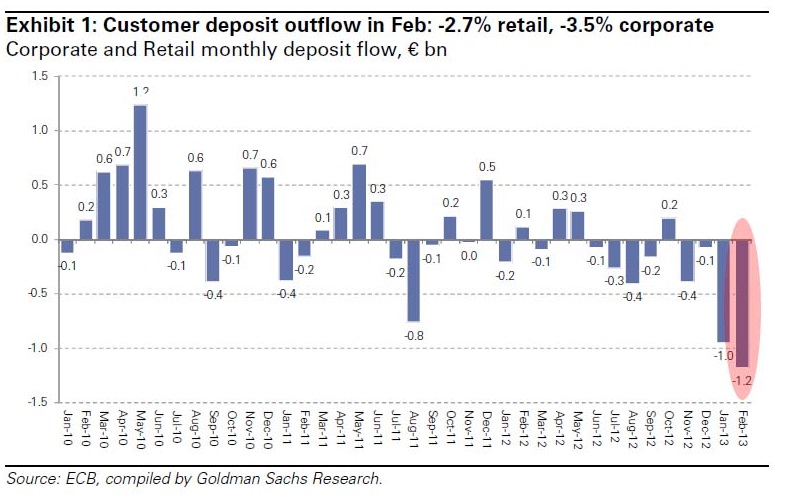
CyprusOutflows

Most people were not given advance notice; if the time comes, you and I will be in that group.

Lots of people are showing that they understand. As the stories above show, people were waiting in line for metals at these prices across the globe. We have seen this play before. Sometimes the elites smash down the prices of metals. Did I see it coming? Nope. Can they do it again? Yep. But as the rising price of gold over the last 12 years proves, they can’t push it down too far. If they do, the Asians and regular people will end up owning all of the gold. And the banksters won’t like that at all since they know the financial (per)version of the golden rule: he who has the gold makes the rules.

Lots of regular people on the planet take these price smashes as a gift. I think these people are smart.

Here is Jim Sinclair’s latest comment on the topic: The US Will Be Cyprused & We Will See $50,000 Gold.

And the recently-released video The Secret World of Gold, while not perfect, has Andrew Maguire briefly explaining how gold and silver prices are manipulated, and brings up the interesting question of whether there is any real gold (and not just gold-plated tungsten bars) at the US gold depository at Ft Knox. Channeled information agrees that Ft Knox is empty of real gold.  It will be a very interesting day when the world finds out about that.
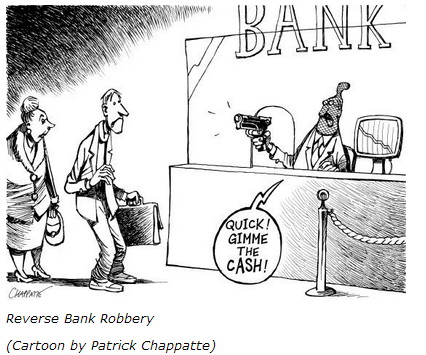
CashGrab1

What is the Transition? Part 7

In the context of the Transition, what are the detectable trends with people?

COMMUNICATION / CONNECTEDNESS: Enabled by the internet and by the radical expansion of telecommunication and video technologies, there is explosive growth in communication. Some communicate almost constantly, staying connected during nearly all waking hours. This is bringing an exponentially growing exchange of information that is making it increasingly difficult for people and organizations to hide information. Beyond the use of technology, some report finding an increasing ability to connect and communicate telepathically.

INNER WORK: People’s interest in inner work is flooding across the planet. Sure, some are searching for an inner secret to magically obtain a Maserati, and yes the world sometimes seems to be nearly-drowning in materialistic striving, but a large and growing number of people are realizing the importance of their inner life and the need to cultivate their insight in this realm.

This can be seen by the remarkable growth of people practicing meditation. Clear examples are organizations such as the Self Realization Fellowship founded by Yogananda, which has 500 centers in 54 countries. Even the Economist magazine stated that Sai Baba–whose organization is said to have centers in 166 countries–could have as many as 100 million followers. And there are thousands of other groups, large and small, teaching meditation, chanting, breathing, and other techniques for the cultivation of inner insight and being. Millions of people have been to therapy. Millions do Qi gong, yoga, or similar disciplines daily. There is explosive growth in this trend.

INSISTENCE ON KNOWLEDGE OVER BELIEF: For many, belief is no longer sufficient, they insist on going by knowledge gained from their own experience. This has resulted in a steady exodus from some of the traditional, belief-oriented religions into the inner work traditions, where experience is typically emphasized over belief. As a side-effect, this is making life more difficult for political parties, the mainstream media, and self-appointed or committee-sanctioned “experts” as people become less likely to simply believe the proclamations of an authority figure in favor of something that corresponds with their own experience.

GROUP CONSCIOUSNESS: Over the last 150 years, we’ve seen the strong emergence of people’s awareness that they belong to groups, communities that have nothing to do with the nation-states delivered to us by local geography and our history of war. Women’s movements and civil rights movements were created to secure equal rights. Labor movements began with the idea that commerce is a field where all participants can win, not just a few on the backs of the many. The environmental movement was begun by those who saw all humans as a group with the right to clean air, clean water, unpolluted land. The peace movement began with the idea that all people are in a group with the right to not be killed or maimed for the political and financial gain of small powerful cliques. Most humans see that groups can accomplish things an individual never could, spelling doom for the idea of “every man for himself.” Some spiritual traditions see all of us as one without separation, that what happens to one happens to all. All of these developments indicate an expansion of consciousness beyond the formerly limiting sense of group defined by family or nationality.

A CHANGING ATTITUDE TOWARD THE PHYSICAL SCIENCES: Most people are rightly respectful of the accomplishments of the physical sciences. But many are increasingly unsatisfied because these same sciences leave so much of life poorly explained. Even within their own fields of study, for example, biologists can’t explain photosynthesis; physicists don’t know the nature of the “dark matter” that they admit comprises at least 85% of the mass of the universe; mapping the human genome has raised at least as many questions as it answered; Western medical sciences are at a loss in the face of many diseases; and so forth. Many are transitioning themselves into intellectual and experiential research into realms which adherents of strictly physical science say do not exist because those realms cannot reliably be detected or measured using physical plane equipment. But Thomas Kuhn eloquently showed in his landmark 1962 book The Structure of Scientific Revolutions that the science of any period operates within a paradigm that excludes “non-standard” thinking despite the fact that new discoveries typically arise from what the keepers of the paradigm consider non-standard thinking. But some of these defenders of the paradigm can become almost religiously dogmatic about their worldview so that non-standard thinkers are often derided and almost invariably deprived of funds by lack of employment and grant money. This exerts a major drag on scientific progress. Thus many people seek direct experience of realms, planes of existence, that lie outside the boundaries to which the physical sciences claim life is limited.

HEALING: Unsatisfied with restricting themselves to the limitations and dangers of Western medical practices, many people are transitioning to receiving and giving energy-based healing techniques delivered physically or telepathically, and thereby enjoying the benefits of healing methods based on the presence of meridians and chakras, of direct treatment of the etheric, astral, and lower mental bodies, and so forth. For some, this path is opened by the inability of Western medicine to cure their problem, for example, rosacea, a difficulty for which conventional medicine has no solution, but which is often completely cured by acupuncture.

Strict defenders of the medical status quo go out of their way, ostensibly in the name of the alleviation of suffering, to put certain alternative practitioners out of business, even in jail, despite testimony from hundreds or even thousands that their suffering has been relieved by such an alternative. What they often say is that there have been no double-blind studies to verify the technique and therefore all reported healing can be written off to the “placebo effect.” But what does it mean that there is a placebo effect, that we even need double-blind studies? It means that people have, within themselves, the ability heal themselves with their own minds. This is not an endorsement by me that people completely forsake Western medicine and rely only on their ability to heal themselves, but simply to point out the obvious fact that the entire apparatus of double-blind studies is a testament to people’s ability to heal themselves, an absolute proof of mind over matter. So in the name of relieving suffering, some people cause more of it, a lot more of it, by hounding, persecuting, and prosecuting methods where there is ample testimony and evidence of the relief of suffering.

ALL IS ENERGY: More people are transitioning themselves to a deeper understanding of what we are told in school—everything is energy—but which many ignore, clinging to a mechanical world view where a bunch of dead billiard balls bouncing off one another somehow create an expanding multitude of galaxies inhabited by multitudes of intelligent beings. Some take this farther, seeing all life as alive, from the tiniest particle to the Sun and beyond.

SENSING ENERGIES AT DIFFERENT LOCATIONS: More people are transitioning themselves to sensing differences in energy at different locations on the planet and concluding that some places are, because of these differences, more conducive to inner work, and to the retrieval of all of their capabilities, than others.

EXPERIENCE OF MULTIPLE PLANES: Some people are transitioning themselves to experience the multiple planes of life that humans can touch, exploring both the perils and vast riches of planes other than the physical.

INTERACTION WITH NATURE INTELLIGENCES: Inspired by work at places like Findhorn and Perelandra, many report startling horticultural results when they elicit direct help from those intelligences that are the true designers and builders in nature, enabling a true working with nature rather than against it.

WHAT CAN I DO TO HELP: Some people are transitioning themselves from a “what can I get” approach to life to an approach that asks “what am I capable of, what can I bring to the table, what can I do to help?” Almost invariably these people seem to get a lot more help than people who are focused solely on “what can I get.”

* * *

There probably is no need to spend much time documenting the fact that acceleration is driving a lot of people insane. Proof can easily be obtained by watching the news or doing a “channel surf” on television. Clearly, events such as mass shootings are accelerating, as can be seen from this and this. And there have been additional shootings since those lists were published.

It’s clear that a lot of people are attempting to deal with acceleration by sedation via legal and illegal drugs and alcohol.  Here are some quotes from just one US state agency web site:

“Unintentional poisonings in North Carolina have more than tripled in the last decade, and 7 out of 10 of those poisonings are from narcotics.”

“Prescription drug abuse is the leading cause of accidental death in North Carolina.”

“National research now shows teens using marijuana more than 20 times a month (heavily) has increased 80 percent in the last three years.”

Acceleration as usual.

And in a deeply tragic insanity of our time, for exhibiting non-standard behavior, a lot of schoolchildren are being given drugs like Ritalin and drugs said to be anti-psychotic. Children are having a difficult time coping, so what do we do? We numb their minds and bodies. This sounds like tactics of a severely repressive dictatorial regime, and yet it is being brought to us by the medical industrial complex and educational system in allegedly free societies. If there is any greater evidence that the powers that be want us all to keep our heads down and just keep munching another clump of grass, I don’t know what it is. Stalin would be very intrigued.

If one takes the time to investigate almost any field of endeavor on the planet at this time—food, politics, finance, medicine, business, legal, education, media, military, fossil fuels, transportation, and so forth—it doesn’t take long before one encounters insanity. There is an upcoming post on this topic that will be called “Runaway Trains.”

In Part 8, we will explore what these current conditions and trends can be expected to yield going forward, in terms of both turbulence and benefits. In other words, we can get to predictions.

What is the Transition? Part 6

You know that thing about time accelerating? As of today, nearly one-fifth of 2013 is in the past!

The Age of Truth

If truth does set us free, then far greater freedom is on the way due to the accelerating emergence of truth. The controllers of the major systems on our planet react to both, that is, they react to the emerging truth by repeated attempts to squelch free expression on the internet and on the streets, and by well-funded propaganda and disinformation campaigns; and they combat emerging freedom by surveillance cameras (1.6 million in the UK alone!), repudiation of laws that protect individual freedom, complete tracking of people’s electronic activities, drone surveillance, and so forth. All under the rubrics of national security, public safety, copyright protection, and so forth. In the US, it appears that this is likely to get worse:

     CIA Head Sworn In On Draft Constitution WITHOUT Bill of Rights

One problem with a discussion of the emergence of truth: On this planet, at this time, when the light of truth shines, it reveals a lot of lies. Many have come to see lies as standard operating procedure, so lies are accelerating in their frequency and boldness. This is a problem for two reasons: lies generally have consequences, victims, that is, they often do damage; and much that goes on in our world is based on trust, for example, when you buy something, you trust that it will work as advertised, and the vendor who sells it to you trusts that your form of payment has value. What is the general consequence of an increasing breakdown in trust resulting from increased lying?

Some lies are easy—once they are exposed. Horsemeat being sold as beef all over Europe comes to mind. Though this fish thing will be tougher to sort out:

     New Study Shows 59% of “Tuna” Sold in the U.S. Isn’t Tuna

Other lies are more tricky because either there is a powerful constituency that supports the lie, or most people want it to be true even if it isn’t, or both. That is the category of lie described in the first major post on this site, The financial system is based on twelve promises that are lies, which described the lies at the foundation of what is called our financial system; and how the recognition of just one of those lies—the lie that real estate prices always goes up—came within hours of dissolving the world’s current financial system.

Governments lie so often now that more and more people assume that anything the government bothers to comment about in public is a lie. It would help their case if they weren’t so obvious, though sometimes one has to do at least the amount of digging that would be required on a standard reading comprehension test to uncover them.

There is a great example of a “policy lie,” and likely the often-associated “lying to keep one’s job,” at this link. It’s of interest here because we used the government’s own database to show the truth of this topic in Part 1. The post reports on a US Geological Survey study that says more people will die from earthquakes during this century than the last. But it is known from repeated examples that it is USGS policy to say that earthquakes are not increasing. So the article dutifully states that it isn’t because earthquakes are increasing that more people will die, but rather because of increasing population density in seismically vulnerable buildings. But the article blows its own policy case. They state that there were seven catastrophic earthquakes in the Twentieth Century, so that’s one every fourteen years. And then they state, and I quote: “Four catastrophic earthquakes have already struck since the beginning of the 21st century.” So that’s one every three years! So the “population density in vulnerable buildings” took a threefold leap right around the year 2000?! Nice try. This is science by policy–and keeping one’s salary or grant money flowing–rather than science by data. Such “science” is unfortunately all too common in our world.

So why does the USGS have a policy that can be easily shown to be a lie using their own database? For one, I’m sure they are correct in thinking that most people are not going to actually go look at the data, so they can say what they want about it and most people will believe it: “It’s from the government. It’s from a scientist. It must be true. What’s on TV?” For another, governments seem to think that keeping people calm is a high priority. Perhaps they correctly believe that they get to stay in power longer when the people are calm. But as each of their lies is uncovered, what they derided as “conspiracy theory” becomes conspiracy fact and they have an accelerating loss of credibility.

The same applies to billionaires. If you see or hear about them saying an investment is bad or good, assume that they are talking their book.  In other words, if they say in public that some investment is fabulous, it means that they own a boatload of it and now want to get rid of it, selling it to anyone who will listen.  And if they deride an investment, they are trying to knock down its price so they can buy more of it cheaper. George Soros was caught doing this with respect to gold twice in just over a year.  Twice he made somewhat nebulous but definitely negative public comments about gold. In both cases, in the quarter following his comment, his hedge fund strongly increased their position in gold as its dollar price fell. These purchases are only revealed well after the fact, so they can’t be uncovered in real time. But if a billionaire bothers to hit the airwaves with investment commentary, assume that they are talking their book. One exception to this idea is Jim Rogers, but he is unusual.

Over the last six weeks, we found out more about the world’s Too Big to Jail treatment of banker crime. In the US, first the Assistant Attorney General said right on TV that he didn’t prosecute the big banks because he worried about the economic fallout:

     Assistant Attorney General Admits On TV That In The US Justice Does Not Apply To The Banks

And then the Attorney General himself, Eric “Place” Holder, admitted the same in testimony before the US Congress:

     Eric Holder: Some Banks Are So Large That It Is Difficult For Us To Prosecute Them

Holder: But I am concerned that the size of some of these institutions becomes so large that it does become difficult for us to prosecute them when we are hit with indications that if you do prosecute, if you do bring a criminal charge, it will have a negative impact on the national economy, perhaps even the world economy. And I think that is a function of the fact that some of these institutions have become too large.

So, big money gets a free pass from what is supposed to be the Department of Justice.

There are entire industries that live by lies:

The tobacco industry is famous for it.

The nuclear power industry, creators of vast quantities of waste that will be deadly toxic for thousands of years, has in recent years been trying to characterize itself as “green”! And there were people who are supposedly environmentalists who fell for it. It took the catastrophe at Fukushima to take at least some of the wind out of their sails.

And the oil industry is a barrel of laughs along these lines. Let’s take the case of alcohol fuel, aka ethanol. Everyone in the US now “knows”–because it was covered this way by both the liberal and the conservative press, so people think it must be true—that it takes more energy to produce ethanol than one can get from the end product. And it drives up the price of food for everyone. And it wrecks engines. So ethanol is bad.

Would it surprise you to find out that all of that “information” is vigorously and continuously disseminated by the American Petroleum Institute in a well-financed campaign to malign ethanol? That it is based on a series of studies by a single person, Cornell Professor David Pimentel (more “science”!) who is the only investigator who claims that ethanol has a negative return on energy invested and whose faulty calculations are strongly at odds with other investigators? That Brazil’s conversion from gasoline to ethanol turned the country from a struggling importer of expensive energy to a net exporter of same? That the oiligarchy regime of Bush and Cheney implemented the ethanol program in a way that was sure to make ethanol look bad? That Henry Ford wanted all cars and trucks to be powered by ethanol, not gasoline, but that a ruthless campaign by John D. Rockefeller made that impossible? Including the fact that Rockefeller funded groups who created Prohibition of alcohol as a drink in the US not because he was against people drinking alcohol but because he wanted to bankrupt the major alcohol distillers in the US (he succeeded) so he could supply oil as the transport fuel of choice? That there are farmers across the globe who distill their own ethanol on their farm and successfully run all of their machinery with it? That alcohol is clean-burning, creating no particulate pollution? So again now, what is it that we “know” about ethanol and how inferior it is to petroleum fuel? Have the engines in all of the cars in Brazil been destroyed because they are burning ethanol? It turns out that, using permaculture, it is possible to become energy independent without driving up the cost of food for anyone. In the late 1970s, PBS funded a nine-part series by David Blume on precisely how to do that. They broadcast the first two episodes. All of their oil company donors said that if they continued airing the series, those oil companies would pull all funding forever. PBS folded under the pressure, even to the point of destroying all copies of the tapes, none of which exist today.

In real estate, it’s always a good time to buy. (I was planning to do a post with that as the title, but I don’t have to, Jim Quinn of the Burning Platform did that, and he did an outstanding job):

     IT’S ALWAYS THE BEST TIME TO BUY

If prices are rising, it is claimed that they will always rise forever. If prices are falling, then they said to be a great bargain.  Some blogs refuse to report the exaggerations that are alleged to be statistical reports from the US National Association of Realtors. At the end of every year, the NAR quietly revises the data it reported for the past year. For several years running, they have “adjusted” the number of existing home sales down by around 800,000 per year. So they report big, increasing, “better than expected” numbers all year, only to quietly admit the truth after each year is done. (The use of “better than expected” when reporting dismal statistics in news headlines deserves a post of its own, but let’s agree to pass on that.) You’ve probably all seen the monthly headlines generated by the NAR. But have you ever seen a headline about the NAR annual revisions? Certainly not in the mainstream media.

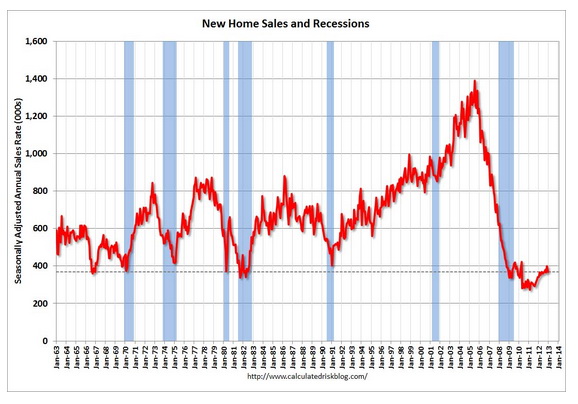
When you see some headline like “Highest New Home Sales in Three Years,” just remember this next chart. Yes, the highest level in three years. But this is a market trying to lift its face out of the mud:

NewHomeSales

Here is Jim Quinn’s comment on that chart:

The media, NAHB, and certain bloggers look at this chart and declare that new home sales are up 20% from 2011 levels. Sounds awesome. I look at this chart and note that 2011 was the lowest number of new home sales in U.S. history. I look at this chart and note that new home sales are 75% below the peak in 2005. I look at this chart and note that new home sales are lower today than at the bottom of every recession over the last fifty years. I look at this chart and note that new home sales are lower today than they were in 1963, when the population of the United States was a mere 189 million, 40% less than today’s population. Do you see any signs of a strong housing recovery in this chart?

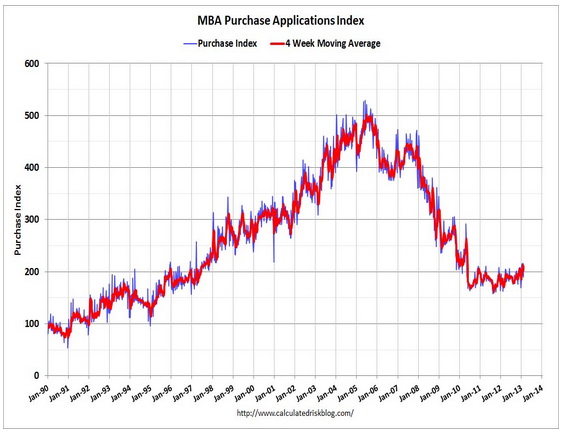
OK, when one includes existing homes sales, the picture is a little better, here’s the chart of mortgage applications for purchase of a home in the US:

MortgageAppsToBuy

So that’s back to 1997 levels. But Jim Quinn correctly notes this:

JP Morgan, Blackrock, Citi, Bank of America, and dozens of other private equity firms have partnered with Fannie Mae and Freddie Mac, using free money provided by Ben Bernanke, to create investment funds to buy up millions of distressed properties and convert them into rental properties, further reducing the inventory of homes for sale and driving prices higher. Only the connected crony capitalists on Wall Street are getting a piece of this action.

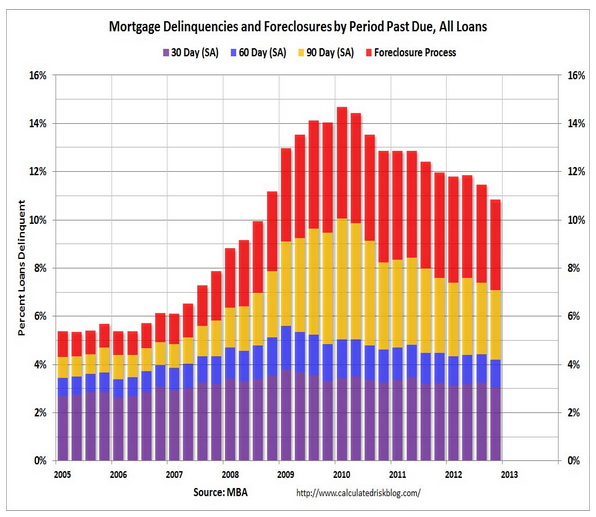
So what just happened? Through a well-orchestrated bubble followed by a continuing foreclosure fest, shown here:

Foreclosures

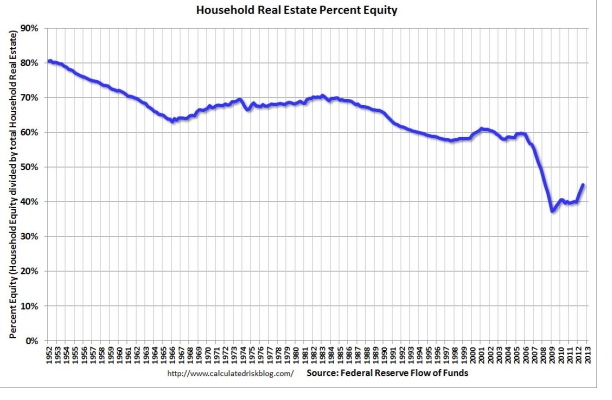
residential real estate ownership in the US is being transferred from Main St to Wall St., facilitated by free money from the US Federal Reserve. Here’s the ownership percentage of regular people in the housing stock in the US:

housholdrealestateequity

So that number has dropped from 80% to 43%. How does that trend look to you? Do you think all of this government real estate assistance, said to be for the benefit of regular people, is for regular people or for Wall St? And this is the system that most people hope remains intact.

And speaking of free money from the Federal Reserve, and indeed, all central banks, the next time you see meek and mild Ben Bernanke on TV telling you he’s doing it all for you, remember who gets free money from him and who does not. The big banks get free money. You and I do not. But, if you are a citizen of the US, you might think, well at least he’s giving money to American banks. But that’s less than half true. Much of Ben’s “quantitative easing” (i.e., the fashionable cover term for money printing) has gone directly into the coffers of European banks via their American branches. Why? The US Federal Reserve is a private corporation among whose major shareholders are large European banking families. And the European banks have a lot of bad loans and their depositors are wising up and withdrawing their deposits:

     Euro-Land Banks In Trouble

A recent study by Ernst & Young has revealed that euro-land banks in the aggregate now hold € 918 billion (US $1.23 trillion) in non-performing loans…

Of course we’ve all heard from the European politicians that everything has been fixed in Europe, though even a cursory look shows that to be a lie.

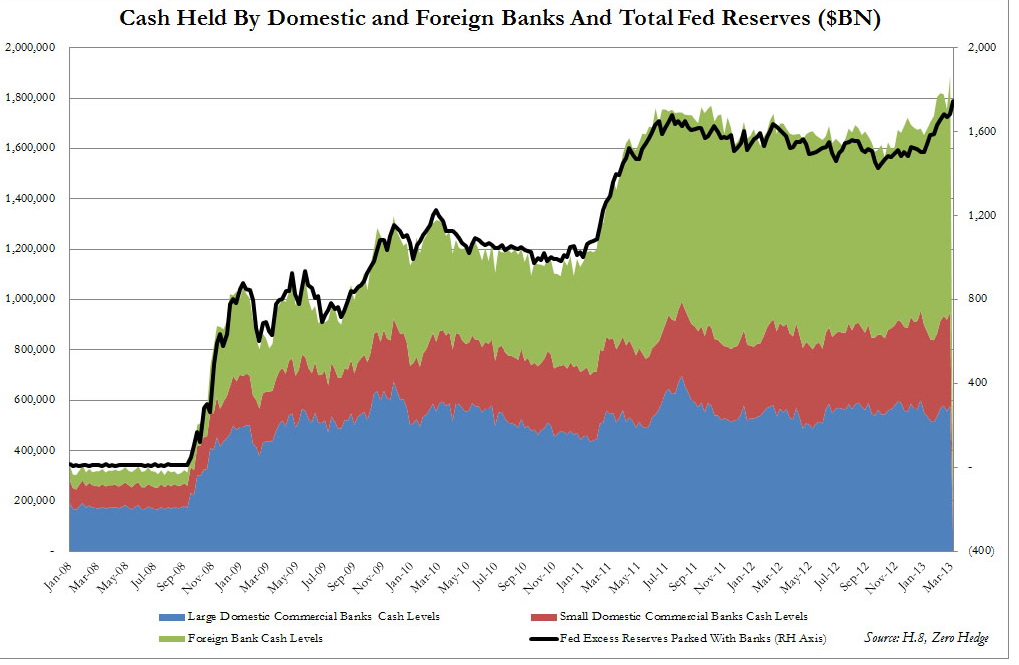
So Ben Bernanke is printing up US Dollars to bail out European banks. He testified to Congress in 2011 that he was not and would not bail out European banks. But those who track the Fed’s money printing have demonstrated that what was called QE2 (Quantitative Easing 2) did not show up on the balance sheet of US banks, it showed up on the balance sheets of the American branches of large European banks, and this has continued. The benefit to the European banks is shown here in green, correlated with the amount of money printing the Fed has done shown as the black line:

EuropeanBankCashFeed

That chart is from:

     Fed Injects Record $100 Billion Cash Into Foreign Banks Operating In The US In Past Week

And speaking of lying, there is a law against what the Federal Reserve is doing. The law says the Fed can’t buy Treasury Bonds directly from the US Treasury. There’s a reason for this: when the Fed prints up new money to buy US Treasury bonds, which is the borrowing of the Government of the US, it’s called “monetizing the debt,” a clear Ponzi scheme where one hand borrows and the other hand prints to enable the borrowing. There’s a law against this because many countries have gone down the tubes once they traveled that road of money printing. Their currency value ultimately went to zero. So what does the Fed do to circumvent the law? They have one of the big NY banks buy the Bonds from the Treasury and then they buy the Bonds from the big NY bank three days later. So the Fed circumvents the law and NY banks get nice commissions and the US Congress gets more free money.  And your income and savings are worth less and less.

     Fed Buys Back 30 Year Bond Auctioned Off Last Thursday

And the politicians and economists who support money printing claim they are Keynesians, that is, that they follow the principles of economist John Maynard Keynes. But they cherry-pick Keynes work, only using that which supports what they want to do anyway, ignoring the rest. Here is a quote from Keynes:

By a continuing process of inflation, governments can confiscate, secretly and unobserved, an important part of the wealth of their citizens. By this method they not only confiscate, but they confiscate arbitrarily; and, while the process impoverishes many, it actually enriches some. … Those to whom the system brings windfalls… become “profiteers” who are the object of the hatred…. the process of wealth-getting degenerates into a gamble and a lottery.

Lenin was certainly right. There is no subtler, no surer means of overturning the existing basis of society than to debauch the currency. The process engages all the hidden forces of economic law on the side of destruction, and does it in a manner which not one man in a million is able to diagnose.

Does that sound like someone who thought money printing was a good idea? Clearly, politicians think all this underhanded dealing is justified:

     Berlusconi: “Bribes Are Necessary – They Are Not Crimes”

This section could go on for days, but let’s stop, though I would like to mention that I think it is advisable that people give consideration to those things derided by  powermongers and their minions in the press as “conspiracy theory.” Many things that the mainstream attempted to relegate to this scrap heap have turned out to be true (here’s a link to an account of 33 of them).

Just one example: Many supposed conspiracies are rejected under the heading that too many people would have to know about it and that this large number of people could never keep it secret. This whole rejection methodology was blown out of the water with the LIBOR scandal where at least dozens of traders at several major banks conspired over decades to manipulate the interest rates on which trillions of dollars of contracts are based. Testimony has been given in the US and the UK that people told the central banks of their respective countries about this manipulation as early as 2008 and the central banks did worse than nothing: The Bank of England is said to have encouraged the practice. Clearly the profit motive was enough to keep this conspiracy operating and quiet for decades. So when you hear that price fixing takes place, with or without government collusion, in fossil fuels, pharmaceuticals, stocks markets, precious metals markets, and so forth, it actually appears to be irrational now to think that price fixing is not taking place. When there is big money to be made, there is big price manipulation in play. All this stuff about “free markets” is a thick, giant smokescreen designed by to increase the power of those who already have it but who crave even more.

However, between insider whistleblowers and great investigative researchers (typically outside the mainstream media that is primarily a compliant tool of those in power), using internet communication as a conduit, discovery and dissemination of truth is clearly on a meteoric rise.

This trend is strongly supported, in my view, by the accelerating increase in the number of people who recognize that individual inner work is beneficial and necessary. People who do the work to identify and become independent of lies they once blindly accepted as true, who continue working to understand the ways in which they fall for illusion, become acceleratingly tough to trick! We will take a look at this and other fabulous developments in Part 7.

What is the Transition? Part 5

ACCELERATION

People’s Perception of Time

Everyone whom I have asked, including young people, feels like time is speeding up, like the day, the week, the year starts, and “before you know it,”, it’s gone. People feel like they have little time to carry out their plans. I would guess that this not universal, but perhaps it is.

Technology

And everyone, or certainly close to it, is aware of Moore’s Law, that the number of transistors that can fit on a chip doubles every two years. And Intel’s David House added that processor performance would double every 18 months. This acceleration in performance, and the fact that the price for that performance has steadily dropped, has changed the world in magnificent ways that have been difficult to envision at any point in time. People like Ray Kurzweil are famous for utilizing this increasing performance and for having made some prescient estimates of the impact of this exponential increase in price/performance, though some of his predictions have been wide of the mark, and it seems his general view that processors will outdistance human intelligence is destined to fail as well since a pathway to program a machine to have a higher self, intuition, noble emotions, will, self-awareness, and a sense of humor seems unavailable, to put it mildly.

Exponential, parabolic trends

As we did with the weather and Earth changes, let’s look at some data.

Money

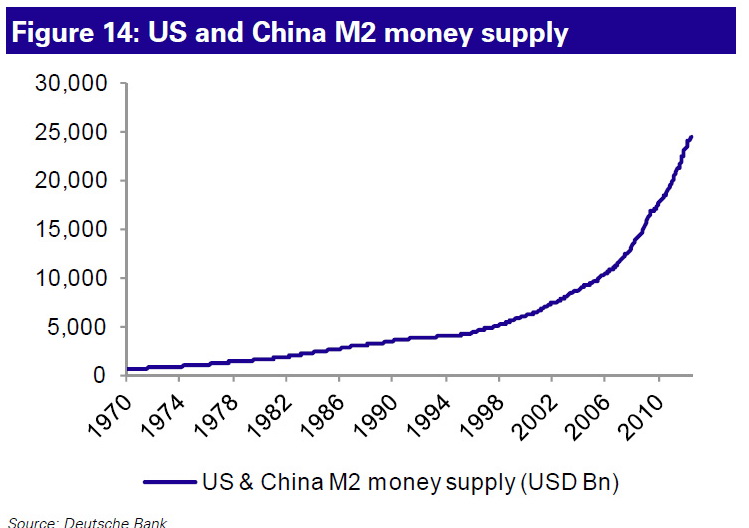
It took the USA until 1990, that is, over 200 years, to create the first trillion US dollars.  The rate of money growth had increased so much by 2007 that it took less than a year to create each additional trillion.  Now, it’s seemingly all in day’s (OK, maybe a month’s) work. Here’s a chart of the money supply in the US and China combined:

USChinaMoneySupply

Yep, between the US and China, that’s $25 trillion floating around.

Another way to look at things is this: From 1971 to 2007, the world economy grew fourfold. Over the same period, the amount of money floating around increased forty-fold. And central banks were just leaving the proverbial starting gate in 2007; the continuing financial crisis had just begun, and the response was, and continues to be: Print Money!

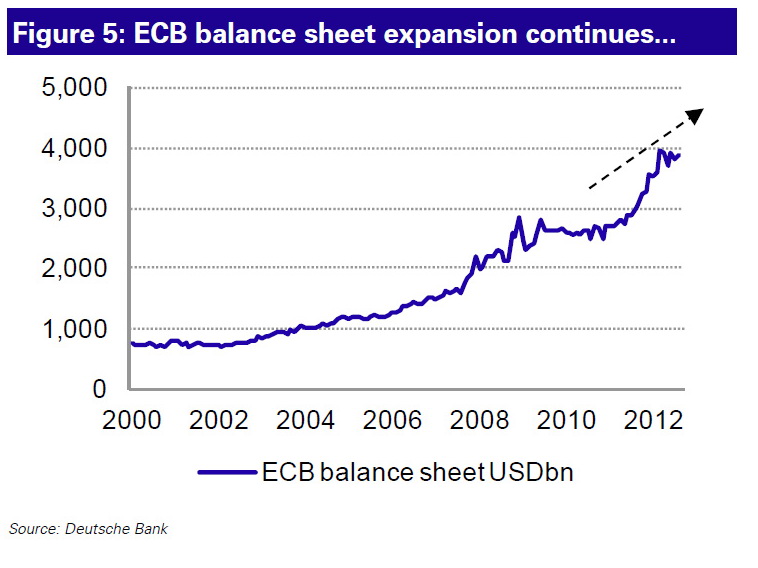
And don’t think the Europeans want the euro to be left out of this print-a-thon:

ECB_BS

And the Japanese just joined the US and the Eurozone saying they would print “whatever it takes” to get their economy humming again.

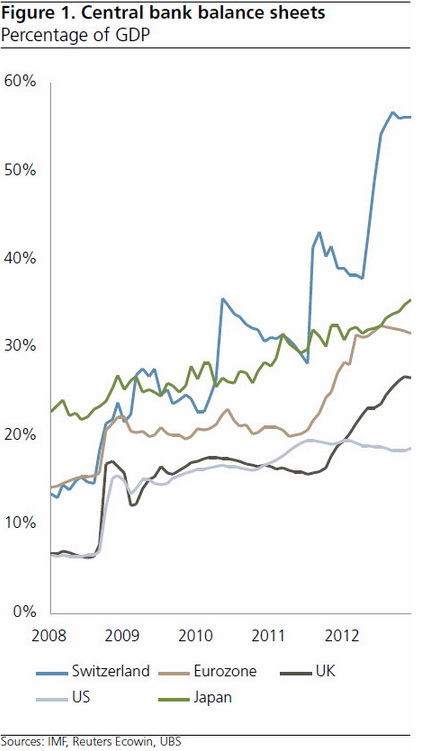
And the Swiss!?!? The most pronounced money printing line on this chart (in light blue) represents Switzerland, purported to be so conservative about money. Ah, the good old days! No longer. For the size of their economy, they are the current money-printing front-runner by a wide margin:

CentralBankBalanceSheets

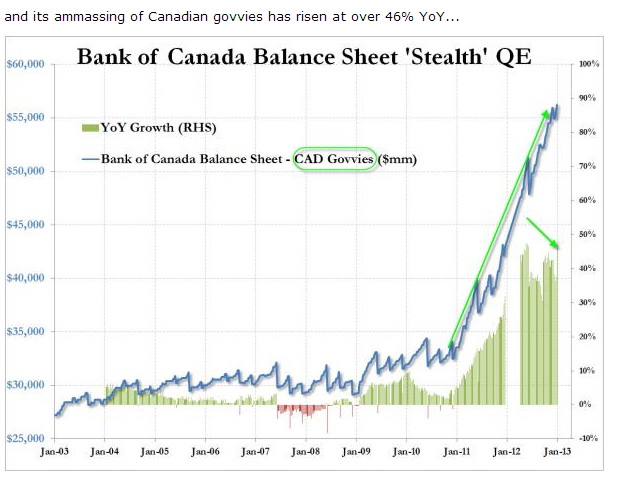
Et tu, Canada? (from zerohedge.com)

CanadaPrinting

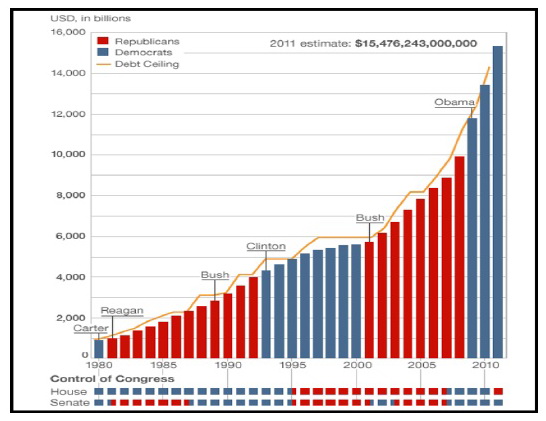
And this has little to do with political parties, as shown on this chart of federal government debt in the US:

USDebt_DemsRepubs

though I would ask that you note the super-acceleration of this trend that started in the year 2000.

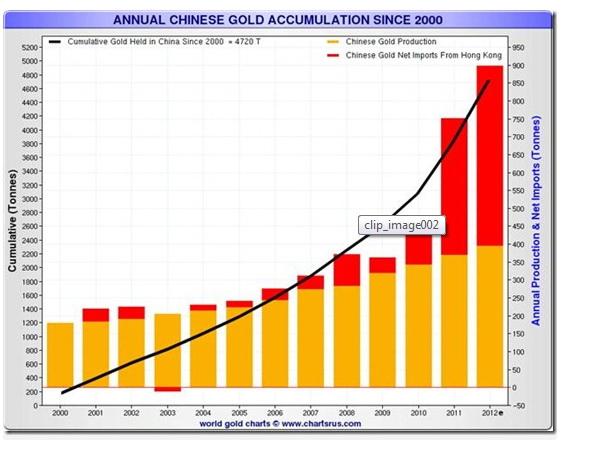
And in today’s world, the Chinese are the ones doing the heavy lifting in terms of manufacturing, so they are collecting a lot of this printed paper money, in other words, the West prints paper, sends it to China, and gets real goods in return. But the Chinese aren’t stupid, they are well aware of how much more of this paper is being created. So what’s their solution? To get real:

ChineseGoldAccum

The Chinese mine more gold than any other country now—none of which leaves the country–and they import even more physical gold from other countries. Insiders at the London Bullion Market Association, the leading venue in the world for trading physical gold, say that the Chinese are vacuuming out the London gold warehouses. And the Chinese are scouring the planet to buy mines, wells, and so forth, especially in Africa

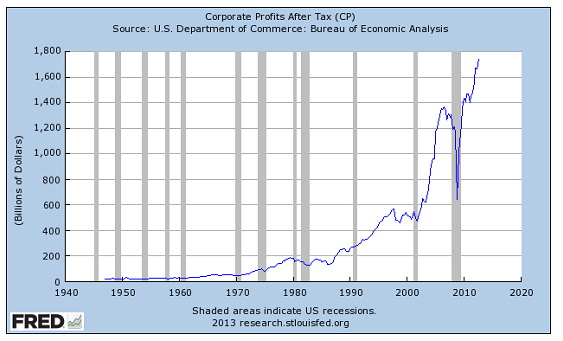
But really, one would think that, with all this money floating around—there must be at least 200 times the money around now versus 1971–everyone must be rich! But we know that’s hardly the case. Sure, there are other parabolic charts, like the one for corporate profits:

CorporateAfterTaxProfits

The corporations seem to be doing quite well. And US banks had profits of $35 billion in the fourth quarter of 2012 alone. (Yes, the same banks that needed those big bailouts. As a group, they had a total of four quarters where they weren’t profitable. It’s been business as usual ever since. And they are hard at work telling legislators, as they bribe them, that any new regulations will seriously hurt their business.)

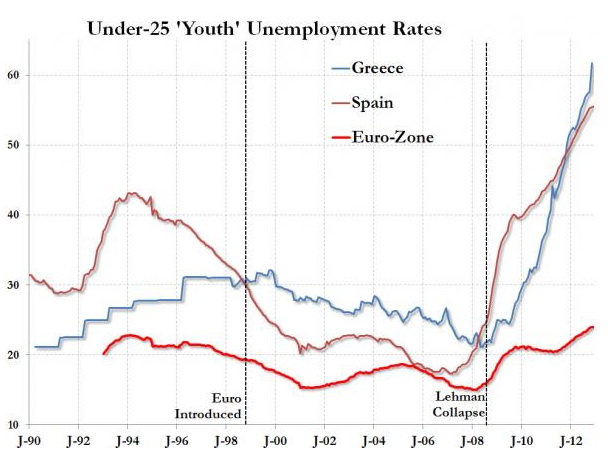
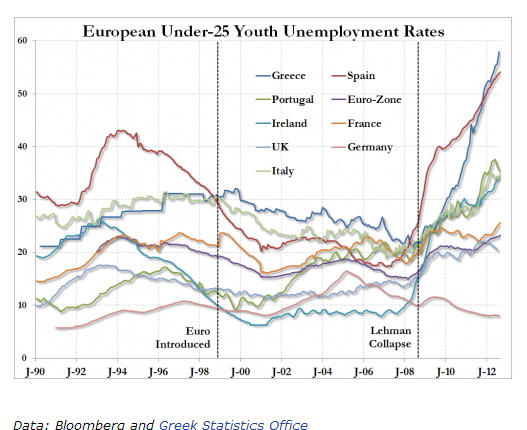
But other parabolic charts tell a different story. Here’s one for youth unemployment in the Eurozone (from zerohedge.com):


GreekYouthUnemployment

Yes, that’s over 60% youth unemployment in Greece, with Spain right behind.

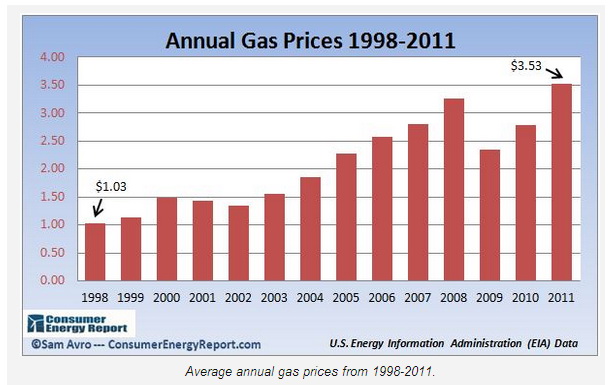
And gasoline prices are “doing great”—for the oil companies, that is. Here’s the price chart for the US, with gas up 243% since 1998:

GasPrices

That chart is only through 2011, but since US gas prices just registered their highest ever price for a February here in 2013, this trend does not seem to be in jeopardy.

And the Food Price Index of the UN Food and Agriculture Organization is up 132% since the year 2000, with the all-important cereals/grains index up 190%. This is putting an extreme and accelerating squeeze on the budgets of the poor around the world.

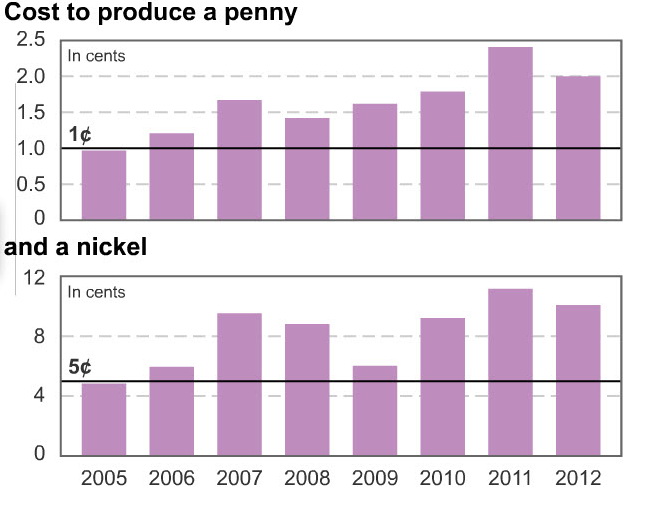
This article contains the chart below showing that in 2005, it cost the US government one penny to mint a penny and one nickel to mint a nickel. Now, after all that money printing, it costs twice as much:

PennyAndNickel

resulting in a loss of $436 million for the Government of the US (GUS) to mint pennies and nickels since 2006.

So it seems clear that the accelerating money printing is accelerating the cost of real things that people need: gasoline, food, the metals that go into manufactured products, and so forth.

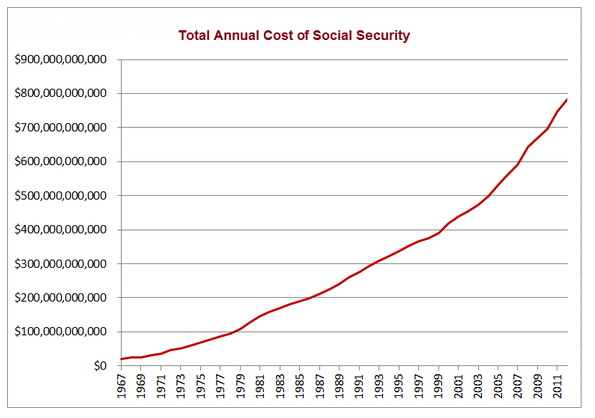
Here’s the accelerating cost of Social Security in the US:

SSA_TotalCost

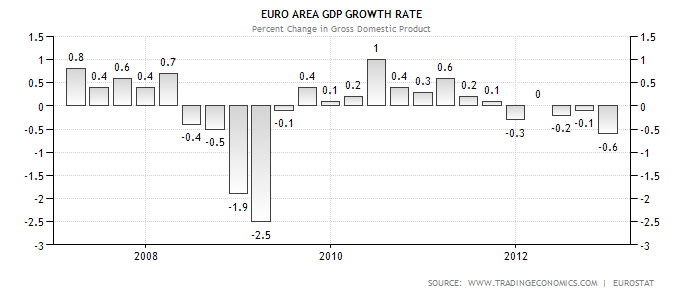
Well, we saw the accelerating youth unemployment in the Eurozone above. And the EU just announced that its overall unemployment rate is 12%. And, as this chart shows, there hasn’t been any growth in the EU economy since late 2011 (chart source):

EU_GDP

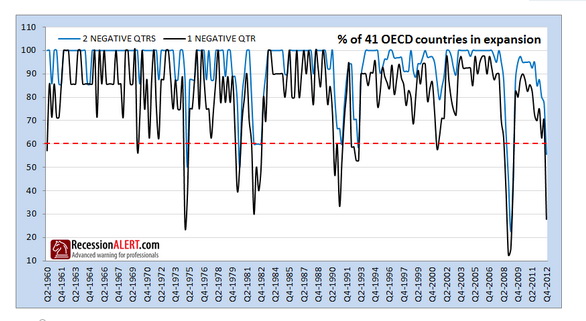
In the US, GUS says the economy hit stall speed (0% “growth”) in the Fourth Quarter 2012. Here is a chart that shows that, of the 41 largest national economies in the world, only 18% of them expanded in the Fourth Quarter of 2012:

OECD_Expanders

Astute chart readers will notice that such a reading corresponds with the worst recessions (1973-74, 1981-82, and 2008-2009) of the last 50 years, so now you know why the central banks have started printing even more money–yes, accelerating!

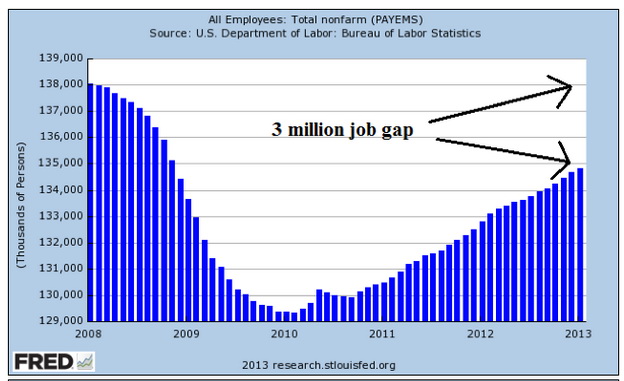
How is it going for jobs in the US? As this chart shows,  the US is still 3 million jobs short of where things were in 2008:

JobsUS

Even worse, as the next chart shows, the large increase in the number of people working part-time means that a lot of the apparent job gains shown on the previous chart are part-time rather than full-time jobs:

PartTimeUS

If you think it’s only uneducated people who are suffering from all this, check this:

     Number Of PhD Recipients Using Food Stamps Surged During Recession

The number of PhD recipients on food stamps and other forms of welfare more than tripled between 2007 and 2010 to 33,655, according to an Urban Institute analysis cited by the Chronicle of Higher Education. The number of master’s degree holders on food stamps and other forms of welfare nearly tripled during that same time period to 293,029, according to the same analysis.

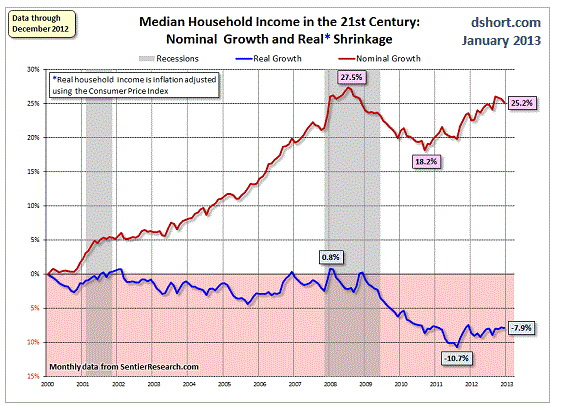
These job difficulties are reflected in household income in the US. The following chart shows two problems. While the red line shows income growth since 2000, it is still lower than it was at the start of the financial collapse in 2007. And the blue line shows household income adjusted for inflation. When GUS-calculated inflation is taken into account, income for the average household is 8% lower than it was 13 years ago:

RealIncome

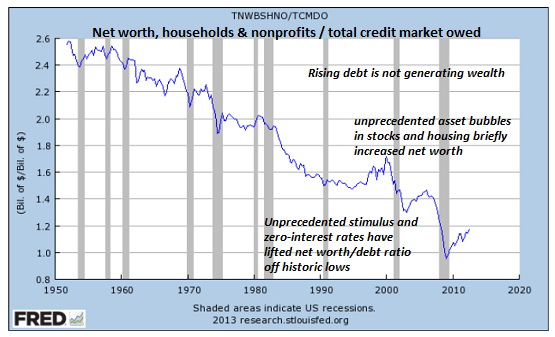
Here is a chart of US household net worth (annotated by Of Two Minds) compared to all of the debt that has been created, showing that all of that debt is not making people richer:

NetWorthbyDebt

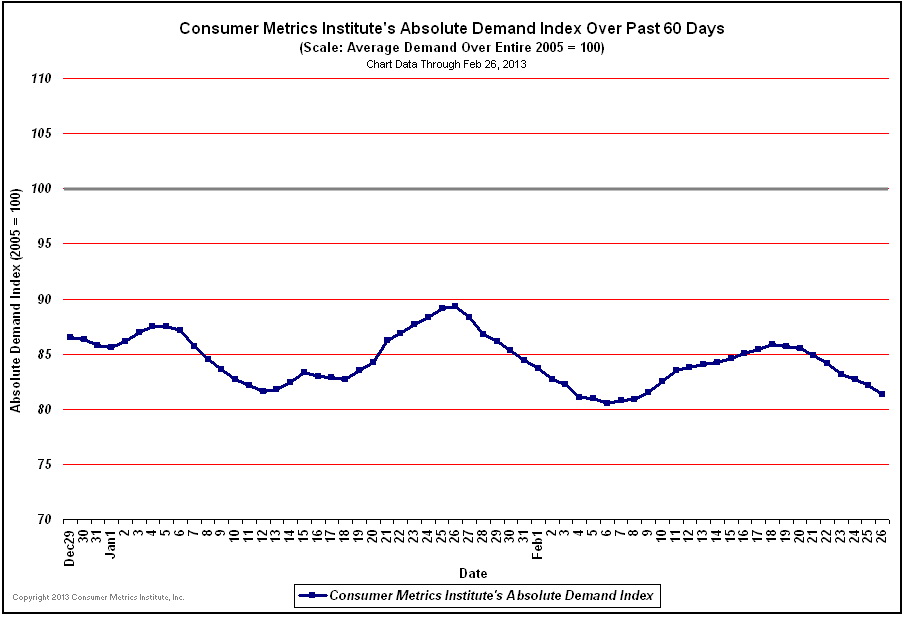
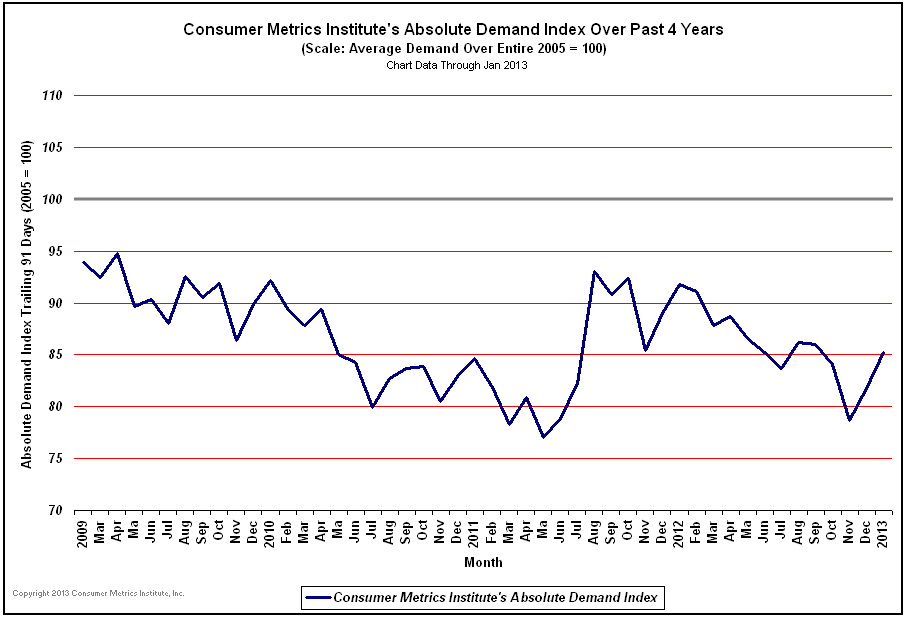
All of these economic charts were compiled by governments who, as we’ll show in a future post on the acceleration in lying, have a strong vested interest (it’s literally and even proudly called MOPE by academics—Management of Perception Economics) in making things look better than they are. In that light, I ask that you consider the following two charts compiled by a private bunch of computer geek types at a place called Consumer Metrics Institute. They thought, in this time of highly-networked business, that it was silly to have to wait until governments spent months collecting data before telling us what happened some months back, that the data could be collected and reported in near-real-time. If you wish, you can find out what they do at their FAQ.

But what they essentially do is track, in real time, discretionary purchases for things like automobiles, housing, vacations, durable household goods and investments.

These two charts show the trend in these purchases where a value of 100 would equal the same level of purchasing as was taking place in 2005. The first chart is the last 60 days:

CMIRecent

And the second chart is of the last three years:

CMILong

So, both charts show their index hovering around 85 or lower, which means that this large portion of the US consumer economy is 15% smaller than it was in 2005! Perhaps that aligns better with the income and net worth charts shown above rather than the rosy “we’re in a wonderful economic recovery” MOPE spewed by minions of The Powers That Be.

So what it looks like is that all that money printing is making a select few richer and, by driving up the prices of real goods, squeezing regular people—whose income is falling and who spend a far greater percent of their income on real goods. And the Western central banks say it isn’t their fault that people are rioting in countries where people’s costs for food have gone from 40% to 80% of their income. Nope, they aren’t driving prices up at all with their money printing, it’s those “evil speculators.” Well, perhaps it is evil speculators, but they are aided and abetted by a vast surplus of gambling chips supplied by the central banks.

There’s more to come. Stay tuned for Part 6.

Gold Goes Mainstream

Gross: Stock and bond managers today must be alchemists: turn lead into gold. NOT likely. Too much lead (bubbled assets).
–Tweet from Bill Gross, Founder of PIMCO, which manages $1.8 trillion

**************

“Do you own gold?” “Oh yeah. I do…There’s no sensible reason not to have some.”
–Ray Dalio to the Council on Foreign Relations

This is being written to put the precious metals market in a larger context for those people who still see the world proceeding much as it has proceeded in the past, a world without the large financial and supply chain disruptions that we foresee.

Strong multi-year upmoves in the price of any asset, aka a secular bull market in that asset, go through three stages:

  1. The speculative, early-proponent phase during which the mainstream investment community ignores or derides the potential of that asset.
  2. The mainstream phase, where the mainstream decides that exposure to that asset is a good idea for just about everyone.
  3. The mania phase, where just about everyone feels that they must own that asset and will tell you so when you meet them by chance in the supermarket.

Phase 1 for gold has been marked by derision from the mainstream investment community. Quoting Keynes, they call gold the “barbarous relic.” Otherwise-intelligent economic commentators such as Nouriel Roubini have been calling for a price top in gold for several years. Some who are old enough to have experienced the gold bull market of the 1970s have been saying, “We heard all this before in the 1970s, anyone who buys gold now will regret it later.” All of these people have been wrong all along as gold and silver have powered higher in price.

During most of Phase 1, the major central banks of the world have been sellers of gold, preferring to buy government bonds of various countries (such as Greece and Spain!) to “get a return” on their money. Gold has been a far better investment for the last 12 years. Over the last three years, central banks have become net buyers of gold, to the tune of hundreds of tons per year. Most but not all of this buying has come from Asia as the western central banks have been preoccupied with printing money in a mad scramble to keep their markets afloat.

Gold has been in Phase 1 since 2001. Most in the financial community regard it as an annoyance when their clients ask about it. The price increased from $256 in 2001 to $1,911 in August, 2011.

A couple of weeks ago, Ray Dalio gave a presentation to the CFR. He was asked if he owned gold, and he said, “Oh yeah. I do.” This marked the start of Phase 2, the mainstream phase.

Who is Ray Dalio? Most people in the investment community respect him as the best active hedge fund manager on the planet. We mentioned his firm, Bridgewater Associates, in a previous post. They manage about $140 billion. Ray is highly respected in both financial and political circles.

And the CFR is the Council on Foreign Relations. If you had to pick one organization that has the most influence on the mainstream political thought in the US, it would have to be the CFR. It was founded by the Rockefellers. You have to apply for membership. There are currently 4,700 members, including Bill Clinton, Robert Zoellick, Janet Yellen, Paul Wolfowitz, Lloyd Blankfein, Jamie Dimon…in other words, the CFR is the public face of The Powers That Be/Were.

Now that all of these mainstream movers and shakers have heard from what some consider the smartest money man on the planet that owning gold is a good idea, well, if we haven’t yet convinced you to get rid of a mainstream financial advisor such as a broker, said broker is likely to be calling you in the not-too-distant future with their “innovative” idea that you should get some gold. Of course, being mainstream, they will likely advise you to own it in paper rather than physical form, which will be a big mistake, but that will be their advice. And they will advise that you put a maximum of 5% of your assets into gold or gold mining stocks. In normal times, this would characterize the mainstream phase for gold, during which its price would rise steadily for years.

More evidence that we’ve entered the mainstream phase comes from Bill Gross, known to many as the “Bond King.” Gross founded PIMCO, which manages over $1.8 trillion. Yes, that’s trillion with a T. Almost all of the money is in conservative bond funds. But here’s a tweet this week from Gross:

Gross: Stock and bond managers today must be alchemists: turn lead into gold. NOT likely. Too much lead (bubbled assets).

Note that Gross, the Bond King, is saying that stocks and bonds are bubble markets. That money managers should turn that lead into gold. Though he also says that’s not likely.
Those who hate gold claim gold is in a bubble. Great examples of bubble markets are internet stocks in 1998 through early 2000; or real estate running up to 2006; or government bonds now. Gold, on the other hand, has had a nice steady rise for years, nothing meteoric or bubble-like at all. And here is someone, Bill Gross, who may know more about bonds than anyone on the planet, saying that bonds and stocks are the bubble, not gold.

Gold can’t possibly enter a bubble until it enters Phase 3, the mania phase. During this phase, you will be regaled on a regular basis from media sources and individuals with stories of people who got rich from gold and silver. Like the stock day traders of the year 2000, or the real estate flippers of 2006, there will be lots people trading gold on a daily basis, probably at gold trading shops like the day trading shops that were operating in 1999. People will be quitting their jobs to trade precious metals to “make their fortune.” 90% of people who talk about gold will assure you that it is the surest thing on earth to guaranteed riches. CEOs of gold mining companies will be like rock stars, getting interviewed by Charlie Rose. That’s what a bubble looks like. How many people do you know who own gold and silver?

Now, with the acceleration that is all around us, it is unlikely that we will proceed through these three phases of a secular bull market as we would in normal times. It is far more likely that gold will have a meteoric rise quite soon. But if you think that the world will proceed in a conventional manner in the years to come, we have outlined the path of the precious metals for you.

Beware the False Flag Attack

Cruisers, aircraft carriers and minesweepers from 25 nations are converging on the strategically important Strait of Hormuz in an unprecedented show of force as Israel and Iran move towards the brink of war.
The Telegraph

What do Daniel Ellsberg, Zbigniew Brzezinski, former high-level CIA officers Robert David Steele and Michael Scheuer, Seymour Hersh, and the Brookings Institution have in common? All have warned of the possibility of a false flag attack staged by the US and/or Israel to make it look like Iran has attacked and killed US citizens. This is covered in its usual excellent way by Washington’s Blog: “What I Fear The Most Is a False Flag – Something Happening Where One of Our Ships Goes Down, Or … a Plane Goes Down, And of Course It HAD To Be The Iranians, You Know, For Sure, For Certain”

A false flag attack is a war operation carried out by a government against its own people but appearing to be carried out by another group or nation; or an attack about which a government knows in advance but which it allows to freely proceed to demonstrate the evil nature of an enemy it wishes to attack.  The World Trade Center attack on 9/11 and the Japanese attack on Pearl Harbor are excellent examples of false flag attacks.  If there is anyone still left on the planet who thinks 9/11 was what the US government says it was, please see the following documentary aired recently on PBS: 9/11: Explosive Evidence — Experts Speak Out.

As the US marks its eleventh year of war in Afghanistan, where 2,000 US soldiers and far greater numbers of Afghanis and Pakistanis have died, many as “collateral damage” from unmanned drone attacks, we think it appropriate to sound the warning because we are convinced that the Powers That Be are aiming to ramp up war to a much greater level.

Why do we think that a large false flag attack is on the way?

To gain public support, large increases in war-making are typically preceded by a false flag attack that is devastating enough to be an emotional shock for in the citizenry. The shock makes people sitting ducks for war propaganda against the alleged perpetrators. People are confused by the shock and are then told precisely where to channel their rage, fear, dismay, etc.

Governments faced with insoluble financial predicaments often try big war as a way out. And many governments, including that of the USA, are in precisely such a predicament.

People and governments around the world are clearly on tenterhooks as shown by recent rioting in many countries, acrimonious borders disputes between Turkey and Syria, China and Japan, etc.

In a few days, the US will have three aircraft carrier groups in the waters off Iran.

And the war propaganda machine is in high gear, in both blatant and subtle ways. Here is a perfect example of the war propaganda machine in its more subtle form. This was the lead story on the front page in a recent USA Today: Defense cuts starting to pinch economy.

First, the idea that war helps the economy, propaganda that most of us were fed in school and which fallacy is still perpetuated by economists such as Paul Krugman, has been debunked by many. Washington’s Blog has covered this topic in great detail: Proof that War Is Bad for the Economy.

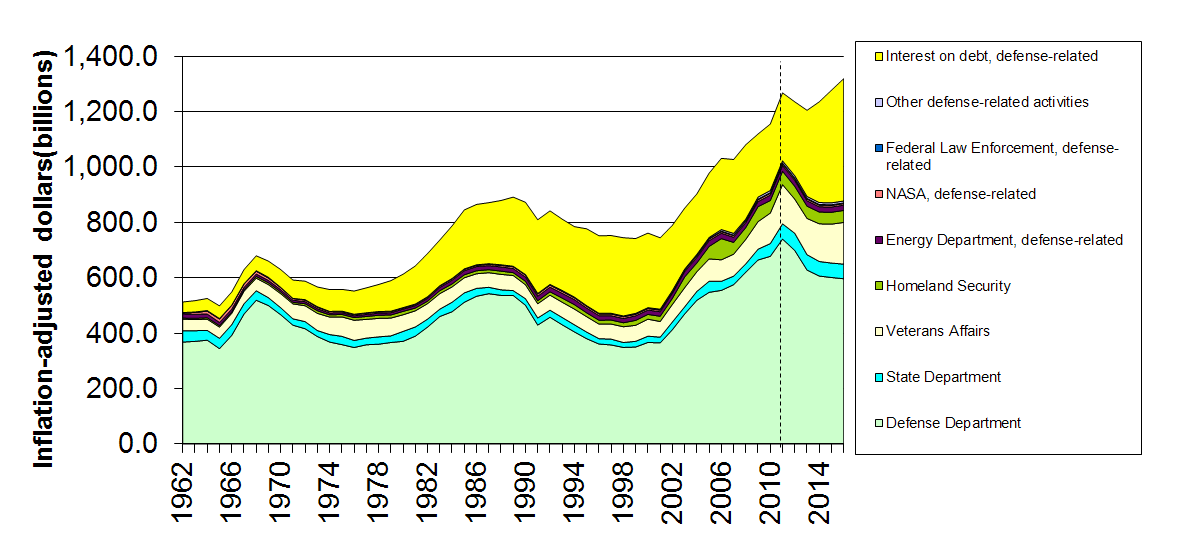
Second, while the US Department of Defense (DoD) and its military contractors claim defense spending is falling, others see it, well, otherwise.  Here’s the chart of US defense spending from wikipedia, not including black ops for which no budgets are published:

The bottom area is the budget for the DoD. Above that are other categories of defense-related expenditures that are not included in the formal DoD budget. Both the formal DoD budget and the combination of all expenditures have been rising strongly in unison, even while we have had a Nobel Peace Prize winning president. Also note that most numbers to the right of the vertical dotted line, numbers for the future, are projected to decline. But wikipedia has some honesty here. If go to detail page for this chart, you’ll see previous versions of this chart from prior years. In each of those previous charts, future expenditures were projected to drop. But they never did. When future becomes present, these expenditures always rise strongly. In other words, there are threats of defense expenditure cutbacks, but since the Clinton years, they have never materialized.

Third, whether or not war is good or bad for the economy is clearly a topic of debate. We think it is horrendous, but others claim it is good. So what USA Today is doing here is taking sides in a debate in what was printed as a Page 1 news story. This article is an editorial disguised as news. As such, it is a lie.

Fourth, how about a little common sense. The article, by linking military spending with the concept of a “good economy,” is telling you that war spending is good for you. Tell it to more than a hundred million people who died in wars in the last 100 years.

Fifth, how about some more common sense. The following countries each have one operational aircraft carrier: Russia, UK, France, India, China, and others. The US has eleven operational carriers and three more under construction. Can it really be “good for an economy” to spend trillions on hardware that is very rarely actually used, which is paraded around the world with an armada of other ships in what is called a “carrier group” devouring incredible amounts of fossil fuels, and which hardware is ultimately scrapped when it is deemed obsolete? Does the US really need eleven carrier groups?

This covers just the tiniest slice of the war propaganda machine. But you get the idea. We ask that whenever you hear a report about war, military spending, the countries that are said to be our enemies, weapons systems, or people who go off and get killed or maimed being characterized as heroes rather than as people who were duped by politicians, that you recall this little post and ask: What is really being said here? What is the real point? Who is the actual enemy?

A Quick Note on Them

We are creating a detailed future post on Them. You know, The Powers That Be/Were. It will make a strong point that those in the true ruling class on this planet have intelligence and will. And these abilities are well-honed in them. In part because that’s all they have. They are not in the least hampered in their pursuit of power by those abilities that are highly valued by the vast majority of us, namely compassion, wisdom, love, and an allegiance to peace and freedom for all. They simply don’t have these things. That is what’s so tough to understand about them. If you think these statements are incorrect, please read this article:

Poor In India Starve As Politicians Steal $14.5 Billion Of Food

If You Think You’ll Get Truth

In The financial system is based on twelve promises that are lies, we mentioned that there were a number of people who understood, well before it “went public” in 2008, that the world had a major financial crisis on the docket. Dr. Michael Burry is one of those people. He and his tactics were profiled in the book The Big Short by Michael Lewis. Burry used his insight to make a great deal of money for himself and investors in his money management funds. Once Burry made that money, he knew he had made enough, he closed his funds, and quit the money management business.

Here is what he said recently while giving the commencement speech at the UCLA school of economics, available here, with this quote starting at 14:00 into the video:

In 2010, I published an op-ed in the New York Times posing what I thought was a valid question of the Federal Reserve, Congress, and the President: I saw the crisis coming, why did not the Fed? Never did any member of Congress, any member of government for that matter, reach out to me for an open collegial discussion on what went wrong or what could be done. Rather, within two weeks, all six of my defunct funds were audited. The Congressional Financial Crisis Inquiry Commission demanded all my e-mails and the list of people with whom I had conversed going back to 2003. And a little later the FBI showed up. A million in legal and accounting costs, and thousands of hours of time wasted, all because I asked questions. It seems they would pump me at gunpoint or not at all. That Summer the Federal Reserve put out a paper that concluded that nothing in the field of economics or finance could have predicted what happened with regards to the housing bust and subsequent economic fallout. Ben Bernanke continues to backfill this logic. And I fear that history is being written wrong yet again. The ignorance is willful.

This is how it is in the world these days. Those in charge in government, large corporations, and the media which they own will not tolerate truth about what is either their incompetence or their dishonesty or both. If you think you can get truth from them about what is transpiring, guess again. Relying on their claims is high risk behavior.

What then can we do? Part 2

This is the true joy in life, the being used for a purpose recognized by yourself as a mighty one; the being thoroughly worn out before you are thrown on the scrap heap; the being a force of Nature instead of…complaining that the world will not devote itself to making you happy.
—George Bernard Shaw

In Part 1, we briefly covered how “Inner Work” and buying precious metal bullion coins could be helpful in having us glide through this transition rather than struggling through it. And remember, our point here is not to frighten, but to offer ways for readers to calmly and persistently prepare for the inevitable problems that will arise from the collapse of the financial system.

In this Part 2, we will deal with “Outer Work” topics related to serious impairments of the global supply chain. Our firm expectation is that this supply chain will experience increasing turbulence and unreliability. As currently configured—though mis-configured is a better description—the supply chain is entirely dependent on the efficient functioning of the transportation fuel markets. And both it and those fuel markets depend on the proper functioning of the banking and credit systems, which will disappear when the financial system collapses.

The collapse of the financial system will not remove one bushel of corn, one apple, or one barrel of oil from the planet. The real things people need will still exist in great abundance. But the process of getting them from where they are produced to where they are needed will be disrupted, sometimes severely. Not forever. People are very clever. Supply chains will be re-established. But it will take time. And their re-establishment will not be instantaneous and smooth. And not all types of goods will be available. Some may disappear for long periods, even forever. Good riddance to some of them.

In this post, the overall recommendation is that you become far more independent of the global supply chain than most people are now. Beyond being practical and likely very beneficial from the point of view of health, this topic has philosophical dimensions. Just how dependent do you want to be on huge corporations and huge governments for your food, water, electricity, health care, etc? In our current world, most purchases are made from very large companies and at large chain stores which buy their supplies from those places on the planet where people will work for the lowest wages, where the workers have little in the way of rights, where there are few or no environmental safeguards, etc. The chain store sells these products and uses its profits to go to the centers of government power to purchase ever-increasing influence, typically with the idea of driving out competition and driving down costs to increase profits. So manufacturing is now done by the poorest, and distribution and retailing are done by the largest, limiting work and profit opportunities for everyone else, who then become more dependent for their income on government, which works on behalf of those who pay the bills of the politicians, namely the big financial institutions and the large corporations and so on—until the whole world is controlled by lumbering behemoths who operate without restraint for their own mega-profits. And nearly every transaction you have with this system is tracked and taxed, eliminating privacy and draining your financial resources to feed its insatiable appetite. And the more they know about you, the more they try to use that data to manipulate you. With every move you make away from dependence on this ever-increasing force of domination and toward local sufficiency—growing and cooking your own food, supporting farmers’ markets, buying truly local products and services, producing your own electricity and heat, living in ways that promote and deliver health rather than disease, etc.—the better off you, and those in your local community, are likely to be.

So this is not simply some survivalist approach, this is equally about transitioning life on this planet toward greater freedom for everyone. And toward sustainability versus the current trend of exponentially increasing resource consumption. So let’s get to it.

BARTER: Barter networks and barter currencies are popping up all over. These will play a vital role since it is unlikely that anyone can anticipate, let alone purchase and store, all of what they might need when the global supply chain fails.

Participating in barter networks and currencies, to understand them and to strengthen them before they are critically needed, is a service to yourself and your community. Purchasing and storing a surplus of goods that would clearly be valuable to others is one useful way to prepare for barter network participation. With some practical goods and with some precious metals coins, you will be well-prepared to participate.

And experimental participation in barter currencies is valuable preparation as well. Just as we don’t recommend keeping a substantial portion of your savings in fiat national currencies, we do not recommend placing a substantial portion of your assets in any barter currency, including the international variety such as Bitcoins. None of these currencies are backed by gold or silver, they are backed by people trusting that the currencies have value. And as we are learning from our experience with government fiat currencies, that trust can be abused by the unscrupulous and by well-intentioned but misguided players. But participating in barter currencies to a limited degree is highly recommended. They will give local communities something to fall back on when trust in national currencies dies. If that local system is well developed and well understood by many in the community, that will be a great advantage for the community. Clearly, from our recent dismal performance, humanity has a lot to understand about money, and these barter networks and currencies will play a role in helping people understand just what money is.

If there are no barter networks or barter currencies in your area, consider starting them up yourself. The barter-oriented (but also survivalist-oriented) website Alt-Market  has a map of some barter networks in the US. If you search the web for “barter networks,” there is a whole lot of info out there. If any readers are experts in this field, we would love to hear from you on this topic. And we will write about the international barter currency Bitcoins soon.

FOOD: Things have gone far enough on the planet that even one fairly large institution is recommending that its members have backup food supplies: It is a requirement of the Mormon church that each LDS household have enough food on hand for a year for each member of the household plus one other person. So if the supply chain fails, everyone head for Salt Lake City. OK, just kidding. But the Mormons are onto something here. Major cities in industrialized countries are known to have a three day supply of food in the region of the city. If re-supply is shut off, the shelves will be empty in a heartbeat. So learning to buy, store, and cycle your own food supply will be very useful. And it does take a little learning. Store what you actually eat and that has some shelf life. Cycle it in to your daily use, eating what was purchased earliest first and adding newly-purchased supplies to the tail end of your own “supply chain.” People tend to make two mistakes when they undertake this task:

  • storing food they never eat: If you don’t eat canned cheese now, you probably won’t want to eat it later.
  • failing to cycle stored food into daily use: thus the stored food goes bad and gets thrown out.

For fresh foods, learn to grow your own. For lazy gardeners who don’t want to spend their life fighting weeds, learn to do raised bed gardening. The book Cinder Block Gardens is the best we know on the topic. This book will tell you how to grow your own vegetables with relative ease even if you have a full time job. And, even if you don’t have room for a formal garden, it will tell you how to do that in your driveway or a parking lot. These raised beds will work outdoors, in a greenhouse, or under a coldframe. And if, for example, you want to grow delicious cucumbers that weight two pounds each, then you’ll need to enlist the delightful help of the nature kingdom like the people at Findhorn did. Here is the website of a current public practitioner of that art and science.

Don’t have room for raised beds? Then at least learn sprouting. Some say that many survived World War II in Europe because they knew how to do sprouting. All you need for sprouting is a window not exposed to direct sunlight, a jar, water, and some sproutable seeds. Because they store and sprout so easily, whole organic lentils are a great place to start. Sprouts are packed with nutrition and energy because they are in the phase of the life cycle of a plant where nature is doing its best to give this seed a leg up in terms of getting established as a new successful plant. So they are a great source of essential nutrients and are easy to use in salads, soups, etc.

And like telling the truth, growing food can be a revolutionary act at this time. Most who grow their own food quickly migrate toward organic ways, where one takes care of the billions of critters in the soil, and the soil and sun take care of the plants. In this method, there ensues a brilliant, intricate, delicate dance of the soil critters and the plant roots, where each communicates their needs to the others and each provide materials for the others. That is the way nature grows things. Working this way, a person is quickly overjoyed and humbled by the abundance and deliciousness that nature provides. And with debris from chemtrails and radiation from Fukushima floating around our atmosphere, growing food in greenhouses may actually become necessary, so the sooner one sets up that infrastructure, the better. Further along the path to growing the way nature does is the world of permaculture, where plants work together in what some call plant guilds. All of this is movement away from industrialized agriculture where the soil is literally de-natured, that is, if an industrial farmer wants to grow corn, they try to kill everything else in the field: weeds, insects, soil critters, etc. Then they truck in bees for pollination and are surprised when the bee colonies collapse when the corn has been sprayed with neocotinoid poisons. And genetically-modified (“GMO”) corn has a terminator gene inserted so that the seed will not propagate and the farmer must buy new seed from Monsanto if they want to grow corn again next season.

And the industrial meat food chain is even worse: the animals are fattened in feed lots where they eat these industrially raised and poisoned GMO “foods,” and stand in so much manure that they have to be pumped full of antibiotics to survive. And of course those antibiotics are ingested by those who eat the meat from these animals, helping to breed antibiotic-resistant super-bugs. Ummmm, yummy!

Seriously, if you haven’t been growing any of your own food, you are missing a lot of fun and some big, delicious treats. Favorite foods grown from heirloom seeds in great soil? Wow, such food is so much better than what you can buy in stores it’ll make your mouth spin.

And speaking of heirloom non-GMO organic seeds, obtaining more of these than you need for the current season, and storing them in a cool dry place, is a great idea if you plan to grow some food, or to perhaps offer seeds to other growers. For most of us, buying seeds is the way to go. Harvesting seeds from the plants you grow is a skill that needs to be cultivated. Seed saving is an art and science, easy for some plants, quite tricky for others. For those interested, the book Seed to Seed is the bible. Heirloom seeds for purchase are best obtained from a local organic seed producer because they are suited to local conditions, but these are not available in all areas. Seeds of Change and Seed Savers Exchange are great sources for ordering seeds on the web.

And to sum up our food discussion, we see backup supplies of food with a good shelf life as something to tide people over until they are either growing their own food or have established availability of a reliable local supply. No matter how much food one has on the shelf, if one wants or needs to feed a group of people, that food will go quickly. We need to arrive at sustainable local sources.

ELECTRICITY: Our dependence on electricity is remarkable. If the electricity grid were down for an extended period of time, the repercussions would be staggering, curtailing lighting, heating, refrigeration, connecting with people by internet and phone, pumping gasoline into our cars and trucks, having our water supplies pumped to us, using debit and credit cards, getting money from ATMs, receiving a wide range of medical and dental procedures, using a wide array of electronic devices, etc. It is reasonable to say that almost all services in the modern world depend on the ready availability of electrical power. This winter, due to an ice storm that felled trees and power lines, affluent residents of parts of the US state of Connecticut had no electricity for eight days. Many were unable to heat their homes because the operation of their furnaces depends on electricity.

Would a collapse of the financial system seriously impair the electricity grid? Given that most electrical utility companies rely on the debt markets for their operation and that a great deal of electricity generation depends on the just-in-time mining and transport of fossil fuels, particularly coal—well let’s just say that the financial system collapse could give the grid some very bad days, or weeks, or more.

So being able to create at least a little electricity when the grid is unavailable will likely turn out to be very useful. And it is doable. But it’s a classic case of easier said than done.

Homeowners with some extra cash can address this problem by purchasing a solar array and related equipment that supplies some or all of their electricity. But if you buy such a system, it is worth checking carefully whether it will supply you with electricity when the grid is down. Many grid-tied photovoltaic systems won’t. By design! (Another great help from The Powers That Be.) “To protect workers” servicing the grid, many inverters are designed to cease operation when the grid is down. If you buy a system with substantial battery backup capability, it is likely to be able to operate during an extensive grid outage. But adding battery backup adds a good deal to the cost of the system, so most forego that capability. We are very much in favor of photovoltaic systems, but buyers should make sure to fully understand what their system will and won’t do.

Winds turbines can be an outstanding addition to a photovoltaic system, though they are prohibited in many urban areas—where they don’t work all that well anyway—and subdivisions.

Microhydro is the ultimate renewable energy system, producing power whether or not the sun is shining or the wind is blowing, but very few of us live on rushing water. And in places like the US, to install a microhydro system legally (some are installed “by moonlight”) requires filing applications with the federal government that can costs tens of thousands of dollars and over five years to process. (Yes, yet another great help from TPTB. Are you getting the idea that they would like us to be entirely dependent on their gargantuan energy systems? On their financial system? On their food system? On their health care system? And on…)

Homeowners and renters can purchase backup generators. We are all in favor of these as well. But again, clearly understanding what you are buying is essential. The small gasoline generators that cost $400 to $500 at the big box stores are designed to run for no more than 200 hours, at which point most of them will fail and, not being designed to be repaired, need to be junked. Some have enough power to run your refrigerator, some do not. The ones that are meant to run well for years cost over $1,000. And there is the problem of gasoline storage. If you store 20 gallons of gasoline, how many hours will that run your generator? Not a whole lot. Storing a lot of gasoline can be cumbersome and dangerous. Again, homeowners with extra cash can install generators that power their entire house, powered by propane from a large tank. Propane lasts virtually forever, so such a setup can run for thousands of hours. But this is not a great option for renters. Renters might wish to consider a tri-fuel generator from Yamaha that is large enough to power their refrigerator (and quiet enough that you and the neighbors will consider the running generator a net plus, not a minus). Tri-fuel means it can run on gasoline, propane, or natural gas. For anyone with access to a large propane tank, here is a small quiet portable generator that should run for thousands of hours if there is a good supply of propane or natural gas. This Yamaha will power a refrigerator with ease, but it will not power appliances such as dryers. But even if you don’t have access to a large tank, propane can be stored in multiple small portable containers used to power propane barbeques.

Small-scale renewable power setups that will not run appliances with motors but which will run DC LED lights, laptops, and other small electronic gizmos are available from a company named Goal Zero. Designed for campers and campsites, Goal Zero sells portable batteries, inverters, solar panels, DC LED lights that consume very little power, etc. Such setups won’t allow you to run your full-size refrigerator, but at least you can have light and computer power at night and be able to re-charge cell phones and the like.

Everyone’s circumstances truly are different when it comes to generating electricity. But in our view, it is a puzzle worth spending time and some money to solve. Ideally, it would be wonderful if we were all generating all of our own electricity from renewable sources (free energy devices would be, of course, the very best) and driving an all-electric vehicle. It would change the world in many ways. Many rightly complain about the unfortunate methods of Big Oil, Big Coal, Big Gas, and the nuclear power industry. But for now, we are their customers, so we are in on the game and it is not so easy to stop playing. But to state it again: this is a puzzle worth spending time and some money to solve.

HEALTH CARE: If you depend on medicines or supplements, obtaining a good supply is likely a very good idea. The financial crisis in Greece is leading to drug and treatment shortages there (Greek health system crumbles under weight of crisis) and Greece is surrounded by countries whose drug suppliers and health care systems are fully functioning. When the entire world financial system goes, many drugs and services are likely to be entirely unavailable in any country for some period of time. Clearly, if you do not have supplies or if you need treatment, having bullion coins or paper cash available should be a big advantage versus relying on government or insurance company promises to pay. Remember, trust in such promises will be the first part of the financial system to go.

The conventional medical system relies on the smooth functioning of the global supply chain, on government and insurance company payment systems, etc. When the economy becomes far more local as global systems fail, those who understand the health benefits available from alternative practitioners and methods—including but not limited to energetic and telepathic healing, acupuncture, Ayurveda, MMS, traditional Chinese herbal medicine, etc.—might find themselves very happy that they investigated these systems in advance to determine what works for them.

HEAT: If you live in a climate that experiences cold weather, planning for a heating method that does not rely on the functioning of the electrical grid is a great idea. It could be a life-saving idea. We highly recommend being able to safely heat with wood or propane and having an adequate supply of one of those on hand.

WATER: Since we can’t live without it for long, a reliable water supply is critical. When the Soviet Union collapsed in 1989, water company employees realized that a lot of people would die if they stopped working so most continued working without pay for several months. That was lucky. And it worked, to some extent, because Russia has plentiful supplies of the energy resources needed to keep the pumps and purifiers of a modern water system functioning. Would all of us be that lucky if the electricity grid were down for a period of time? Perhaps. But having backup supplies, or an alternative source of water that you can purify yourself without electricity, seems like a good plan. Filters such as those from Berkey and Aquarain are examples of quality filters that don’t require electricity and can purify water from almost any source. At least as long as that water hasn’t been Fukushima’ed.

HOUSEHOLD GOODS: Which household goods are considered critical is a highly personal judgment. But having some backups for the supplies you use on a daily basis seems wise. If you end up with an excess, supplies considered by many people to be necessary will make for very good barter items.

LOCATION: Where is the best to live for the future being outlined here? That is a large topic, so to not distract from the essentials described above and in Part 1, we will punt on this topic for now and cover it later in a stand-alone post.

To summarize, we recommend methodically moving away from dependence on big government and corporations and toward local sufficiency. Such moves are useful, and most find them to be a good deal of fun as well.

How The Powers That Be become The Powers That Were

In a word: TRUTH! Truth in plain sight for all to see.

Here’s an article about the head of the IMF (International Monetary Fund), Christine Lagarde, talking tough to Greeks, telling them to pay their taxes:

It’s payback time: don’t expect sympathy – Lagarde to Greeks

And of course she wants the Greeks to pay their taxes, and everyone else too–because she doesn’t pay any taxes at all on her salary and benefits package, which is worth way more than $500,000 per year:

Christine Lagarde, scourge of tax evaders, pays no tax

And if people didn’t pay exorbitant taxes, there wouldn’t be any IMF at all.

But if there weren’t any IMF, then that would be one less conduit for funneling tax money from hardworking people to banksters. Hmmm, can’t have that.

******************

Hat tips to the UK GuardianZero Hedge, and to Clif High for his repeated use of the phrase “The Powers That Were.”