An evolutionary event

It isn’t often that one realizes, at the time of an event, that it will have a definite evolutionary impact. But I think this one will.

For those interested, the Sanctus Germanus Foundation has posted a simple yet powerful chant designed to intentionally develop or enhance clairaudience, to make this ability commonplace.  This has the potential to change people’s experience of what life is.

Clearly, from the amount of channeled information in books and on the web, clairaudience is already more commonplace than in prior time periods. Some of this channeled info is extraordinarily helpful, some is misleading. Thus, precautionary comments are in order: Success will reveal that not all beings from “the other side” are beneficent saints. Nor are they omniscient. Some communicate to advance their own selfish interests, not the interests of the seeker of truth. And just as misunderstandings happen in standard verbal communications, so can the same easily happen with clairaudient communications. The best protection is to take the Mystery School course that is the source of the chant; this provides the wider context and the opportunity to work directly with the Master Serapis Bey.

For those who wish to go it alone: first, if you get into trouble, let’s just say with an entity that doesn’t want to go away, you can request a telepathic healing for that here; second, you might want to read the section under the heading “Tricky Discarnate Souls” at this link.

These cautions are not given to discourage anyone from developing a skill that is the right of all humans, but to highly recommend that discernment and reason be an integral part of the process.

The chant is explained here in a transcript excerpt from the course audio; and you can hear the chant at the link which is the title of that page.

For those who wish to do so, this can help people expand the portion of the energetic spectrum in which they are conscious participants.

Earth Changes Update, End of 2014 – Part 1

When I tell the truth, it is not for the sake of convincing those who do not know it, but for the sake of defending those that do.
–William Blake

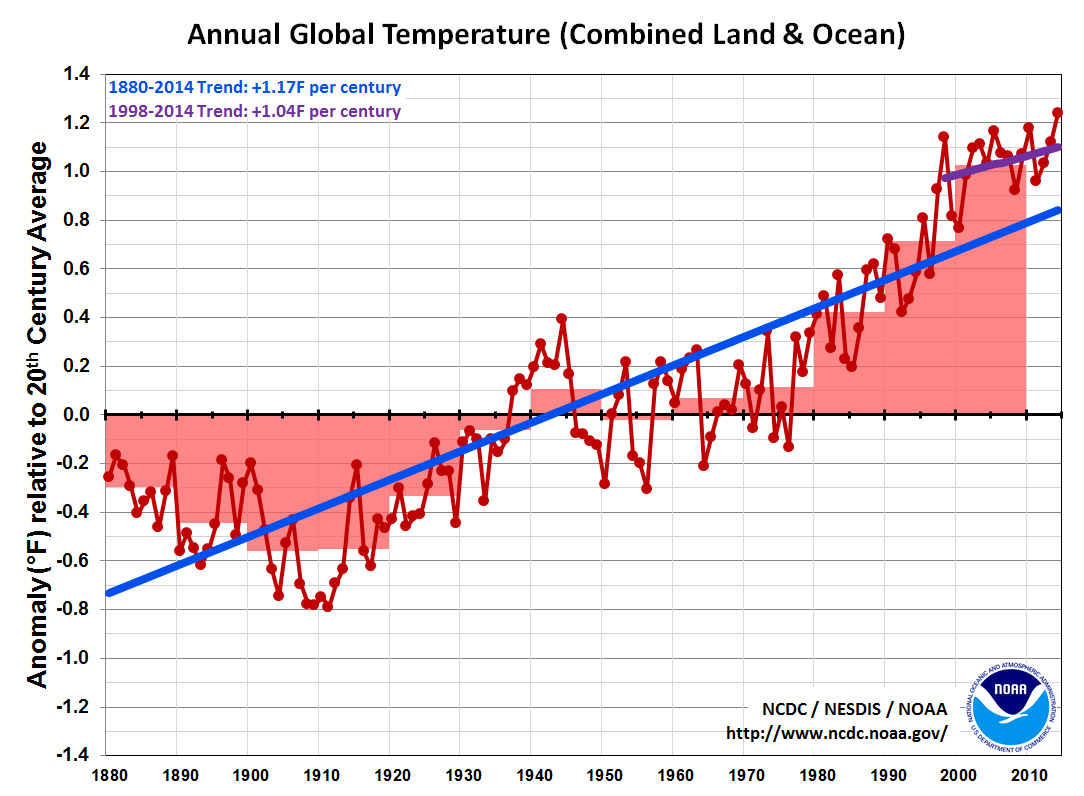
NOAA, NASA, the Japanese, and the World Meteorological Org. all say 2014 is the hottest year in the modern record.

From NOAA Global Analysis – Annual 2014 :

The year 2014 was the warmest year across global land and ocean surfaces since records began in 1880….To date, including 2014, 9 of the 10 warmest years on record have occurred during the 21st century. 1998 currently ranks as the fourth warmest year on record.

NOAAtrend-since-1998

Six individual months ranked as the warmest for that month in the modern record:

Six months of 2014 (May, June, August, September, October, and December) were record warm, while April was second warmest, January, March, and July were fourth warmest for their respective months, and November was seventh warmest.

Bloomberg did an interesting, brief (20 seconds) animated display of the temperature record since 1880, at this link:

     2014 Was the Hottest Year on Record

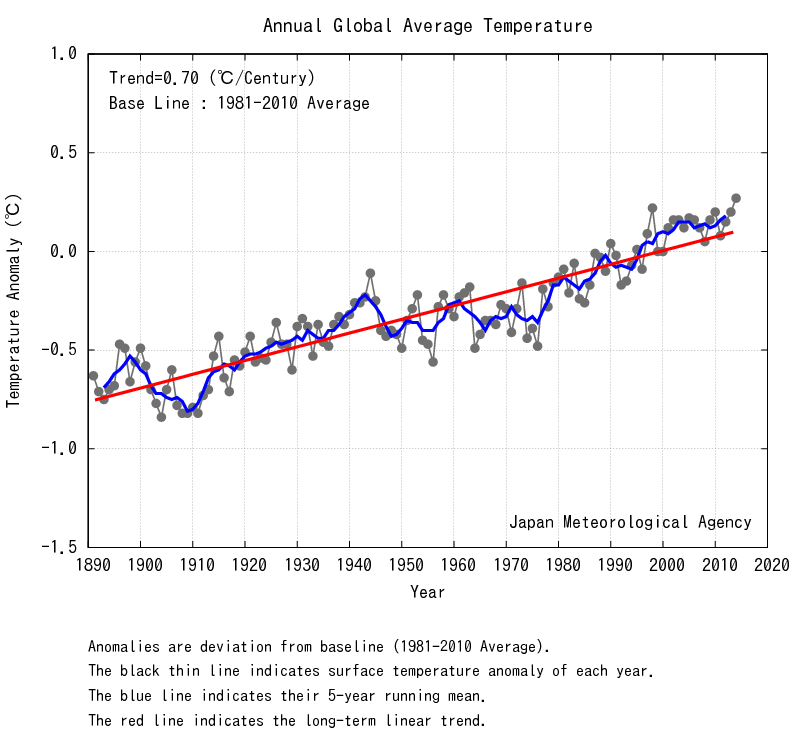
And from Japan:

     2014 was the hottest year on record, Japanese scientists say

Japan_an_wld.0

The global cooling people (they may have one good point, mentioned below) have a couple of things they’ll trot out. One is that 2014 was not the hottest year in the satellite temperature measurement data sets. The headline from the folks who keep the satellite data says this:

     2014 was third warmest, but barely

The article at the link, which only sometimes works, explains that they take measurements at different altitudes. In one data set, 2014 was the third warmest year; in another, 2014 was the sixth warmest year.

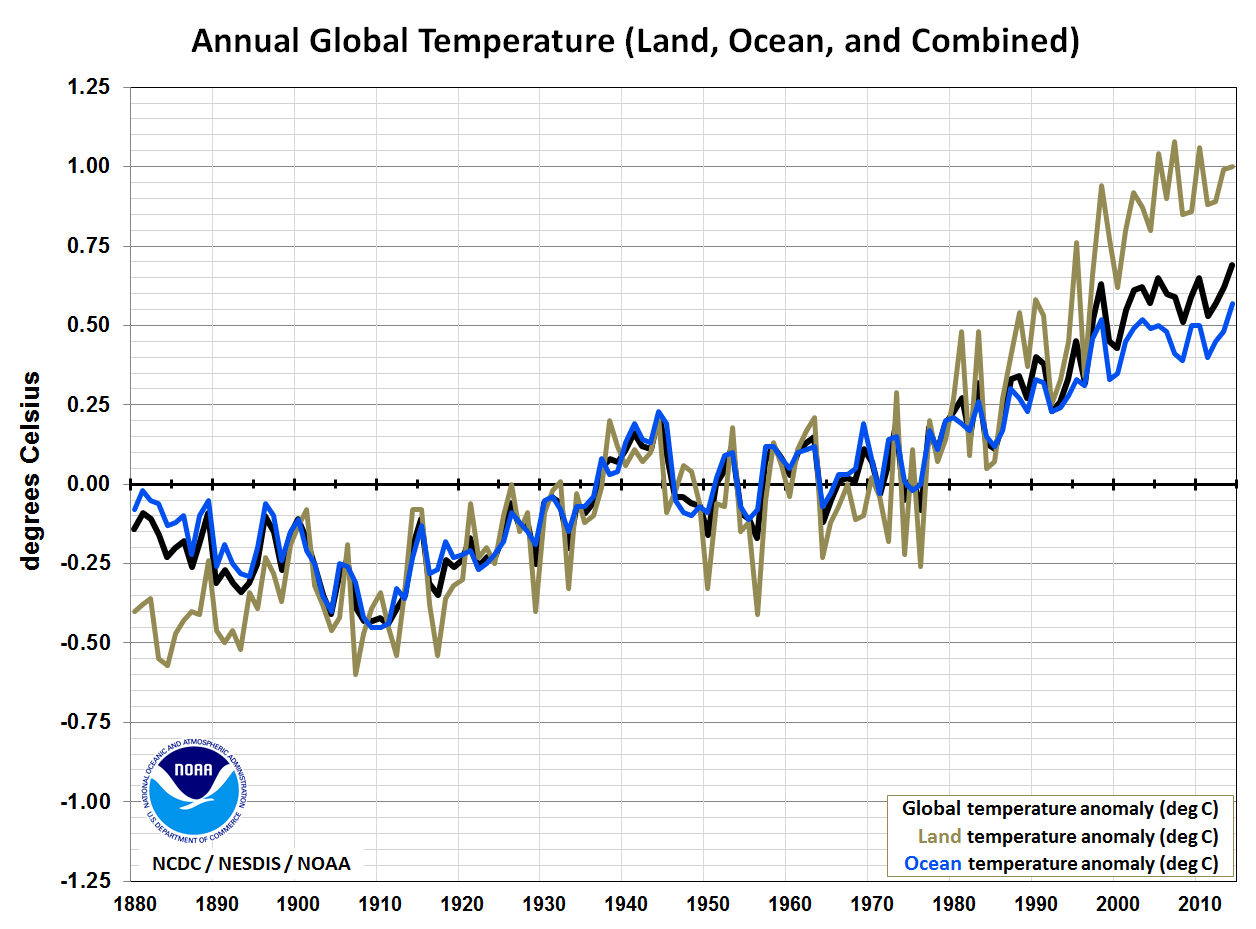
The other point is in this chart from NOAA:

NOAAland-ocean-combined

This shows the separate trends for temperatures taken on land, ocean, and the two combined. 2014 is the hottest year in the combined data (the black line) and in the ocean data (the blue line). It is the fourth warmest in the land-only data (the gold line). Some global cooling people impugn the ocean temperature data, claiming that the thousands of ocean temperature buoys provide suspect data. Even if they turned out right about that, which seems very unlikely, the long-term trends are exceedingly clear on all of these charts.

Where the global cooling people may have a point is not about the warming trend being a fallacy, clearly they seem wrong about that, but about the cause of the warming. While I think humans do play a part in the warming, I think that part is small compared with natural cycles, especially those driven by the Sun, which people underestimate across the board: the Sun not only keeps our physical bodies alive, but also lights our inner life via its connection with each of us at the point of the pineal gland, in the center of the head. So the Sun has a very wide spectrum of influence. People have been amazed in recent years by repeated largest-storm-ever-recorded events, but these aren’t happening only on Earth, they’ve been noted on other planets as well. Check this from UC Berkeley:

     Amateur, professional astronomers alike thrilled by extreme storms on Uranus

uranusIR

“This type of activity would have been expected in 2007, when Uranus’s once-every-42-year equinox occurred and the sun shined directly on the equator,” noted co-investigator Heidi Hammel of the Association of Universities for Research in Astronomy. “But we predicted that such activity would have died down by now. Why we see these incredible storms now is beyond anybody’s guess.”

Sea levels

While the warming trend brings changes, I think those changes will be quite welcome in the long run. Unless, of course, the place you live has a lot of its infrastructure near sea level. Coastal cities the world over are hiring Dutch water engineers to plan how to keep the rising water out. Cities like Miami don’t like to talk about it (they worry about real estate values!), but they are spending hundreds of millions on new sea walls, as shown in this seven-minute video (h/t KR):

     Is Miami Beach drowning?

Those new sea walls won’t help a bit with storm drains that, instead of draining water away from city streets, now bring sea water to those streets at high tide. Most of these people make their plans using the UN’s IPCC estimates for sea level rise, stated in millimeters per year. I think such numbers will come to be seen as vastly underestimating the trend. As the video of Prof. Bartlett’s famous course on exponential growth shows so well, people have a tough time seeing the implications (and sometimes dangers) of something that grows by a fixed percent each year. Chris Martenson tries to summarize the exponential concept in a six-minute video and does a pretty good job of it:

     Crash Course Chapter 3: Exponential Growth

Storms and Floods

And the storms–on Earth, that is–just keep on coming. The increase in precipitation is likely great proof of the Earth’s warming trend as more water evaporates and becomes available for storms.

     Increases in extreme rainfall

Dr Westra … said trends in rainfall extremes were examined over the period from 1900 to 2009 to determine whether they were becoming more intense or occurring more frequently.
“The results show that rainfall extremes were increasing over this period, and appear to be linked to the increase in global temperature of nearly a degree which also took place over this time.
“If extreme rainfall events continue to intensify, we can expect to see floods occurring more frequently around the world.” Dr Westra said.

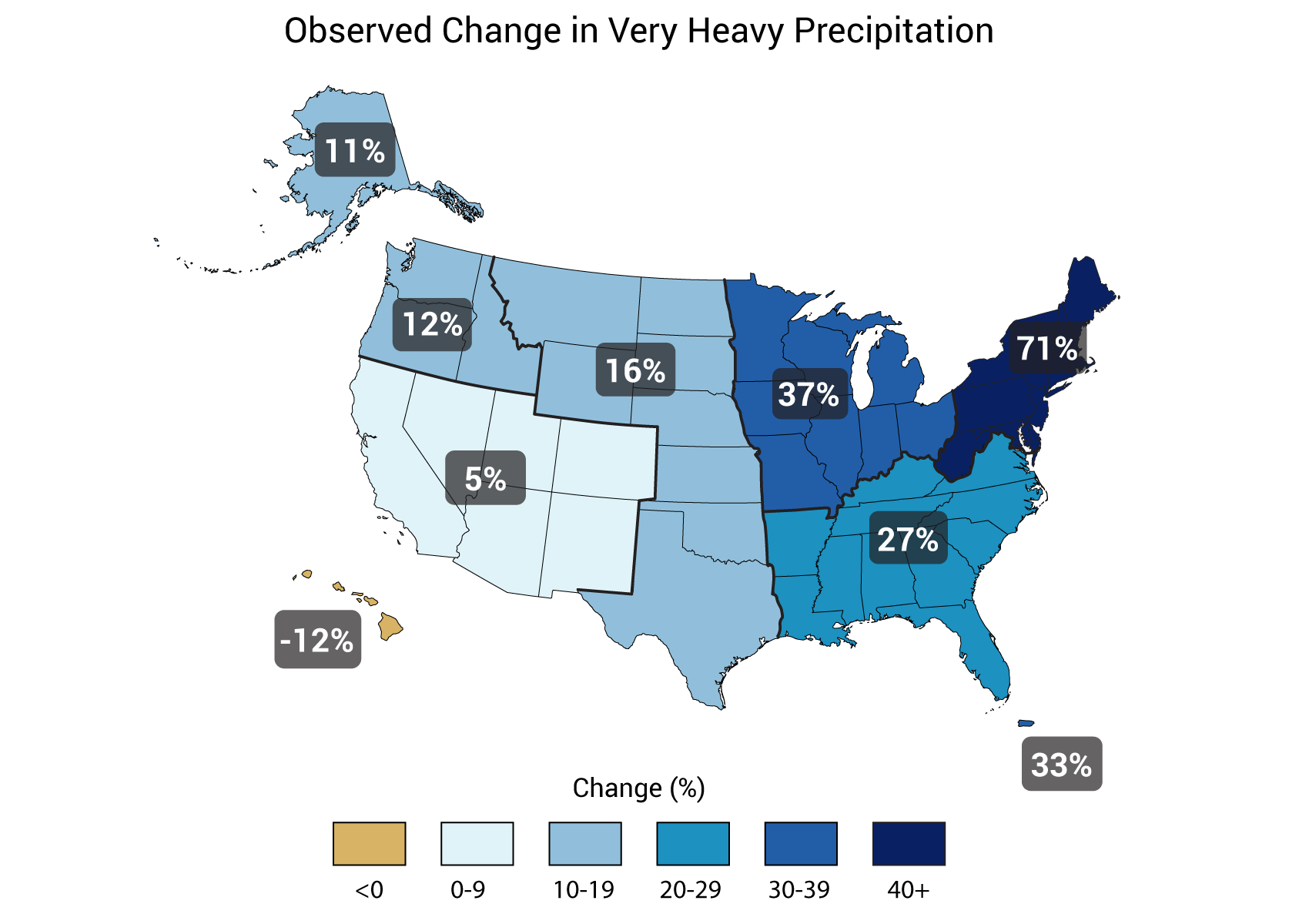
Here is a map showing the observed increases in very heavy precipitation events in the USA by region from 1958 to 2012:

HeavyCS_very-heavy-precip_V8-1

(Map source.)

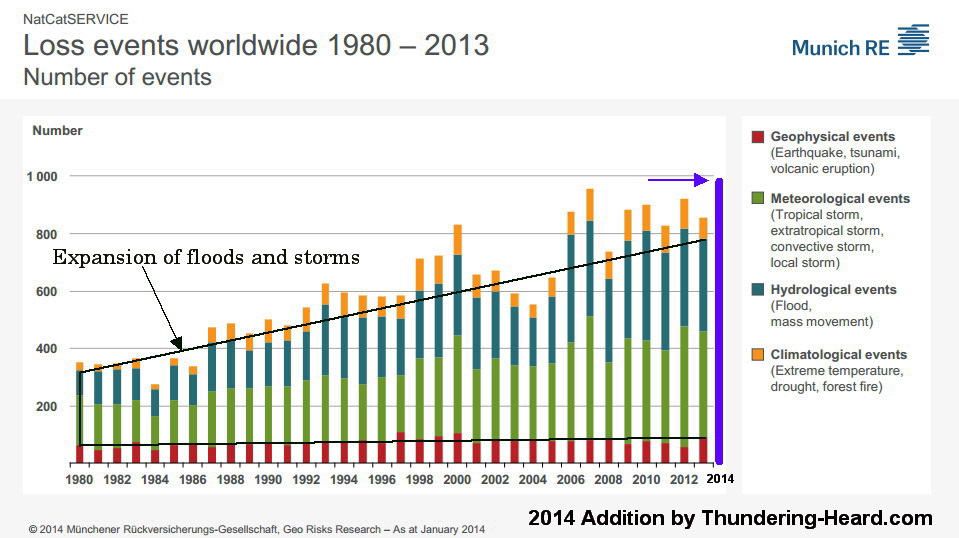
In last year’s Earth changes statistical update, a chart from the world’s largest re-insurance company, Munich Re, was used to show that the increase in storms and floods was not imagined by deranged bloggers but was being reported by the hard-nosed insurance industry. This year, they didn’t update the chart, but they did publish that the number of “loss events,” as the insurance world calls them, hit a new record of 980 events:

In total, 980 loss-related natural catastrophes were registered, a much higher number than the average of the last ten and 30 years (830 and 640).

If they had updated the chart, it would include a bar similar to the one I added in purple for 2014, with the 980 level shown by the purple arrow:

MunichReWeatherAndEarthChanges2014BarAdClearly, the trend of natural catastrophes, especially storms and floods, is still on the rise. Munich Re noted that there were fewer deaths than previous years and–while noting that the death toll was lowered by the lack of a mega-catastrophes like the Japan earthquake/tsunami of 2011–applauded countries for their use of improved early warning systems. It sounds like both nations and individuals are wisely beginning to gain respect for the power of these events. Let’s hope that this is a general trend that leads to more and more people moving away from areas prone to flooding, typhoons, earthquakes, and tsunamis. An appropriate regard for these accelerating trends can save individuals and humanity a great deal of anguish.

Unusual and massive flooding has become, well, usual, even epidemic. Here are some just from the last month, compiled by SOTT.NET:

     Catastrophic flooding continues in southern Africa, considered one of worst disasters in years

     Flooding hits Zimbabwe, Malawi and Mozambique

     South Australia prepares for flooding: 15 times their monthly rainfall

     Flooding, landslides and power outages hit Washington state

     Uruguay suffers severe flooding with much of Montevideo under water

     31 dead, 7 missing after Tropical Storm Jangmi triggers floods, landslides in Philippines

     Malaysian national park receives heaviest rainfall in more than 40 years

     Flash floods in Sri Lanka displace 46,000

     4 dead and 14,000 evacuated after flooding on the Thailand – Malaysia border

     Extreme flooding in Sao Paulo, Brazil

Earthquakes

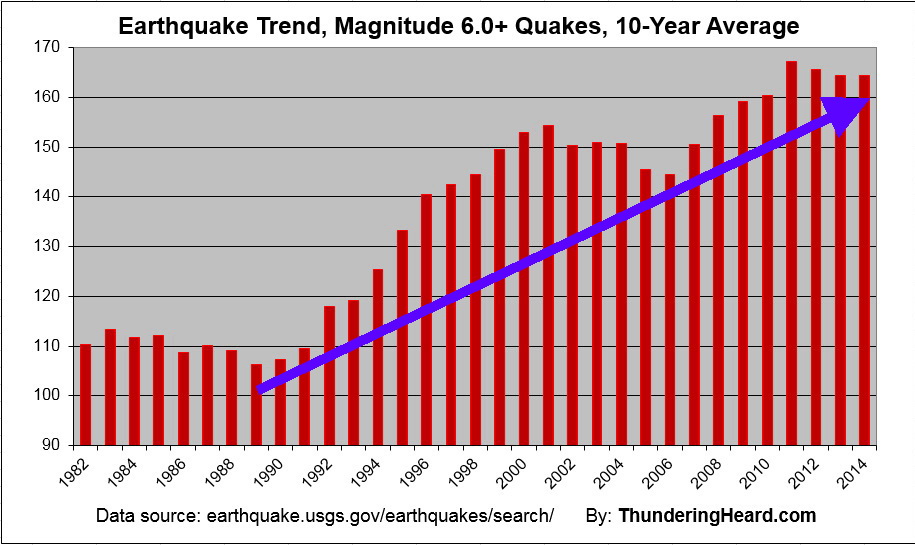
With 156 magnitude 6.0 or greater earthquakes during 2014, the large-earthquake uptrend is more than intact. Here is my updated chart, using data from the USGS, with the arrow showing the clear trend:

QuakeTrend2014ShorterLabeledArrow

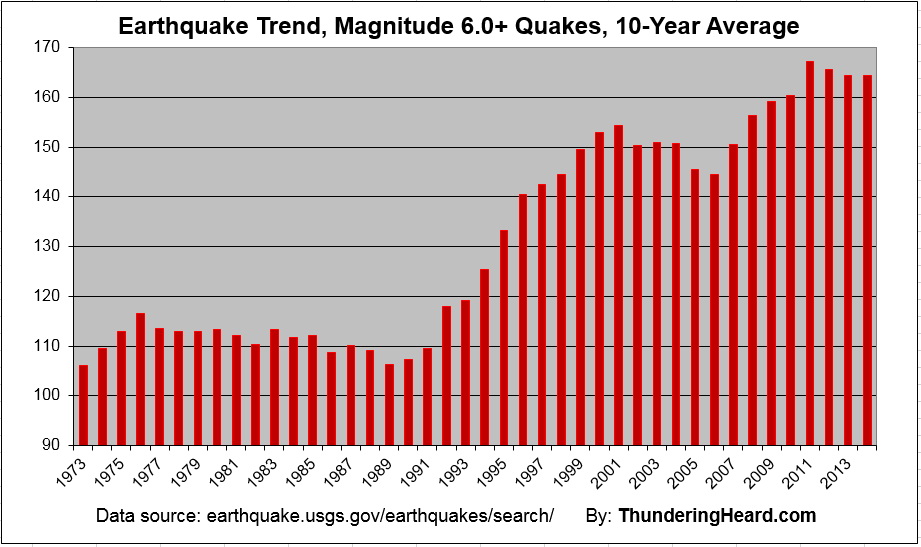
Maybe you think that’s an anomaly, not enough data is shown? Here’s the same chart with an additional nine years of data, back to 1973:

QuakeTrendThru2014Labeled

The science community is starting to admit the trend:

     A global surge of great earthquakes from 2004-2014 and implications for Cascadia

The last ten years have been a remarkable time for great earthquakes. Since December 2004 there have been no less than 18 quakes of Mw8.0 or greater – a rate of more than twice that seen from 1900 to mid-2004.

In 2014, there were no mega-quakes like the magnitude 9+ quakes that caused the deadly tsunamis of 2004 in the Indian Ocean and 2011 in Japan, so there were no major tsunamis.

It’s becoming commonly accepted that fracking and its associated wastewater injection activity causes earthquakes. So far, at least, these have been smaller-size quakes:

     Hydraulic fracturing linked to earthquakes in Ohio

     Oil Wells Linked to Oklahoma’s Stunning Increase In Earthquakes

     Second Greeley, Colorado earthquake halts injection site work

     Wastewater disposal may trigger quakes at a greater distance than previously thought

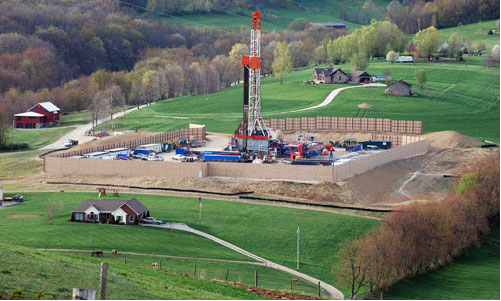
If you don’t live near a fracking site, here’s a great “meet your new neighbors” photo:

Fracking

Volcanoes

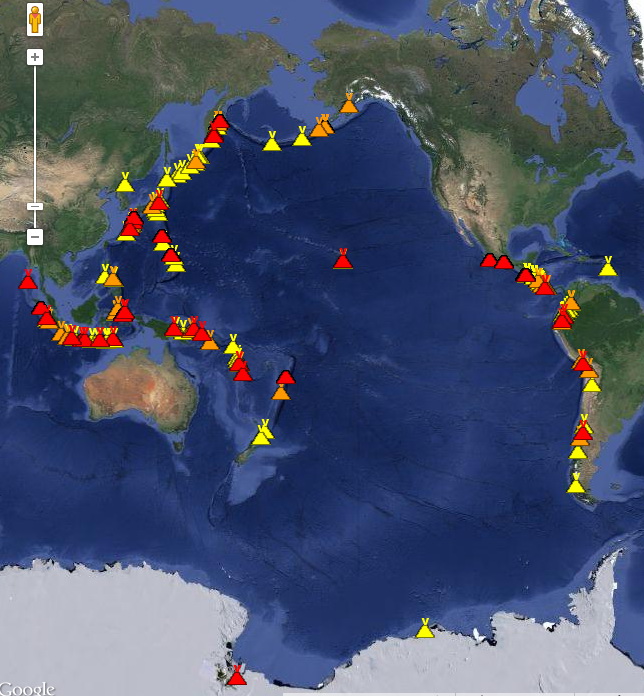
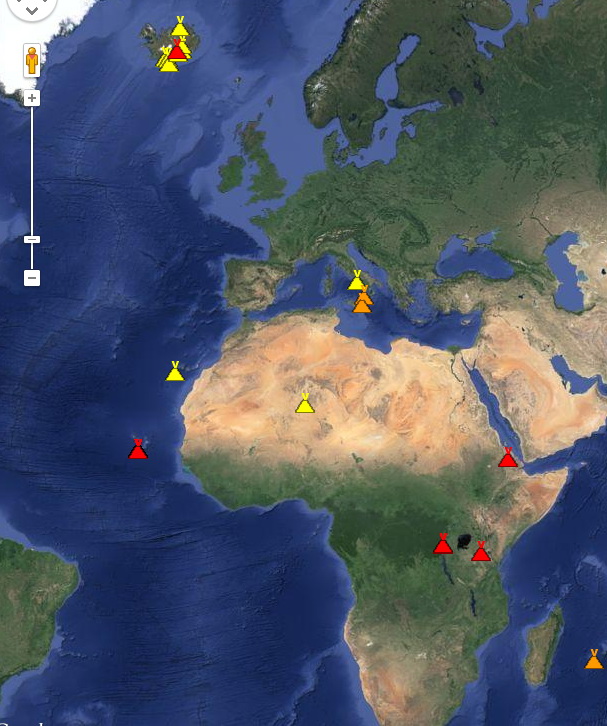
At the start of 2015, these were the numbers for currently-active volcanoes, with their colors as shown on the maps below (the interactive version of the map is here):

Erupting (red)   44
Warning/minor activity (orange)   32
Unrest (yellow)   75
      TOTAL 151

Ring of Fire map:

VolcanoesRingOfFire2015Start

Rest of the world:

VolcanoesAME2015Start

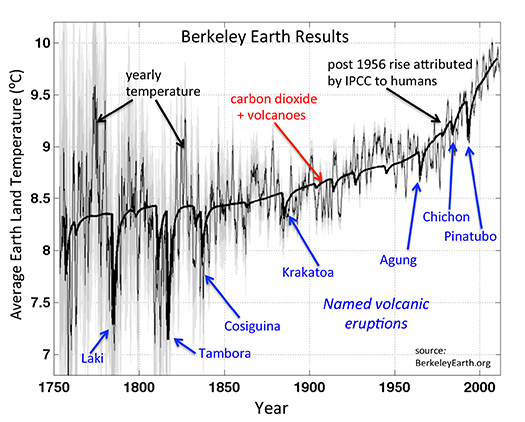
Some say that the extraordinary amount of volcanic activity is contributing to weather wildness and a slowing of the Earth’s warming trend. The latter point would not be surprising given this chart from the Berkeley Earth Surface Temperature project showing that truly major volcanic eruptions temporarily slow the rising temperature trend:

volcWeatherresults-plot-volcanoes

(Chart Source)

The article at this link has a short video of Iceland’s Bardarbunga volcano which has been producing 50 to 70 cubic meters of lava per second since August, 2014.

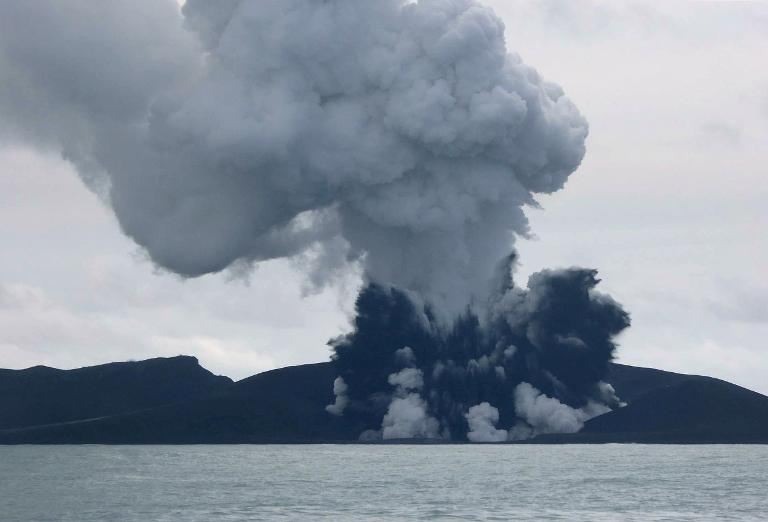
And these are just the land-based volcanoes. No one knows how many undersea volcanoes are active, though some are starting to think they are active enough to be warming the oceans. Previously-underwater volcanoes have been creating new islands, one in Tonga (which has been erupting every five minutes for a month) and two in Japan.

      Tongan Volcano Creates New Island

tonga_volcano-new-island

     Dramatic Video Shows Volcano Making New Island Off Japan 

Methane

Methane is being released not just from the ocean floor in the Arctic:

     Arctic Ocean releasing large volumes of methane

but also all along the Atlantic Coast of the USA:

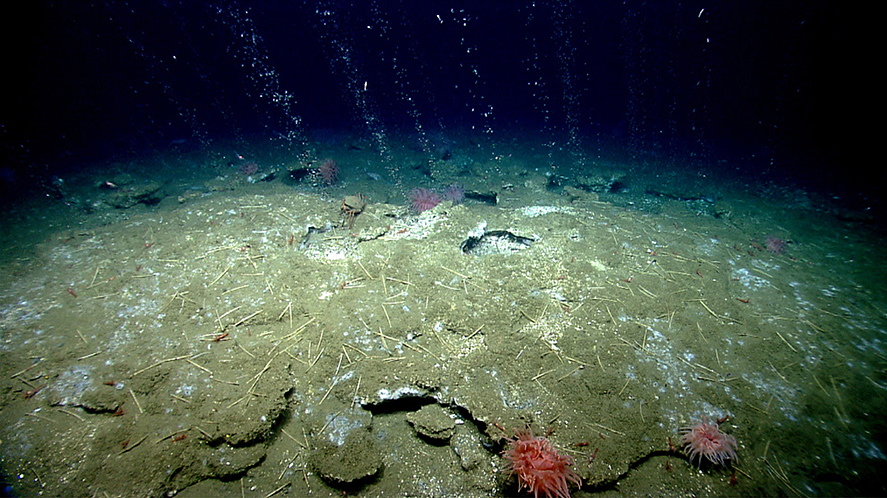
     Hundreds of Methane Plumes Erupting Along East Coast

methane-bubbles

In an unexpected discovery, hundreds of gas plumes bubbling up from the seafloor were spotted during a sweeping survey of the U.S. Atlantic Coast….Between North Carolina’s Cape Hatteras and Massachusetts’ Georges Bank, 570 methane seeps cluster in about eight regions, according to sonar and video gathered by the National Oceanographic and Atmospheric Administration ship Okeanos Explorer between 2011 and 2013.

Sinkholes

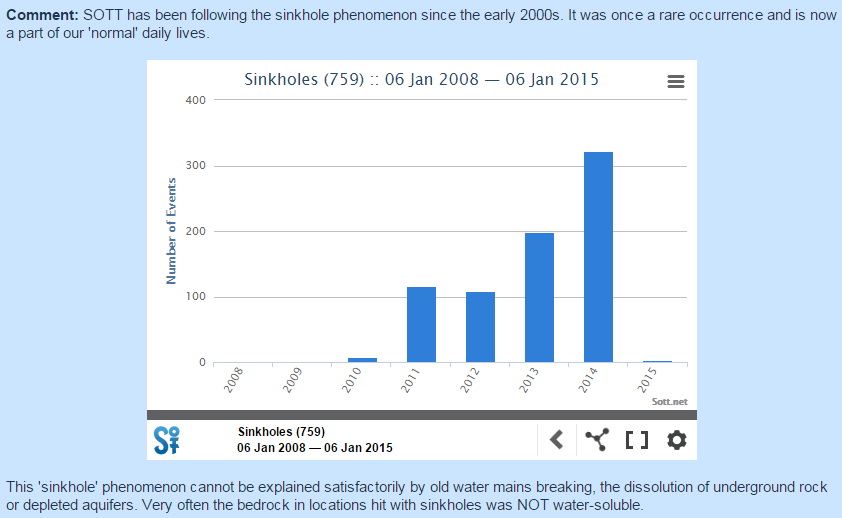
Sinkholes continue to proliferate. SOTT.NET is the only service I have seen tracking these numerically. Yes, many sinkholes can be explained by broken water mains and the like, but others have no known explanation. SOTT.NET shows this as the emerging trend:

SinkholesSOTT2014

What’s causing these trends?

There are several theories about the cause of these increasing Earth changes. In my view, the one that best encompasses the full array of changes is the one that says, summarized briefly: Earth and humanity are beginning their evolutionary passage from third dimension to fourth dimension reality and therefore everything, everything is becoming more permeable, from the Earth’s crust to the lies of our governments to the divisions between the planes of existence, enabling more people to increasingly access realms of life that have traditionally been hidden. In any case, it seems that two things are clear:

1. These trends are accelerating, not diminishing, and as such, they deserve people’s attention and respect. Prof. Bartlett is right, people don’t realize the power of exponential trends, even less so with accelerating trends. Living in places that these trends indicate as high risk areas reminds me of a phrase in the financial markets for remaining in trades to the very last minute where the chance of gain is small and the risk of loss is huge: “picking up nickels in front of a steamroller.”

2. Whatever the cause or causes, there is clearly a pervasive energetic component to this planetary event. One demonstration of this is the great upset and upheaval taking place in the animal kingdom, which will be covered in Part 2.

The deflationary wave intensifies

Little darling, I feel that ice is slowly melting
Little darling, it seems like years since it’s been clear
Here comes the sun, here comes the sun
And I say it’s all right
     –George Harrison, The Beatles, Here Comes the Sun

Most people have probably heard by now that world crude oil prices are in a dramatic plunge. In the futures market, the price is down 47% since June, from $107.68 per barrel to $57.49. The scuttlebut is that prices in the cash market are even lower as desperate countries and companies get what prices they can.

And it isn’t just crude oil prices that are crashing. Think stuff that China used for its “economic miracle,” like the price of iron ore (used in making steel), which has been cut in half since 2013.

But this current wave of deflation has taken on a new intensity. ZeroHedge summarized the most recent week quite well in Crude Carnage Contagion: Biggest Stock Bloodbath In 3 Years, Credit Crashes [my explanatory remarks in brackets]:

WTI’s [oil] 2nd worst week in over 3 years (down 10 of last 11 weeks)
Dow’s [stocks] worst worst week in 3 years
Financials [stocks] worst week in 2 months
Materials [stocks] worst week since Sept 2011
VIX’s Biggest week since Sept 2011 [VIX is a fear index, it rises when people are afraid]
Gold’s best week in 6 months [Gold is real money, solidified sunlight 🙂 ]
Silver’s last 2 weeks are best in 6 months [Silver is also real money!]
HY Credit’s worst 2 weeks since May 2012 [HY = High Yield (aka junk) bonds]
IG Credit’s worst week in 2 months [IG= Investment Grade bonds]
10Y Yield’s best week since June 2012 [10Y = US 10 year note]
US Oil Rig Count worst week in 2 years [Rigs are for drilling/fracking]
The USDollar’s worst week since July 2013
USDJPY’s worst week since June 2013 (USDJPY = US$ priced in Japanese Yen]
Portugal Bonds worst week since July 2011
Greek stocks worst week since 1987

So, why the intensifying deflation? Because, as has been explained here on several occasions, the world is groaning under an increasingly fierce debt load. The central banks have printed up $11 trillion in new money in the last 5 years to try to fend off deflation. Why? Because when debt loads get too large, some people and companies can’t pay back their loans, so they default, and the money they owe disappears. If they are companies, their employees lose their jobs. So their households spend less. Putting pressure on more businesses because of lost sales. Leading to more layoffs and more defaults. It’s a vicious cycle, an economy in reverse, and economy that is deflating. Remember, because all of the money in the system is debt, the economy must always grow to pay the interest on that debt. If the economy stops growing, the interest can’t be paid, defaults arise, and the deflationary cycle ensues. People tend to associate deflation with falling prices, but the falling prices are the result of deflation, not its cause.

So the central banks tried to ease the debt load by lowering interest rates to zero or lower. But one of the results was that all that cheap money financed all kinds of projects that would never have been created without this almost-free money because they weren’t very good ideas to begin with, such as the stories we’ve all heard about China having 3,000 companies all basically in the same business–how can they all make money? They can’t. Such overcapacity makes life tough for all of the companies, which all have to lower their prices, which start laying off employees, which can’t pay back their debts, etc. etc. as explained above. So this lowering of rates might seem to work for a short time, but when it’s carried on for years, it’s deflationary!

The second thing the central banks did was create this new $11 trillion to buy more debt! So they are trying to fight a problem of too much debt by creating more debt! Historians will marvel at the lack of logic by an entire academic profession. The reason for this pervasive illogic is that academic economists have for years purged from their ranks anyone who brought up the topic of gold as real money, ridiculing and marginalizing them. So they banished logic from their own ranks.

But let’s get back to the big deal of the last several weeks, the crash in oil prices. Cool, you might say, I’ll be able to pay less when I fill up my car with gas. True. But it might be wise to consider why oil prices are crashing:

     World Oil Demand Outlook Cut Again; Sub-$60 Price Seen Holding

Any hope that global demand would provide a floor for oil’s freefall was dashed as the leading energy forecaster cut its outlook for the fourth time in five months and crude extended its tumble.

Frankly, I don’t think I’ve ever heard of one of these international organizations like the International Energy Agency cutting their forecast four times in five months. So what’s happening is collapsing demand for oil.

Several recent financial statistics that measure changes in the economy are reporting levels of decline “last seen in 2009.” Recall that in 2009, a lot of people thought the world economy was not just staring into the abyss, but was about to fall in.

     PPI Slides, Misses Estimates, After Finished Goods Prices Tumble Most Since July 2009

     Short-Term Inflation Expectations Have Crashed To 5 Year Lows (In The US)

Now how does this relate to yet another “miracle” discovered by the pom-pom and short-skirt-bedecked economic and political cheerleaders, the “US shale miracle”? This is the miracle by which the US will allegedly frack its way to energy independence.

For the last three years, the US shale drillers have been borrowing $1.50 for every $1.00 in oil and gas that they pull from the ground. And that was with oil prices above $100 per barrel. The industry as a whole expected to get to breakeven–instead of losing money hand over fist, which is what they have been doing with oil just above $100–with oil above $120 per barrel. But now the price is under $60, which is less than half of the price needed for them to break even. (Chris Martenson’s group has done a great, clear video on this if you want the details.)

All told since early 2010, these energy producers have borrowed at least $550 billion. Remember that the size of the sub-prime mortgage problem was around $1.1 trillion, and the collapse of that sub-prime mortgage market nearly took down the whole system. These oil frackers have borrowed over a half trillion just since 2010 and now it looks like a lot of that borrowing will not get repaid, that is, they will default.

Now that $550 billion was a lot of spending for purchasing equipment and creating jobs to use that gear. It turns out that 1/3 of business capital spending in the US in recent years has been for energy exploration and production. And some estimate that 90% of new jobs created in the US in the last five years are related to energy production.

But now suddenly, no one wants to lend the frackers cheap money to create more overcapacity in the shale patch (because the lenders know there is a good chance they will never get paid back.) So now there will be a huge drop in equipment purchases and lots of job layoffs, leading to, you guessed it, more deflation!

If you don’t think this will happen, check this headline:

     Exclusive: New U.S. oil and gas well November permits tumble nearly 40 percent

Plunging oil prices sparked a drop of almost 40 percent in new well permits issued across the United States in November, in a sudden pause in the growth of the U.S. shale oil and gas boom that started around 2007.

Data provided exclusively to Reuters on Tuesday by industry data firm Drilling Info Inc showed 4,520 new well permits were approved last month, down from 7,227 in October.

So, the “US shale miracle” will be proven to be another fable, along with the US energy independence it was supposed to engender. It was fueled by a supply of ultra-cheap money that has now dried up. One aspect of fracked wells is that they lose 70% of their production capacity in two years, and 80% to 90% in three years. So to keep more oil flowing, these fracking companies have had to borrow more and more money to drill more and more wells. As described above, it wasn’t a very good business model and would not have existed were it not for the cheap money being provided to Wall St by the central banks.

So while you may be able to buy cheaper gas for your car, the US economy is likley to take a serious hit relating to jobs and business spending from the oil collapse.

And the US is supposed to be the bright spot in the world economy. Japan is in recession yet again. The Eurozone perennially flirts with recession, and is being dragged down by the US-led sanctions against Russia, which itself has fallen back into recession. China claims to still be growing, but the hard evidence of the falling prices mentioned above, falling real estate prices, and stalling growth in the use of electricity in China argues otherwise. From Deutsche Bank:

…the global financial system is still extremely fragile and not sustainable…2015 will be the 9th year of highly unconventional central bank policy and…we’re no nearer to finding a sustainable solution…
–Deutsche Bank

But not to worry: Uber, the emerging ride sharing service, is said to be valued at $40 billion. (Those must be some rides!)  And Jessica Alba’s new diaper-cleaning service company is apparently valued at $1 billion!

     No Bubble At All: Jessica Alba’s Diaper-Delivery Startup Is Valued At $1 Billion, Prepares For IPO

So I guess everyone will get rich (again, like in the year 2000) from internet startups?

Historically, deflation is rather unkind to stock prices. World stock markets are currently being floated by the free money from the central banks, but how long can that last? And this deflationary trend has supports beyond the overload of debt, such as the end of several cycles, including the the 26,000 year precession of the equinoxes, which tends to really clear the decks on this planet.

Now, will this deflation crash the price of gold? Not at all likely. Historically, gold increases in purchasing power during both inflationary and deflationary periods; these are periods during which people start to think that governments are losing control, so people opt for real money over government-issued scrip. Gold loses purchasing power when people think everything is, to put it technically, hunky-dory, and that their government is doing a great job. Most people don’t see it that way during bouts of deflation. Intelligent observers are still stacking real coins:

     Sales Of Silver American Eagles Rise To Record High For Second Consecutive Year

and likely hanging onto their hats to get ready for a very wild ride. Because sometimes, in reaction to deflation, governments really ramp up the money printing presses, and people lose all confidence in government money, which is known as hyper-inflation.

Whatever it is that’s coming, it’s good to know that our bank regulators will be well protected:

     Why Is The US Treasury Quietly Ordering “Surival Kits” For US Bankers?

The Department of Treasury is spending $200,000 on survival kits for all of its employees who oversee the federal banking system, according to a new solicitation. As FreeBeacon reports, survival kits will be delivered to every major bank in the United States and includes a solar blanket, food bar, water-purification tablets, and dust mask (among other things). The question, obviously, is just what do they know that the rest of us don’t?

Numb

Imagine the impact if people alive in the 1950’s had encountered these articles, all from today:

     Sixty dead in suicide blasts in Nigeria

Two explosions at a crowded market in northeastern Nigeria have killed at least 60 people.

The twin bomb blasts, thought to have been carried out by female suicide bombers, hit a market in Maiduguri, the capital of Borno state.

“After the first explosion happened and people started to gather, a second explosion took place,” Al Jazeera’s Rawya Rageh, reporting from Abuja, said…

Hospitals have been flooded with injured residents, Al Jazeera sources said.

     Suicide blast kills dozens in Afghanistan

Officials say bomber targeted volleyball tournament match attended by large crowd in province bordering Pakistan.

People living in the 1950’s would have been deeply shocked. Not fake “shocked,” like our politicians pretend to be. Truly, deeply disturbed.

Today? For most people? Just another day in the news. Background noise, if they even hear about these events at all. The mainstream media tends to ignore them in favor of politicians sniping at each other, the demonizing of trumped-up enemies, the antics of movie stars, and lies masquerading as economic statistics to get people to spend and borrow rather than save.

     ‘Scores dead’ in air strikes on Syria’s Raqaa

Government raids on ISIL-held northern city have mainly killed civilians, with hundreds more injured, activists say.

     Pakistan says 20 fighters dead in air strikes

     Iraq’s Anbar grapples with devastation 

As usual, if people are getting blown up, it’s easy to find US involvement:

     Group: Death toll of U.S.-led airstrikes in Syria tops 900

     Hacked US Documents Said To Reveal Extent Of Undisclosed US “Lethal Aid” For Ukraine Army

And here’s a headline from Oct. 17 that says plenty (hat tip to JS):

     Pentagon readying for long war in Iraq, Syria

Every day, people are literally being blown to bits in the many conflicts (these used to be called wars), on the many battlefronts around the globe. Many are killed, many more seriously injured, still more are devastated in their minds and hearts. What has happened to us that such events do not sink in? How can these reports just pass on by like reports on sports or the weather?

Think this killing is just in the Middle East?

2,200 National Guard Troops To Be Deployed In Ferguson Tonight

     Forget Ferguson, 244 Teenagers Have Been Shot In Chicago Since Michael Brown Died

Statistics on the war in Chicago from this site:

     Totals Since Ferguson (Aug 9 – Nov 24)
          Shot & Killed: 130
          Shot & Wounded: 725
          Total Shot: 855
          Total Homicides: 155
     Year To Date Totals
          Shot & Killed: 343
          Shot & Wounded: 2,003
          Total Shot: 2,346
          Total Homicides: 408

So, we’re blowing up and shooting people, we’re killing off lots of species, we’re killing the oceans, we’re poisoning our farmlands, we’re draining the world’s great aquifers so quickly that entire cities are sinking, we’re fracturing the Earth’s crust for oil and gas and pumping the poisons from the process back into our aquifers, 30 million people are held as slaves, 800 million people don’t have enough food or clean water…you know this sentence could go on for a long time.

And yet, and yet…this is the status quo that people want to maintain. This is the system they want to keep. Maybe with a few minor tweaks around the edges, a few reforms.

What has happened to us? How did we get so distracted, so numb? What will it take for people to awaken?

Saturday morning cartoons

(But) look at these sexagenarian dogs! Their dog-teeth get sharper at every moment. The hairs drop from the fur of an old dog; (but) see these old (human) dogs clad in satin! See how their passionate desire and greed for women and gold, like the progeny of dogs, is increasing continually! Such a life as this, which is Hell’s stock-in-trade, is a shambles for the butchers (executioners) of (the Divine) Wrath; (Yet) when people say to him, “May your life be long!” he is delighted and opens his mouth in laughter.
He thinks a curse like this is a benediction: he never uncloses his (inward) eye or raises his head once (from the slumber of heedlessness). If he had seen (even as much as) a hair’s tip of the future state, he would have said to him (who wished him long life), “May thy life be like this!”
–Rumi, The Mathnawi, Book VI, circa 1270 A.D.

The cartoons at the link below should be required viewing (and understanding!) in school, especially any history or economics class. These cartoons are all from 100 years ago or more. They clearly describe the cementing into law–pending at the time– of the rigged banking, currency, and stock markets that financially enslave almost everyone on the planet to the endless hunger for humongo-profits of the few. They show that at least a some people understood the game then. Sadly, few understand the game even now. How do we get this understanding to everyone so that we can end this vicious travesty? How do we bring in the logic and compassion that clearly show the primitive and self-defeating nature of systematically-enshrined greed? Continue reading

Currency Balloons

Given the state of most media reporting, it’s sometimes tough to know whether to laugh or cry. Here’s a story from last week about a surge in gold bullion purchasing in Germany in August and September:

     German Bullion Dealers Report Major Increase in Sales

Christian Brenner, Chief Executive of Philoro Edelmetalle GmbH: “Already in August we noticed an increase on orders compared to the previous months, but September… September beats it all. From a German viewpoint it’s the strongest month of 2014.”. At their head office in Austria they also register an “overproportional high level” of revenue.

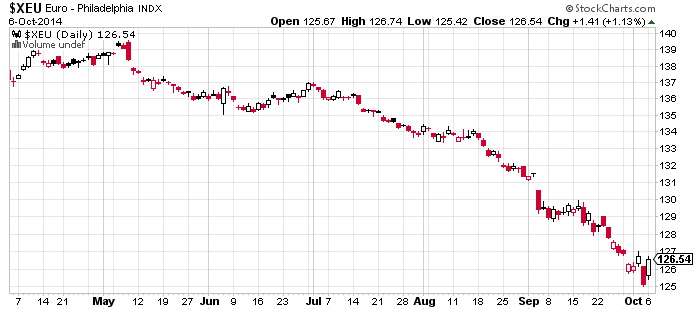
At the end of the article, there is a stumbling attempt to explain the recent surge with no mention of its real reason. Here’s a chart of the Euro showing it losing over 7% of its “value” in August and September, in the context of a 10% loss since May:
Euro2014107

It would seem clear that at least some people in Germany and Austria noticed that someone was letting the air out of their Euros and decided to convert to real money.

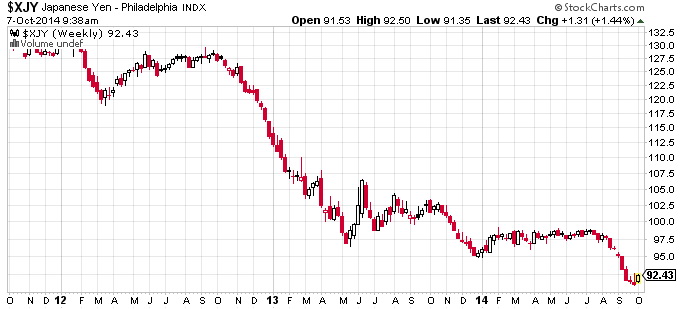
It was the same for the Japanese in August and September, but much worse overall since the Japanese government has been hellbent on devaluing the Yen for two years. Here’s a chart showing the loss in “value” of the yen of more than 31% in the last three years:

Yen20141007Since these losses in “value” are measured against the biggest balloon of them all, the US Dollar, this is the source of what you may have been hearing lately about the “strong Dollar”! In other words, the “strong Dollar” is simply the result of other major governments succeeding in intentionally letting air out of the balloons known as their currencies.

They are doing this in an attempt to create inflation! Unlike regular people, who like it when prices drop and they can get good deals, governments, being the largest debtors on the planet, want inflation so that their debts can be repaid in cheaper and cheaper currency as time passes. In case you haven’t noticed, that’s a form of grand theft: I’ll borrow money from you today, and pay it back with cheaper money later.

Well so what, you might say. If they are all doing that, what’s the big deal? Continue reading

Excellent videos on recent Earth changes

If you find Thundering Heard at all interesting, you owe it to yourself to see this video, either on youtube:

     SOTT Earth Changes Summary – July 2014

or on vimeo. It’s a truly remarkable video summary of events on our planet during July.

And if you found that interesting, here are the summaries from the prior two months:

     SOTT Earth Changes Summary – June 2014

     SOTT Earth Changes Summary – May 2014

For those who can’t access youtube, here are links for those same June and May videos on vimeo.

SOTT.NET is doing a great job on these videos.


Lightning, and the Earth’s weakening magnetic field

Why lightning? Because, in articles found since July 1:

     Lightning Strikes 14 People In California

     Ball of lightning hospitalises woman and kills hundreds of pigs at farm in China

     Single lightning strike kills 45 head of Black Angus cattle on Montana ranch

     In Bashkortostan, lightning killed 101 sheep

     Two reports of lightning going inside homes and striking people down

     Family of four struck by one lightning bolt

     Second lightning strike fatality in two days at Colorado park, officials say

Four people were injured in Saturday’s strike, and eight were hurt on Friday, officials said in a news release.

For those interested, more headlines about increasingly fierce lightning since July 1 are at the bottom of this post.

From the Manifesto for this site:

This transition is not limited to things human. It reverberates through our entire energetic continuum: the Earth itself is having documented increases in earthquakes, volcanic eruptions, changing weather patterns, and extreme weather events; energy is dancing from the Sun as we’ve never seen before; even the Earth’s magnetic poles are on the move in accelerating fashion.

This is yet another manifestation of the full-spectrum energetic change we are beginning to experience. Yes, lighting strikes occur millions of times a day across the planet. But in recent months, the power of some of these strikes has clearly escalated. Single bolts are striking multiple people and are able to kill a hundred animals at a time. This is not usual.

The cause? It could be from the general increase in the power of storms documented here in several past posts. But it could also be related to this, based on the latest readings from the European Space Agency’s (ESA) satellite array called Swarm:

     Earth’s Magnetic Field Is Weakening 10 Times Faster Now

Once every few hundred thousand years the magnetic poles flip so that a compass would point south instead of north. While changes in magnetic field strength are part of this normal flipping cycle, data from Swarm have shown the field is starting to weaken faster than in the past. Previously, researchers estimated the field was weakening about 5 percent per century, but the new data revealed the field is actually weakening at 5 percent per decade, or 10 times faster than thought. As such, rather than the full flip occurring in about 2,000 years, as was predicted, the new data suggest it could happen sooner…

Earth’s magnetic field acts like a giant invisible bubble that shields the planet from the dangerous cosmic radiation spewing from the sun in the form of solar winds.

So, yet another example of acceleration and energetic change. When one combines this with the idea of an electric universe–that is, one in which electricity is present everywhere, a view that is being proven by excellent work summarized at sites like the Thunderbolts Project–then as the magnetic field weakens, our environment is being stimulated in an increasing way by the emanations of the Sun. Researches such as Mitch Battros have for years been showing an extremely high correlation between geomagnetic storms that hit the Earth and an increase in earthquakes and storms in the 24 to 72 hours that follow, as he did again this weekend at his Earth Changes Media web site:

BREAKING NEWS: Friday’s Two M-Class Flares Accelerate Ocean and Jet Stream Currents

On August 1st, two M-class flares fired off from sunspot regions 2130 and 2127, both of which were located at the Sun’s central meridian producing direct hits to Earth.

Within 24 to 48 hours of these solar storms, four tropical storms; Genevieve, Bertha, Halong, Iselle – were either produced or elevated. Within an additional 24 hours, the NOAA Tsunami Warning Center a 7.2 magnitude earthquake hit near Lorengau, Papua New Guinea at 00:22:03 UTC, August 3rd 2014.

He could haven mentioned these earthquakes as well:

     Update: At least 367 killed in southern China after strong earthquake

     USGS: Earthquake Magnitude 6.1 – Federated States of Micronesia region

So, what’s the moral of the story?

1. If you are in the vicinity of a lightning storm, don’t mess with it. Ignoring the storm based on thoughts of the low probability of being struck by lightning may no longer be a wise approach.

2. Expect further acceleration in the trends documented at Thundering Heard: extreme weather, earthquakes, magnetic pole migration, and so forth, and take whatever measures, if any, you deem appropriate.

3. Expect an increasing effect from these energetic changes on society and on you, at all levels of your being.

Here are some additional lighting links gathered since July 1:

     3,400 lightning strikes in Central Oregon – dozens of wildfires erupt

     Spanish World Cup team plane struck by lightning on way back from Brazil

     Colorado man struck by lightning while filming storm

     Severe lightning storms tear through Chicago area

     Lightning knocks Atlanta-area man clean out of his ‘smoking’ boots

     Dramatic film of lightning strikes as July storms hit the UK

     UK storms cause further disruption after lightning

     UK freak lightning & hail plunge commuters into ‘Zombie Apocalypse’

     Spectacular lightning strike filmed in New York

     Lightning storm creates terrifying nuclear bomb-style mushroom cloud above Sardinia

     ‘Whistling’ Volcanic Lightning Heard Halfway Around the World


A major change, Part 2

Continuing, following Part 1, with the idea that an energetic pressure has been lifted from the Entrenched Elites and their minions, allowing them to better recognize reality and to speak more freely:

If you think that you can escape the clutches of the money confiscators plotting their bank bail-ins by having your money in a US-based money market fund, think again. The SEC (Securities and Exchange Commission)–founded to protect people from the wolves of Wall St but which now protects the wolves–sees the crises rolling toward us and has just ruled that money market funds can suspend withdrawals or place high fees on those withdrawals “during times of market stress.”

     The “Gates” Are Closing: SEC Votes Through Money Market Reform

Some think this attempt to prevent runs on money market funds will actually create such runs since, as more people become aware of such rules, their first reaction during “market stress,” also known as a panic, will be to withdraw their money before the exit gates are closed. Others think they are trying to scare people out of money market funds and into stocks to further enhance the “wealth effect” which allegedly makes people spend more when they feel good because they see the stock market rising as a signal that “everything is OK.” Either way, and as usual these days, this isn’t good for regular people. The government regulators see these runs on the horizon and will try to “protect the system” by controlling what people can do with what is supposed to be their own money.

And if you think you can escape the money confiscation vice by being in bond mutual funds, the Fed sees the potential for runs on these funds, so you’ll soon be out of luck there as well. According to the Financial Times:

Federal Reserve officials have discussed imposing exit fees on bond funds to avert a potential run by investors, underlining regulators’ concern about the vulnerability of the $10tn corporate bond market…

Exit fees would seek to discourage retail investors from withdrawing funds, thereby making their claims less liquid and making a fire sale of the assets more unlikely.

Wonder how long it will take before they put exit gates on stock market mutual funds. And then, at some point, the whole stock market. For our own good, of course. To save the system. For national security. All please now rise for a rendition of God Save the Queen.

Next, the so-called BRICS (Brazil, Russia, India, China, and South Africa), home to 3 billion of our fellow inhabitants of Earth, announced that they have had enough of being treated as poor relations on the world economic stage, and enough of broken promises from EUUSUK (European Union, US, and UK), and have formed their own alternative to the IMF (International Monetary Fund) called the New Development Bank. From the joint statement by these five major countries:

“We remain disappointed and seriously concerned with the current non-implementation of the 2010 International Monetary Fund (IMF) reforms, which negatively impacts on the IMF’s legitimacy, credibility and effectiveness. The IMF reform process is based on high-level commitments, which already strengthened the Fund’s resources and must also lead to the modernization of its governance structure so as to better reflect the increasing weight of EMDCs in the world economy.”

The old guard countries promised the Emerging Market countries, in 2004 and again in 2010, greater say in the governance of the IMF in exchange for greater monetary contributions from the BRICS; they took the money but never come through on their promises. For example, Belgium still has more votes at the IMF than Brazil despite the fact that Brazil’s economy is more than five times larger. And the IMF is strongly dominated by the US despite the fact that, according to the World Bank’s calculations, the Chinese economy will be the world’s largest by the end of 2014. That wasn’t “supposed” to happen till 2020 by US government calculations, but the USgov tends to use very strange calculators that have a button that says, “Make the US economy look better than it is,” and they press that button a lot. Anyway, the BRICS are backing their new bank with $50 billion up front, with another $50 billion promised as a contingency fund.

This presents an alternative for countries in financial distress. No longer is the IMF the only game in town. This is important since IMF “rescues” can often be summed up like this: “Oh, you’re in trouble with your bankers? Tell us absolutely everything about the finances of your country, your banking system, your companies, etc. and then we’ll loan you a bunch of new money that will first and foremost go to paying your international bankers, and be sure to spend some of the rest with the following US and European companies who will help you develop your natural resources and get you a price that will be very fair for those companies. And since you will now have even more debt than before, you’ll have to implement austerity measures that will further impoverish your citizens. Sign here or default on your debts and lose all access to the international capital markets.”

As a side note, this New Development Bank is yet another whack to the US Dollar’s status as the world reserve currency.

If Portugal weren’t in the EU, they could probably take advantage of the New Development Bank for their next bailout. The Euro-pols have been parading Portugal as a country bailout success because their economy is expected to expand a meager 0.9% this year. That’s despite the unmentioned fact that said economy will be 16% smaller than it was in 2009. But all that won’t matter now that Portugal’s largest banking group, Espirito Santo, is going down the tubes, and a second bank, Rio Forte, is filing for bankruptcy. And going along with the theme of this post, Portugal’s President Cavaco Silva actually said publicly what politicians never say: that this is going to hurt the economy:

“If some citizens, some investors suffer significant losses (from the Espirito Santo group), they may delay investment decisions, or some of them may find themselves in very big difficulties,” Cavaco Silva said in comments during a visit to South Korea, which were aired on local television. “We cannot ignore that there will be some impact on the real economy.”

Previously, politicians have always claimed any problem is “well-contained,” a tempest in a teapot, nothing to worry about. Perhaps the President is being savvy in trying to distance himself from the Espirito Santo group. Now that everyone knows the banking group is in trouble, there’s little point in hiding the dirty laundry any longer from some misplaced fear that truth about a country’s largest bank will “hurt the economy”. The authorities have detained the man who was that groups’s CEO until his resignation a month ago:

     Banco Espirito Santo CEO, Who Quit Last Month, Detained In Money Laundering Probe

I guess the phrase honest bank executive can be firmly placed in the list of oxymorons along with crash landing, even odds, and good grief.

This points rather nicely (or nastily, depending on one’s point of view) back to the IMF. In its continuing frank admission that countries will never be able to pay back a lot of the money they’ve borrowed, the IMF published another of what Martin Armstrong accurately calls “partial default options” for countries, that is, they are telling countries, “don’t default on all of your debt, here are some ways to not-pay your debts, but in smaller chunks so as to be less noticeable and alarming.” Some of the “options” they have previously discussed:

Financial repression: This is described on the IMF website as:

Financial repression occurs when governments implement policies to channel to themselves funds that in a deregulated market environment would go elsewhere. Policies include directed lending to the government by captive domestic audiences (such as pension funds or domestic banks), explicit or implicit caps on interest rates, regulation of cross-border capital movements, and (generally) a tighter connection between government and banks.

This option has already been chosen and activated by the US, the European Union, Japan, the UK, and so forth. This is where governments print money to buy bonds to drive interest rates to near-zero or, in the case of the European Central Bank, negative. This saves the government huge amounts in interest expenses. Instead of paying 5% or 6% interest, a reasonable estimate of the historical average for government debt, they now pay almost nothing. This steals money from savers, pension funds, insurance companies, etc., who get little or no interest on their savings/investments, but it allows national governments to temporarily maintain the appearance of solvency, to keep their power and their empires and, for government’s upper management, to continue to live like royalty.

The IMF website goes on to say:

In the current policy discussion, financial repression issues come under the broad umbrella of “macroprudential regulation”…

Well how do you like that: the new Chairwoman of the US Federal Reserve, Janet Yellen, used the phrase macroprudential regulation repeatedly last week in testimony to Congress and in her press conference. She is telling everyone with ears to hear that she will go further down the road of financial repression during the next phase of the crisis. See the quote above that includes “directed lending to the government by captive domestic audiences,…regulation of cross-border capital movements.” In other words, like they did in Cyprus, if they say so, then your money will have to stay in the country. And it may get lent to the government whether you like it or not. If you think these people won’t pull such stunts when they decide it’s a matter of national security (which equates in their minds with them remaining in power), then you need to study them more carefully. And admittedly this one is semi-coded, but they are informing you up-front that they will take such measures.

What else has the IMF recommended?

Wealth Tax: From this IMF paper:

The sharp deterioration of the public finances in many countries has revived interest in a “capital levy”— a one-off tax on private wealth—as an exceptional measure to restore debt sustainability. The appeal is that such a tax, if it is implemented before avoidance is possible and there is a belief that it will never be repeated, does not distort behavior (and may be seen by some as fair).

Folks, if you need to, “distort your behavior”!!! In other words, they have gone on record saying that this tactic only works if they give no advance warning. So that IMF paper is the advance warning. If they pull this tactic, and I think desperate countries will, it will be just as it happened in Cyprus, their test bed: You go to sleep Friday with X dollars in your account, and when you check your balance on Monday, some of it is gone! In the case of Cyprus, a lot of it was gone for some people. And for what? To save a failing bank. So “distort your behavior” ahead of time and get your savings out of their way. Any account balance you can call up on a screen is in their way.

The IMF also calculated just how high they thought each country could raise its income tax rates and not crash their economy. For some countries, the rates were a lot higher than they are now. And of course they recommended higher property tax rates because it’s very difficult for people to hide their houses or move them to another country, so property owners are sitting ducks.

So what is the IMF’s recent addition to this list?

Duration extension: For this one, they came up with the name “re-profiling.” Which means I’m wrong that maybe they now they think they can really call a spade and spade: they still feel the need to make up BS names for the tricks they pull on people. Still, I think the last couple of months have shown a striking increase in honesty from these folks. Anyway, what’s this re-profiling?

This would be the ability to extend the duration of debt at will. Sounds esoteric, but it’s really rather simple. Most government borrowing is very short term, say 30 days to 90 days: The government says, “Lend me some money, I’ll pay you back, plus a little bit of interest, in 30 days.” These short-term debt instruments end up in money market funds, corporate treasuries, etc. Most people treat their money market fund like cash, that is, they write checks from it, pay bills from it, etc. But this tactic would allow the government to say: that 30-day Treasury Bill is now a 5-year Bond, that is, we’re not going to pay the principal back in 30 days, we’re going to pay it back in 5 years. And we’ll give you the same miniscule interest rate we have been paying on that 30-day bill, namely something like 0.01%. So then lots of people who thought they had ready access to their cash? They would find out their “cash” was now tied up for years. This would enable the government to put off its own bills till way off in the future, giving them free reign to continue ordering caviar and champagne for their free red-carpet junkets around the world.

In my view, the best thing about all this is they are telling people up front what they plan to do. I hope regular readers have already taken the appropriate measures to protect themselves from these tactics, but if you haven’t, it still isn’t too late.

I am remembering a scene in the movie Body Heat where a hardened white-collar criminal chides William Hurt for being someone who won’t “do whatever it takes.” Be assured that when the next inevitable phase of this ongoing financial and political crisis hits, those in power will “do whatever it takes” to stay there.

In the longer term, their efforts will fail. But there’s some road to travel before we get to that longer term. From recent events, it’s fairly clear that part of that road involves war. So far, the biggest downside I can see to this lifting of pressure from the Elites and their minions is that they seem to think they can do and say just about anything they want in terms of threatening, and in some cases attacking, other countries. I’ll take up this topic soon in an update on the War Cycle.
A major change, Part 1

A significant change has taken place. A pressure seems to have been lifted from members of the so-called Elites. This can be seen by two effects:

1. Some of these System Controllers are taking a look around and are none too pleased with what they see.

2.  Some of them realize they can now speak more freely.

Here are some examples. The first is a set of quotes from the Chief Investment Officer of Allianz, by some metrics Europe’s largest insurer, and the third largest insurance company in the world:

The fundamental problems are not solved and everybody knows it.

Let’s hear that again:

The fundamental problems are not solved and everybody knows it.

Wow, for the last five years, one had to peruse surly blogs to hear that truth, but this is from Maximilian Zimmerer, the guy in charge of the assets for one of the 20 largest corporations in the world. He also stated that the “euro crisis is not over.” With that latter quote, he just told us that all those Euro-pols running around saying the “euro crisis is over” and “Europe has been fixed” are very mistaken and/or very full of it.

Next, someone let the Wall St Journal know that the US Federal Reserve has been railing about extreme problems at Germany’s top bank, Deutsche Bank:

In a letter to Deutsche Bank executives last December, a senior official with the New York Fed wrote that financial reports produced by some of the bank’s U.S. arms “are of low quality, inaccurate and unreliable.”

It said examiners found “material errors and poor data integrity”…The shortcomings amount to a “systemic breakdown” and “expose the firm to significant operational risk…”

So what’s the US central bank doing castigating Germany’s largest commercial bank? DB has large US operations; we showed here that half of the Fed’s money printing went to European banks, so DB probably has a lot of that cash, that is, from the Fed’s point of view, they had to bail out DB before, they don’t want to have to do it again; and, drumroll please, DB has the largest exposure to derivatives of any bank in the world. Again, what are derivatives? They are highly leveraged bets on every imaginable financial price movement. Here’s what ZeroHedge says about DB and derivatives:

Recall that as we have shown for two years in a row, Deutsche has a total derivative exposure that amounts to €55 trillion or just about $75 trillion. That’s a trillion with a T, and is about 100 times greater than the €522 billion in deposits the bank has. It is also 5x greater than the GDP of Europe and more or less the same as the GDP of… the world.

And here is that text in chart format:

So that’s Germany’s total economy in green on the left; Europe’s economy in blue in the center; and Deutsche Bank’s derivative bets in red on the right. So when it becomes clear that DB has a serious problem, it will be way too big for Germany to handle; probably way to big for Europe to handle; and possibly way too big for anyone to handle, that is, it could be game over, system down, everyone start from scratch. What the US Fed is saying is that DB’s recordkeeping and reporting is so bad that it results in “significant operational risk.” We likely won’t know till after DB goes down the tubes whether this was error or intentional obfuscation on their part. My guess is it’s probably a lot of both: their business is so huge, they have little understanding of many of its parts, some of which likely have twenty-something rogue traders putting on huge derivative bets; and they have plenty to hide.

Next, the Bank for International Settlements (BIS) has overtly questioned the sanity of just about all central banks and just about everyone participating in the financial markets. So why should anyone care? Perhaps you’ve been blessed during this lifetime and have never heard of the BIS. It is the organization that was described as follows on Bloomberg:

It was especially useful to the Nazis.

Though headed by an American during World War II, the BIS adhered to a priestly neutrality…in order to continue dealing with all sides in the conflict. Unfortunately, this put the institution squarely in the position of abetting Nazi terror.

The BIS accepted plundered gold and made it possible for Germany to acquire desperately needed war materiel. It even permitted Germany, once it had invaded Czechoslovakia, to confiscate that nation’s gold reserves.

I can just hear you saying: “Oh that BIS.” Anyway, from such disgusting beginnings, the BIS has continued its traditions and thereby has risen to be the central bank above all other central banks, that is, if you are the head of a major central bank in the world, you get a seat at the table at the BIS. Here it is, what some call the Tower of Basel, such a friendly-looking nuclear plant cooling tower place:

I’m told that if you’ve got a war to finance or a lot of drug money to launder, the BIS is your one-stop-shopping place. But I digress. In this article:

     BIS Slams “Market Euphoria”, Finds “Puzzling Disconnect” Between Economy And Market

you can find the Financial Times summary of the latest BIS Annual Report:

The Bank for International Settlements has warned that “euphoric” financial markets have become detached from the reality of a lingering post-crisis malaise, as it called for governments to ditch policies that risk stoking unsustainable asset booms.

While the global economy is struggling to escape the shadow of the crisis of 2007-09, capital markets are “extraordinarily buoyant”, the Basel-based bank said, in part because of the ultra-low-rate monetary policy being pursued around the world…calling for policy makers to halt the steady rise in debt burdens around the world and embark on reforms to boost productivity.

In its annual report, the BIS also warned of the risks brewing in emerging markets, setting out early warning indicators of possible banking crises in a number of jurisdictions, including most notably China.

So there you have it, the ultimate insider organization saying what the surly blogs have been saying for years: stock and bond markets are wildly detached from economic reality, central banks are keeping interest rates too low and printing too much money, expect banks to fail all over the world, especially in places like China, etc.

Next, speaking of bank failures, the EU, US, and UK (I think an appropriate pronounceable acronym for this particular axis of evil is EUUSUK) have decided to “show us their feelings” about bank bailouts and have come clean about their attempt to get all countries to go along with their scheme to replace bank bailouts with bail-ins, through which, if you have money in a bank that fails, they are going to steal a bunch of your money to save the bank, like they did in the test case, Cyprus:

     Bank Of England Leads Push For Deposit Confiscation – Japan, China, Russia Against Bail-Ins

They are pushing all major countries to go along with this plan for an obvious reason: Let’s say you are a global corporation or a gazillionaire and can place your money in whatever countries you choose. Why would you keep your money in countries where you could lose a lot of money in a bail-in? You wouldn’t be such a fool, of course, you’d move that money to safer countries, or into safer forms such as gold. However, the EUUSUK axis is being brutally honest here about their intent. Perhaps people living within the axis will be helped by the reluctance of the Asians and Russians to go along with this draconian plan to continue saving reckless banks by theft from regular people; but I doubt it.

Let’s call it a day and save more of this new-found realism and truth-telling for Part 2.